
Sold by: DBSync
Deployed on AWS
DBSync provides a platform for quick and easy synchronization, and integration of your schema and data between your salesforce.com instance and your database. With Cloud Replication, Create a backup or create a datawarehouse easily with DBSync
Overview
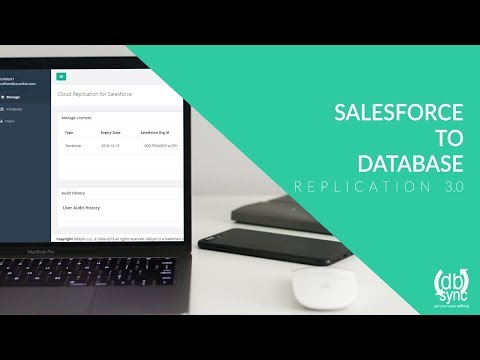
Replicate, Backup, Recover your Salesforce data into any Database, Big Data, AWS or Azure. Build your Data Warehouse, comply with regulations, Sandbox seeding, copy into another Salesforce. Gartner has positioned DBSync in the Niche Players Quadrant of 2016, 2017 & 2018 Magic Quadrant for Enterprise Integration Platform as a Service, Worldwide.
Why DBSync Cloud Replication Tool:
- Integrate, Replicate, Synchronize, Migrate your data and schema between Salesforce.com and Oracle, SQL Server, MySQL, AWS Redshift, Big Data, Cassandra, DB2, Sybaseand most JDBC compliant databases.
- Easy configuration and multiple ways to sync - using batch, API, user interface, scheduled and more.
- Replicate, Integrate, Migrate, Datawharewouse and Run reports easily with Reporting engines like SQLServer Reporting Services, Cognos, Business Object and more.
- Comply with Regulatory requirements like SOX, FINRAA, Healthcare and more
Highlights
- Bi-directional Replication between Salesforce.com and your database
- Automatic schema updates without dropping and rebuilding tables
- Cross Platform - Windows, Linux or Unix
Details
Sold by
Categories
Delivery method
Delivery option
64-bit (x86) Amazon Machine Image (AMI)
Latest version
Operating system
Win2012R2 WIn2019
Deployed on AWS
New
Introducing multi-product solutions
You can now purchase comprehensive solutions tailored to use cases and industries.

Features and programs
Financing for AWS Marketplace purchases
AWS Marketplace now accepts line of credit payments through the PNC Vendor Finance program. This program is available to select AWS customers in the US, excluding NV, NC, ND, TN, & VT.

Pricing
Pricing is based on actual usage, with charges varying according to how much you consume. Subscriptions have no end date and may be canceled any time. Alternatively, you can pay upfront for a contract, which typically covers your anticipated usage for the contract duration. Any usage beyond contract will incur additional usage-based costs.
Additional AWS infrastructure costs may apply. Use the AWS Pricing Calculator to estimate your infrastructure costs.
Dimension | Cost/hour |
|---|---|
m3.medium Recommended | $1.96 |
d2.xlarge | $1.96 |
c4.xlarge | $1.96 |
t2.medium | $1.96 |
m3.xlarge | $1.96 |
t2.large | $1.96 |
r3.4xlarge | $1.96 |
m4.xlarge | $1.96 |
m4.10xlarge | $1.96 |
i2.xlarge | $1.96 |
Dimensions summary
You pay by the hour, and the rate depends on the EC2 instance type you run. Each dimension maps to a specific AWS instance size, so pricing scales with the compute, memory, and storage capacity you choose. Smaller instances like t2.medium or m3.medium suit lighter replication jobs. Larger instances like x1.32xlarge, m4.16xlarge, or i2.8xlarge give more capacity for heavier data volumes. Memory-optimized (r3), storage-optimized (d2, i2, hs1), compute-optimized (c3, c4), and GPU (g2, cg1) families are all available. You select one instance type and pay only for the hours it runs.
Top-of-mind questions for buyers
You pay per hour for one running EC2 instance of the type you select. Each dimension maps to a specific instance size with fixed compute, memory, and storage. The rate covers the software running on that single instance. Running two instances bills two hourly rates.
The hourly software charge meters running time only, so a fully stopped instance stops accruing software charges. Underlying AWS storage and other resources tied to a stopped instance may still incur AWS fees. To stop software charges, stop or terminate the instance.
Larger and specialized instance types handle heavier replication volumes and change data capture jobs. Memory-optimized and storage-optimized families suit large datasets, while smaller instances suit lighter jobs. Cost scales with the capacity of the instance you select, since each type carries its own hourly rate.
www.mydbsync.com+1
Helpful?
Vendor refund policy

Legal
Vendor terms and conditions
Upon subscribing to this product, you must acknowledge and agree to the terms and conditions outlined in the vendor's End User License Agreement (EULA) .
Content disclaimer
Vendors are responsible for their product descriptions and other product content. AWS does not warrant that vendors' product descriptions or other product content are accurate, complete, reliable, current, or error-free.
Delivery details
64-bit (x86) Amazon Machine Image (AMI)
Amazon Machine Image (AMI)
An AMI is a virtual image that provides the information required to launch an instance. Amazon EC2 (Elastic Compute Cloud) instances are virtual servers on which you can run your applications and workloads, offering varying combinations of CPU, memory, storage, and networking resources. You can launch as many instances from as many different AMIs as you need.
Version release notes
Additional details
Usage instructions
Access the application by clicking on the shortcut named "DBSync Launch" on your desktop. To connect to the operating system use RDP and user name Administrator.
Resources
Vendor resources
Support
Vendor support
Email Support: support@mydbsync.com , Phone Support: 1-877-732-2818, Live Chat
AWS infrastructure support
AWS Support is a one-on-one, fast-response support channel that is staffed 24x7x365 with experienced and technical support engineers. The service helps customers of all sizes and technical abilities to successfully utilize the products and features provided by Amazon Web Services.
Similar products

Druva SaaS data protection provides simplicity, security and savings compared to legacy solutions. Enhance data security and cyber resilience by protecting workloads across cloud, data centers and remote sites from a single platform.
Commvault Cloud is an enterprise-grade platform built for unified cyber resilience across cloud-native, AI, and traditional datacenter applications to meet the demands of the hybrid enterprise in the face of ransomware and other cyber threats. Commvault Cloud unifies the best data security with the fastest recovery, advanced AI, and the power of a broad partner ecosystem to help the world's largest organizations reduce risk, minimize downtime, and keep business moving forward.

N2W offers automated, efficient, and secure backup and DR. Prepare for any data loss scenario, archive data for compliance, and optimize AWS spend. Ensure that critical data is protected by orchestrating recovery scenarios and performing 1-click DR - all from a single user interface.

AWS backup and Disaster Recovery (DR) that is automated, efficient and secure. Prepare for any data loss scenario, archive data for compliance, and optimize AWS spend.
Customer reviews
No customer reviews yet
Be the first to review this product . We've partnered with PeerSpot to gather customer feedback. You can share your experience by writing or recording a review, or scheduling a call with a PeerSpot analyst.