Sold by: UST
CapacityIQ uses closed-loop automation and agentic AI to forecast network demand and auto-provision capacity ahead of need, preventing congestion while optimizing infrastructure spend.
Overview
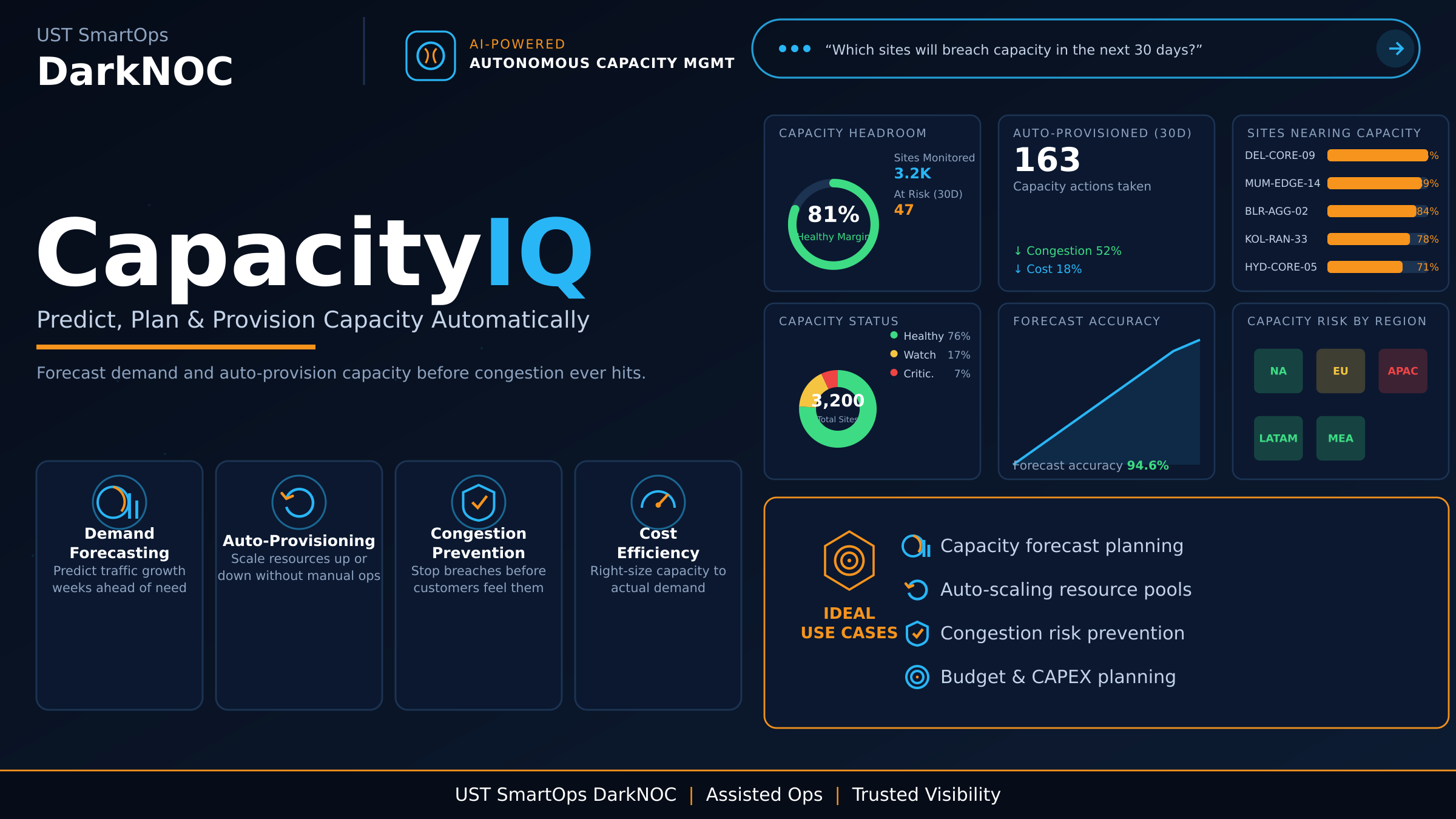
UST SmartOps CapacityIQ - Autonomous Capacity Management
CapacityIQ continuously analyzes traffic trends across your network to forecast where and when capacity constraints will occur, then automatically triggers provisioning actions to stay ahead of demand. Built on UST SmartOps' closed-loop automation framework with agentic AI and policy-aware decision-making, CapacityIQ removes the guesswork and lag time from traditional, manual capacity-planning cycles.
By right-sizing capacity to actual and forecasted demand - rather than static, over-provisioned baselines - CapacityIQ prevents congestion-driven service degradation while keeping infrastructure spend efficient and predictable.
What Makes CapacityIQ Different
Unlike conventional capacity tools that only alert on thresholds, CapacityIQ employs closed-loop automation that transforms predictive insights into autonomous provisioning actions. The platform combines agentic AI for intelligent decision-making, policy-aware controls for governance compliance, and human-in-the-loop oversight for critical actions - ensuring optimized network performance with measurable ROI.
Key Features
- Predictive traffic and demand forecasting with site-level granularity
- Automated capacity provisioning and scaling via closed-loop automation
- Site-level capacity risk ranking and proactive alerts
- Congestion-prevention monitoring across the entire estate
- Forecast-accuracy and cost-efficiency reporting dashboards
Key Benefits
- Reduces congestion incidents by up to 52%
- Lowers infrastructure cost by up to 18% through right-sizing
- Prevents customer-facing degradation before it happens
- Removes manual effort from capacity-planning cycles
- Supports data-driven budget and CAPEX planning
AWS Integration
CapacityIQ integrates natively with key AWS services to deliver end-to-end autonomous capacity management:
- Amazon CloudWatch and AWS X-Ray for real-time monitoring, observability, and telemetry ingestion
- AWS Auto Scaling and Amazon EC2 for automated compute provisioning and resource scaling
- AWS Lambda for event-driven automation and orchestration of provisioning workflows
Use Cases
- Mobile operators managing large cell-site estates: Forecast capacity needs weeks ahead across thousands of sites, automatically scaling resources before subscriber growth triggers congestion.
- ISPs and fixed-network providers: Auto-scale resource pools ahead of demand surges, preventing degradation during peak usage periods.
- High-growth site management: Identify and prioritize sites with accelerating demand curves for proactive capacity investment.
- CAPEX planning for network teams: Use forecast-driven analytics to support data-driven budget allocation and infrastructure investment decisions.
Prerequisites and Scope
- Network telemetry data sources (traffic counters, utilization metrics) must be accessible
- Buyer provides API access or data feeds for capacity-relevant network elements
- Engagement covers deployment, configuration, and optimization handoff
- Minimum network scope applies; contact UST for sizing guidance
Next Step
Request a discovery call to receive a complimentary network demand assessment and learn how CapacityIQ can be tailored to your environment.
Highlights
- CapacityIQ uses closed-loop automation with agentic AI and policy-aware decision-making to forecast network demand weeks ahead and auto-provision capacity without manual intervention. Unlike threshold-based alerting tools, it transforms predictive insights into autonomous actions with human-in-the-loop governance for critical decisions, delivering measurable ROI through intelligent, continuous optimization of network resources.
- Reduces congestion incidents by up to 52% and lowers infrastructure cost by up to 18% through demand-driven right-sizing. The platform continuously monitors capacity risk across your entire network estate, ranking sites by growth trajectory and automatically scaling resources before customers experience degradation - replacing reactive, over-provisioned baselines with efficient, forecast-driven capacity allocation.
- Structured engagement delivered in three phases: Discovery and Assessment (network demand baseline report), Implementation and Integration (configured platform with validated provisioning policies), and Optimization and Handoff (accuracy review, runbooks, and team enablement). The engagement typically spans 12 weeks, with clear deliverables at each milestone and defined prerequisites including network telemetry access and API connectivity.
Details
New
Introducing multi-product solutions
You can now purchase comprehensive solutions tailored to use cases and industries.

Pricing
Custom pricing options
Pricing is based on your specific requirements and eligibility. To get a custom quote for your needs, request a private offer.

Legal
Content disclaimer
Vendors are responsible for their product descriptions and other product content. AWS does not warrant that vendors' product descriptions or other product content are accurate, complete, reliable, current, or error-free.
Support
Vendor support
Support Channels
- Email: salesteam_tes@ust.com
- AWS Marketplace messaging: Available through your AWS Marketplace account
- Dedicated engagement channel: A direct communication channel is established during your engagement for ongoing project coordination
Engagement Process
Upon purchase, UST initiates a scoping call to understand your network environment, telemetry sources, and governance requirements. The engagement follows a structured delivery path:
- Discovery and Assessment (Weeks 1-3): UST maps your network topology, identifies high-growth sites, and establishes a demand baseline. You will need to provide access to network telemetry data and designate a technical point of contact.
- Implementation and Integration (Weeks 4-8): CapacityIQ is deployed and configured with auto-provisioning policies aligned to your operational governance. Buyer responsibilities include API access and stakeholder availability for policy validation.
- Optimization and Handoff (Weeks 9-12): Forecasting models are tuned, accuracy is validated, and your operations team receives enablement training. Handoff artifacts include runbook documentation and a post-deployment accuracy report.
Post-Engagement Support
After handoff, ongoing support is available through the established communication channel and email. For urgent issues, contact UST via email or AWS Marketplace messaging.
Getting Started
To begin, request a discovery call through AWS Marketplace messaging or email salesteam_tes@ust.com to schedule a complimentary network demand assessment.