Sold by: UST
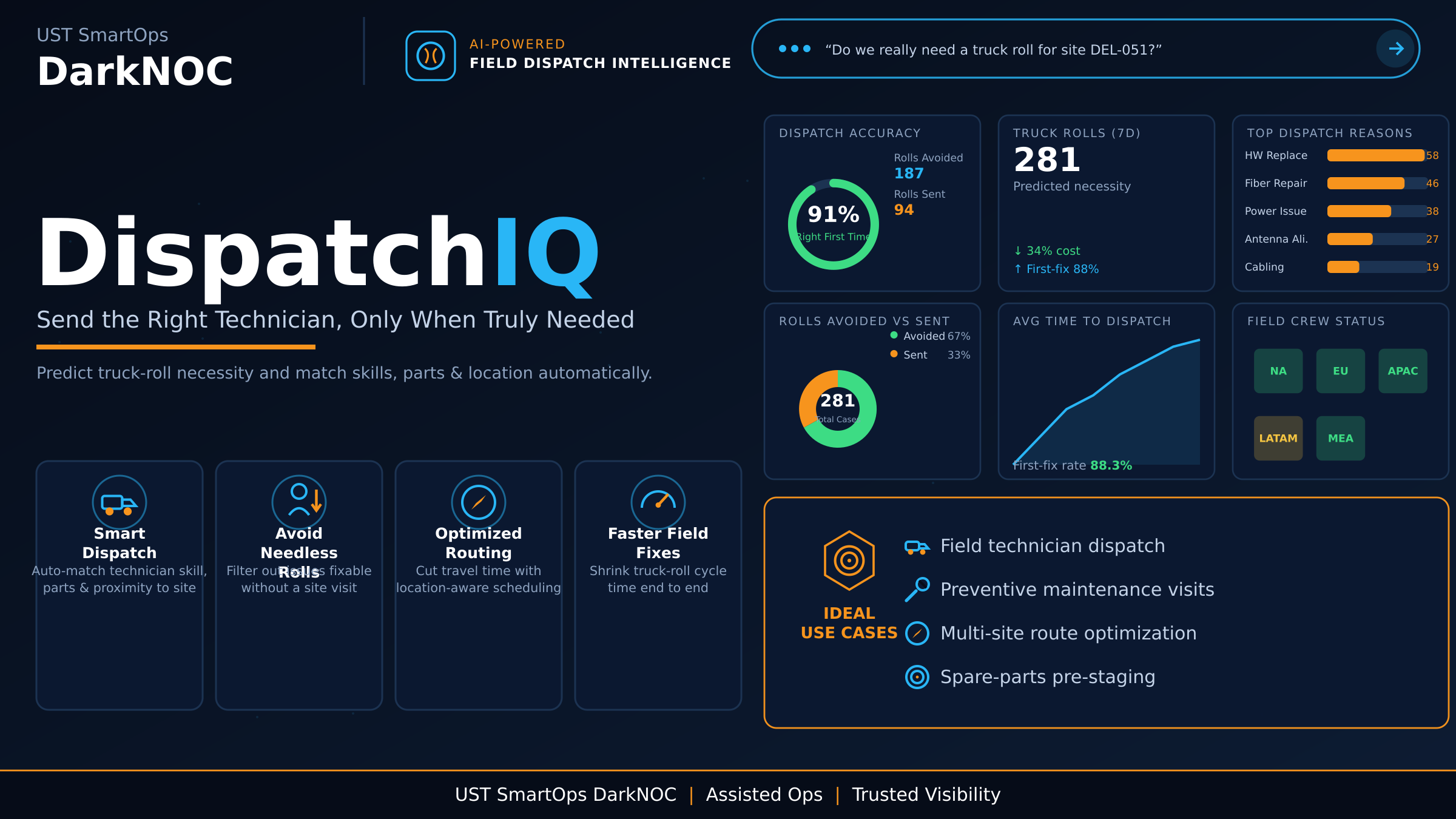
DispatchIQ uses predictive analytics to eliminate unnecessary truck rolls and auto-match technicians to jobs, cutting field costs by ~34% while boosting first-time-fix rates above 88%.
Overview
UST DispatchIQ - Intelligent Truck Roll and Field Dispatch Optimization
DispatchIQ is a professional services engagement from UST that deploys predictive analytics to determine whether a reported issue genuinely requires a site visit or can be resolved remotely - eliminating a significant share of unnecessary truck rolls. When a visit is required, it automatically selects the best-matched technician based on skill set, spare-parts availability, and proximity.
The result is a leaner, smarter field operation: fewer wasted trips, optimized routing across multiple sites, and higher first-time-fix rates - all while keeping field crews focused on the visits that genuinely need them.
Engagement Model
UST delivers DispatchIQ through a phased professional services engagement:
Phase 1 - Discovery and Scoping (2-4 weeks)
- Assessment of current dispatch workflows, ticketing systems, and field operations data
- Identification of integration points and data requirements
- Definition of success metrics and baseline measurements
- Deliverable: Scoping document with architecture blueprint and implementation roadmap
Phase 2 - Pilot Deployment (4-8 weeks)
- Configuration of predictive truck-roll scoring model using historical ticket data
- Integration with existing ticketing and workforce management systems (e.g., ServiceNow, Salesforce Field Service)
- Limited rollout to a subset of field operations for validation
- Deliverable: Configured predictive model, integration layer, and pilot performance report
Phase 3 - Production Rollout and Optimization (4-6 weeks)
- Full-scale deployment across all dispatch operations
- Model tuning based on pilot learnings
- Training for operations teams on dashboards and reporting
- Deliverable: Production-ready system, runbook, operational dashboards, and knowledge transfer
AWS Services Integration
DispatchIQ leverages AWS cloud services to deliver scalable, secure analytics. The solution can integrate with Amazon SageMaker for ML model training and inference, and Amazon Connect for remote resolution workflows - enabling a seamless handoff between AI-driven triage and technician dispatch.
Key Capabilities
- Predictive truck-roll necessity scoring - ML-driven analysis of ticket data to classify issues as remote-resolvable or requiring a site visit
- Automated technician-skill and parts matching - Assigns the right technician with the right parts based on job requirements
- Location-aware route and schedule optimization - Minimizes travel time across multi-site dispatch schedules
- Real-time field-crew status tracking - Visibility into technician availability and job progress
- First-time-fix analytics and reporting - Dashboards measuring resolution rates and operational efficiency
- System integrations - Compatible with leading platforms including ServiceNow, Salesforce Field Service, and existing workforce management systems
Proven Outcomes
- Reduces unnecessary truck rolls by approximately 34%
- Improves first-time-fix rate to over 88%
- Shortens overall field-resolution cycle time
- Optimizes technician utilization and travel time
- Improves customer satisfaction with faster, accurate field fixes
Security and Data Handling
UST applies enterprise-grade security practices throughout the engagement. Buyer data ingested for model training is encrypted in transit and at rest. Access to systems and data is governed by role-based controls, and all credentials and integration tokens are managed securely. At engagement completion, UST follows agreed-upon data retention and deletion policies to ensure buyer data is handled in accordance with organizational and regulatory requirements.
Industry Use Cases
- Telecom network fault dispatch - Scores the likelihood that remote resolution is possible before dispatching a technician, reducing unnecessary site visits
- Utilities preventive maintenance scheduling - Optimizes preventive maintenance visits across geographically distributed infrastructure, pre-staging spare parts at regional depots
- Cable and broadband multi-site route optimization - Sequences daily dispatch routes for field crews, minimizing drive time and maximizing jobs completed per shift
- Spare-parts pre-staging for scheduled visits - Predicts required parts based on ticket classification and ensures technicians arrive equipped for first-time resolution
Prerequisites
To engage with DispatchIQ, buyers should have:
- An existing ticketing or work-order management system (e.g., ServiceNow, Salesforce Field Service, BMC Helix) with historical dispatch data
- Minimum 6 months of historical ticket data for model training
- Designated technical and operations stakeholders for discovery workshops
Next Step
Request a discovery call through AWS Marketplace to discuss your dispatch operations and receive a tailored scoping proposal from UST.
Highlights
- Predicts truck-roll necessity using ML-driven scoring of ticket data, reducing unnecessary field visits by approximately 34%. This outcome has been demonstrated in production dispatch environments processing thousands of daily tickets. The predictive model analyzes historical resolution patterns, fault codes, and equipment data to classify issues as remote-resolvable or requiring on-site intervention - enabling operations teams to redirect technician capacity toward genuinely complex jobs.
- Auto-matches technician skills, certified parts inventory, and geographic proximity to each job. When a site visit is confirmed necessary, DispatchIQ evaluates technician certifications, current workload, available spare parts at nearby depots, and real-time location to assign the optimal resource - driving first-time-fix rates above 88% and eliminating repeat visits caused by mismatched skills or missing components. Integrates with platforms such as ServiceNow and Salesforce Field Service.
- Delivered as a structured professional services engagement leveraging AWS cloud services including Amazon SageMaker for ML model training. UST provides phased discovery, pilot deployment, and production rollout over 10-18 weeks. Buyers receive a configured predictive model, system integration with existing ticketing and workforce management platforms, operational dashboards, and full knowledge transfer - with measurable ROI validated during the pilot phase.
Details
New
Introducing multi-product solutions
You can now purchase comprehensive solutions tailored to use cases and industries.

Pricing
Custom pricing options
Pricing is based on your specific requirements and eligibility. To get a custom quote for your needs, request a private offer.

Legal
Content disclaimer
Vendors are responsible for their product descriptions and other product content. AWS does not warrant that vendors' product descriptions or other product content are accurate, complete, reliable, current, or error-free.
Support
Vendor support
Support Channels
UST provides support for DispatchIQ engagements through the following channels:
- Email: salesteam_tes@ust.com
- AWS Marketplace messaging: Available directly through your AWS Marketplace account
- Dedicated engagement channel: A direct communication channel is established with your UST delivery team during the engagement
Engagement Delivery
During active engagements, UST assigns a dedicated project manager as your primary point of contact. The delivery team includes data engineers and solution architects who work alongside your operations and IT stakeholders throughout discovery, pilot, and production phases.
Buyer responsibilities include:
- Providing access to historical ticket and dispatch data
- Designating technical and operations stakeholders for workshops
- Granting system access for integration configuration
Handoff artifacts at engagement completion:
- Configured predictive model and integration documentation
- Operational runbook and troubleshooting guide
- Performance dashboards and reporting templates
- Knowledge transfer sessions for your operations team
Post-Engagement Support
After production go-live, UST provides a transition period to ensure stable operations. For ongoing support needs, optimization requests, or questions about your engagement, contact UST via email or AWS Marketplace messaging.
To begin a new engagement or request a discovery call, reach out through AWS Marketplace or email salesteam_tes@ust.com .