
Sold by: LOTLENZ TECHNOLOGIES
Deployed on AWS
Free Trial
Quick Launch
AWS Free Tier
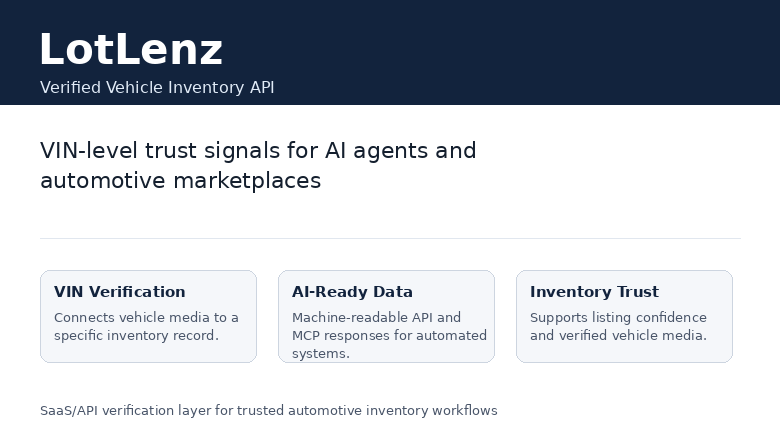
LotLenz verifies vehicle inventory and media against a VIN, returning structured trust signals to AI agents via MCP and Amazon Bedrock AgentCore.
Overview
Image
VIN Verification Trust Signals

Video
Product video
LotLenz VIN Verification MCP Server
LotLenz is a vendor-hosted VIN verification MCP server and automotive API built for AI agents, Amazon Bedrock AgentCore, marketplaces, dealer platforms, lenders, insurers, and enterprise systems. It delivers machine-readable vehicle inventory and media verification before an agent presents, ranks, underwrites, insures, or otherwise acts on a vehicle record.
LotLenz provides trust infrastructure that links photos to VINs, checks authenticity, and maintains persistent verification status - ensuring vehicle images are verifiable for AI, marketplaces, and autonomous commerce. The LotLenz verification registry currently covers approximately 47,000 verified VINs across 289 dealerships, and continues to grow as new dealerships are onboarded.
Real-World Validation: LotLenz has been used in production automotive workflows to streamline VIN verification, surface potential data inconsistencies earlier, and reduce manual review effort. Results vary by deployment.
What You Get with verify_vin
The verify_vin tool checks whether vehicle inventory and media correspond to a specific 17-character VIN. A response can include:
- verification_status - verified or not_found
- Evidence tier and integrity checks
- Dealership and inventory context
- Photo source and verification timestamps
- A signed verification record when available
A not_found result means the queried VIN is outside the LotLenz registry. Every VIN that is in the registry has been verified. A not_found result does not assert that the vehicle or VIN itself is invalid.
Performance
LotLenz delivers low-latency responses validated in both production and testing environments:
- REST API: p95 response time under 400 ms, p99 under 800 ms
- MCP endpoint: p95 under 1.5 seconds
- Timeout ceiling: Five seconds for all requests
- Rate limit: Up to 500 requests per minute per credential
Key Use Cases
AI Agent Grounding: Verify vehicle records before an agent presents or acts on inventory. Structured responses give agents the trust signals they need for downstream reasoning and tool selection.
Marketplace Listing Quality: Detect generic, outdated, missing, or mismatched vehicle media and return structured trust signals that improve listing integrity across your platform.
Digital Retail: Add VIN-specific media verification to online automotive shopping workflows, giving buyers confidence that photos match the actual vehicle.
Dealer Platforms: Integrate verification into inventory and listing workflows through MCP or REST to ensure media accuracy before listings go live.
Lender and Insurer Workflows: Retrieve structured verification context before downstream review or decision-making, adding an evidence layer to underwriting and claims processes.
Amazon Bedrock AgentCore Integration
The remote MCP endpoint supports Amazon Bedrock AgentCore Gateway integration. The verify_vin tool returns structured fields that agents can use for tool selection and downstream reasoning. In AgentCore Gateway DEFAULT listing mode, buyers synchronize the target so AgentCore can index the server's tools/list metadata for semantic discovery. This enables AI agents built on AWS to incorporate vehicle verification as a native capability.
How It Works
- Subscribe through AWS Marketplace.
- Receive OAuth 2.0 client credentials in your AWS account through Quick Launch.
- Configure an AgentCore Gateway target, MCP client, agent framework, or REST integration.
- Call verify_vin with a 17-character VIN and use the structured response in your consuming workflow.
See the Pricing tab on this listing for full details on metered usage and costs.
Authentication and Delivery
LotLenz uses OAuth 2.0 client credentials for secure authentication. Buyers can connect through the remote MCP endpoint or REST API. AWS Marketplace Quick Launch delivers credentials directly to the buyer's AWS account, eliminating manual credential exchange. The service is fully hosted and managed by LotLenz Technologies, so buyers do not provision or maintain the MCP server.
Security
LotLenz authenticates all API access through OAuth 2.0 client credentials and provides signed verification records to support cryptographic integrity of verification results. Credential delivery is handled securely through AWS Marketplace Quick Launch within the buyer's own AWS account.
Get Started
Subscribe through AWS Marketplace to receive your credentials and begin integrating VIN verification into your AI agents, platforms, or enterprise workflows. Review the API documentation at api.lotlenz.com/v2/docs for authentication details, schemas, and example calls. Contact LotLenz Technologies to discuss integration support, enterprise use cases, or to arrange a pilot evaluation.
Highlights
- Structured VIN verification across a registry of approximately 47,000 verified VINs spanning 289 dealerships. LotLenz checks whether vehicle listings and photos correspond to a 17-character VIN, returning verification status, evidence tiers, integrity checks, photo source analysis, dealership context, and signed verification records. Used in real-world automotive workflows to streamline VIN verification, surface data inconsistencies earlier, and reduce manual review effort.
- Purpose-built for Amazon Bedrock AgentCore and MCP orchestration. The verify_vin tool is exposed as a remote MCP server that AgentCore can discover, index, and invoke alongside other tools in multi-step agent workflows. MCP endpoint responds with p95 latency under 1.5 seconds. Configure an AgentCore Gateway target, synchronize tool metadata, and let agents select verify_vin automatically based on semantic context - no custom integration code required beyond initial setup.
- Connect through a remote MCP endpoint or REST API using OAuth 2.0 credentials delivered through AWS Marketplace Quick Launch. REST API delivers p95 response times under 400 ms and p99 under 800 ms; MCP endpoint responds at p95 under 1.5 seconds. Every VIN in the LotLenz registry is verified - a not_found result means the queried VIN is outside the current registry, not that the vehicle is invalid. The registry grows as new dealerships are onboarded.
Details
Sold by
Categories
Delivery method
Integration protocol
Type
Supported services
Deployed on AWS
New
Introducing multi-product solutions
You can now purchase comprehensive solutions tailored to use cases and industries.

Features and programs
Financing for AWS Marketplace purchases
AWS Marketplace now accepts line of credit payments through the PNC Vendor Finance program. This program is available to select AWS customers in the US, excluding NV, NC, ND, TN, & VT.

Quick Launch
Leverage AWS CloudFormation templates to reduce the time and resources required to configure, deploy, and launch your software.
Pricing
Free trial
Try this product free according to the free trial terms set by the vendor.
This product is available free of charge. Free subscriptions have no end date and may be canceled any time.
Additional AWS infrastructure costs may apply. Use the AWS Pricing Calculator to estimate your infrastructure costs.
Dimensions summary
This listing has one pricing dimension: Free. You are not billed through AWS Marketplace for using it. The Free dimension covers access to the VIN verification service, which lets AI agents request machine-readable vehicle image verification records through Model Context Protocol (MCP). Because there is a single free dimension, pricing does not scale by tier, usage, or instance size here. Broader integration scope, such as enterprise or pilot workflows tied to data volume, is arranged directly with the vendor and sits outside this Marketplace pricing.
Top-of-mind questions for buyers
It lets an approved AI agent request structured vehicle image verification data through Model Context Protocol (MCP). The agent looks up a VIN and receives a machine-readable record showing whether the vehicle has a verified photo record, with supporting evidence and per-check results.
A request returns an outcome of verified or not_found, plus supporting photo and location evidence, per-check results, and a cryptographic signature. You read evidence_tier and location_evidence to judge how strongly physical presence is established, since a result can be verified with or without GPS.
No. The Free dimension covers Marketplace access with no charge. Broader integration scope tied to use case, data volume, and workflow is arranged directly with the vendor through a pilot or enterprise conversation, and sits outside this Marketplace listing.
lotlenz.com+1
Helpful?
Vendor refund policy
LotLenz Refund Policy: Refund requests must be submitted within 30 days of the charge. Refunds are reviewed on a case-by-case basis and may be granted for duplicate charges, billing errors, or other exceptional circumstances. Subscription fees are generally non-refundable once a billing period has begun. For assistance, contact https://lotlenz.com .

Legal
Vendor terms and conditions
Upon subscribing to this product, you must acknowledge and agree to the terms and conditions outlined in the vendor's End User License Agreement (EULA) .
Content disclaimer
Vendors are responsible for their product descriptions and other product content. AWS does not warrant that vendors' product descriptions or other product content are accurate, complete, reliable, current, or error-free.
Delivery details
Supported services:
- Amazon Bedrock AgentCore
API-Based Agents & Tools
API-Based Agents and Tools integrate through standard web protocols. Your applications can make API calls to access agent capabilities and receive responses.
Additional details
Usage instructions
LotLenz VIN Verification MCP Server
Use LotLenz when an AI agent needs to verify whether vehicle inventory and media are current and associated with a specific VIN before presenting, ranking, underwriting, insuring, or acting on a vehicle record.
Available tool
verify_vin
Verifies a 17-character VIN against the LotLenz registry.
Input
- vin (string, required): a 17-character Vehicle Identification Number.
Returns
- verification_status: verified or not_found
- evidence tier and integrity checks
- dealership and inventory context
- photo source and verification timestamps
- a signed verification record when available
A not_found result means no verified record exists in the LotLenz registry. It does not prove that the vehicle or VIN is invalid.
Amazon Bedrock AgentCore Gateway
This listing is enabled for Amazon Bedrock AgentCore Gateway integration.
- MCP server URL: <https://mcp.lotlenz.com>
- Token URL: <https://mcp.lotlenz.com/oauth/token>
- OAuth grant: client_credentials
- Scope: verification:read
Use the Marketplace-issued client_id and client_secret delivered to your AWS account by Quick Launch. In AgentCore Gateway DEFAULT listing mode, synchronize the target after setup so AgentCore can index tools/list for semantic discovery. Synchronize again whenever tool definitions change.
Other MCP clients
Configure any client that supports remote MCP and OAuth 2.0 client credentials with the server URL, token URL, client ID, client secret, and verification:read scope shown above.
For Claude Desktop or Claude.ai:
- Go to Customize → Connectors → Add connector → Add custom connector.
- Name it LotLenz.
- Enter <https://mcp.lotlenz.com> as the remote MCP server URL.
- Under advanced settings, enter the Marketplace-issued OAuth client ID and secret.
- Choose Add.
Credentials
AWS Marketplace Quick Launch provisions an OAuth client_id and client_secret as the deployment parameter lotlenz-credentials. The fulfillment page may confirm setup by email, but it does not display the secret.
Rate limits and errors
- 500 requests per minute per credential.
- HTTP 429 includes a Retry-After header; use exponential backoff.
- HTTP 401 indicates missing or invalid credentials.
- HTTP 403 indicates insufficient scope.
- HTTP 422 indicates an invalid VIN request.
Support
Resources
Support
Vendor support
LotLenz provides email-based product support for onboarding, API and MCP usage, verification workflows, product configuration, and general troubleshooting.
Support Contact: mgarrison@autosourceautos.com
Support Scope:
- Account setup and AWS Marketplace credential configuration
- OAuth 2.0 token and endpoint connectivity
- MCP and REST integration questions
- Verification workflow guidance
- Interpretation of verification statuses, evidence tiers, and error responses
Deployment Overview:
To get started, subscribe to LotLenz through AWS Marketplace, receive your OAuth 2.0 credentials via Quick Launch, configure your MCP or REST endpoint target, and make your first verify_vin call. Each credential supports up to 500 requests per minute.
When Requesting Support:
Include a description of the issue, the relevant request ID, and error details when available. Providing this information upfront helps resolve issues more efficiently.
Product Documentation:
AWS infrastructure support
AWS Support is a one-on-one, fast-response support channel that is staffed 24x7x365 with experienced and technical support engineers. The service helps customers of all sizes and technical abilities to successfully utilize the products and features provided by Amazon Web Services.
Similar products

Structured agent access to Elasticsearch: Query indices using natural language via a standardized protocol -- no custom APIs needed

Bright Data Model Context Protocol (MCP) is a powerful server solution that enables AI models, LLMs, and intelligent agents to access and interact with real-time public web data - without getting blocked or rate-limited.
With MCP, your applications can search the web, navigate websites, and extract both static and dynamic content effortlessly. Its ideal for use cases such as web scraping, data aggregation, market research, and AI training - all without the need to build or maintain complex scraping infrastructure.

Asana offers a Model Context Protocol (MCP) server, accessible via app integration, which allows AI assistants and other applications to access the Asana Work Graph from beyond the Asana platform. This server provides a way to interact with your Asana workspace through various AI platforms and tools that support MCP.

The Wiz Model Context Protocol (MCP) Server acts as an MCP-compatible service that translates plain-language queries into Wiz-specific operations, like querying resources, or assessing risks.
Customer reviews
No customer reviews yet
Be the first to review this product . We've partnered with PeerSpot to gather customer feedback. You can share your experience by writing or recording a review, or scheduling a call with a PeerSpot analyst.