
Sold by: Steadybit
Deployed on AWS
Free Trial
AWS Free Tier
Steadybit helps teams running business-critical applications proactively validate resilience, uncover weak spots early, reduce downtime, and improve confidence in system reliability.
4.9
Overview
Image
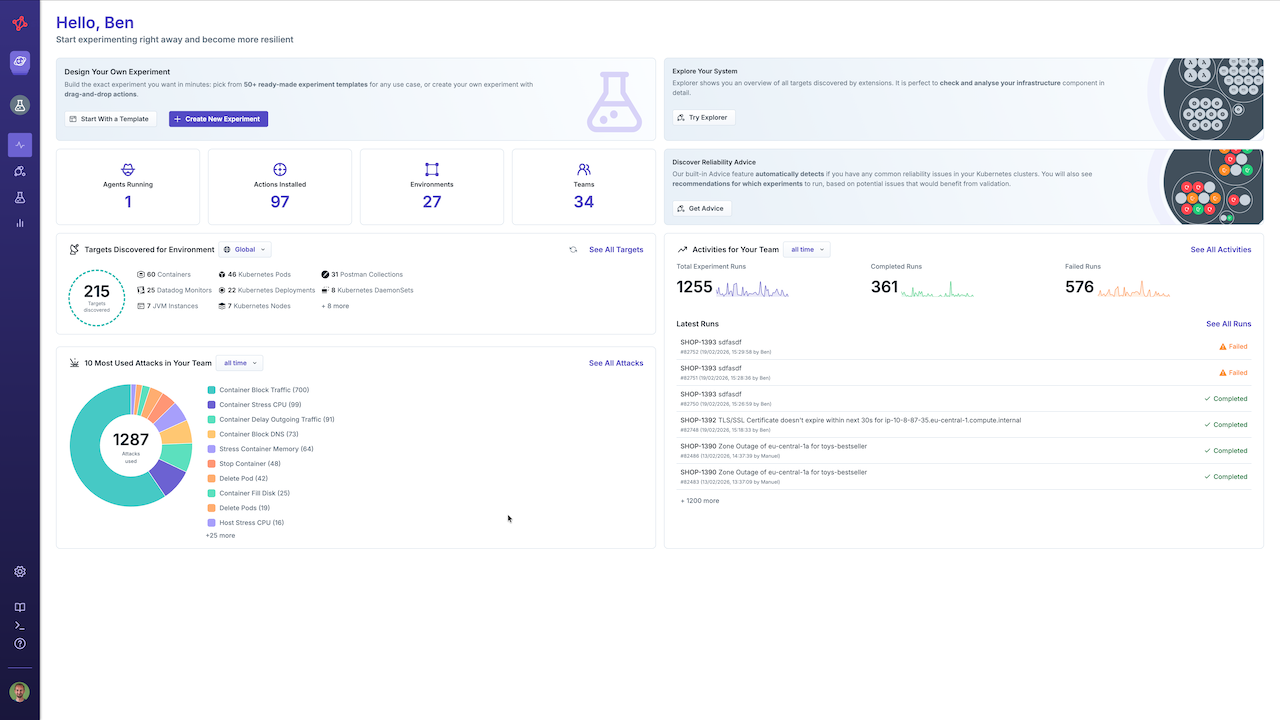
Steadybit Reliability Dashboard
Image
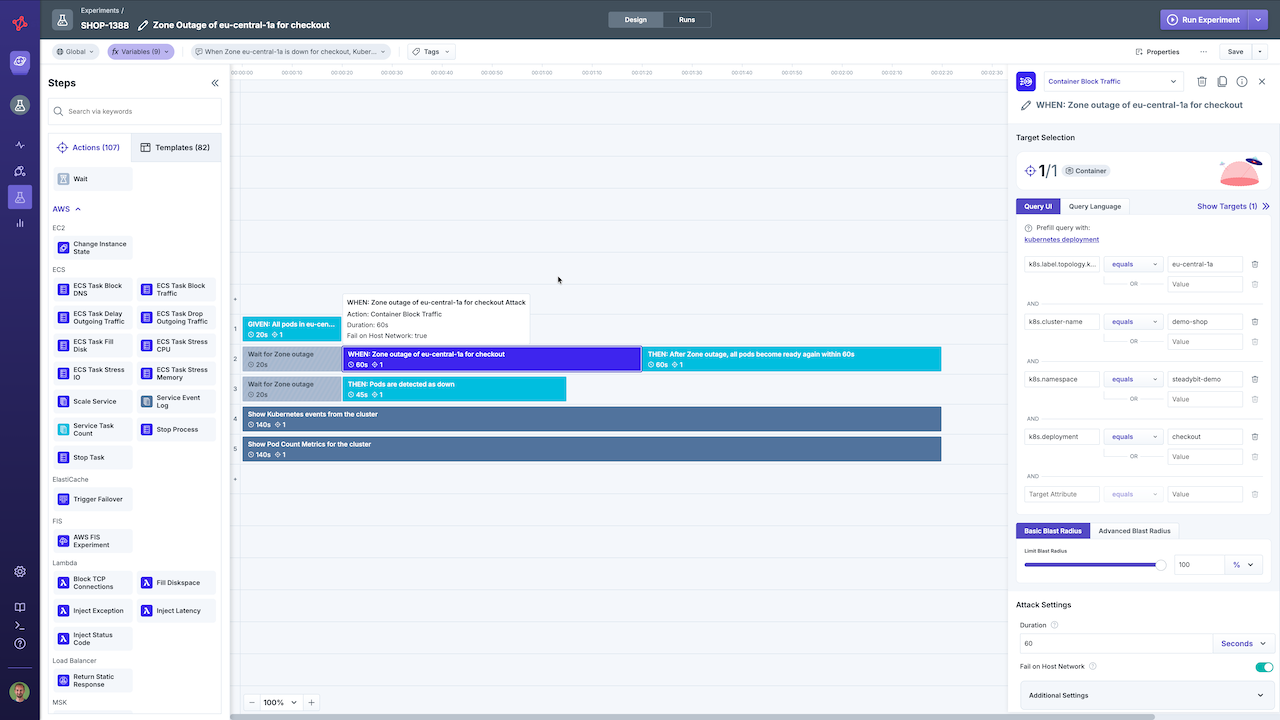
Steadybit Experiment Designer
Image
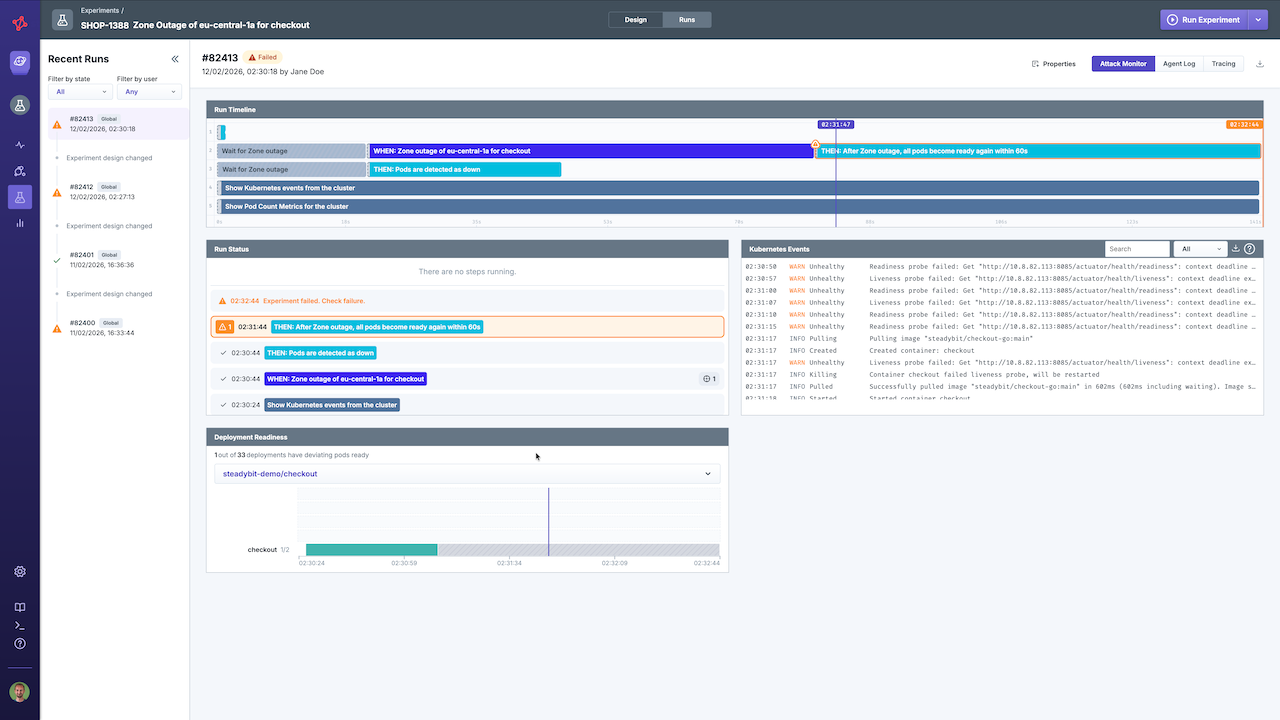
Steadybit Experiment Report
Image
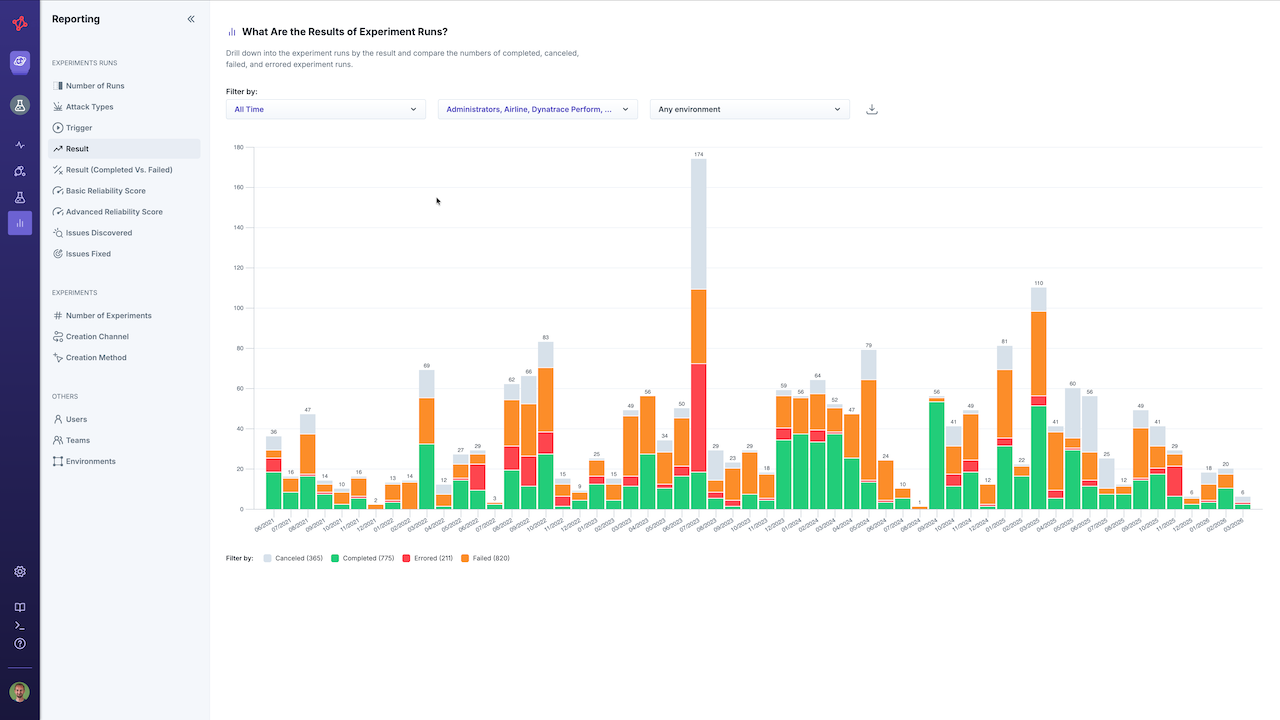
Steadybit Reporting

Video
Product video
Steadybit is a standalone resilience engineering platform, licensed independently and operated as a SaaS or self-hosted solution. It helps engineering teams running business-critical applications proactively identify weak spots in their systems by running safe, controlled experiments that validate application, infrastructure, and dependency behavior under failure conditions. Instead of discovering reliability issues during live incidents, teams can uncover and address them earlier.
The Steadybit platform is fully functional on its own and provides a complete experience for resilience engineering, including a web-based UI, experiment editor, scheduling, reporting, role-based access control, and a broad library of fault-injection actions across compute, network, container, Kubernetes, application, and database layers. Teams can model their services, define hypotheses, run experiments with a controlled blast radius, automate resilience checks in CI/CD pipelines, and measure reliability continuously over time. Steadybit operates across cloud and on-premises environments.
For customers running workloads on AWS, Steadybit works with a wide range of AWS services, including EC2, ECS, EKS, Lambda, RDS, Application Load Balancers, ElastiCache, and MSK, and integrates with AWS Fault Injection Service (FIS).
The platform is designed for platform engineering teams, SREs, DevOps teams, cloud operations teams, and software engineering organizations that manage distributed systems, microservices, and Kubernetes-based workloads. It is especially useful for companies that need high availability, strong operational confidence, and predictable service performance in complex cloud environments.
Steadybit addresses the need to reduce downtime, improve incident readiness, and increase confidence in system reliability.
Highlights
- Proactively identify weak spots in business-critical applications with safe, controlled resilience experiments across services, infrastructure, and dependencies.
- Continuously validate system reliability and improve incident readiness before failures impact customers, operations, or revenue.
- Enable platform, SRE, DevOps, and engineering teams to build resilience into everyday delivery across distributed systems, microservices, and Kubernetes environments.
Details
Sold by
Delivery method
Deployed on AWS
New
Introducing multi-product solutions
You can now purchase comprehensive solutions tailored to use cases and industries.

Features and programs
Financing for AWS Marketplace purchases
AWS Marketplace now accepts line of credit payments through the PNC Vendor Finance program. This program is available to select AWS customers in the US, excluding NV, NC, ND, TN, & VT.

Pricing
Free trial
Try this product free according to the free trial terms set by the vendor.
Pricing is based on the duration and terms of your contract with the vendor. This entitles you to a specified quantity of use for the contract duration. If you choose not to renew or replace your contract before it ends, access to these entitlements will expire.
Additional AWS infrastructure costs may apply. Use the AWS Pricing Calculator to estimate your infrastructure costs.
Dimension | Description | Cost/12 months |
|---|---|---|
Steadybit Professional: 3 Environments | Resilience engineering platform including 3 environments for 12 months, unlimited agents and targets, Landscape Explorer, Reliability Advice, experiment templates, unlimited users and teams, unlimited experiment executions, experiment scheduling, and Standard Support. | $24,500.00 |
Steadybit Professional: 3 Environments | Resilience engineering platform including 3 environments for 12 months, unlimited agents and targets, Landscape Explorer, Reliability Advice, experiment templates, unlimited users and teams, unlimited experiment executions, experiment scheduling, and Standard Support. | $24,500.00 |
Steadybit Professional: 3 Environments | Resilience engineering platform including 3 environments for 12 months, unlimited agents and targets, Landscape Explorer, Reliability Advice, experiment templates, unlimited users and teams, unlimited experiment executions, experiment scheduling, and Standard Support. | $24,500.00 |
Dimensions summary
You buy the Steadybit Professional plan under a 12-month contract, priced per unit. Each unit covers 3 environments. The pricing scales by quantity, so you add units to expand the number of environments you need. There is one tier available here. Within it, you get unlimited agents, targets, users, teams, and experiment executions, so those factors do not change your cost. Your price depends only on how many 3-environment units you commit to for the year. Standard Support is included with this plan.
Top-of-mind questions for buyers
An environment is a logical scope for running experiments and grouping targets. Each unit you buy covers 3 environments. Agents, targets, users, and experiment executions stay unlimited within each environment, so those numbers never affect your count. Only the number of 3-environment units you commit to sets your price.
No. This plan includes unlimited agents, targets, users, and teams. You install one agent per network with no cap. You can invite as many team members as you want, using role-based access controls. None of these factors change your price. Only the number of 3-environment units you buy drives cost.
You add more units. Each unit covers 3 environments, so buying two units gives you 6 environments, three units gives 9, and so on. Pricing scales by quantity of units under the same 12-month contract. There is one plan tier available here, so all included features stay the same as you add units.
steadybit.com
Helpful?
Vendor refund policy
All sales are final and non-refundable. No refunds or credits will be issued except where required by applicable law. For questions regarding billing or cancellation, please contact support@steadybit.com .

Legal
Vendor terms and conditions
Upon subscribing to this product, you must acknowledge and agree to the terms and conditions outlined in the vendor's End User License Agreement (EULA) .
Content disclaimer
Vendors are responsible for their product descriptions and other product content. AWS does not warrant that vendors' product descriptions or other product content are accurate, complete, reliable, current, or error-free.
Delivery details
Software as a Service (SaaS)
SaaS delivers cloud-based software applications directly to customers over the internet. You can access these applications through a subscription model. You will pay recurring monthly usage fees through your AWS bill, while AWS handles deployment and infrastructure management, ensuring scalability, reliability, and seamless integration with other AWS services.
Resources
Vendor resources
Support
Vendor support
Email support is offered Monday through Friday during business hours at support@steadybit.com . Standard Support includes assistance with product configuration, troubleshooting, and issue resolution. Additional support options and service levels can be agreed individually based on customer requirements.
AWS infrastructure support
AWS Support is a one-on-one, fast-response support channel that is staffed 24x7x365 with experienced and technical support engineers. The service helps customers of all sizes and technical abilities to successfully utilize the products and features provided by Amazon Web Services.
Similar products

Steady is the zero-effort coordination platform for running high-performance teams. It distills plans & progress from tools, teams and people into hyper-personalized digests that keep everyone in sync.
By automating structured updates and synthesizing key insights from tools and teams, Steady boosts productivity, reduces complexity, and empowers high-performance, distributed work environments. Steady contracts measurably deliver a >50X ROI.

Digibee is the only integration platform that minimizes cost and complexity while enabling rapid digital transformation. Any developer can build and manage integrations, connecting and modernizing the critical systems that drive their business.

Hive Platform is an all-in-one service that provides everything you need to develop and operate games. Experience the know-how of global game services experienced in more than 180+ countries with one Hive Platform.

Upstash makes data easiest part of your job. We manage everything for you. You focus on more important things. With per-request pricing, you pay only for what you use.
Customer reviews
Krishna P.
A wholistic, feature rich Chaos Engineering solution
Reviewed on Jan 22, 2026
Review provided by G2
What do you like best about the product?
Steadybit offers a scalable and performant Chaos Engineering solution that has significantly improved the resilience of our services. As a large enterprise with thousands of services managed by hundreds of scrum teams and demanding high Availability SLAs, we rely on robust software.
The Steadybit team has been a valuable partner for several years, providing timely and quality support while developing a solid, feature-rich solution. We are highly satisfied with their software and collaboration. If you are seeking a wholistic, end-to-end Chaos Engineering platform, I’d strongly recommend Steadybit.
The Steadybit team has been a valuable partner for several years, providing timely and quality support while developing a solid, feature-rich solution. We are highly satisfied with their software and collaboration. If you are seeking a wholistic, end-to-end Chaos Engineering platform, I’d strongly recommend Steadybit.
What do you dislike about the product?
While not strictly a "dislike," a common question in the industry is about alternatives to Steadybit. While open-source solutions exist and can form the basis of a chaos engineering practice, they may only be viable for smaller organizations. Beyond a certain operational scale, maintaining and evolving an open-source tool often becomes significantly more time-consuming. Furthermore, these alternatives may lack specific features critical to larger, more complex environments. Therefore, a thorough evaluation of the pros and cons is necessary before making a final decision.
What problems is the product solving and how is that benefiting you?
Help fault test our services and environments, help identify any gaps in how services are built and deployed. Ultimately leading to highly available and scalable services.
Angel Daniel B.
Fantastic Support and Effortless Setup for Chaos Engineering
Reviewed on Jan 06, 2026
Review provided by G2
What do you like best about the product?
I really benefit from Steadybit's programmatic scalability and its interesting features like reliability advice, which bolster our chaos engineering strategy and help it grow into a more self-service capacity. The support team is great; they are always eager to assist us, gather requirements for new features, and help with any implementation issues or malfunctions related to their services. The initial setup of Steadybit was very easy.
What do you dislike about the product?
Some of the features we are looking to use to expand our chaos engineering to self service require to be tuned and extended to meet our case. It is not out of the box. We are looking to use the Advice section to have an inventory and automatically run injections. That is not something that it is currently supported out of the box.
What problems is the product solving and how is that benefiting you?
Steadybit is programmatically scalable with features like reliability advice, supporting our chaos engineering strategy while evolving to a self-service capacity.
Ilias T.
Open, Extensible Chaos Engineering That Scales With Your Organization
Reviewed on Dec 15, 2025
Review provided by G2
What do you like best about the product?
What really made Steadybit stand out during our proof of value was its open and extensible model. The fact that extensions are open source, that we can contribute back, and that we can build our own custom extensions was a decisive factor for us. Other vendors were largely on par in terms of features, pricing, and overall experience, but Steadybit’s openness aligned much better with how we work as an engineering organization.
From a UI standpoint, Steadybit also felt the most mature compared to other vendors we evaluated. The interface is well thought out, clear, and focused on enabling engineers to get things done quickly, without unnecessary friction or visual noise.
From the very first meetings, the Steadybit team was also very much down to business. We were clear that this was a technical evaluation and that we were not interested in polished sales decks or flashy presentations. We wanted to see what the product could actually do and get straight to the point, and they delivered. The focus was consistently on real capabilities, hands-on evaluation, and practical use cases.
From a day-to-day perspective, the platform is easy to use and integrates very naturally with Kubernetes. Creating and running experiments is straightforward, and the safety mechanisms make it suitable even for teams that are still building confidence in chaos engineering.
Customer support is another major strength. The Steadybit team is highly responsive, technically strong, and genuinely invested in our success. Questions, edge cases, and feedback are handled quickly, usually through direct conversations rather than slow back-and-forths.
From a UI standpoint, Steadybit also felt the most mature compared to other vendors we evaluated. The interface is well thought out, clear, and focused on enabling engineers to get things done quickly, without unnecessary friction or visual noise.
From the very first meetings, the Steadybit team was also very much down to business. We were clear that this was a technical evaluation and that we were not interested in polished sales decks or flashy presentations. We wanted to see what the product could actually do and get straight to the point, and they delivered. The focus was consistently on real capabilities, hands-on evaluation, and practical use cases.
From a day-to-day perspective, the platform is easy to use and integrates very naturally with Kubernetes. Creating and running experiments is straightforward, and the safety mechanisms make it suitable even for teams that are still building confidence in chaos engineering.
Customer support is another major strength. The Steadybit team is highly responsive, technically strong, and genuinely invested in our success. Questions, edge cases, and feedback are handled quickly, usually through direct conversations rather than slow back-and-forths.
What do you dislike about the product?
If I had to point out a downside, it would be that we’ve pushed the platform to its limits due to the size and complexity of our Kubernetes clusters. This is less a fundamental issue and more a natural result of operating at enterprise scale.
Beyond that, there are a few minor nitpicks here and there, but nothing blocking. In practice, most of these are resolved quickly through discussion with the Steadybit team, which makes them far less painful than they could otherwise be.
Beyond that, there are a few minor nitpicks here and there, but nothing blocking. In practice, most of these are resolved quickly through discussion with the Steadybit team, which makes them far less painful than they could otherwise be.
What problems is the product solving and how is that benefiting you?
Before Steadybit, we didn’t have a reliable way to test, reproduce, or safely troubleshoot failure scenarios that we had experienced in production. Post-incident learning was largely theoretical, and validating assumptions around resilience was difficult.
Steadybit gives us a structured, safe, and repeatable way to experiment with failures and validate system behavior. Even though we are currently running it in pre-production, we are already seeing strong engagement from teams and growing confidence in chaos engineering as a practice. People are eager to use it because they can clearly see the value.
As we prepare to roll it out to production, Steadybit is helping us move from reactive incident handling to proactive reliability engineering, which is a significant shift for an organization of our size.
Steadybit gives us a structured, safe, and repeatable way to experiment with failures and validate system behavior. Even though we are currently running it in pre-production, we are already seeing strong engagement from teams and growing confidence in chaos engineering as a practice. People are eager to use it because they can clearly see the value.
As we prepare to roll it out to production, Steadybit is helping us move from reactive incident handling to proactive reliability engineering, which is a significant shift for an organization of our size.
Dimosthenis K.
Exceptional Collaboration and Expert Support from Steadybit
Reviewed on Dec 12, 2025
Review provided by G2
What do you like best about the product?
I like super fast support and commitment from the steadybit team.
What do you dislike about the product?
They can make their product even more friendly for not so technical people.
What problems is the product solving and how is that benefiting you?
The Steadybit platform has enabled us to take a more proactive approach to testing, which has strengthened the resilience of our ecosystem and increased our confidence in the reliability of our services.
Telecommunications
Outstanding Experience from Start to Finish
Reviewed on Dec 10, 2025
Review provided by G2
What do you like best about the product?
My experience with Steadybit has been genuinely impressive from day one. The installation was smooth and effortless—we were able to run experiments straight away, which was a huge relief after the challenges we faced with other tools. What really stood out, though, was the team behind it. They were incredibly responsive, always willing to jump on a call at short notice, and consistently supportive throughout the entire process. It felt like they genuinely cared about helping us succeed.
Using the platform itself has been a pleasure. Steadybit discovers everything accurately, and the way you select targets and build experiments is so intuitive that it removes all the usual friction. The reporting is simple, clear, and easy to work with, and the variety of attacks—especially around network behaviour—gave us exactly the flexibility we needed.
Overall, Steadybit felt reliable, modern, and backed by a team that goes above and beyond. It’s a tool I’d happily recommend because it not only works well, but it also makes the whole chaos engineering journey feel far smoother and more enjoyable.
Using the platform itself has been a pleasure. Steadybit discovers everything accurately, and the way you select targets and build experiments is so intuitive that it removes all the usual friction. The reporting is simple, clear, and easy to work with, and the variety of attacks—especially around network behaviour—gave us exactly the flexibility we needed.
Overall, Steadybit felt reliable, modern, and backed by a team that goes above and beyond. It’s a tool I’d happily recommend because it not only works well, but it also makes the whole chaos engineering journey feel far smoother and more enjoyable.
What do you dislike about the product?
I genuinely think Steadybit is the most complete chaos engineering tool on the market. From the moment we started using it, everything just worked—the installation was smooth, the UI is intuitive, and the experiment flow feels thoughtfully designed. Their team has been incredibly supportive and responsive, often jumping on calls at short notice and really partnering with us throughout the process.
What I appreciate most is how comprehensive the platform is: accurate discovery, easy target selection, clear reporting, and a wide range of powerful attacks, especially on the network side. It covers everything we need without the friction we’ve experienced elsewhere.
Overall, Steadybit doesn't just offer features—it delivers a full, polished experience that makes chaos engineering both effective and enjoyable.
What I appreciate most is how comprehensive the platform is: accurate discovery, easy target selection, clear reporting, and a wide range of powerful attacks, especially on the network side. It covers everything we need without the friction we’ve experienced elsewhere.
Overall, Steadybit doesn't just offer features—it delivers a full, polished experience that makes chaos engineering both effective and enjoyable.
What problems is the product solving and how is that benefiting you?
Steadybit is solving three big problems for us:
Visibility & Targeting Complexity
Before Steadybit, discovering the right services, nodes, and dependencies for chaos tests was time-consuming and often incomplete. Steadybit accurately discovers everything and makes target selection effortless.
Benefit: I can design meaningful experiments much faster, with confidence that I’m hitting the right components.
Operational Friction Around Chaos Testing
Other tools created blockers—installation issues, manual setup, confusing selectors, unclear reporting. Steadybit removes that friction completely.
Benefit: Chaos experiments go from a stressful, time-heavy process to something smooth and repeatable, which means I can focus on learning from failures rather than fighting the tooling.
Realistic Fault Injection for Modern Distributed Systems
Steadybit offers a richer and more practical library of attacks—especially on the network layer—which maps perfectly to the types of failures we actually care about in production.
Benefit: We can run experiments that reflect real failure scenarios, helping us build confidence in our systems’ resilience.
Visibility & Targeting Complexity
Before Steadybit, discovering the right services, nodes, and dependencies for chaos tests was time-consuming and often incomplete. Steadybit accurately discovers everything and makes target selection effortless.
Benefit: I can design meaningful experiments much faster, with confidence that I’m hitting the right components.
Operational Friction Around Chaos Testing
Other tools created blockers—installation issues, manual setup, confusing selectors, unclear reporting. Steadybit removes that friction completely.
Benefit: Chaos experiments go from a stressful, time-heavy process to something smooth and repeatable, which means I can focus on learning from failures rather than fighting the tooling.
Realistic Fault Injection for Modern Distributed Systems
Steadybit offers a richer and more practical library of attacks—especially on the network layer—which maps perfectly to the types of failures we actually care about in production.
Benefit: We can run experiments that reflect real failure scenarios, helping us build confidence in our systems’ resilience.