
Sold by: K-AI
Free Trial
AWS Free Tier
K-AI finds the conflicts, duplicates and outdated content that make AI agents answer wrong. It maps your corpus with a semantic graph and exposes a clean, governed knowledge base. Teams search it; AI agents consume it through Model Context Protocol, with access rights mirrored and query-level lineage. GDPR and EU AI Act ready.
Overview
Your AI agents hallucinate because your documents contradict each other.
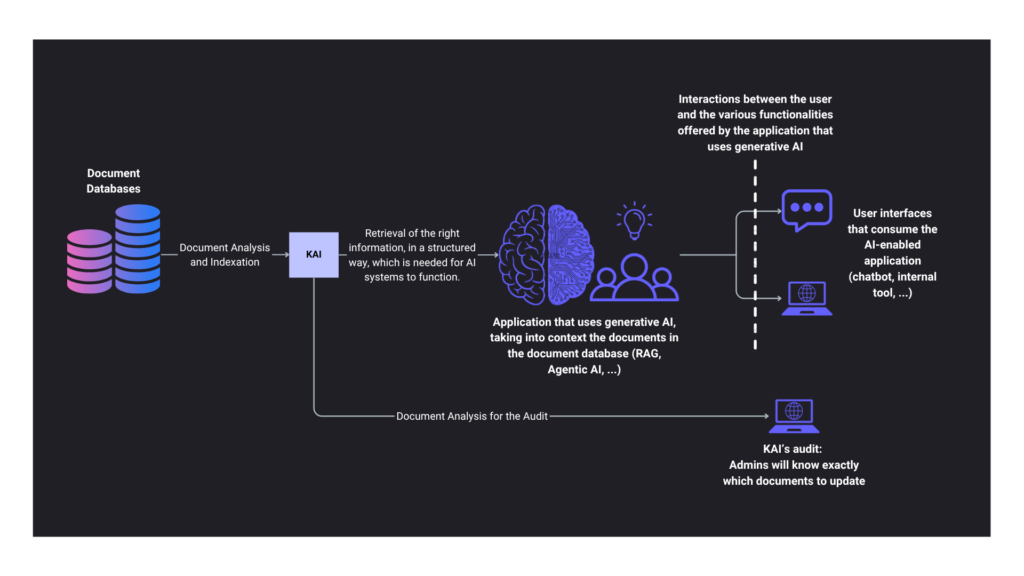
K-AI is a Document Knowledge Platform. It sits between your document repositories and everyone who consumes them, human or machine, and does three things: govern, clean, activate.
The problem
An HSE procedure written in 2019 states a four-hour response time. A 2024 service memo states thirty minutes. Both live in your repository. Your copilot answers one or the other, with no way to know which is current.
Between 80 and 90 percent of enterprise data is unstructured (RTInsights, 2026), and only 7 percent of organizations consider their data fully AI-ready (Cloudera and Harvard Business Review Analytic Services, March 2026). Gartner expects 60 percent of AI projects to be abandoned by the end of 2026 for lack of data quality.
What K-AI does
Govern. Inventory your document estate as business products, with an owner, a quality level, a lifecycle and traceability.
Clean. The K-AI Neural Semantic Graph links documents, concepts, topics, actors and dependencies, and continuously surfaces four signal types: conflicts between documents, outdated content, duplicates, and missing topics. Your experts arbitrate; K-AI proposes.
Activate. Expose the cleaned base to people through search, and to AI agents through Model Context Protocol, with access rights mirrored and lineage traced on every answer.
Platform and access
A five-layer architecture: sources, ingestion and indexing, semantic document layer, governance and quality, exposure and consumption.
Administrators work in the K-AI admin console: user groups, document instances, and declared business links between instances so retrieval routes a query to the relevant bases instead of searching everything.
A K-AI instance is one coherent domain. The test is simple: would it be a problem if a document from domain A appeared in search results for domain B? If yes, those are two instances.
Access is provided through a REST API with organization API keys or OAuth 2.1. AI agents connect through Model Context Protocol, validated with Claude Desktop, Cursor and Le Chat.
Roles
Document Authority, Document Owner, Document Steward, Document Producer, Document Consumer. The platform is operated by a CDO or CIO; Document Owners configure the scope of their own instances.
Proven results
A CAC 40 industrial group discovered 32 percent of its base was divergent duplicates, surfaced in two weeks and resolved in six.
A European energy and industry deployment detected 398 conflicts and removed around 30 percent of documents, with over 90 percent detection precision across more than 1,300 anomalies.
At TotalEnergies Retail Power and Gas, Head of Digital Products Thomas Bensoussan reports that the approach surfaced conflicts that would have been hard to spot by eye.
Compliance and sovereignty
K-AI is a French company headquartered in Versailles. Access control lists are preserved end to end and every AI answer carries traceable lineage, which the EU AI Act requires for high-risk systems from August 2026. GDPR compliant.
Highlights
- Detects conflicting, outdated, duplicate and missing content across your document estate. A 2019 procedure stating a 4-hour response time against a 2024 memo stating 30 minutes is surfaced, not guessed.
- Exposes the cleaned knowledge base to AI agents through Model Context Protocol, tested with Claude Desktop, Cursor and Le Chat. Role-based access control is inherited automatically and resolved server-side from the consumer identity, so retrieval cannot leak beyond a user's rights.
- A CAC 40 industrial group found 32% of its corpus was divergent duplicates: surfaced in two weeks, resolved in six. A European energy and industry deployment detected 398 conflicts across more than 1,300 anomalies.
Details
Sold by
Categories
Delivery method
Deployed on AWS
New
Introducing multi-product solutions
You can now purchase comprehensive solutions tailored to use cases and industries.

Features and programs
Financing for AWS Marketplace purchases
AWS Marketplace now accepts line of credit payments through the PNC Vendor Finance program. This program is available to select AWS customers in the US, excluding NV, NC, ND, TN, & VT.

Pricing
Free trial
Try this product free according to the free trial terms set by the vendor.
Pricing is based on the duration and terms of your contract with the vendor. This entitles you to a specified quantity of use for the contract duration. If you choose not to renew or replace your contract before it ends, access to these entitlements will expire.
Additional AWS infrastructure costs may apply. Use the AWS Pricing Calculator to estimate your infrastructure costs.
Dimension | Description | Cost/month |
|---|---|---|
K-AI Instance | One K-AI instance for one use case | $50,000.00 |
Dimensions summary
Pricing uses a single dimension: the K-AI Instance, billed as a contract. One instance covers one use case, meaning each separate knowledge base or document scope needs its own instance. You scale by adding instances as your number of use cases grows. Each instance provides a governed document knowledge base that you access through a role-based admin console and expose to AI agents via an MCP endpoint. There are no separate tiers or add-ons; the price reflects the instance quantity you configure for the contract term.
Top-of-mind questions for buyers
A use case maps to one knowledge base — a governed document scope for a specific domain, such as safety procedures or contracts. Each instance carries its own access model, groups, and MCP endpoint. Separate domains with distinct ownership or document scopes each need their own instance.
Cost scales with the number of instances you run. Each new use case or domain knowledge base needs its own instance, added to the contract. Growing document volume within one existing use case does not add instances. You pay per instance configured, not per document or user.
Yes. Each instance exposes one MCP endpoint serving two functions: an audit surface for experts to resolve conflicts and duplicates, and a retrieval surface for consumers and AI agents. Both run from the same instance under the configured role-based access policy. You do not buy these separately.
k-ai.ai+2
Helpful?
Vendor refund policy
Please contact us at support@k-ai.ai .
Custom pricing options
Request a private offer to receive a custom quote.

Legal
Vendor terms and conditions
Upon subscribing to this product, you must acknowledge and agree to the terms and conditions outlined in the vendor's End User License Agreement (EULA) .
Content disclaimer
Vendors are responsible for their product descriptions and other product content. AWS does not warrant that vendors' product descriptions or other product content are accurate, complete, reliable, current, or error-free.
Delivery details
Software as a Service (SaaS)
SaaS delivers cloud-based software applications directly to customers over the internet. You can access these applications through a subscription model. You will pay recurring monthly usage fees through your AWS bill, while AWS handles deployment and infrastructure management, ensuring scalability, reliability, and seamless integration with other AWS services.
Support
Vendor support
Email support at support@k-ai.ai . Every request is acknowledged the same business day, including when the full answer takes longer. Service-affecting issues are escalated to the engineering team on receipt.
Documentation: https://k-ai.gitbook.io/knowledge-ai
Enterprise customers purchasing through a private offer can contract dedicated support levels, including response and resolution commitments and a named technical contact.
AWS infrastructure support
AWS Support is a one-on-one, fast-response support channel that is staffed 24x7x365 with experienced and technical support engineers. The service helps customers of all sizes and technical abilities to successfully utilize the products and features provided by Amazon Web Services.
Similar products
Kore.ai AI for Service equips your customer service organization with agentic AI that automates interactions and assists human agents in real time. AI agents do the heavy lifting, resolving repetitive issues, pulling data from systems, and guiding conversations, so your team can focus on more complex needs. The platform supports omnichannel experiences, integrates easily, and delivers measurable gains in efficiency, speed, and satisfaction.

Kore.ai provides an advanced AI agent platform designed to help enterprises transform work, service, and processes with intelligent automation, orchestration, and AI insights. It enables deployment of AI agents at enterprise scale.
AI for Process is an AI Agent platform designed to automate knowledge-intensive business processes. By combining deep domain AI agents with robust integration, it streamlines operations, reduces human dependency, and boosts compliance and efficiency. It features Multi-Agent Process Automation for handling complex decisions using structured and unstructured data, and Process-Specific AI Orchestration for customizable workflows aligned with business goals. Its Human-in-the-Loop Framework enables human intervention at key decision points. With Enterprise Integrations, it connects systems via standardized data exchange. Pre-configured templates accelerate setup, while built-in Governance & Compliance ensures transparency and industry-aligned control.
Yellow.ai is an enterprise-grade agentic AI platform that enables organizations to automate customer and employee conversations across 35+ channels using advanced large language models, low-code tools, and deep enterprise integrations.
Customer reviews
No customer reviews yet
Be the first to review this product . We've partnered with PeerSpot to gather customer feedback. You can share your experience by writing or recording a review, or scheduling a call with a PeerSpot analyst.