
Sold by: Seemplicity
Deployed on AWS
Fighting AI with AI, Seemplicity is your Exposure Action Platform accelerating remediation speed with autonomous AI analysts that investigate, guide fixes, and verify total resolution.
4.7
Overview
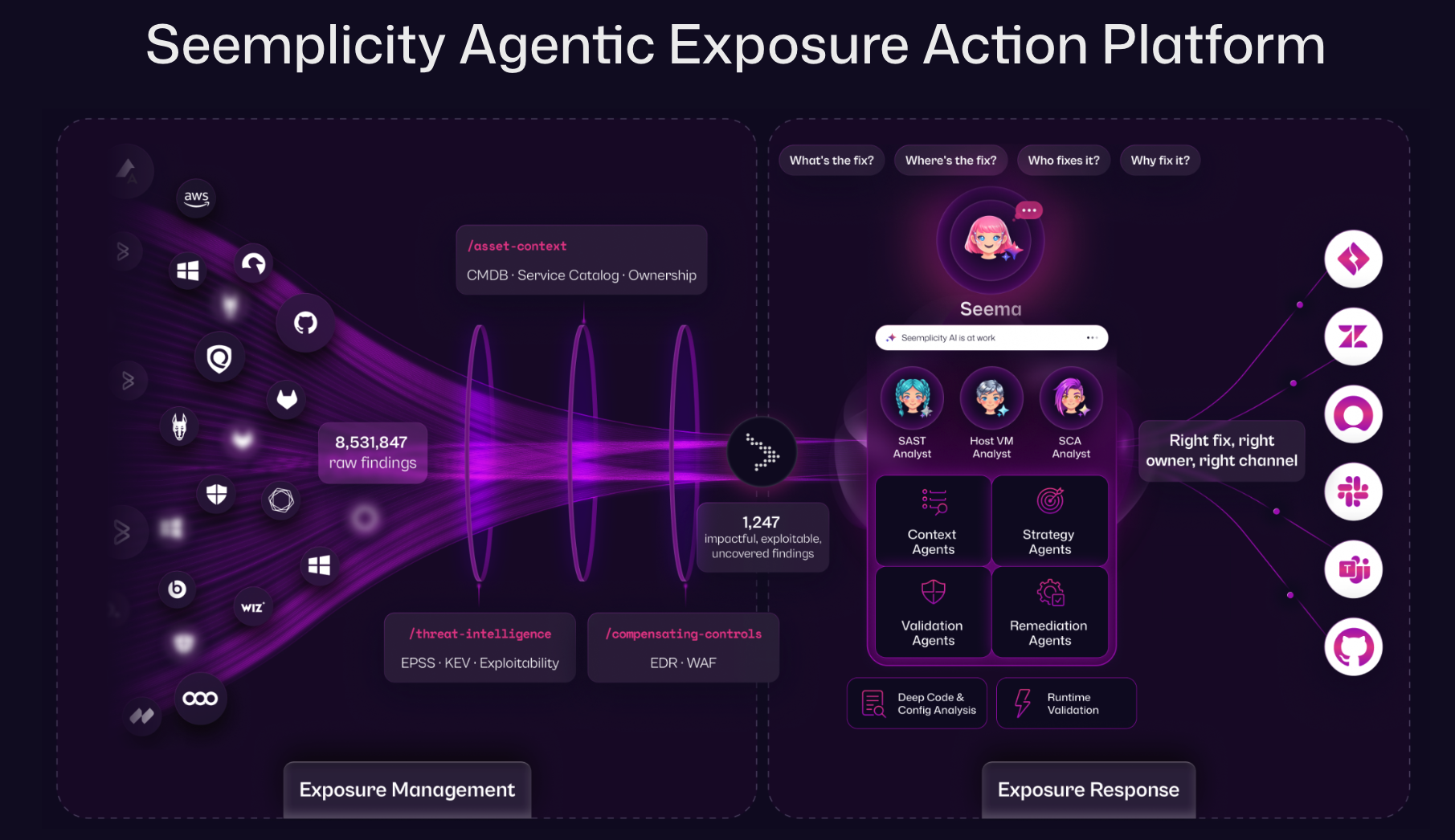
Image
Agentic Exposure Action Platform Architecture
Video
Seemplicity Overview
Video
Seemplicity AI Analysts in Action

Video
Meet Seema The Exposure Management AI Assistant

Video
Product video
Claude Mythos and other AI LLMs have changed the shape of the threat landscape, moving discovery and exploitation from a human-speed process to an autonomous, agentic-speed one. The window between a vulnerability being found and being weaponized has collapsed from weeks to minutes. The real risk isn't the finding itself anymore, it's the organizational lag in responding to it.
Seemplicity is the Agentic Exposure Action Platform built to counter machine-speed threats with machine-speed remediation. Instead of relying on manual coordination, Seemplicity uses an automated, agentic defense so your team can outpace AI-driven attacks by turning every discovery into an immediate, verified fix.
Seemplicity is built around an Agentic Workforce, including Seema (a conversational AI assistant) and specialized AI Analysts for code, dependencies, and infrastructure. Together, they power a fast, context-aware exposure management and autonomous response engine.
Machine-speed find-to-fix: Seemplicity integrates with your existing scanners (Wiz, CrowdStrike, Tenable, and others), automatically ingests findings, enriches them with business context, and routes them to the right owner in Jira or ServiceNow, cutting out the manual handoffs attackers rely on.
Measurable impact:
- 60% reduction in mean time to remediation (MTTR)
- 80% decrease in manual operations
- 75% increase in SLA compliance
- 98% backlog reduction through automatic deduplication and aggregation
- 4x improvement in the number of exposures remediated
- Over 85% reduction in unknown asset ownership
Security teams don't struggle with detection, they struggle with action. In a world where AI is finding vulnerabilities faster than ever, Seemplicity ensures you fix them first.
Seemplicity is trusted by enterprises including Carlsberg Group, Morningstar, SoFi, Graphic Packaging, NTT, West Bend, Hertz, and OpenWeb.
Highlights
- Agentic prioritization: with AI generating thousands of new findings, Seemplicity's agents analyze business risk to prioritize the backlog and consolidate scattered individual findings into consolidated, actionable fixes.
- Root cause investigation: rather than forwarding a raw CVE number and a deadline, Seemplicity's agents trace code reachability and map blast radius to deliver the actual root cause and asset-specific guidance.
- Evidence-based verification: closing a ticket isn't enough when an asset can be re-exploited in seconds. Seemplicity independently verifies that the window of exposure is actually shut, rather than trusting ticket status alone.
Details
New
Introducing multi-product solutions
You can now purchase comprehensive solutions tailored to use cases and industries.

Features and programs
Buyer guide
Gain valuable insights from real users who purchased this product, powered by PeerSpot.
Financing for AWS Marketplace purchases
AWS Marketplace now accepts line of credit payments through the PNC Vendor Finance program. This program is available to select AWS customers in the US, excluding NV, NC, ND, TN, & VT.

Pricing
Pricing is based on the duration and terms of your contract with the vendor. This entitles you to a specified quantity of use for the contract duration. If you choose not to renew or replace your contract before it ends, access to these entitlements will expire.
Additional AWS infrastructure costs may apply. Use the AWS Pricing Calculator to estimate your infrastructure costs.
Dimension | Description | Cost/12 months |
|---|---|---|
Basic | Seemplicity Platform Basic | $70,000.00 |
Dimensions summary
This listing has one pricing dimension: Seemplicity Platform Basic, sold as units under a contract. You commit to a fixed number of units for the contract term rather than paying per hour or per usage event. Because there is a single tier, pricing scales only with the quantity of units you purchase. The platform covers exposure management and response, including signal aggregation, prioritization, and remediation workflows. To size your unit count or align pricing with your environment, contact the vendor.
Top-of-mind questions for buyers
The pricing table lists the Basic tier sold in units under a contract, but it does not define what a single unit maps to, such as an asset, user, or finding. Contact the vendor to confirm how units are counted for your environment before you commit.
You commit upfront under a contract for a set number of units across the contract term. This is not hourly or usage-metered billing. You pay for the committed unit quantity regardless of day-to-day activity. Ongoing charges do not fluctuate with the volume of findings or scans processed.
The Basic tier covers exposure management: signal aggregation, prioritization by business context, remediation routing, and AI-driven investigation across your attack surface. Cost scales only with the unit quantity you buy, since there is one tier. Contact the vendor to size units against your assets and integrations.
seemplicity.ai+1
Helpful?
Vendor refund policy
All fees are non-cancellable and non-refundable except as required by law. In any case, contact us at support@seemplicity.io
Custom pricing options
Request a private offer to receive a custom quote.

Legal
Vendor terms and conditions
Upon subscribing to this product, you must acknowledge and agree to the terms and conditions outlined in the vendor's End User License Agreement (EULA) .
Content disclaimer
Vendors are responsible for their product descriptions and other product content. AWS does not warrant that vendors' product descriptions or other product content are accurate, complete, reliable, current, or error-free.
Delivery details
Software as a Service (SaaS)
SaaS delivers cloud-based software applications directly to customers over the internet. You can access these applications through a subscription model. You will pay recurring monthly usage fees through your AWS bill, while AWS handles deployment and infrastructure management, ensuring scalability, reliability, and seamless integration with other AWS services.
Resources
Vendor resources
Support
Vendor support
Contact Seemplicity Customer Services and Support
- Web: https://seemplicity.ai/contact/
- Email: CS@seemplicity.ai
We believe that your success should be driven by platform performance, not by costly Professional Services engagements. To that end, every subscription includes a dedicated technical and strategic success team at no additional cost. Our goal is to provide the expert guidance you need to accelerate your outcomes while keeping your team in the driver's seat.
**You own the platform. We accelerate your outcomes. **
Seemplicity provides embedded technical and strategic expertise at no additional cost to ensure your platform is continuously aligned to your business.
- Dedicated Customer Success Engineer (CSE): A technical resource responsible for operationalizing Seemplicity from data ingestion through automations and reporting.
- Strategic Success Manager (CSM): Provides project and relationship management to track against your specific business goals.
- Integrated Solutions Team: Access to engineering resources for custom integrations or specialized professional-grade efforts.
- No Hidden Fees: Training sessions and technical working sessions are provided as a complementary service.
User Empowerment Comprehensive training sessions are available to equip your users with the skills to manage the platform independently. Direct Collaboration Access support through a dedicated Slack or Teams channel to fit Seemplicity into your existing daily workflow. Consultative Support Technical working sessions are designed to complete milestones and address complex requirements as your business evolves. Roadmap Influence Your CSM tracks your specific feature requests and prioritizes them with our Product Team to align with your journey.
AWS infrastructure support
AWS Support is a one-on-one, fast-response support channel that is staffed 24x7x365 with experienced and technical support engineers. The service helps customers of all sizes and technical abilities to successfully utilize the products and features provided by Amazon Web Services.
Updated weekly
By Seemplicity

By Rapid7

Top
50
In Security Observability
Top
10
In Security Observability
Top
100
In Infrastructure as Code
Sentiment is AI generated from actual customer reviews on AWS and G2
Functionality
Ease of use
Customer service
Cost effectiveness
Positive reviews
Mixed reviews
Negative reviews
AI generated from product descriptions
Agentic Prioritization and Consolidation
AI agents analyze business risk to prioritize vulnerability backlog and consolidate scattered findings into consolidated, actionable fixes.
Root Cause Investigation and Blast Radius Mapping
Agents trace code reachability and map blast radius to deliver root cause analysis and asset-specific remediation guidance.
Evidence-Based Verification
Independent verification of exposure closure through active validation rather than relying on ticket status alone.
Multi-Scanner Integration and Automated Enrichment
Integration with existing vulnerability scanners including Wiz, CrowdStrike, and Tenable with automatic ingestion, business context enrichment, and routing to ticketing systems.
Specialized AI Analyst Workforce
Agentic workforce including conversational AI assistant and specialized AI analysts for code, dependencies, and infrastructure analysis.
Attack Surface Visibility
Provides complete internal and external views of attack surface with asset enrichment from first-party and third-party data sources
Risk Prioritization and Scoring
Delivers risk scoring and threat-aware risk context to identify toxic combinations and prioritize remediation based on business impact
Multi-Layer Exposure Detection
Aggregates exposure detection findings from on-premises vulnerability management, cloud security, and application testing capabilities
Compliance Monitoring and Enforcement
Discovers assets missing required controls or permissions and enforces organizational policies with automated alerts upon configuration drift detection
Native Automation and Integration
Supports no-code automation with over 450 out-of-the-box integrations to popular security and ITOps tools for automated remediation and ticketing workflows
Multi-Source Security Data Aggregation
Aggregates data from multiple detection technologies and correlates related issues to provide unified visibility across code, clouds, applications, and infrastructure
Root Cause Analysis and Tracing
Traces security findings back to root causes and correlates multiple alerts into single fixes to reduce remediation complexity
Risk Prioritization Engine
Prioritizes security findings using exposure analysis, exploitability assessment, and business impact evaluation to identify critical issues requiring immediate attention
Automated Remediation Guidance
Generates actionable remediation guidance using generative AI with contextual information on what needs to be fixed, impact assessment, and recommended fix approaches
CI/CD Pipeline Security Integration
Integrates with development platforms and security tooling to identify security coverage gaps, authentication and access issues, misconfigurations, and exposure issues within CI/CD pipelines
Standard contract
No
No
Customer reviews
Kate Park
Automation has reduced vulnerability workload and keeps remediation efforts consistently prioritized
Reviewed on Aug 31, 2026
Review from a verified AWS customer
What is our primary use case?
For us, the main use case for Seemplicity is to get vulnerability findings in order to remediate the issue, and then some of our teams need to automatically check the vulnerability based on our automation setting.
Whenever we find or identify new findings in Seemplicity, we set up the vulnerability rule on our end, which identifies what the previous rule setting was, and the auto-fix is based on what we configured and what we want to mitigate, using this automation setting for these vulnerabilities.
What is most valuable?
The best features that Seemplicity offers include the risk finding, rule setting, and the analytics in the dashboard, where we can identify all types of vulnerabilities.
Out of those features, I find myself using the analytics in the dashboard most often because in some cases, I need to investigate the findings, while the second one is the rule setting based on the team request.
Seemplicity has a huge positive impact on our organization because once we have a vulnerability, it acts as a great assistant with its auto-mitigate feature, which can be used for a variety of different types of vulnerabilities, supporting our cybersecurity analysis.
The positive outcomes from using Seemplicity include saving our human effort, and while I cannot calculate the exact hours, it usually saves over five hours per employee, and our security posture is always up-to-date with the standard framework based on all of the vulnerability findings.
What needs improvement?
Seemplicity can be improved because sometimes the rule setting can be a little complicated, and for instance, filtering out the criteria may not be useful at times, as it can be too complicated based on the business requirements.
If we can have more metrics in Seemplicity dashboard, it could be very useful and helpful for us, as some parts of the dashboard just look to require a template, suggesting that more widgets would greatly enhance it.
For how long have I used the solution?
I have been using Seemplicity for less than one year.
What do I think about the stability of the solution?
Seemplicity is stable.
What do I think about the scalability of the solution?
Its scalability is great because once we set up new teams, their risk and vulnerability finding process is very scalable.
How are customer service and support?
Customer support for Seemplicity is great because whenever I open a ticket and chat with support, the admin responds right away.
What other advice do I have?
Seemplicity contributes significantly to our organization's readiness for regulatory audits because most of our InfoSec team uses it when investigating vulnerabilities.
I would rate Seemplicity an eight out of ten. I choose eight out of ten because overall, Seemplicity is a great tool, but it sometimes has a sync issue between other applications and itself, such as Twist or some other inventory data or sources of data, indicating a need for improved functionality for synchronizing data.
While I do not quite use Seemplicity's AI capabilities a lot, I was recently informed about them and have utilized the AI for problem-solving by chatting with it to get an immediate solution or instant message, which proves to be useful.
I cannot measure the accuracy of Seemplicity's AI, but I think its reliability is around eighty percent, as I feel a bit doubtful about the accuracy since my usage has mainly been through the chat feature.
My advice for others looking into using Seemplicity is that it would be beneficial since you can clearly see the vulnerability findings. My review rating for Seemplicity is eight out of ten.
reviewer2892675
Automation has transformed how we prioritize vulnerabilities and streamline remediation workflows
Reviewed on Aug 26, 2026
Review from a verified AWS customer
What is our primary use case?
Our main use case for Seemplicity is that we work with a number of large financial institutions as well as large enterprises, predominantly on the West Coast of the United States, and we use their exposure management and response platform to service our customers. We help them by integrating the technology into their environments, making sure that they're identifying and prioritizing vulnerabilities and exposures that need to be remedied or remediated as quickly as possible.
For example, we work with a large technology firm as well as one of the largest financial brokerage firms where we take the technology to go into their environment and identify the millions of findings and vulnerability findings that they have, and then use the technology to identify which of those millions of findings need to be addressed and prioritized for patching or fixing or remediating any sort of problem. Our technical team uses Seemplicity to work with the customer's technical team to identify those vulnerabilities and exposures, and then apply in an automated fashion the right fixing that they otherwise would not have the time to do or the means to remediate in a very quick manner.
We also use Seemplicity for reporting and dashboarding on their exposure risk and how many exposures they have and are currently servicing at any given moment, by integrating through their ticketing systems.
What is most valuable?
Seemplicity's best feature is probably the automation and the ability to automate a lot of the workflow for prioritizing and remediating that patching, that identifying of the exposures, being able to make sure that any sort of fixes that need to be made in the environment are done as rapidly as possible. The ability to not only prioritize but automate the workflow is extremely powerful, and to do it with a lens of AI, using some AI technologies to make that workflow even faster.
The automation and AI help both our technical teams as well as our customer's technical teams execute with speed. I think the biggest challenge has been teams always don't have enough time or resourcing to prioritize properly and what Seemplicity does in working with the DataSec team and working with our clients is execute the fixes with speed and accuracy as well as understand the stacking or the ranking order of what needs to be fixed in a swift manner and in the fastest possible way.
Seemplicity has become an important partner to us from a technology perspective as we work with best implement best practices based on not only industry standards but provide sort of comprehensive security solutions that are informed and guided by our own knowledge and expertise. It's been instrumental technology in our overall ecosystem of endpoint technologies and other technologies. We're definitely delivering more to our customers that demand sort of the best options for cybersecurity.
It's difficult to quantify some of it, but in some areas, we've seen customers, one financial customer experience 20 to 30% reduction in the amount of manual fixing and remediating. We also saw another customer of ours achieve an extremely high rate of optimization by reducing the number of untouched findings from numbers in the millions down to thousands. Definitely reducing the workflow, and then there's also a time component where we've heard anecdotally about speeding the time to fix. Those security teams within our customers are feeling a much more secure posture at the end of the day.
Seemplicity's AI capabilities meet the needs today in terms of what customers expect to have. There hasn't been anything that's been a gap. I know there's lots of concerns with our customer environments and with even our own technical teams about the use of AI and how AI will either create risk or not create risk or create help within the environment. It's meeting those needs by providing a tangible outcome.
What needs improvement?
Seemplicity doesn't need too much improvement right now. We're seeing some satisfaction with our customer environments and even with our technical teams. There are some bits on the cleanliness of dashboarding and maybe a little bit on the reporting side, but not too much improvement needed as of now. The teams are fairly happy. There can always be potentially more integrations, but the Seemplicity technical team is usually very responsive about providing necessary integrations if there's something that they don't already have out of the box.
For how long have I used the solution?
I have been using Seemplicity for over two years.
What do I think about the stability of the solution?
Seemplicity is stable. There are no major issues. There are always in all of our technologies that we evaluate, some form of instability, but Seemplicity I would say outperforms a lot of what we typically see, and they're very responsive to any concerns that we may have.
What do I think about the scalability of the solution?
Scalability has not been an issue. We service some of the largest customers and largest financial and technology companies on the West Coast of the United States. I've never seen an issue with scalability.
How are customer service and support?
Customer support has been first-class. They are very attentive. We've had face-to-face meetings even with our customers and with our technical teams, as well as myself, and they are whenever a concern is brought up, very attentive and very responsive. I would say it's a first-class customer experience.
The Seemplicity team is very accommodating and responsive to specific needs that our customers have and how that works with the rest of our technology stack. Pricing is very much competitive and in line. Of course, customers always demand a lower price, but setup costs and pricing overall are very much in line for the value that the technology provides.
Which solution did I use previously and why did I switch?
We didn't necessarily use a previous solution, but we evaluated other solutions from the likes of Armis and CrowdStrike and multiple other ticketing technologies that didn't really provide the full end-to-end management component and response or remediation side. Seemplicity really shines on that remediation component and being able to automate that workflow, and that's a gap where we could not find one of our existing technology partners to be able to fill that void.
What was our ROI?
The use has definitely created fewer employees needed. It's not so much fewer employees needed, but less need to go out and have to hire more expensive employees. Customers are coming back and saying that, including one large brokerage company that came back and said they've saved a lot of time and money from doing that. It's a bit hard to quantify, but in terms of time saved, there is absolutely time saved, fewer resources and people needed, and in terms of more visibility into the risk and exposure across the environment, whether it's in applications, whether it's in runtime environments, or whether it's in cloud environments, there's definitely a return.
Which other solutions did I evaluate?
We evaluated other options from the likes of Armis, CrowdStrike, Wiz, and Nucleus. There were some other folks that were in that equation, but again, most of them could not provide a full comprehensive view of both exposure management and exposure remediation. Seemplicity really shines more on that automated remediation workflow, which seemed to be a gap with some of the other existing technologies that we have in our ecosystem as well as those that we've evaluated.
What other advice do I have?
The automation and AI help both our technical teams as well as our customer's technical teams execute with speed. I think the biggest challenge has been teams always don't have enough time or resourcing to prioritize properly and what Seemplicity does in working with the DataSec team and working with our clients is execute the fixes with speed and accuracy as well as understand the stacking or the ranking order of what needs to be fixed in a swift manner and in the fastest possible way.
I would give them a nine on customer support.
I would give advice to know the specific pain and outcome you're looking to achieve when it comes to vulnerabilities or patching and to really understand what was missing from either existing technologies or even trying to use AI to build it yourself. Once you have an understanding of where those challenges were, the value proposition of Seemplicity will be much clearer for any organization looking to implement this type of exposure management technology.
I have given this review an overall rating of ten.
Which deployment model are you using for this solution?
Hybrid Cloud
If public cloud, private cloud, or hybrid cloud, which cloud provider do you use?
Amazon Web Services (AWS)
reviewer2881386
Centralized vulnerability insights have improved remediation tracking but need auto-remediation links
Reviewed on Aug 20, 2026
Review provided by PeerSpot
What is our primary use case?
My main use case for Seemplicity is providing vulnerability data to customers via tools like Qualys. Seemplicity helps us run vulnerability data to customers by allowing us to filter all of the data from Qualys directly into the customer's ITSM platforms, enabling them to manage their remediations.
How has it helped my organization?
Seemplicity has positively impacted our organization by allowing us to provide a single viewpoint into vulnerability management and pen testing for our customers. That single viewpoint has changed things for our customers and team by allowing for better updates in terms of vulnerabilities and pen test results, enabling them to better organize how they resolve those challenges and issues.
Seemplicity has contributed to our organization's readiness for regulatory audits by being beneficial for our customers.
What is most valuable?
The best features Seemplicity offers are phenomenal aggregation that reduces the total count of vulnerabilities down by a huge amount, and SEMA, the AI, is very good as well. When it comes to aggregation reducing the total count of vulnerabilities, SEMA stands out to me for its ability to troubleshoot issues directly within the platform while allowing the AI to also query things internally, providing good and accurate responses without having to use guides or third-party solutions. Depending on how it's set up with the customer and their goals, you can reduce total counts from hundreds into under ten tickets that need to be raised very quickly.
Seemplicity has a great library of integrations. Seemplicity's AI capabilities tick all the boxes of what we need it to do in terms of governance and security. In terms of accuracy and reliability of output, I have mainly used Seemplicity for troubleshooting and querying if things are possible within the platform, and it has given good outputs that have worked, so I have no issues with it.
What needs improvement?
If I had to think of one thing that could be even better, it would be auto-remediation for vulnerabilities, specifically the ability to link into solutions that can handle the auto-remediation, translating Qualys's information to another tool that can then do the auto-remediation. The support is great, and I do not see any main reasons or main things for improvement off the top of my head.
For how long have I used the solution?
I have been using Seemplicity for two and a half years.
What do I think about the stability of the solution?
Seemplicity is stable.
What do I think about the scalability of the solution?
I have not seen any issues with the scalability of Seemplicity.
How are customer service and support?
The customer support has been phenomenal, with Alon getting responses as quickly as possible, solving issues, and getting on calls if we need them for priority issues. I rate the customer support a nine on a scale of one to ten.
Which solution did I use previously and why did I switch?
We did not previously use a different solution that handled what Seemplicity does.
How was the initial setup?
My experience with pricing, setup cost, and licensing is that pricing and setup costs were not in my area. The setup itself was reasonably smooth. Licensing is also not my area, as I am more of the technical, hands-on person.
What about the implementation team?
Seemplicity is deployed in my organization via Seemplicity themselves, and we manage the platform configuration. I am not sure if it is public cloud, private cloud, hybrid cloud, or on-premises.
What was our ROI?
I have not seen a return on investment since financial figures are not my area. I am a technical person.
What's my experience with pricing, setup cost, and licensing?
My experience with pricing, setup cost, and licensing is that pricing and setup costs were not in my area. The setup itself was reasonably smooth. Licensing is also not my area, as I am more of the technical, hands-on person.
Which other solutions did I evaluate?
I did not evaluate other options before choosing Seemplicity. That was not in my area, as I was just given the tool to utilize.
What other advice do I have?
My advice to others looking into using Seemplicity is to be aware that you will get more information from support than from the documents themselves, and it can take a bit of time after feeding in data to show meaningful results. However, it does show meaningful results in the end. I rate Seemplicity a seven on a scale of one to ten.
Sripriya Vutty
Unified vulnerability views have accelerated prioritization and remediation workflows
Reviewed on Aug 19, 2026
Review from a verified AWS customer
What is our primary use case?
My main use case for Seemplicity is unified vulnerability management. I use Seemplicity for unified vulnerability management by aggregating the detections from various sources which we use for performing the scans, and this provides a view for our stakeholders and for the mitigation team as well to cut the tickets and work on the process.
What is most valuable?
The interesting challenge that is solved with Seemplicity is aggregating the detections and then showcasing it according to our requirement based on our prioritization framework.
The best features Seemplicity offers include the aggregation logic, the way it is simplified to view and access, and the ability to have a view in a simpler way.
The aggregation logic in Seemplicity stands out for me because it made the features simpler for the team and the aggregation logic and other features are something useful for us in speeding up the things for the mitigation activities.
Seemplicity has positively impacted our organization, as we are still in the phase of production for all the zones, so we don't have feedback yet, but for now, it's all good.
What needs improvement?
To improve Seemplicity, I would suggest having more knowledge base and more threat intel. Adding the threat intel features will improve much, such as having its own threat intel source which is covered from the third-party sources and then converted, that will help.
For how long have I used the solution?
I have been using Seemplicity for more than a year now.
What do I think about the stability of the solution?
Seemplicity is stable.
What do I think about the scalability of the solution?
Seemplicity's scalability is good.
How are customer service and support?
The customer support for Seemplicity is amazing.
Which solution did I use previously and why did I switch?
We did not previously use a different solution.
How was the initial setup?
My experience with pricing, setup cost, and licensing is that earlier we felt it was too pricey, but I think it's worth it.
What about the implementation team?
We use AWS, Azure, and GCP, and right now we have Seemplicity on a private cloud.
What was our ROI?
I have seen a return on investment with Seemplicity, as we are saving money, so it's worth it.
What's my experience with pricing, setup cost, and licensing?
My experience with pricing, setup cost, and licensing is that earlier we felt it was too pricey, but I think it's worth it.
Which other solutions did I evaluate?
Before choosing Seemplicity, we evaluated other options, including Nucleus and Armis.
What other advice do I have?
My advice to others looking into using Seemplicity is that it is highly recommended. Regarding Seemplicity's AI capabilities in terms of governance and security, I think it's all good. Regarding Seemplicity's AI capabilities, I think its accuracy and reliability of output are good for now.
reviewer2885727
Automation has reduced triage effort and prioritizes critical security risks efficiently
Reviewed on Aug 06, 2026
Review provided by PeerSpot
What is our primary use case?
My main use case for Seemplicity is aggregating all the security findings across the application security from SAST, secrets finding, vulnerability scanning, or cloud CSPM finding, and deduping them, as well as using rules to categorize based on the risk according to our custom policies, and then using the remediation workflow to assign it to the right folks and track those Jiras, making sure SLAs are mandated.
In my day-to-day work, I use Seemplicity to track each product's vulnerabilities, such as upstream vulnerabilities discovered. As they are discovered, they are scanned by one of the tools, and then that finding is passed on to Seemplicity to evaluate the true risk of that finding. Once that is done, if it's not something that we need to work on, Seemplicity's rule set autonomously identifies whether the issue needs action or not, and if it does, it gets routed to the right team to ensure it does not get dropped and we minimize the response time from security risk to remediation.
What is most valuable?
The best features Seemplicity offers are the data integrations, the ability to redefine rules, the custom rules to categorize or prioritize findings, and the remediation workflows that can pass the findings to the right folks.
The custom rules feature in Seemplicity helps us prioritize findings and makes my job easier by allowing us to recategorize security findings to meet our environment-specific or deployment-specific risks, ensuring that of the 100 issues found, maybe only one or even less needs action, which helps prevent being overwhelmed by alerts.
Seemplicity provides a variety of integrations covering most of the well-known security tools, so all the data can be easily aggregated.
Seemplicity has positively impacted my organization by helping to reduce the meantime to resolution of security issues by categorizing the right risks, ensuring the highest risk ones are addressed first and routed to the correct team, thus avoiding delays during assignment.
Seemplicity has contributed to my organization's readiness for regulatory audits by helping in vulnerability management SLA tracking, although we are not using it specifically for regulatory requirements.
What needs improvement?
As the account is growing, some of the dashboards are slowing down, so optimizing that could be one area for improvement.
I found some pauses between responses where it took about 30 seconds to move to the next action, which could save time.
For how long have I used the solution?
I have been using Seemplicity for two months.
What do I think about the stability of the solution?
Seemplicity is stable.
What do I think about the scalability of the solution?
Seemplicity's scalability is pretty good for us. We have one of the large deployments and issues, and it scales well for all the use cases we are adding on top of it.
How are customer service and support?
Customer support for Seemplicity is pretty good with weekly calls and regular support for any change requests that are prioritized immediately.
I would rate the customer support a perfect 10 because they have consistently taken care of all requests from day one post-deployment.
Which solution did I use previously and why did I switch?
This was the first solution we evaluated and used.
How was the initial setup?
My experience with pricing, setup cost, and licensing has been pretty good.
What was our ROI?
Seemplicity has helped us see a return on investment by reducing the need for an L1 analyst for AppSec findings through its categorization, deduplication, and automatic remediation assignments, which has significantly decreased the headcount required for initial analysis.
What other advice do I have?
My advice to others looking into using Seemplicity is to give it a try if they have a large application security backlog, as it can definitely assist in the first level triage, prioritization, and help the security team shift left and move tasks to the corresponding owners easily.
I have not used Seemplicity's AI capabilities much other than summarizing issues and some of the aggregated findings, and the governance of that is well within the boundary with no issues observed.
In my usage, Seemplicity's AI accuracy is pretty good. It captures the critical and high issues needing attention effectively when summarizing a large number of issues into one aggregated issue.
I give this review an overall rating of 9 out of 10.