Sold by: cloudimg
Deployed on AWS
Free Trial
AWS Free Tier
This product has charges associated with it for seller support. Production-ready Qdrant vector database AMI with per-instance API key security, nginx reverse proxy, and 24/7 cloudimg support. Deploy in minutes - no manual setup required.
Overview
Image
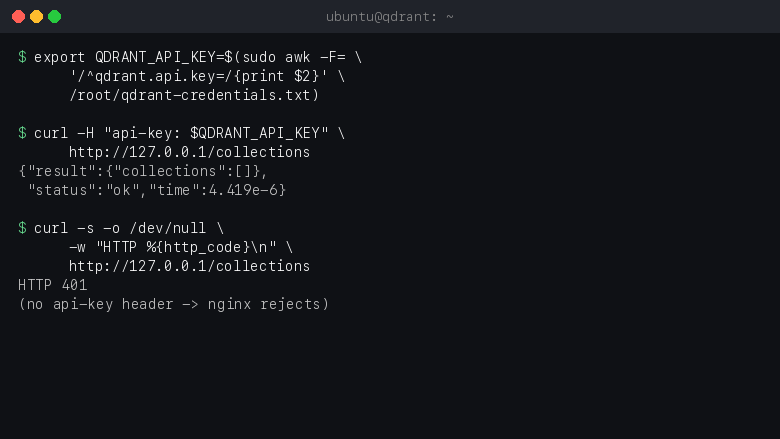
Listing collections over the REST API
Image
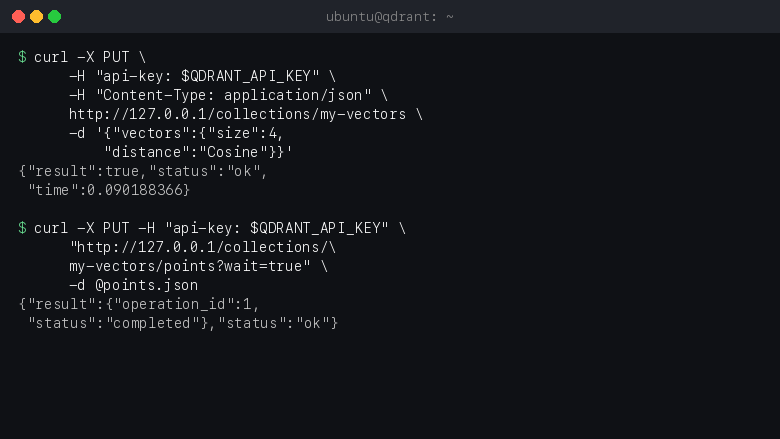
Inserting a vector with payload
Image
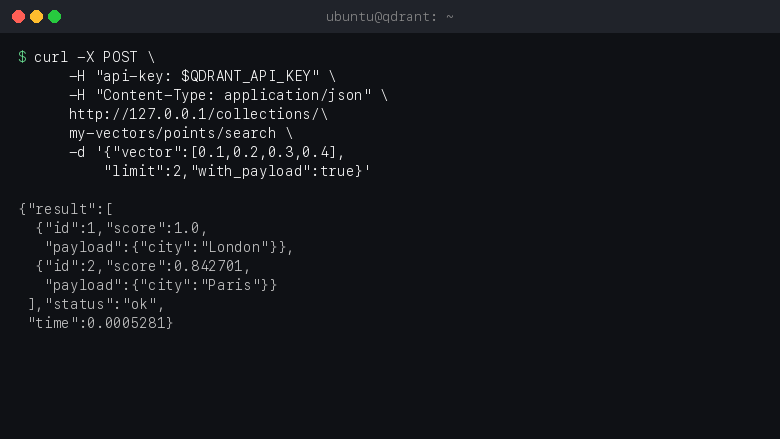
Nearest neighbour vector search
This is a repackaged open source software product wherein additional charges apply for cloudimg support services.
Qdrant Vector Database - Production-Ready AMI with 24/7 Support
This AMI delivers Qdrant, the high-performance vector search engine built in Rust, fully installed and configured so your team has a complete vector database running within minutes of launch - no manual compilation, no dependency management, and no default credentials to rotate.
Why This AMI Over Self-Managed or Managed Alternatives
- Faster than DIY: Skip the manual steps of provisioning, installing dependencies, configuring systemd services, and hardening API access. This image handles all of it at first boot.
- More secure than default Docker deployments: Every instance generates its own unique API key on first boot - no shared secrets, no default passwords. The key is stored in a root-only file, and all unauthenticated requests are rejected.
- Lower overhead than JVM-based alternatives: Qdrant's Rust-based engine requires no JVM, no Python runtime, and no Erlang - resulting in a smaller memory footprint and faster cold-start times compared to databases that carry heavy runtime dependencies.
- Expert support included: Unlike community-only support tiers, this listing includes 24/7 technical assistance from cloudimg engineers who specialize in vector database deployment and optimization.
Database Stack
Qdrant runs as a systemd service in single-node mode. The .deb package installs the qdrant binary directly with zero external runtime dependencies. The REST API is fronted on port 80 by an nginx reverse proxy with an api-key header guard, while native Qdrant ports (6333 for REST, 6334 for gRPC) remain available for direct client connections. Collection segments are stored on a dedicated, independently resizable EBS data disk.
Integrations and Ecosystem Compatibility
This Qdrant AMI works seamlessly with popular AI and ML frameworks including:
- LangChain and LlamaIndex for retrieval-augmented generation pipelines
- Amazon Bedrock and Amazon SageMaker for embedding generation and ML workflows
- OpenAI embeddings API for text and multimodal vector creation
- Haystack for building end-to-end NLP search applications
Any client that speaks HTTP or gRPC can connect, making integration straightforward with your existing AI stack.
Secure First Boot Process
On the first boot of your instance, a one-shot systemd service generates a cryptographically random API key unique to that instance, writes it into the Qdrant environment file, restarts Qdrant so the new key takes effect, and stores the plaintext value at /root/.qdrant-api-key (readable only by root). No shared or default credentials ever ship in the image.
Use Cases
- Retrieval-Augmented Generation (RAG): An engineering team indexing millions of document chunk embeddings to ground LLM responses with factual, up-to-date content from internal knowledge bases.
- Semantic Search: E-commerce platforms searching product catalogs by meaning rather than keywords, serving real-time results across large embedding collections.
- Recommendation Systems: Personalizing content, product, or media recommendations by finding nearest-neighbor embeddings in sub-millisecond response times.
- Anomaly Detection: Identifying outlier embeddings in fraud detection, security monitoring, or quality assurance workflows.
- Multimodal Search: Combining text, image, and audio vectors in a single collection for cross-modal retrieval.
Getting Started
Launch the AMI, wait for first-boot completion, retrieve your API key from the root-only file, and send your first collection creation request. To explore whether this AMI fits your workload, contact cloudimg for a free consultation on collection design, instance sizing, and indexing parameter selection.
cloudimg Support
24/7 technical support by email and live chat. Assistance covers Qdrant deployment, upgrades, collection design, indexing parameters, performance tuning, and troubleshooting. Critical issues receive a one-hour average response time.
All product and company names are trademarks or registered trademarks of their respective holders. Use of them does not imply any affiliation with or endorsement by them.
Highlights
- Qdrant vector database preinstalled and ready, with the RESTful HTTP API fronted on port 80 by nginx with an api-key header guard and no manual setup required
- Hardened first boot generates a fresh Qdrant API key for every instance and stores it in a file only the root user can read, so the database is never left open without authentication
- 24/7 technical support from cloudimg, with expert assistance for vector database deployment, collection design, indexing and performance tuning
Details
Sold by
Delivery method
Delivery option
64-bit (x86) Amazon Machine Image (AMI)
Latest version
Operating system
Ubuntu 24.04
Deployed on AWS
New
Introducing multi-product solutions
You can now purchase comprehensive solutions tailored to use cases and industries.

Features and programs
Financing for AWS Marketplace purchases
AWS Marketplace now accepts line of credit payments through the PNC Vendor Finance program. This program is available to select AWS customers in the US, excluding NV, NC, ND, TN, & VT.

Pricing
Free trial
Try this product free for 7 days according to the free trial terms set by the vendor. Usage-based pricing is in effect for usage beyond the free trial terms. Your free trial gets automatically converted to a paid subscription when the trial ends, but may be canceled any time before that.
Pricing is based on actual usage, with charges varying according to how much you consume. Subscriptions have no end date and may be canceled any time. Alternatively, you can pay upfront for a contract, which typically covers your anticipated usage for the contract duration. Any usage beyond contract will incur additional usage-based costs.
Additional AWS infrastructure costs may apply. Use the AWS Pricing Calculator to estimate your infrastructure costs.
If you are an AWS Free Tier customer with a free plan, you are eligible to subscribe to this offer. You can use free credits to cover the cost of eligible AWS infrastructure. See AWS Free Tier for more details. If you created an AWS account before July 15th, 2025, and qualify for the Legacy AWS Free Tier, Amazon EC2 charges for Micro instances are free for up to 750 hours per month. See Legacy AWS Free Tier for more details.
Dimension | Description | Cost/hour |
|---|---|---|
m5.large Recommended | m5.large | $0.08 |
t2.micro | t2.micro instance type | $0.04 |
t3.micro | t3.micro instance type | $0.04 |
c6id.12xlarge | c6id.12xlarge instance type | $0.24 |
g6.24xlarge | g6.24xlarge instance type | $0.24 |
m6in.12xlarge | m6in.12xlarge instance type | $0.24 |
g6f.large | g6f.large instance type | $0.08 |
c7a.xlarge | c7a.xlarge instance type | $0.12 |
g5.12xlarge | g5.12xlarge instance type | $0.24 |
t2.nano | t2.nano instance type | $0.00 |
Vendor refund policy
Refunds available on request.

Legal
Vendor terms and conditions
Upon subscribing to this product, you must acknowledge and agree to the terms and conditions outlined in the vendor's End User License Agreement (EULA) .
Content disclaimer
Vendors are responsible for their product descriptions and other product content. AWS does not warrant that vendors' product descriptions or other product content are accurate, complete, reliable, current, or error-free.
Delivery details
64-bit (x86) Amazon Machine Image (AMI)
Amazon Machine Image (AMI)
An AMI is a virtual image that provides the information required to launch an instance. Amazon EC2 (Elastic Compute Cloud) instances are virtual servers on which you can run your applications and workloads, offering varying combinations of CPU, memory, storage, and networking resources. You can launch as many instances from as many different AMIs as you need.
Version release notes
Initial release of Qdrant 1 vector database.
Additional details
Usage instructions
Connect via SSH on port 22 as the default login user for your operating system variant (the user guide lists it per variant). Qdrant serves the REST API on port 6333 directly and on port 80 via nginx; the gRPC API is bound to localhost only by default for security. Every request must include an 'api-key' header. Retrieve the generated key with: sudo cat /root/qdrant-credentials.txt. Probe the database with: curl -H "api-key: <key>" http://<instance-public-ip>/collections. Restrict ports 80 and 6333 to trusted networks. The user guide covers creating collections, upserting vectors, running searches and accessing gRPC over an SSH tunnel.
Resources
Vendor resources
Support
Vendor support
cloudimg Support
cloudimg provides 24/7 technical support for this Qdrant AMI product via email and live chat.
What We Help With
- Deployment and initial configuration
- Qdrant upgrades and patch management
- Collection design and indexing parameter selection
- Performance tuning and query optimization
- Troubleshooting connectivity, API key, and service issues
- Instance sizing guidance for your workload
Response Times
Critical issues receive a one-hour average response time. Our engineers are available around the clock to ensure your vector database remains operational.
Free Consultation
Not sure which instance type to choose or how to structure your collections? Contact us for a free consultation on architecture planning, sizing, and indexing strategy for your RAG, semantic search, or recommendation workload.
Contact
Email: support@cloudimg.co.uk
For refund requests, troubleshooting, or any product-related questions, reach out via the email above and our team will respond promptly.
AWS infrastructure support
AWS Support is a one-on-one, fast-response support channel that is staffed 24x7x365 with experienced and technical support engineers. The service helps customers of all sizes and technical abilities to successfully utilize the products and features provided by Amazon Web Services.
Similar products

Qdrant is an open-source and fully managed high-performance Vector Database. The vector search engine provides a production-ready service with a convenient API to store, search, and manage vector embeddings.

Qdrant is an open-source and fully managed high-performance Vector Database. The vector search engine provides a production-ready service with a convenient API to store, search, and manage vector embeddings.
This product has charges associated with it for seller support. Qdrant is an open source, high performance vector database and similarity search engine designed for AI, machine learning, and semantic search applications.

This production-ready AMI delivers a pre-configured stack featuring Qdrant vector database, LangChain, LlamaIndex, and MinIO. Designed by Intuz for AI developers building RAG, semantic search, and ML-powered applications on AWS.
Customer reviews
No customer reviews yet
Be the first to review this product . We've partnered with PeerSpot to gather customer feedback. You can share your experience by writing or recording a review, or scheduling a call with a PeerSpot analyst.