Sold by: Sonatype
Deployed on AWS
Govern open source and AI-assisted development with trusted dependency intelligence, policy enforcement, and automated remediation.
4.2
Overview
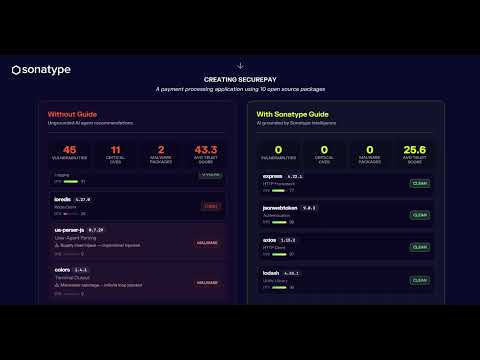
OSS Governance
Control open source risk across human-led and AI-assisted development. Sonatype Guide Enterprise helps teams define and enforce policies for vulnerabilities, malware, licenses, and component quality; continuously monitor applications for newly discovered issues; and prioritize the risks that require action. With industry-leading open source intelligence, teams have the context to make informed decisions without slowing delivery.
Agentic Dependency Management
Guide developers and AI agents toward trusted dependencies and automate the work of keeping them current. The Guide MCP Server brings policy-aware open source intelligence into AI coding assistants so teams can make better dependency decisions before risky components enter the build. Agent P continuously identifies safe upgrade opportunities, validates changes, and creates remediation pull requests to reduce manual maintenance.
Software Compliance
Maintain current, audit-ready visibility into what is inside your software. Generate, ingest, manage, and share SBOMs across your organization. Use VEX to keep vulnerability status current, and streamline license obligations and legal reviews. With continuous monitoring and centralized reporting, organizations can demonstrate software transparency across first- and third-party software and respond confidently to customer, regulatory, and audit requirements.
With Sonatype Guide Enterprise, you can:
- Set and enforce policies across vulnerabilities, malware, licenses, and component quality.
- Continuously monitor applications and prioritize newly discovered risks with actionable remediation guidance.
- Bring trusted dependency intelligence into AI coding assistants through the Guide MCP Server.
- Automate validated dependency upgrades and remediation pull requests with Agent P.
- Generate, manage, and share SBOMs and AI-BOMs; maintain VEX information; and streamline license compliance workflows.
- Manage policy waivers, including automated waivers for issues without a viable remediation path.
- Discover and govern open source in container images with continuous monitoring and policy-driven enforcement.
- Govern AI/ML models and associated open source risk, including model-level license visibility and control.
As the industry-leading software supply chain management platform and a Leader in the 2026 Gartner® Magic Quadrant™ for Software Supply Chain Security , the Sonatype Platform is the choice of organizations currently using or evaluating solutions such as Mend, JFrog, Snyk, or GitLab. Sonatype provides a comprehensive and integrated solution for all aspects of the software development lifecycle, from secure development to release automation, helping organizations reduce risk and accelerate their time to market.
Highlights
- Sonatype has analyzed 270M+ open source components and detected 1.81M+ malicious open source packages, giving teams the intelligence to govern dependency risk with confidence.
- Sonatype Guide MCP delivers a 155% security improvement over a leading AI coding assistant, helping developers and AI agents make safer dependency decisions.
- Sonatype Golden Versions reduce open source component upgrade costs by 82%, helping teams keep dependencies current with less manual effort and rework.
Details
New
Introducing multi-product solutions
You can now purchase comprehensive solutions tailored to use cases and industries.

Features and programs
Trust Center

Access real-time vendor security and compliance information through their Trust Center powered by Drata or Vanta. Review certifications and security standards before purchase.
Buyer guide
Gain valuable insights from real users who purchased this product, powered by PeerSpot.

Financing for AWS Marketplace purchases
AWS Marketplace now accepts line of credit payments through the PNC Vendor Finance program. This program is available to select AWS customers in the US, excluding NV, NC, ND, TN, & VT.

Pricing
Pricing is based on the duration and terms of your contract with the vendor. This entitles you to a specified quantity of use for the contract duration. If you choose not to renew or replace your contract before it ends, access to these entitlements will expire.
Additional AWS infrastructure costs may apply. Use the AWS Pricing Calculator to estimate your infrastructure costs.
Dimension | Description | Cost/12 months |
|---|---|---|
Sonatype Lifecycle | For One User | $931.00 |
Guide - Pro Plan | Guide Pro plan, 5000 credits included | $1,200.00 |
Dimensions summary
This listing offers two separate pricing dimensions billed under a contract. Sonatype Lifecycle prices per user, so your cost scales with the number of users you license. Guide - Pro Plan prices by plan and includes 5,000 credits, where credits track usage against dependency management activity. These dimensions are independent choices rather than ascending tiers. One scales with user count; the other bundles a fixed credit allowance into the plan. Pick based on whether you need per-user licensing or credit-based usage.
Top-of-mind questions for buyers
Credits track usage of dependency management activity across the Sonatype Guide platform. The Pro Plan includes 5,000 credits. Credits are consumed as developers and AI coding assistants make dependency decisions and run intelligence queries through the connected tools. The seller does not define a per-action credit rate in the provided data.
The Sonatype Lifecycle dimension prices for one user. Your cost scales with the number of individual user licenses you buy. Each person who needs access counts as one user. Add users by purchasing more units of this dimension.
Sonatype Lifecycle bills per user, so cost rises as you add licensed users. The Guide - Pro Plan bills by plan with 5,000 credits included, so cost ties to usage activity rather than headcount. They bill independently. Choose based on whether per-user or credit-based usage fits your team.
www.sonatype.com
Helpful?
Vendor refund policy
We do not offer refunds.
Custom pricing options
Request a private offer to receive a custom quote.

Legal
Vendor terms and conditions
Upon subscribing to this product, you must acknowledge and agree to the terms and conditions outlined in the vendor's End User License Agreement (EULA) .
Content disclaimer
Vendors are responsible for their product descriptions and other product content. AWS does not warrant that vendors' product descriptions or other product content are accurate, complete, reliable, current, or error-free.
Delivery details
Software as a Service (SaaS)
SaaS delivers cloud-based software applications directly to customers over the internet. You can access these applications through a subscription model. You will pay recurring monthly usage fees through your AWS bill, while AWS handles deployment and infrastructure management, ensuring scalability, reliability, and seamless integration with other AWS services.
Resources
Vendor resources
Support
Vendor support
Sonatype offers support Contact: https://support.sonatype.com Resources:
AWS infrastructure support
AWS Support is a one-on-one, fast-response support channel that is staffed 24x7x365 with experienced and technical support engineers. The service helps customers of all sizes and technical abilities to successfully utilize the products and features provided by Amazon Web Services.
Updated weekly
By Sonatype
By Solve DevOps
Top
25
In Software Development
Top
10
In Continuous Integration and Continuous Delivery, Application Development, Security
Top
10
In Agile Lifecycle Management, Source Control
Sentiment is AI generated from actual customer reviews on AWS and G2
Functionality
Ease of use
Customer service
Cost effectiveness
Positive reviews
Mixed reviews
Negative reviews
AI generated from product descriptions
Open Source Intelligence Database
Analysis of 270M+ open source components with detection of 1.81M+ malicious packages to provide dependency risk governance context
Policy Enforcement and Compliance
Definition and enforcement of policies across vulnerabilities, malware, licenses, and component quality with continuous application monitoring
AI-Assisted Dependency Management
Guide MCP Server integration with AI coding assistants for policy-aware open source intelligence and Agent P automation for validated dependency upgrades and remediation pull requests
Software Bill of Materials Management
Generation, ingestion, management, and sharing of SBOMs and AI-BOMs with VEX information maintenance and centralized reporting capabilities
Container and AI Model Governance
Discovery and governance of open source in container images with continuous monitoring and policy-driven enforcement, including model-level license visibility for AI/ML models
Universal Artifact Management
Support for 60+ natively supported package and file types, including ML models and generic repositories across the software supply chain.
Integrated Security Analysis
Contextual vulnerability analysis with prioritization, anti-tampering mechanisms, and signed provenance integrated across the entire software supply chain.
Software Supply Chain Visibility
Single system of record providing complete visibility and control over all software packages, data, and AI assets across the software supply chain.
Secure Distribution
Fast, secure distribution of verified multi-repository release bundles with capability to sync large-scale geo-distributed teams and accelerate deployments.
AI and ML Asset Governance
Control and governance of AI models, agent skills, and MCP servers alongside traditional artifacts within a unified platform.
Multi-Format Artifact Repository
Supports hosting and proxying Docker, Maven, npm, PyPI, Go, PHP, Python, and other artifact formats from a single platform
Role-Based Access Control
Implements role-based access controls to manage permissions for publishing, reading, and administering repositories across teams
CloudWatch Integration
Pre-configured Amazon CloudWatch agent that ships Nexus application logs, request logs, and host metrics including CPU, memory, disk, and TCP connection data to CloudWatch Logs with 30-day retention
Per-Instance Secrets Encryption
Generates unique per-instance secrets-encryption key on first boot with 256-bit random key stored in nexus.secrets.json with restricted file permissions
AWS Systems Manager Integration
Includes pre-configured SSM Agent supporting Session Manager, Run Command, Patch Manager, and Inventory capabilities for instance management
Standard contract
No
No
Customer reviews
Amal Alshehri
Automation has strengthened devsecops and has enabled faster secure releases
Reviewed on Jul 06, 2026
Review provided by PeerSpot
What is our primary use case?
Sonatype Lifecycle is basically a central use case for scanning applications in the CI/CD for vulnerabilities or non-compliant open-source dependencies and enforces policy across the dev lifecycle. It is reactive, continuous monitoring of what's already in your application. This is the benefit of it.
What is most valuable?
The benefits or features that I appreciate about Sonatype Lifecycle are that it is reactive and it supports CI/CD. There is early detection, so it will flag the vulnerabilities in the open-source dependencies straight away. Also, if you have the policies, it will automate the enforcement for you. If you have severity thresholds or you define something, it enforces them automatically in the CI/CD builds.
There is also the remediation guidance. It will give you the best version to upgrade to. It will not just flag that there is a CVE, but it will also give you recommendations on what version you need to fix to. Continuous monitoring is another benefit.
The reporting, audit and reporting is also valuable. In the dashboard, you will see the application risks reports, and security teams will look at and see what's happening with certain applications. In a nutshell, it enables faster releases and lower security exposure.
If we add Sonatype Lifecycle for Azure, it works for pipelines, and it allows you to run pipelines in the environment. You will have CI/CD, continuous integration, continuous development. People will have faster results. Instead of having DevOps, we have DevSecOps because of this. It improves security and allows teams to have security shift left from the beginning, instead of just leaving it at the end to find out this open-source library is insecure or having to rewrite the code in other ways or reuse a different library.
Sometimes changing those libraries or open-source requires a rewrite. I remember one time we had a vulnerability of some Java, and the solution was to use another Java. Using that another Java forced the developer to rewrite many components because there was a huge difference. This helps identify issues fast instead of waiting until the end to find out it is vulnerable and having to make changes.
What needs improvement?
The areas for improvement in Sonatype Lifecycle could be the UI. There is way to improve it as it has many tabs and nested sections. Sometimes when you look for something, if you are new to this, it might take you a little to get your head around things. This is something I feel they can simplify.
Also, the policy configuration is powerful, but at the same time, there is a steep learning curve. You need to make sure that you configure it correctly. You do not want to configure it in a way that blocks things.
If they improve the reporting, the UI, and the user experience, it would be beneficial. The design could be improved. If they add certain features and make it simple for the security analyst and to the user as well, it would help. Sometimes you have to look for many things to find a button that does something specific. They can do a good job fixing this.
Also, in the waiver management, it currently does not send notification. If some developer raises a waiver or adds a waiver to some component, we will not be notified. I have to go to the system to find out. This can be improved.
For how long have I used the solution?
I do not have specific information about how many years I have been aware of Sonatype Lifecycle. Probably since I am aware, maybe four or five years. I could be wrong, but this is as far as I remember.
What do I think about the stability of the solution?
It is very, very stable. I hardly had any issue with it going down or something.
What do I think about the scalability of the solution?
I think it is scalable, but being costly will make you revise what you want to do. If you have an expensive tool, you want it to work the bare minimum to cover the environment. It covers all our environment. I do not see any problem with the scalability.
How are customer service and support?
I would give the same support rating for Sonatype Lifecycle as previous products. They are the same people.
Which solution did I use previously and why did I switch?
I have not used or compared Sonatype Lifecycle to any similar products. Maybe there were tools in the past, but I was not here. This is the only thing I know.
How was the initial setup?
We did not run the installers ourselves for the installation and deployment process of Sonatype Lifecycle. We are two teams and we have another team who do the administration, the installation, and the patching. We are more from the security side. We are the policy administrators. Another team handles the installation and setup. I am not aware of any problems. We have the support from the vendor themselves, and sometimes if they need help, they get the help.
What about the implementation team?
Some developers did integrate Sonatype Lifecycle with CI/CD tools, but I am not aware of the details. I know they tried something. We use Azure DevOps mainly.
What was our ROI?
I really do not know how to quantify time or money savings from using Sonatype Lifecycle. For me to answer this, I need to be aware of everything. There are some savings, but I do not know how much. I cannot state it.
What's my experience with pricing, setup cost, and licensing?
It is expensive. It is one of the pricier SCA tools in the market. You license their developer application, and it can be expensive at scale. If you want to scale, you just need to pay more. For us, we have the IQ Server and we have the firewall, which is already another separate license. So to have all together, it is an expensive environment to run, honestly speaking. If they can do something about that, it would be beneficial.
What other advice do I have?
Automation of policy enforcement impacts my development process. You can build it in a way that stops the CI/CD itself if a library has a vulnerability or certain severity. You can be specific about things that stop the pipeline or if it has vulnerabilities or certain conditions. This helps a lot for creating security policies around applications.
Component health is very important. We can always see the health of the open-source component. It shows if it is vulnerable or not, what is the severity, is it banned, is it standard, is it not standard. The health is the same as when you say severity of something. Is it okay to be used or not?
I gave this product a review rating of 8 out of 10. Although Sonatype Lifecycle is one of the most expensive solutions at a rating of 10 for cost, it is worth the investment in certain areas. The time savings is significant because it allows the CI/CD to be more productive. Security adds complexity to development. If you develop alone, that would be different than developing with security in mind. This will ease the part of security because not everyone is aware of all security. Sometimes developers may know how to code, but they do not know how to code securely. This will save them time and provide hints and alarms. It speeds the process of adopting to security and adopting to DevSecOps. It also protects the environment because you sometimes pay for something that is valuable to secure it. In these areas, it is worth the buying, although it is costly.
SangramGupta
Integrated DevSecOps has enabled earlier risk detection and reduced remediation effort
Reviewed on May 19, 2026
Review provided by PeerSpot
What is our primary use case?
I have used Sonatype Lifecycle for one year, primarily as a part of DevSecOps and software composition analysis initiatives focused on my application security project, which involves identifying and managing open-source dependencies risks within application environments.
For Sonatype Lifecycle, I actually use it for two purposes in application security: security composition analysis (SCA) and Static Application Security Testing (SAST), with the intention to identify code-level vulnerabilities when developers write any code, allowing me to scan the code, prioritize vulnerabilities, and fix those areas to reduce overall application risks.
Before using Sonatype Lifecycle, I used to get vulnerabilities in the deployment phase, also known as Dynamic Application Security Testing (DAST), but after implementing Sonatype Lifecycle, it adds an additional security layer by allowing me to conduct SAST and SCA scans early in the coding phase, enabling me to prioritize and remediate vulnerabilities as soon as possible, which reduces time and effort.
What is most valuable?
In my opinion, the strongest feature of Sonatype Lifecycle is its ability to provide continuous visibility and governance over open-source dependencies throughout the software development lifecycle, with the most standout aspect being its effective integration of security directly into DevSecOps workflows instead of treating security as a separate, post-development activity.
The policy-based governance and vulnerable component rejection capabilities are tremendously valuable for my team because they shifted security enforcement earlier in the lifecycle. For example, I configured policies to flag or block builds with open-source components with critical vulnerabilities, and that was impactful when Sonatype Lifecycle detected a high-severity vulnerability during a build process.
Overall, Sonatype Lifecycle has a very positive impact on the organization, particularly in improving software supply chain security and DevSecOps practices, with measurable improvements including earlier detection of vulnerabilities and faster remediation cycles.
I have definitely observed measurable operational improvements after integrating Sonatype Lifecycle into my workflows, highlighted by a noticeable reduction in vulnerable open-source components progressing to production stages, allowing me to remediate them before deployment.
What needs improvement?
While Sonatype Lifecycle provides strong value for software composition analysis and software supply chain security, one area for improvement is alert prioritization and noise reduction, especially in larger development environments.
The primary area for improvement I mentioned is alert prioritization and noise reduction, in addition to improving dashboard and reporting customization.
For how long have I used the solution?
I have used Sonatype Lifecycle for one year.
What do I think about the stability of the solution?
Sonatype Lifecycle is pretty stable and works fine.
What do I think about the scalability of the solution?
In my experience, Sonatype Lifecycle scales well for enterprise DevSecOps and software supply chain security use cases, particularly in environments with multiple development teams and a large number of applications and dependencies.
How are customer service and support?
The customer support for Sonatype Lifecycle is very helpful, and they are technically sound, providing positive feedback.
Which solution did I use previously and why did I switch?
Before Sonatype Lifecycle, I used a DAST solution called Qualys for application security, and this is my first tool for SAST and SCA scans.
What was our ROI?
From my point of view, once I introduce Sonatype Lifecycle with the DevSecOps pipeline, it offers automated vulnerability scanning, prioritization, and allows me to focus on risk assessment and remediation, saving me about 40% in time and effort.
What other advice do I have?
If you are working in a DevSecOps or application security project and want to prioritize vulnerabilities early, implementing Sonatype Lifecycle in your project will be helpful in addressing risks before they escalate. I provided this review with a rating of 8.
@RahulVerma
Compliance used to slow us down. Sonatype Lifecycle turned it into an automated, streamlined step that accelerates delivery instead of blocking it.
Reviewed on Dec 07, 2025
Review provided by PeerSpot
What is our primary use case?
My main use case for Sonatype Lifecycle is open-source scanning for SCA. We pair it with Fortify (our SAST/DAST platform), and together they give us a more complete security picture within the CI/CD pipeline.
A recent example: we integrated Sonatype Lifecycle with its Nexus SCA Manager into our Jenkins workflow. Our code already went through SAST/DAST, but some smaller open-source packages and sub-libraries were not primary focus —especially those with licensing or legal considerations. Lifecycle fills that gap by checking every component for vulnerabilities, version risks, and license obligations, so we’re confident the entire codebase is covered.
We also use Lifecycle’s JSON mapping to share vulnerability and application data across Jenkins, Fortify, and other tools. What used to be a bit scattered is now clean, automated, and easy to maintain. This brings better visibility on all components across applications and versions.
How has it helped my organization?
sonatype lifecycle has helps us get clearer visibility into open-source risk, improve compliance, and catch issues earlier in the development process. By automating checks in our CI/CD pipeline, it has reduced manual effort needed by teams to deliver secure, reliable software with more confidence.
What is most valuable?
One of the best things about Sonatype Lifecycle, in my experience, is how easy it is to set up and start using. You don’t need to be a core developer to get started with it. Anyone with basic technical knowledge can create an application, assign it to an org, connect the code, and within just a few clicks generate a CycloneDX(SBOM report) or a PDF. Even integrating it with Jenkins was straightforward, and with clear and simple instruction, we had everything up and running in just a couple of days.
Sonatype Lifecycle has also made a clear positive impact on our organization. It helps us stay streamlined with open-source risks (security, license, quality). Customer in the financial, manufactoring, government and technology sectors appreciate and do value. The tool is easy to integrate, well-documented, and lightweight, which made adoption simple and required minimal resource overhead. Overall, it strengthened our software supply chain and gave management confidence in our open-source security process.
What needs improvement?
Sonatype Lifecycle already does a nice job, but as you use it, you can’t help but notice a few spots where it could feel even smoother. Imagine opening it and immediately seeing a clearer, friendlier dashboard that tells you exactly what deserves your attention without digging around. As you move through your workflow, it would be great if the tool connected more naturally with what you’re already using, so everything just flows. And when an issue pops up, instead of leaving you guessing, it could guide you through what to do next in a way that feels simple and supportive.
Even having a bit more visibility into anything happening behind the scenes would make the experience feel more complete. It’s already strong, but with touches like these, it could feel even more helpful and intuitive in everyday use.
For how long have I used the solution?
I've been using Sonatype Lifecycle for a little over two years.
What do I think about the stability of the solution?
Solution is fairly stable in terms of core functionality, and with minimal technical issues. Aside for minor resolves all goes well.
What do I think about the scalability of the solution?
Sonatype Lifecycle scales really well. Whether you are using it on-prem or the SaaS version, it is pretty easy to add more resources and handle bigger workloads as you grow. It adjusts smoothly without much hassle, so you don’t really feel limited as your team or projects get larger.
How are customer service and support?
Customer support has been quite responsive, usually getting back to us within a couple of hours. Teams are flexible to connect on criticality of issue and the assistance needed.
How would you rate customer service and support?
Positive
Which solution did I use previously and why did I switch?
We previously tried using an open-source scanner from Fortify, but eventually shifted to Sonatype Lifecycle because it offered a more complete and dependable approach for our SCA needs. There are other options in the market like Snyk and JFrog, but Lifecycle aligned better with what we were looking for in terms of accuracy, ease of use, and overall coverage.
How was the initial setup?
The initial setup was straightforward overall, and with the technical know-how and a clear understanding of the environment, the whole process moves smoothly and rather quickly.
What about the implementation team?
We have specialized consultants who are fully trained on Sonatype products and available for consultation, architecture design, and integration or deployment support. They take the time to understand each customer’s environment, which allows them to deliver solutions that truly fit the need rather than just dropping in technology.
What was our ROI?
Customer have seen a clear return on investment with Sonatype Lifecycle. Compliance scores improved, vulnerabilities dropped, and the overall workload became much lighter because we now get clear visibility into everything being built. Need for fewer people to manage the process, developers get quicker feedback, and testing team has far less manual work. Cost of running infra for the same needs went down since we’re able to run things efficiently on a single VM. All of this has saved us both time and effort in a noticeable way.
What's my experience with pricing, setup cost, and licensing?
From my experience, the licensing side is pretty straightforward to handle. Most of the cost and pricing considerations really come down to how the solution is deployed. Since we work with partners and other OEMs who help run Sonatype Lifecycle through their services, the final pricing details are usually best explained by the sales teams who manage pricing and licensing more directly.
Which other solutions did I evaluate?
I was not the deciding person on evaluating options before selecting Sonatype Lifecycle; however, the ease of adoption with sonatype to connect with existing SAST and DAST solutions was a key factor in the decision to choose Sonatype Lifecycle.
What other advice do I have?
I would rate Sonatype Lifecycle a 9/10. It’s a great product, and my main advice for anyone considering it is to take the time to understand your organisation needs get most out of this offering. Once you match the features to your goals, it really strengthens and simplifies your security process.
Which deployment model are you using for this solution?
Private Cloud
If public cloud, private cloud, or hybrid cloud, which cloud provider do you use?
Amazon Web Services (AWS)
AbhilashJain
Consistently manages artifacts with clear UI and effective cleanup
Reviewed on Apr 24, 2025
Review provided by PeerSpot
What is our primary use case?
Whenever we have builds, we upload our builds or artifacts to Sonatype Container. This is the basic purpose. Sonatype Container makes cleanup and uploading artifacts easy with its clear UI for management.
What is most valuable?
Sonatype Container is a reliable artifact manager. Although I do not have a comparison at the moment, it has consistently been a good choice for our organization. Its management features are effective, and the UI is clear, making it easy to upload and manage artifacts. Additionally, the use of Sonatype Container ensures efficient cleanup and file handling.
What needs improvement?
Sonatype Container can accommodate bigger file sizes for artifacts and improve performance, especially when dealing with large files. Moreover, the RBAC controls could be more simplified in a more human-readable language.
For how long have I used the solution?
I have been working with Sonatype Container for more than five years.
What do I think about the stability of the solution?
I would rate the stability as eight out of ten.
How are customer service and support?
Technical support from Sonatype is not much needed. I had a problem once while creating a repository when the artifacts uploaded were not showing up, but this may have been due to configuration details.
Which solution did I use previously and why did I switch?
We have been using Sonatype Container for a long stretch of time and have not tried anything else.
How was the initial setup?
The setup is simple; however, if we consider RBAC, the roles we assign to users could be simplified. The response from the roles assigned to the artifacts should be more human-readable.
What's my experience with pricing, setup cost, and licensing?
Pricing is out of my context as a developer. This is known by the project managers.
What other advice do I have?
I would rate the overall solution as eight out of ten.
Carlos Leão
Utilize a reliable BRM tool to manage software artifacts efficiently with outstanding vulnerability identification capabilities
Reviewed on Mar 24, 2025
Review provided by PeerSpot
What is our primary use case?
We use Sonatype Lifecycle primarily as a binary repository management solution for managing software artifacts. Our company has a large stack of tools for software development, and Sonatype Lifecycle is part of these tools. We use it solely for managing software artifacts without utilizing the software composition analysis or the vulnerability checking capabilities. We are expanding our clients and services as part of Digital Service of Brazil.
What is most valuable?
The most valuable feature for us is Sonatype Lifecycle's capability in identifying vulnerabilities. It has a large portfolio for vulnerability analysis, making it a leader in vulnerability checking. In comparison, the performance of other products, like JFrog's, does not reach the same level in identifying vulnerabilities. Additionally, Sonatype Lifecycle is very stable, especially in managing binary artifacts for over fifteen years with minimal problems, even with more than 700 developers working on a single node.
What needs improvement?
Both JFrog and Sonatype should redesign their products to separate the binary repository management solution from the software composition analysis solutions. We prefer to purchase the binary repository management solution independently, but they offer both together, which increases costs. This integration is good but raises the price, being a significant issue for us. We also noticed a lack of detailed information for configuring Sonatype Lifecycle for high availability and data recovery.
For how long have I used the solution?
I have used Sonatype Lifecycle for over fifteen years.
What do I think about the stability of the solution?
Sonatype Lifecycle is very stable, especially in the binary repository management use case for managing binary artifacts. We have not experienced any significant issues over the fifteen years of use.
What do I think about the scalability of the solution?
Both Sonatype and JFrog have solutions for high availability and data recovery, but Sonatype is more complex to configure. JFrog is easier to configure for high availability as it does not require extra components. It handles high availability at the database level, such as synchronizing JFrog repository servers without complicated configurations.
How are customer service and support?
We use Sonatype Lifecycle in its open-source software edition, so we do not have experience with their customer service or technical support.
What's my experience with pricing, setup cost, and licensing?
According to my calculations, if you are working with up to 200 developers, Sonatype is cheaper than JFrog. However, for larger numbers like our case with 1,000 user licenses, JFrog becomes much more cost-effective, roughly ten times cheaper than Sonatype. Their licensing models are different, impacting the price depending on the number of developers.
Which other solutions did I evaluate?
I compared Sonatype Lifecycle with JFrog Artifactory and Xray.
What other advice do I have?
Overall, I would rate Sonatype Lifecycle a nine out of ten.