
Sold by: cloudimg
Deployed on AWS
Free Trial
AWS Free Tier
This product has charges associated with it for seller support. Production-ready MySQL AMI with enforced password auth, dedicated data volume, and unique credentials generated per instance. Backed by 24/7 cloudimg support with one-hour response.
Overview
Image
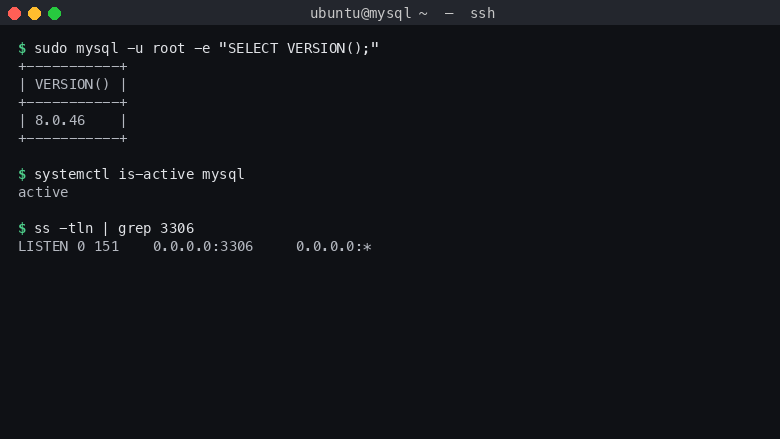
MySQL server version and status
Image
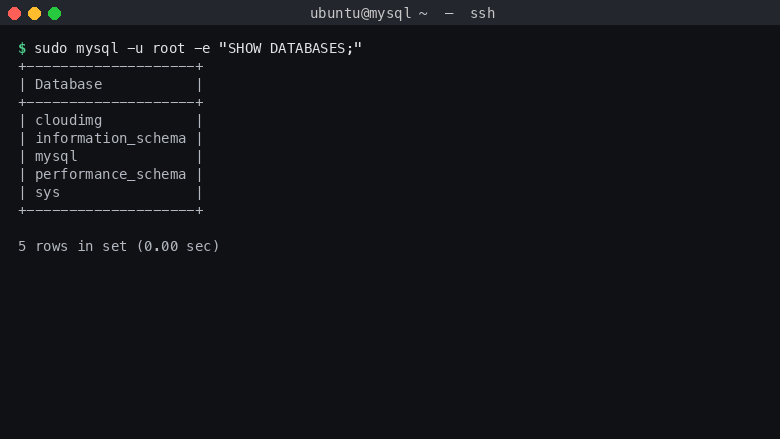
Databases on the new instance
Image
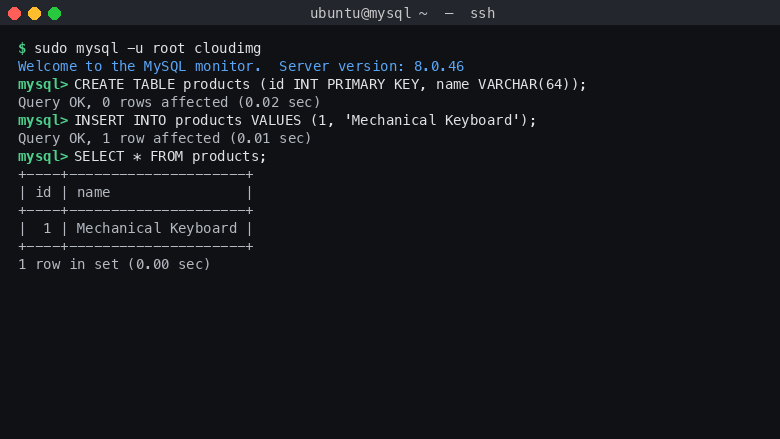
SQL round trip on the cloudimg database
This is a repackaged open source software product wherein additional charges apply for cloudimg support services.
Overview
MySQL Community Server is the world's most popular open source relational database. This cloudimg AMI delivers a fully hardened, production-ready MySQL instance that accepts connections within minutes of launch - no manual package installation, repository configuration, or credential setup required. Unlike default MySQL images that ship with blank root passwords or shared credentials, this image enforces authentication from the first second and isolates database storage on its own volume for independent management.
Why Choose This Image Over Alternatives
Many marketplace MySQL AMIs place data on the root EBS volume, making independent snapshots and resizing impossible. Others ship with static default credentials shared across every deployment, creating a security liability. This cloudimg image eliminates both risks by generating unique credentials per instance and mounting all MySQL data on a dedicated, independently resizable volume.
What Is Included
- MySQL Community Server installed from the official MySQL APT repository
- InnoDB storage engine configured and optimized
- Standard utilities and the mysql command-line client preconfigured
- MySQL daemon enabled and auto-starting at boot
- Single-workload image with no competing processes - lean and predictable
Secure First Boot
On first boot, a one-shot service initializes a fresh data directory, generates a strong random root password and a separate cloudimg admin user password unique to that instance, creates the cloudimg database, and writes credentials to a file readable only by the root OS user. No anonymous logins, no remote root access, no test database, and no shared default credentials. The secure caching_sha2_password authentication plugin is used throughout.
Data On Its Own Volume
MySQL data, transaction logs, and binary logs reside on a dedicated EBS volume mounted at the MySQL data directory. This separation means you can grow storage independently, take point-in-time snapshots without affecting the OS disk, and schedule backups on their own cadence - critical for multi-tenant SaaS applications that rely on nightly snapshot-based recovery.
AWS Integration Points
- Amazon CloudWatch - Monitor MySQL metrics including connections, query throughput, and disk utilization by installing the CloudWatch agent on the instance
- Amazon S3 - Export logical backups or binary logs to S3 for durable, cost-effective long-term retention
- AWS Systems Manager - Manage patching, run commands, and maintain inventory across your MySQL fleet
- Security Groups - Control access to the standard MySQL port (3306) from specific application subnets
Use Cases
- Multi-tenant SaaS back ends - The dedicated data volume supports nightly EBS snapshots for per-tenant recovery, while unique-per-instance credentials prevent cross-environment credential leakage across staging and production
- E-commerce platforms - The hardened authentication model fits PCI-scoped checkout services where no anonymous database access is permitted; compatible with platforms such as WordPress WooCommerce, Magento, and custom Laravel or Django applications
- OLTP transactional workloads - InnoDB row-level locking and ACID compliance handle concurrent order processing and inventory management
- Reporting and operational analytics - Binary log replication enables read replicas for analytics queries without impacting production write performance
Getting Started
- Launch the AMI on a t3.medium or larger instance with a security group allowing SSH (port 22) from your IP
- SSH into the instance and read the generated credentials: cat /root/.credentials
- Connect to MySQL: mysql -u root -p
- Create your schemas, users, and tables
- Open port 3306 in your security group from your application subnet to allow application connections
cloudimg Support
24/7 technical support by email and live chat with a one-hour average response time for critical issues. Our engineers assist with MySQL deployment, replication setup, high-availability architecture, schema design, performance tuning, and ongoing database administration. To discuss your deployment requirements before purchasing, contact our team for a guided setup consultation.
All product and company names are trademarks or registered trademarks of their respective holders. Use of them does not imply any affiliation with or endorsement by them.
Highlights
- MySQL Community Server preinstalled and ready, running with the InnoDB engine and the standard mysql command line client, with no manual package or repository setup required
- Password authentication is enforced by default and a fresh root password plus a separate cloudimg admin password are generated for every instance on first boot and stored in a file only the root user can read
- MySQL data lives on a dedicated, independently resizable storage volume, and 24/7 technical support from cloudimg covers deployment, replication, performance tuning and database administration
Details
Sold by
Categories
Delivery method
Delivery option
64-bit (x86) Amazon Machine Image (AMI)
Latest version
Operating system
Ubuntu 24.04
Deployed on AWS
New
Introducing multi-product solutions
You can now purchase comprehensive solutions tailored to use cases and industries.

Features and programs
Financing for AWS Marketplace purchases
AWS Marketplace now accepts line of credit payments through the PNC Vendor Finance program. This program is available to select AWS customers in the US, excluding NV, NC, ND, TN, & VT.

Pricing
Free trial
Try this product free for 7 days according to the free trial terms set by the vendor. Usage-based pricing is in effect for usage beyond the free trial terms. Your free trial gets automatically converted to a paid subscription when the trial ends, but may be canceled any time before that.
Pricing is based on actual usage, with charges varying according to how much you consume. Subscriptions have no end date and may be canceled any time. Alternatively, you can pay upfront for a contract, which typically covers your anticipated usage for the contract duration. Any usage beyond contract will incur additional usage-based costs.
Additional AWS infrastructure costs may apply. Use the AWS Pricing Calculator to estimate your infrastructure costs.
If you are an AWS Free Tier customer with a free plan, you are eligible to subscribe to this offer. You can use free credits to cover the cost of eligible AWS infrastructure. See AWS Free Tier for more details. If you created an AWS account before July 15th, 2025, and qualify for the Legacy AWS Free Tier, Amazon EC2 charges for Micro instances are free for up to 750 hours per month. See Legacy AWS Free Tier for more details.
Dimension | Description | Cost/hour |
|---|---|---|
m5.large Recommended | m5.large | $0.08 |
t2.micro | t2.micro instance type | $0.04 |
t3.micro | t3.micro instance type | $0.04 |
m5a.large | m5a.large instance type | $0.08 |
r5dn.24xlarge | r5dn.24xlarge instance type | $0.24 |
c8ine.xlarge | c8ine.xlarge instance type | $0.12 |
m5ad.xlarge | m5ad.xlarge instance type | $0.12 |
m6idn.32xlarge | m6idn.32xlarge instance type | $0.24 |
m7i.2xlarge | m7i.2xlarge instance type | $0.24 |
p3dn.24xlarge | p3dn.24xlarge instance type | $0.24 |
Vendor refund policy
Refunds available on request.

Legal
Vendor terms and conditions
Upon subscribing to this product, you must acknowledge and agree to the terms and conditions outlined in the vendor's End User License Agreement (EULA) .
Content disclaimer
Vendors are responsible for their product descriptions and other product content. AWS does not warrant that vendors' product descriptions or other product content are accurate, complete, reliable, current, or error-free.
Delivery details
64-bit (x86) Amazon Machine Image (AMI)
Amazon Machine Image (AMI)
An AMI is a virtual image that provides the information required to launch an instance. Amazon EC2 (Elastic Compute Cloud) instances are virtual servers on which you can run your applications and workloads, offering varying combinations of CPU, memory, storage, and networking resources. You can launch as many instances from as many different AMIs as you need.
Version release notes
Remediates flagged CVEs: full apt update (kernel + userspace); rng-tools added.
Additional details
Usage instructions
Connect via SSH on port 22 as the default login user for your operating system variant (the user guide lists it per variant). MySQL Community Server listens for the MySQL wire protocol on 0.0.0.0 port 3306 on the instance itself; open a security group rule from your application subnet to allow remote access. Retrieve the generated root password with: sudo cat /root/mysql-credentials.txt. Open the mysql client locally with: sudo mysql -u root. The user guide explains how to create databases, users and grants and how to connect from a remote application tier.
Resources
Vendor resources
Support
Vendor support
cloudimg provides 24/7 technical support for this MySQL Community Server AMI via email and live chat.
Response Times
- Critical issues (database down, data at risk): one-hour average response
- General inquiries (configuration, tuning, replication setup): handled during the same business day
What Support Covers
- Initial deployment and instance sizing guidance
- MySQL replication and high-availability configuration
- Schema design and query performance tuning
- Security hardening and credential management
- Volume expansion and backup strategy
- Troubleshooting connectivity, performance, and configuration issues
- Assistance with updates and version upgrades
Getting Started After Purchase
- Launch the AMI on a t3.medium or larger instance
- SSH in and retrieve credentials from /root/.credentials
- Connect with mysql -u root -p and begin creating schemas
- Open port 3306 in your security group from your application subnet
If you need help at any stage - from initial deployment through production scaling - contact our team at support@cloudimg.co.uk . For refund requests or billing questions, use the same email address and include your AWS instance ID for faster resolution.
AWS infrastructure support
AWS Support is a one-on-one, fast-response support channel that is staffed 24x7x365 with experienced and technical support engineers. The service helps customers of all sizes and technical abilities to successfully utilize the products and features provided by Amazon Web Services.
Similar products

This product has charges associated with it for seller support. Migrate from CentOS 8 EOL to Alma Linux 8 in under 60 seconds with zero licensing fees. 1:1 RHEL 8 compatible, AWS-optimized, backed by 24/7 support with guaranteed 24hr response SLA.

This product has charges associated with it for seller support. Production-ready LAMP stack for developers and agencies hosting WordPress, e-commerce, or PHP apps on AWS - pre-configured with Apache, MySQL/MariaDB, and PHP with24/7 expert support.

This product has charges associated with it for seller support. Deploy a production-ready MariaDB database on Windows Server in minutes. Pre-configured with Galera Cluster, CloudWatch, and SSM - backed by cloudimg 24/7 support with guaranteed 24hr response.

This product has charges associated with it for seller support. Production-ready MariaDB on EC2 with secure auto-provisioning and 24/7 expert DBA support from cloudimg - no manual setup required.
Customer reviews
No customer reviews yet
Be the first to review this product . We've partnered with PeerSpot to gather customer feedback. You can share your experience by writing or recording a review, or scheduling a call with a PeerSpot analyst.