Sold by: Neo4j
Deployed on AWS
Neo4j Aura offers a graph database-as-a-service for uncovering data patterns. Explore flexible pricing and scale your innovation.
4.3
Overview
Image
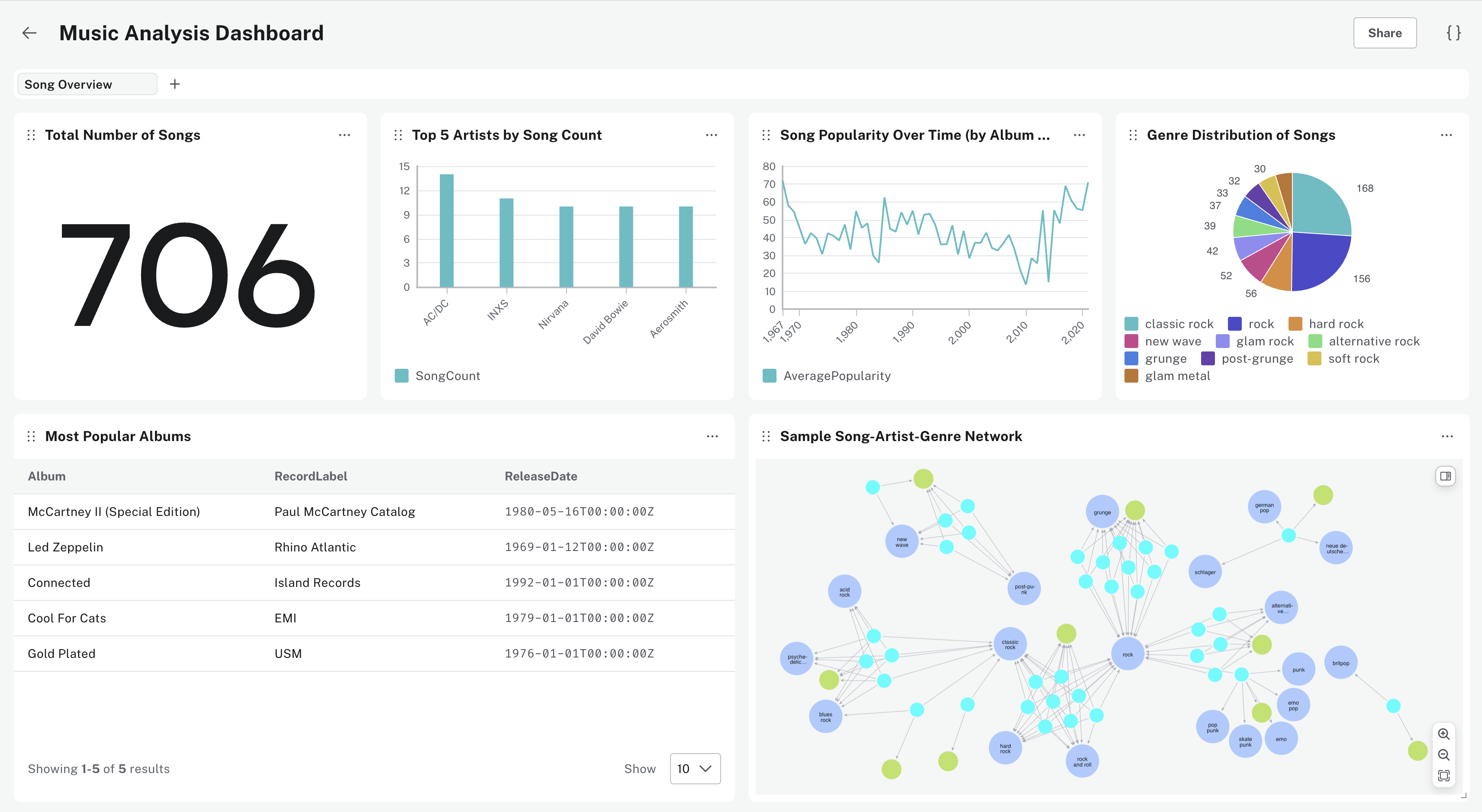
No-Code Visualizations
Image
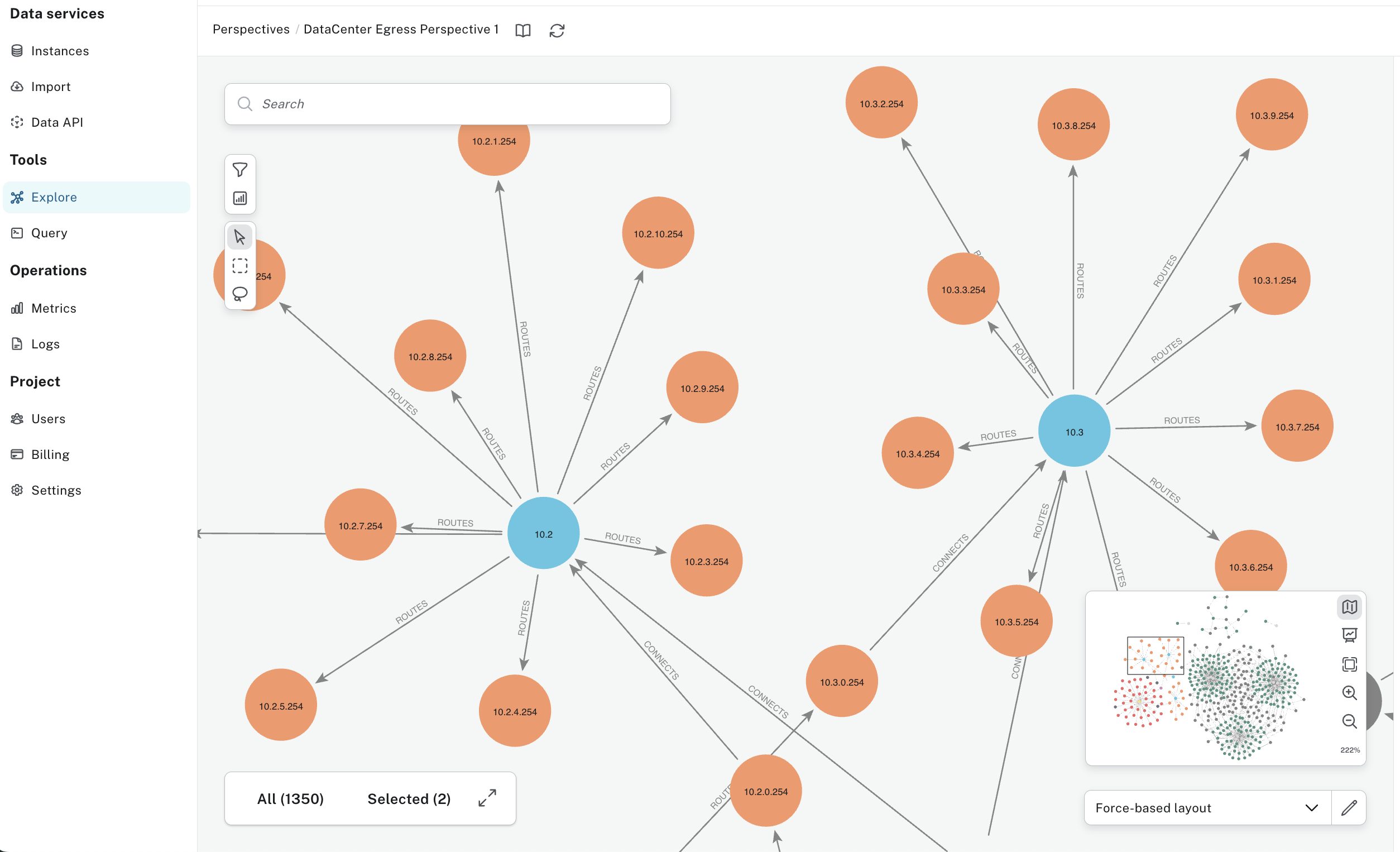
Network Management

Image
Graph Algorithms

Video
Neo4j Aura Overview

Video
Product video
Neo4j is the leading graph database and analytics platform, helping organizations uncover hidden patterns and relationships across connected data. Neo4j AuraDB is a fully managed, secure, and highly available cloud graph database built for modern applications and GenAI. It enables enterprises to turn connected data into knowledge assets that drive better decisions across use cases such as fraud detection, customer 360, supply chain optimization, recommendations, and knowledge graphs.
AuraDB helps organizations ground AI in real business context by supporting knowledge graphs, GraphRAG, and agentic AI systems that reason over relationships, not just keywords or vectors. By combining native graph storage, vector search, graph analytics, and visualization in one unified platform, AuraDB makes it easier to build more accurate, contextual, and explainable AI-powered applications.
- Fully managed and always on: Provision in minutes, scale on demand, and reduce operational overhead with automated updates and maintenance
- Built for connected intelligence: Use native graph technology to uncover patterns, trace relationships, and power real-time decision-making
- Supports modern AI architectures: Build knowledge graphs, accelerate GraphRAG, and support agentic AI with connected business context
- Integrated analytics and visualization: Combine graph queries, advanced analytics, and visual exploration to move from raw data to insight faster
- Enterprise-grade security and reliability: Benefit from encryption, high availability, and advanced controls designed for production workloads
- Flexible consumption model: Pay as you go with transparent pricing that scales with your needs
- Expert support: Access Neo4j expertise, proactive monitoring, and guidance to keep critical applications running smoothly**
To inquire about annual commitments or other deployment options, including self-managed Neo4j, contact us marketplace-sales@neo4j.com .
For more information about Neo4j Aura plans, visit https://neo4j.com/pricing .
Highlights
- Fully Managed Graph Platform: Build and scale modern applications and AI solutions with a fully managed graph database service that minimizes operational overhead.
- Built for Connected Intelligence: Uncover patterns and relationships across connected data with native graph technology designed for knowledge graphs, GraphRAG, and advanced analytics.
- Global Scale and Availability: Deploy confidently across multiple regions with a secure, highly available service built for production workloads.
Details
New
Introducing multi-product solutions
You can now purchase comprehensive solutions tailored to use cases and industries.

Features and programs
Trust Center

Access real-time vendor security and compliance information through their Trust Center powered by Drata or Vanta. Review certifications and security standards before purchase.
Buyer guide
Gain valuable insights from real users who purchased this product, powered by PeerSpot.

Financing for AWS Marketplace purchases
AWS Marketplace now accepts line of credit payments through the PNC Vendor Finance program. This program is available to select AWS customers in the US, excluding NV, NC, ND, TN, & VT.

Pricing
Pricing is based on actual usage, with charges varying according to how much you consume. Subscriptions have no end date and may be canceled any time.
Additional AWS infrastructure costs may apply. Use the AWS Pricing Calculator to estimate your infrastructure costs.
Dimension | Description | Cost/unit |
|---|---|---|
Aura usage (in ACU) | Aggregated Aura usage expressed in Aura Consumption Units (ACU) | $0.01 |
Dimensions summary
This listing uses a single usage-based dimension. You pay for aggregated Aura usage measured in Aura Consumption Units (ACU). There are no fixed tiers or instance sizes to select here. Instead, your cost tracks your actual resource use over time. As you provision more capacity or run more workload, your ACU total rises, and your bill rises with it. When you scale down or pause a database, your consumption drops, and charges fall accordingly. This pay-as-you-go structure means you are billed only for what you consume, with no upfront commitment.
Top-of-mind questions for buyers
An ACU reflects the database capacity you provision and run. Your provisioned memory size and how long it runs both feed into ACU totals. Storage, input/output, backups, and data transfer are included in the provisioned capacity price, so they add no separate charges.
When you pause a database, running costs drop sharply, and your ACU consumption falls accordingly. Your data and backups stay stored securely while paused. You resume with one click. Charges track active, provisioned capacity, so pausing lowers what you pay.
You add or reduce capacity in the console without service interruption. Larger provisioned capacity raises your ACU consumption and your bill. Reducing capacity lowers both. Metering is hourly, so cost changes track the capacity you run at any given time.
www.neo4j.com
Helpful?
Vendor refund policy
All fees are non-cancellable and non-refundable except as required by law.
Custom pricing options
Request a private offer to receive a custom quote.

Legal
Vendor terms and conditions
Upon subscribing to this product, you must acknowledge and agree to the terms and conditions outlined in the vendor's End User License Agreement (EULA) .
Content disclaimer
Vendors are responsible for their product descriptions and other product content. AWS does not warrant that vendors' product descriptions or other product content are accurate, complete, reliable, current, or error-free.
Delivery details
Software as a Service (SaaS)
SaaS delivers cloud-based software applications directly to customers over the internet. You can access these applications through a subscription model. You will pay recurring monthly usage fees through your AWS bill, while AWS handles deployment and infrastructure management, ensuring scalability, reliability, and seamless integration with other AWS services.
Resources
Vendor resources
Support
Vendor support
Neo4j Support:
AWS infrastructure support
AWS Support is a one-on-one, fast-response support channel that is staffed 24x7x365 with experienced and technical support engineers. The service helps customers of all sizes and technical abilities to successfully utilize the products and features provided by Amazon Web Services.
Similar products
Fully-managed, always-on graph database as a service for intelligent, context-driven applications using connected data sets. Built on the battle-tested Neo4j graph platform, Aura offers a scalable and reliable service with advanced security, built-in visualization and developer tools.
The most trusted, secure, and globally deployed graph database. At real-world scale, you get no-compromise performance, reliability, and data integrity.
The most trusted, secure, and globally deployed graph database. At real-world scale, you get no-compromise performance, reliability, and data integrity.
VeloDB Cloud: The Real-Time Analytical Database Built for Analytics and AI.
VeloDB Cloud is the fully managed, cloud-native real-time analytical database powered by Apache Doris - the fastest open-source OLAP engine trusted by 5,000+ enterprises worldwide. Deliver sub-second analytics, hybrid search, and AI-ready data infrastructure from a single unified platform.
Customer reviews
Pauline Bernat
Creating detailed waterway knowledge graphs has supported our digital twin research platform
Reviewed on Apr 21, 2026
Review provided by PeerSpot
What is our primary use case?
My main use case for Neo4j AuraDB is to create a knowledge graph with data that represents a waterway network and infrastructure. I get the data from sources such as URIs or OpenStreetMap and create a knowledge graph that allows me to connect waterway sections together and link infrastructures such as bridges, locks, and terminals to these sections. I also have a knowledge graph to represent vessels, barges, and other vessels that navigate these waterways. Each vessel can be represented as individual components that form the vessel, whether it is the hull, the propulsion system, the energy system more generally, the cargo type, the route, and the itinerary that the vessel will take can also be represented in a knowledge graph.
What is most valuable?
The best features Neo4j AuraDB offers include being fairly easy to use once you are familiar with Cypher, which I was not when I started. For me, the most useful feature is the rapidity with which I can extract shortest paths and relationships between nodes. I have used it with very long Cypher queries, and I find that quite confusing. My preferred method is to gather bigger datasets with shorter Cypher queries and then narrow it down.
The rapid extraction of shortest paths and relationships is a key feature, and it is particularly useful because Neo4j AuraDB currently acts as the data repository behind a digital twin platform for the static data, not for the live data or the dynamic state of the rivers, but really for the static features that form the modeling structure. It is convenient to quickly access the skeleton of the model whenever a user wants to run something live.
Neo4j AuraDB has impacted my organization positively as it was extremely useful to prototype the knowledge graphs for this digital twin platform. Because I work in different organizations within a consortium for a European project, I needed to create a minimum viable product to demonstrate to partners before integration to the digital twin platform that this approach could work. I used Neo4j AuraDB to benefit from the free access for sharing with partners outside my organization and for sharing the basic knowledge graph that I wanted to implement into the digital twin platform. This gave them access to the data, and it helped a few partners extract the data they needed and learn about Cypher at both small and large scales. I created a manual at some point with a few go-to Cypher queries to extract the data they needed. There was one small caveat in that I needed to reactivate it every seven days, which was not particularly convenient. It was good for prototyping and confirming that this was what we wanted. It was beneficial because people user tested the knowledge graph, told me what they could find, what they could not find, and what relationship was ambiguous so I could improve the overall taxonomy or the overall ontology underlying the knowledge graph before we moved into using a Neo4j instance on a virtual machine that could be linked to the digital twin platform.
What needs improvement?
One small thing that could improve Neo4j AuraDB is that the limited size of the free tier is not necessarily a problem. It is somewhat slower than when you have your own Neo4j desktop application, but it is still quite performant. For me, the thing that was the most painful is the seven-day expiration where you need to reactivate or restart it. That was perhaps the only thing that I found frustrating.
I cannot give a perfect score because of this inconvenience of the seven-day reset. I would also appreciate the ability to share credentials in a confidential way so we could share a session that would be convenient. Additionally, it would be nice to have better access to historical query Cypher statements that were tested or examples of Cypher, which I believe nowadays with AI would be absolutely doable. Providing the user with suggestions and explanations of what the Cypher would mean would be helpful. Neo4j AuraDB is a very good initiation or way for someone new to knowledge graphs to become familiarized with them, but it is a lot to take in, especially if you come from SQL where everybody says it is an easy transition, but in fact it is not exactly the same approach. It would be interesting to have some examples. I would also appreciate better explanations when errors occur or when syntax is wrong. It is typically quite generic in what is wrong about it. If there was a way to get more information, that would be helpful.
For how long have I used the solution?
I have been using Neo4j AuraDB for a year and a half.
What do I think about the stability of the solution?
Neo4j AuraDB is absolutely stable.
What do I think about the scalability of the solution?
Regarding Neo4j AuraDB's scalability, my experience with scaling up my data or adding new users is that the free tier was good enough to give access to a few people pending the seven-day expiration limit.
How are customer service and support?
I never interacted with customer support. I never had the need to.
Which solution did I use previously and why did I switch?
I did not use a different solution previously. Until now, I never had to deal with relationship databases. It was always very static, so that was my first time dealing with a knowledge graph.
How was the initial setup?
I did not have any experience with pricing, setup costs, and licensing because I did not purchase Neo4j AuraDB.
What about the implementation team?
As for the deployment of Neo4j AuraDB in my organization, because it was not my organization but another organization that dealt with the deployment, I understand that Neo4j itself was private. The GraphQL and Apollo server were made available via a public link. No one can actually directly access the knowledge graph, but they can query from it and mutate it via an Apollo server.
What was our ROI?
I have not seen a return on investment because for us it was not about money since it was really a research-funded project. All I can say is that this offered a way for a few partners to access data and to eventually create a platform that is meant to be accessible by a greater pool of stakeholders.
What's my experience with pricing, setup cost, and licensing?
I did not have any experience with pricing, setup costs, and licensing because I did not purchase Neo4j AuraDB.
Which other solutions did I evaluate?
Before choosing Neo4j AuraDB, I do not think I evaluated other options. I do not recall looking into anything else. Neo4j AuraDB came as a quick way to share the data. What I started doing actually was building my own Neo4j on my desktop application. Neo4j AuraDB came as a way to share it with external partners.
What other advice do I have?
I would recommend playing with the databases locally first.
I am grateful for the free tier, as it gave me an opportunity to share early projects with others without any incurred costs. I suggest adding a progression bar for the interview so the interviewee knows how long or how far they are in this process. I understand it is not necessarily obvious because it depends on the question asked, but there were some reactive questions, which is always good, but it would be nice to see a bar to know how far one is in the interview process. My overall rating for Neo4j AuraDB is eight out of ten.
Satish Annavar
Graph modeling has powered complex relationship queries and now supports flexible cloud workflows
Reviewed on Apr 17, 2026
Review provided by PeerSpot
What is our primary use case?
My usual use case for Neo4j AuraDB is as a graph database tool to model relationships between components in our BOM system. This allows us to efficiently query complex relationships, which is especially important for our AI and features that we integrated in our BOM system.
How has it helped my organization?
The positive impact and benefits that I have seen from using Neo4j AuraDB include its suitability for easy setup and scalability without managing infrastructure, as well as the flexibility for improvement.
What is most valuable?
From a DevOps perspective, the features and capabilities of Neo4j AuraDB that I have found most valuable include the straightforward provisioning of the AuraDB instance. I used Terraform automated setup, and it required minimal code with a module provided to make it quick and efficient. Additionally, we explored the startup credit program and secured $16,000 in credits, which significantly reduced our initial cost.
Regarding scalability, Neo4j AuraDB offers different instance sizes, and we can scale after initial setup. For example, if we already set up an instance with 2GB RAM and 4 core CPU, we can scale it in the future if we require more resources. There is also a feature that allows us to pause the instance when we are not using it, making it cost-effective when it is running.
What needs improvement?
In my opinion, there are areas of Neo4j AuraDB that could be improved or enhanced due to some limitations. I have noticed a lack of flexibility in plugins, as we could not install some custom plugins, which restricts some advanced use cases. Additionally, Neo4j AuraDB only supports a single database per instance, and we could not create multiple databases within the same instance, which significantly increases infrastructure overhead. Cost is another factor to consider, as Neo4j AuraDB can be relatively expensive and resource-intensive compared to some alternatives.
For how long have I used the solution?
I have been working with this solution for two years.
What do I think about the stability of the solution?
The stability and reliability of Neo4j AuraDB have been very good. It is a managed service with a 99.95% SLA, so the stability is impressive. I have not faced any outages when the product stopped working abruptly during my tenure of one and a half years.
How are customer service and support?
I have communicated with the technical support of Neo4j AuraDB very rarely. Based on my limited experience, the impression of the technical support is that they were seeking solutions. While they were not able to guarantee the addition of multiple instances soon, they mentioned they are planning to add that feature. However, they did not provide any specific timeline for implementation.
Which solution did I use previously and why did I switch?
Before Neo4j AuraDB, I used a different solution by self-hosting Neo4j in our managed clusters. I decided to switch from the previous solution because it was a tedious task to manage. It was very resource-intensive and the startup was challenging, so we moved to managed Neo4j AuraDB.
How was the initial setup?
I participated in the initial setup of Neo4j AuraDB. The process for me involved requirements like credentials. We needed to generate our credentials as a user, and we had a specific Neo4j module in Terraform created by Neo4j. We used that module, updated our values based on our requirements, enabled the necessary features, and disabled those we were not using, such as analytics. We triggered the provisioning using Terraform commands like init and apply, created the instance, and monitored the instance creation using the Neo4j Aura console. I found the initial setup process of Neo4j AuraDB very straightforward.
What was our ROI?
Regarding return on investment with AuraDB, I did not see any return.
What's my experience with pricing, setup cost, and licensing?
We explored the startup credit program and secured $16,000 in credits, which significantly reduced our initial cost.
Which other solutions did I evaluate?
Other than Neo4j AuraDB, we have not evaluated other options or solutions because we had a specific requirement from our AML engineers to use Neo4j.
What other advice do I have?
Overall, I rate Neo4j AuraDB as a product an 8.5 out of 10.
Ali Nasser
Graph-based property insights have boosted personalized recommendations and response speed
Reviewed on Apr 12, 2026
Review provided by PeerSpot
What is our primary use case?
I used Neo4j AuraDB for building a graph in which I listed properties and the properties of these properties, such as the bedrooms, bathrooms, and whether it is a new or old home. I also made nodes for people who own these properties and used this information.
Neo4j AuraDB helped us in building the recommendation system for our project in which we have nodes of people and nodes of properties and use easy links between those properties and people, enabling us to recommend specific properties to specific people dependent on their preferences.
We set the recommendation system as if a user likes properties with two bedrooms and one bathroom. We make a Cypher query that filters properties he liked with two bedrooms and one bathroom. Then we look for another recommendation for him such as properties with three bedrooms or one bathroom or three bedrooms and three bathrooms.
In this project, approximately 1,000 users use it daily now for recommendations, in which they enter the system and we generate a Cypher query for them and display properties from the project depending on this.
What is most valuable?
Building the graph easily is the best thing that Neo4j AuraDB offers. Also, navigating the graph and navigating from one node to another was very helpful. The GUI of Neo4j AuraDB and how I can look at the schema of the graph was a very helpful feature.
In the interface of Neo4j AuraDB, I can watch the schema of my graph, in which I can choose some nodes and the GUI draws these nodes, so I can see the graph with my eyes and do some edits to it or use it as it is.
The speed of recommendation really increased after we converted the first graph we had to a Neo4j AuraDB graph. We had the speed initially at about 5 to 10 seconds. Now we have the speed from 1 to 5 seconds. The response time of navigating Neo4j AuraDB graph reduced from 5 to 10 seconds in some cases to 1 to 5 seconds in most of the cases.
For how long have I used the solution?
I have been using Neo4j AuraDB for two and a half years. The last time I used Neo4j AuraDB was three months ago, in which I built a graph using Neo4j nodes.
What do I think about the stability of the solution?
Neo4j AuraDB is very stable.
What do I think about the scalability of the solution?
It is very scalable as we now handle about 1,000 users each day with our graph in Neo4j AuraDB, and it works very well.
How are customer service and support?
They are very helpful.
I will rate the customer support a 10 as they helped us in most of the cases. I think that our calls take too long now as I was expecting this call to continue from 5 to 10 minutes, but now we have about 15 minutes.
Which solution did I use previously and why did I switch?
We were using a solution that was built on my company. Neo4j AuraDB solution was built on a data structure in which we build a graph by a data structure graph and we use all things in this graph. This was built in my company locally, so it does not have all the required features and is different from Neo4j AuraDB.
Which other solutions did I evaluate?
We did not see any other solutions.
What other advice do I have?
If you have a graph that you need to build, you can use Neo4j AuraDB directly and not navigate any other solution as this solution has all required things. I rate this product a 9 overall.
Rajveer Mathur
Graph-based knowledge has streamlined interconnected support queries and improves debugging
Reviewed on Apr 05, 2026
Review provided by PeerSpot
What is our primary use case?
My main use case for Neo4j AuraDB is solving problems with the documentation adhering to what we have on the chatbot for problem solving. These documentations are of Microsoft Surface Laptop, and there are multiple problems over there, but they are all interconnected. This interconnection of documents or rather sites of problem can be done in a more sufficient way. In the conventional RAG way, it was problematic because there was no connection between two problems. However, with Neo4j AuraDB, a problem is connected. There are hyperlinks in one documentation which leads to another documentation. This is where Neo4j AuraDB, which has the graph capabilities to connect two segments or two documentations, was very beneficial.
Neo4j AuraDB helped me tackle those interconnected documentation challenges by making things much faster. Each of the nodes I define in the graph is one documentation. The connections, these relationships were simpler when it comes to graph architecture because, for example, one problem would be blue screen. The solution to it would be restarting your laptop or if your device hardware is damaged. All these two connections were given to two other nodes. We have a map out of it. The number of nodes decreased at a very huge level when it comes to the conventional way. With Neo4j AuraDB, documentation and adding things were very easy because the UI is very exploratively helpful.
Regarding my use case with Neo4j AuraDB, something I want to add is that if we go the conventional way, there were a lot of conventions because the first problem which the customer comes in and adds to the chatbot could be anything. Then the next problem would be L2 level. Then, anything coming in interaction could be L3 level. In the conventional way, it was going very redundant. There was no connection to it. However, in Neo4j AuraDB, it was a graph, so the number of documentation and the number of storage was very much decreased at a very huge level. The connections were very logical. Backtracking of things was very much helpful because we were able to see that in level three, when the customer went for an answer like restarting your laptop, then why they came down to this ladder of graph or nodes from L2 and then L1. This was helping us to backtrack the solution and maybe debug things. This was where a few of the challenges we faced from the conventional and helped us to push our things to Neo4j AuraDB.
How has it helped my organization?
Neo4j AuraDB has positively impacted my organization with specific outcomes or improvements. I may not be able to answer on the organizational level because I am on the development side of it, but a specific outcome or improvement that I have noticed while using Neo4j AuraDB is that if you find your data on which you are working is interconnected, those chunks, which we call chunks in RAG, are a set of data and a set of NLP lines which we generally retrieve or add into the vector embedding. If we find things that are interconnected and those interconnections are meaningful, then Neo4j or graph architecture is something that is very much beneficial. Neo4j would be a pioneer of this technology online, giving us a free tier to explore and enjoy and understand things at a much higher level. On the organizational level, if this would not have been in place, which I am speaking for Neo4j AuraDB, then things would have prolonged in more efforts plus line level. We may have spent more time on development things, which are very much futile and not fruitful to us. However, Neo4j helped us decrease our development time and also the storage level, which was very much helpful.
In sharing metrics around the reduction in development time or storage with Neo4j AuraDB, mentioning exact numbers would be unfair to my current organization. For development time, the development time is reduced by around forty to fifty percent because in the conventional way, development involved getting up with a system that understood this type of data where connections also meant something. Neo4j was a platform itself where we just feed in data. That is another feature to it, that we can just feed in data, and it tries to understand itself with the use of AI. That is the feature which helped us to decrease at this magnitude of time. In terms of storage, it helped us around twenty percent because it was removing redundant places. In the conventional way, we had to duplicate a few things for more functioning, but as the architecture changed, we went to something faster. Caching of non-duplicate was something we were doing in the conventional way, but with Neo4j, we now have a very good amount of search time. Development time decreased, as well as on the customer front, the query time also decreased.
What is most valuable?
The best features Neo4j AuraDB offers, the best feature which stands out is the exploration and the UI which comes up. We can drag and drop, we can see what things are there, what nodes are connected to whom in a visual way. It is more understandable to people who are from the business side and non-technical side, who are not able to understand the query itself. We were able to explain things to them with the UI itself. This is one of the features. The second thing is the visualization of the graph, which is really helpful to make others understand what was happening and to backtrack things. The generative AI feature to create the Cypher query languages is valuable because CypherQL is not something which everybody is well-versed with. With the generative AI part to it, it was really helpful that we explain what we want, and it creates an easier level of query languages which goes there. Those features are valuable in day-to-day life because whenever we have a review with the tech team or our client, those graphs, when things get to backtracking of the solution, are very much helpful with the visualization, understanding them, understanding the problem, and how things went in. Debugging was very helpful.
In day-to-day life, the testing team found the generative AI query formation very helpful because then anybody can become an expert on the Cypher query language, which was embedded into the AuraDB interface. That was very helpful, and nobody has to go anywhere else to query or give intricate security details there to generate a query onto other platforms rather than in here itself. We can give what we want, and this used to generate our query languages. We were very much so secured that the data resides there and only we are asking questions.
Regarding the features of Neo4j AuraDB, another point I would like to add is that they offer a free tier. Even before we start off with client billing and everything, we were able to explore those things. We were able to understand that the documentation is really helpful in these places. They also provide us with some sample data so that we can play around with the graph architecture and understand how things are working around in the free tier. That is very much important. These were a few features that we like. The agent is a very new feature I am trying to explore, but not on this use case. However, the agent is something which I can see can be helpful for more business type of use cases where we add what we want.
What needs improvement?
If I say so, how Neo4j AuraDB can be improved, at a very minute level, I can say that the graphs, if I want things to be in three dimensions. Currently we get them in two dimensions. When we scale this up, the maps become complicated, and in two dimensions things can be complex in visualization purposes. When we put in filters, the connections also vanish sometimes. The visualization side is something that could help. Additionally, if there is a voice search capability, which we can implement, that would add more functionality. With so much AI involved, AI could be helpful if we put in our data and enable it to give insights from the networks already developed in the graph. Some insights could be shown to our client, indicating that their data already contains meaningful insights, which could serve an analytical purpose. Voice search on the graph would be easily understandable and provide faster outputs to the customer.
For how long have I used the solution?
I have been using Neo4j AuraDB for the past two years, but on a very minimal level, primarily for research purposes. It has been here and there, but I have been in touch with AuraDB.
What other advice do I have?
What advice would I give to others looking into using Neo4j AuraDB? First, please know how your data reacts, how your data is interconnected, and how your data moves around the other data in itself. What is the subset and the superset of each other? How can you manage your data? If you have this level of information, then this is the go-to-market solution for you. Second, if you are currently using conventional databases or other systems, you need to understand how graphs work. You have to work to comprehend this concept, and then come to this solution; it would be very helpful because this solution has some documentation and a learning curve. Do your homework before coming to this stage of work.
If you know your data and the connection between your data has meaning and you see that those meanings can be helpful in understanding your data, this is a perfect solution.
Qazi Ahmad
Managed graph queries have transformed real-time recommendations and dependency mapping
Reviewed on Apr 03, 2026
Review from a verified AWS customer
What is our primary use case?
My main use case for Neo4j AuraDB is building recommendation and dependency mapping systems. For example, one of the projects involves using the model to establish relationships between users and products to generate personalized recommendations in real time. In another project, I am mapping dependencies between microservices and APIs to identify potential bottlenecks or failure points. Neo4j AuraDB's graph structures and queries make it easier to manage complex relationships compared to other databases.
I have been using Neo4j AuraDB for about two years. I first started with Neo4j as a community edition for local prototyping, then moved to Neo4j AuraDB for production workloads because of the fully managed setup and seamless integration with AWS. Over that time, I have used it mainly for building recommendation systems and dependency mapping features, where graph queries significantly improved performance compared to other relational models.
How has it helped my organization?
Neo4j AuraDB has had a positive impact on our organization by significantly reducing our infrastructure and maintenance overhead, allowing our team to focus more on product deployment and data modeling rather than managing servers or scaling issues. From a business perspective, it has improved the performance of our recommendation and dependency mapping systems, which directly enhances user experience and reliability. The query response time has decreased, and overall, Neo4j AuraDB has increased our deployment speed, improved system stability, and lowered operational costs, making our entire database stack more efficient and scalable.
What is most valuable?
In my opinion, the best features of Neo4j AuraDB are its fully managed environment, the Cypher query language, and the visualization tools. The managed setup saves considerable DevOps time since we do not have to worry about clustering, backups, and patching. Cypher is very intuitive for working with complex relationships, making it easy to express graph traversals that could be complicated in SQL. The visualization tools are also excellent for debugging and understanding data relationships.
Additionally, Neo4j AuraDB's seamless integration with AWS and its ability to scale automatically make it ideal for production workloads without manual infrastructure management. The fully managed environment is the feature that has made the biggest difference for our team. Before using Neo4j AuraDB, we spent considerable time maintaining clustering and backups and managing updates manually. With Neo4j AuraDB, all of that is automated, allowing us to focus entirely on the deployment and optimization of our graph instead of worrying about infrastructure. It has also improved reliability; we no longer have to deal with downtime for patching or scaling issues. The managed setup ensures consistent performance during automatic traffic spikes, especially during recommendation queries.
I would also mention that the managed environment gives us peace of mind with automatic backups and security updates, ensuring our data is always protected and compliant without extra effort from our side. The performance consistency across environments from development to production has also been reliable. Overall, it has allowed us to focus on delivering new features instead of maintaining infrastructure.
What needs improvement?
Neo4j AuraDB is a very strong platform, but there are a few areas for improvement. The pricing model can be somewhat unpredictable as your database grows, since costs scale with node and relationship counts. More transparency or cost estimation tools would be helpful. Additionally, importing large datasets should be smoother; bulk data sometimes requires extra tuning or batching to avoid timeouts. The documentation is good overall, but it would benefit from including more real-world production examples and best practices for optimized Cypher queries and scaling patterns. Lastly, on the lower-tier plans, the cold start time can be frustrating during production, so improving the setup speed would enhance the developer experience.
One improvement that would make daily work easier is having better monitoring and performance analytics directly in the Aura dashboard. Currently, we rely on external tools and custom scripting to track query performance and resource usage. Having native, real-time insights would help us quickly identify slow queries or inefficient patterns. Additionally, smoother integration with our CI/CD pipelines would be beneficial, such as an easy way to manage schema migrations or automatically seed data, which would make our development and testing process more efficient. These small enhancements could streamline our workflow.
For how long have I used the solution?
I have been working in my current field for almost four years. I work specifically in backend development. During that time, I have focused on scaling backend systems, native cloud-native programming, and integrating and managing different databases. I am experienced in designing APIs and microservices on different technology stacks.
What other advice do I have?
My advice for others considering Neo4j is to clearly identify where their data model truly benefits from graph relationships. If your application involves complex connections such as recommendations, dependencies, or network analysis, Neo4j AuraDB is an excellent choice. Take advantage of the managed services to save DevOps time while also monitoring your node and relationship counts to keep cost predictions in check. I also recommend investing time in learning Cypher properly; it is intuitive once you become accustomed to it and makes querying relationships very powerful. Finally, use the visualization tools early in deployment; they are great for understanding your data structure and debugging relationships. I would rate this product a nine out of ten.