
Sold by: cloudimg
Deployed on AWS
Free Trial
AWS Free Tier
This product has charges associated with it for seller support. Production-ready Kiwi TCMS AMI for open source test case management: organise test plans, test cases and test runs, track executions and requirements, and integrate with your bug tracker. Every application secret and a strong admin password are generated uniquely on first boot. Backed by 24/7 cloudimg support.
Overview
Image
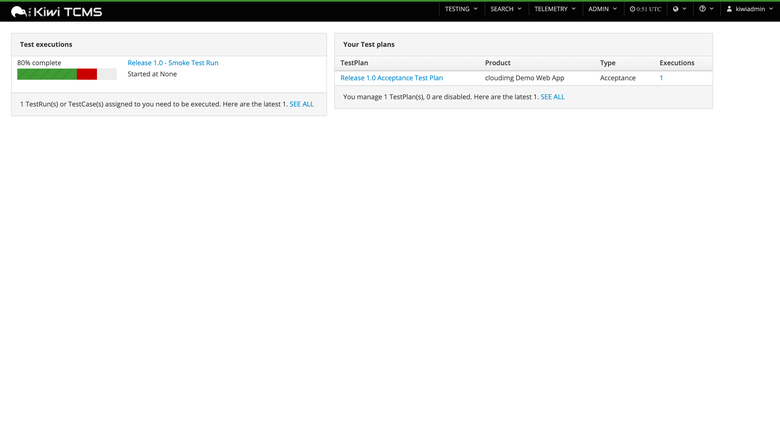
Kiwi TCMS dashboard
Image
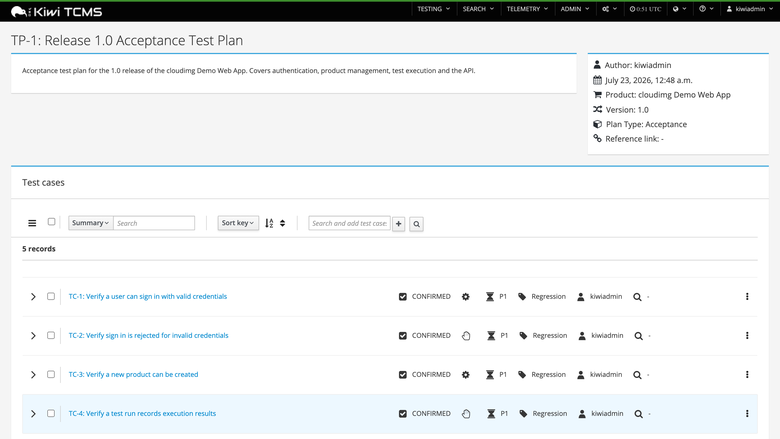
Test plan with test cases
Image
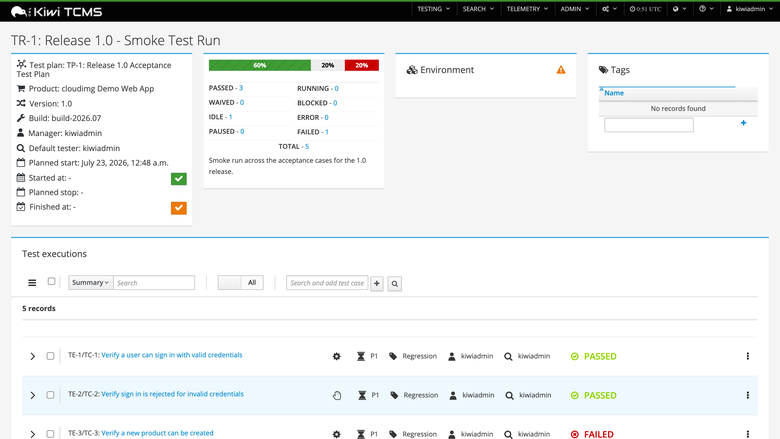
Test run execution results
This is a repackaged open source software product wherein additional charges apply for cloudimg support services.
Overview Kiwi TCMS is a mature, open source test case management system used by QA and engineering teams to plan, organise and track manual and automated testing. This image delivers Kiwi TCMS fully installed and running as the official Docker Compose topology, so a working test management console is serving over HTTPS within minutes of launch.
Why This Image Instead of Self-Deployment Deploying Kiwi TCMS from the upstream repository requires wiring the Compose stack, generating a Django secret key, configuring the database, provisioning TLS, disabling open self-registration and integrating everything with systemd. This image removes that operational burden: every component is pre-configured and tested, all secrets and a strong administrator password are generated automatically on first boot, stateful data lives on a dedicated resizable disk, and the full stack starts on boot via systemd behind an nginx TLS front door.
Application Stack The appliance runs the official Kiwi TCMS Compose topology: the Kiwi web application (a Django app served by Apache and mod_wsgi) and a MariaDB database. The database is kept on the internal container network with no externally reachable port. Host nginx terminates TLS on port 443 with a per-instance self-signed certificate and reverse-proxies to the application; plain HTTP on port 80 redirects to HTTPS. The database volume and the uploads volume are relocated onto a dedicated, independently resizable data disk kept separate from the operating system disk.
Plan, Execute and Track Testing Kiwi TCMS organises testing into products, test plans and test cases, and records execution results across test runs. Track requirements, link findings to your bug tracker, capture history and comments on every case, and use the built-in reporting and telemetry to communicate testing progress and coverage to your team. A full API is available for automation and CI/CD integration.
Secure First Boot No shared or default password ships in the image, and there is no built-in default administrator account. On the first boot of your instance a one-shot service generates a fresh Django secret key, a fresh database password and a strong, unique administrator username and password, provisions a per-instance TLS certificate, initialises an empty database, disables public self-registration, and records the administrator credentials in a file that only the root user can read. Every instance is independent.
Ready To Use Retrieve the generated administrator credentials over SSH, open the console in your browser over HTTPS, and sign in to create your first product and test plan. The REST and JSON-RPC API is available for automating test result submission from your pipeline.
Use Cases QA teams centralise manual test plans, cases and execution runs in a single system of record with history, requirements traceability and reporting. Engineering teams submit automated test results from CI/CD pipelines through the Kiwi TCMS API and correlate them with manual testing coverage. Compliance-driven teams keep an auditable record of what was tested, by whom and with what outcome across releases.
cloudimg Support 24/7 technical support by email and chat. Our engineers help with deployment, TLS and custom domain configuration, bug-tracker and API integration, backup and storage planning, and scaling the stack.
All product and company names are trademarks or registered trademarks of their respective holders. Use of them does not imply any affiliation with or endorsement by them.
Highlights
- Open source test case management ready in minutes: launch this image and have a production-ready Kiwi TCMS console serving over HTTPS, eliminating the manual Docker Compose wiring, secret generation, database configuration, TLS provisioning and systemd integration that self-deployment from the upstream repository requires
- Organise test plans, test cases and test runs, track executions and requirements, keep full history on every case, integrate with your bug tracker, and automate test result submission from CI/CD through the REST and JSON-RPC API, with built-in reporting and telemetry to communicate coverage and progress
- Zero-trust security from first boot: no default administrator account ships, and every instance generates its own unique admin credentials, Django secret key, database password and TLS certificate automatically, with public self-registration disabled and the database kept off any external port. Stateful data lives on a dedicated, independently resizable disk, backed by 24/7 cloudimg support
Details
Sold by
Categories
Delivery method
Delivery option
64-bit (x86) Amazon Machine Image (AMI)
Latest version
Operating system
Ubuntu 24.04
Deployed on AWS
New
Introducing multi-product solutions
You can now purchase comprehensive solutions tailored to use cases and industries.

Features and programs
Financing for AWS Marketplace purchases
AWS Marketplace now accepts line of credit payments through the PNC Vendor Finance program. This program is available to select AWS customers in the US, excluding NV, NC, ND, TN, & VT.

Pricing
Free trial
Try this product free for 7 days according to the free trial terms set by the vendor. Usage-based pricing is in effect for usage beyond the free trial terms. Your free trial gets automatically converted to a paid subscription when the trial ends, but may be canceled any time before that.
Pricing is based on actual usage, with charges varying according to how much you consume. Subscriptions have no end date and may be canceled any time. Alternatively, you can pay upfront for a contract, which typically covers your anticipated usage for the contract duration. Any usage beyond contract will incur additional usage-based costs.
Additional AWS infrastructure costs may apply. Use the AWS Pricing Calculator to estimate your infrastructure costs.
If you are an AWS Free Tier customer with a free plan, you are eligible to subscribe to this offer. You can use free credits to cover the cost of eligible AWS infrastructure. See AWS Free Tier for more details. If you created an AWS account before July 15th, 2025, and qualify for the Legacy AWS Free Tier, Amazon EC2 charges for Micro instances are free for up to 750 hours per month. See Legacy AWS Free Tier for more details.
Dimension | Description | Cost/hour |
|---|---|---|
m5.large Recommended | m5.large | $0.08 |
t2.micro | t2.micro instance type | $0.04 |
t3.micro | t3.micro instance type | $0.04 |
c5a.12xlarge | c5a.12xlarge instance type | $0.24 |
c5a.16xlarge | c5a.16xlarge instance type | $0.24 |
c5a.24xlarge | c5a.24xlarge instance type | $0.24 |
c5a.2xlarge | c5a.2xlarge instance type | $0.24 |
c5a.4xlarge | c5a.4xlarge instance type | $0.24 |
c5a.8xlarge | c5a.8xlarge instance type | $0.24 |
c5a.large | c5a.large instance type | $0.08 |
Vendor refund policy
Refunds available on request.

Legal
Vendor terms and conditions
Upon subscribing to this product, you must acknowledge and agree to the terms and conditions outlined in the vendor's End User License Agreement (EULA) .
Content disclaimer
Vendors are responsible for their product descriptions and other product content. AWS does not warrant that vendors' product descriptions or other product content are accurate, complete, reliable, current, or error-free.
Delivery details
64-bit (x86) Amazon Machine Image (AMI)
Amazon Machine Image (AMI)
An AMI is a virtual image that provides the information required to launch an instance. Amazon EC2 (Elastic Compute Cloud) instances are virtual servers on which you can run your applications and workloads, offering varying combinations of CPU, memory, storage, and networking resources. You can launch as many instances from as many different AMIs as you need.
Version release notes
Initial release of Kiwi TCMS as a ready-to-use open source test case management appliance running the official Docker Compose stack behind an nginx TLS front door, with all secrets and a strong administrator account generated on first boot, public self-registration disabled, and the database and uploads on a dedicated data disk.
Additional details
Usage instructions
Connect via SSH on port 22 as the default login user for your operating system variant (for the Ubuntu 24.04 variant the user is ubuntu). Retrieve the per-instance administrator credentials with: sudo cat /root/kiwi-tcms-credentials.txt. Open the console in a browser at https://<instance-public-ip>/ (the image uses a per-instance self-signed certificate, so accept the browser warning) and sign in with the generated administrator username and password. Plain HTTP on port 80 redirects to HTTPS on port 443. The Kiwi TCMS Docker Compose stack lives under /opt/kiwi-tcms and its stateful volumes are on a dedicated data disk mounted at /var/lib/kiwi-tcms. The database is on the internal container network only and is not reachable externally. The stack runs under systemd: systemctl status kiwi-tcms.service and sudo docker compose -f /opt/kiwi-tcms/compose.yaml --env-file /opt/kiwi-tcms/.env ps. The security group opens ports 22, 80 and 443.
Resources
Vendor resources
Support
Vendor support
cloudimg provides 24/7 technical support for this product by email and live chat. Our engineers help with deployment, configuration, updates, performance tuning and troubleshooting; critical issues receive a one hour average response. Contact support@cloudimg.co.uk .
AWS infrastructure support
AWS Support is a one-on-one, fast-response support channel that is staffed 24x7x365 with experienced and technical support engineers. The service helps customers of all sizes and technical abilities to successfully utilize the products and features provided by Amazon Web Services.
Similar products

Amazon Web Services is a wild world of over 200 services and growing, each with its nuances around usage and cost. Your company has a number of applications, with different features and requirements in terms of security, scalability, reliability, and availability. It’s not an easy task to map your application and business needs to what can be done with the cloud. We are here to help with that.
The official Rocky Linux 10 image with LVM

ops0 is a cloud security platform. It discovers what's running across AWS, Kubernetes, and other cloud providers, scores risk, and generates infrastructure-as-code to fix it. Powered by Kiwi, our AI engine, ops0 brings unmanaged resources under management and enforces policy at design time to stop drift. Fix and govern your cloud from one platform. SOC 2 Type II compliant.

This product has charges associated with it for seller support. Deploy a secure by default Ergo IRC server in minutes: a single self-contained Go binary with built-in account and channel services, native TLS and message history, running under systemd. A unique operator password and TLS certificate are generated on first boot, with no shared credentials. Backed by 24/7 cloudimg support.
Customer reviews
No customer reviews yet
Be the first to review this product . We've partnered with PeerSpot to gather customer feedback. You can share your experience by writing or recording a review, or scheduling a call with a PeerSpot analyst.