AWS Public Sector Blog
Transforming Public Sector Procurement with Agentic AI on AWS
Public sector procurement is one of the most complex operational processes in government, but the technology supporting it hasn’t kept pace with its progress. Agencies manage dozens of systems built independently over decades, resulting in data silos, inconsistent portals, and excessive manual effort spent on document creation, compliance verification, and cross-referencing regulations.
Intelligent agents can now autonomously handle regulation-heavy tasks while maintaining human oversight at every decision point. This post explores how an agentic AI architecture on Amazon Web Services (AWS) modernizes the procurement lifecycle from solicitation to proposal evaluation while maintaining compliance with government regulations including United States of America FAR (Federal Acquisition Regulation), United States of America DFARS (Defense Federal Acquisition Regulation), and Canadian procurement frameworks (Public Service Procurement Canada (PSPC) /Shared Services Canada (SSC).
What is an agentic procurement solution?
An agentic procurement solution is a serverless, multi-agent AI platform where intelligent agents can reason, plan, and act autonomously within defined boundaries. Unlike rigid automation, agents seek information, make contextual decisions, and collaborate to complete complex workflows. Key outcomes include:
- Automated solicitation generation through multi-stage, human-in-the-loop (HITL) workflows
- AI-powered proposal evaluation with comparative and single-mode scoring
- Retrieval Augmented Generation (RAG)– Department grounded responses eliminate hallucination through mandatory citation
- Regulation-aware compliance considering FAR/DFARS and Canadian PSPC/SSC at every stage
- Intelligent data discovery that connects to data wherever it resides on premises, in the cloud, or across external sources
Solution architecture: A four-layer serverless platform
The solution below shows how Amazon components and Agentic frameworks come together to solve a business requirement around Procurement
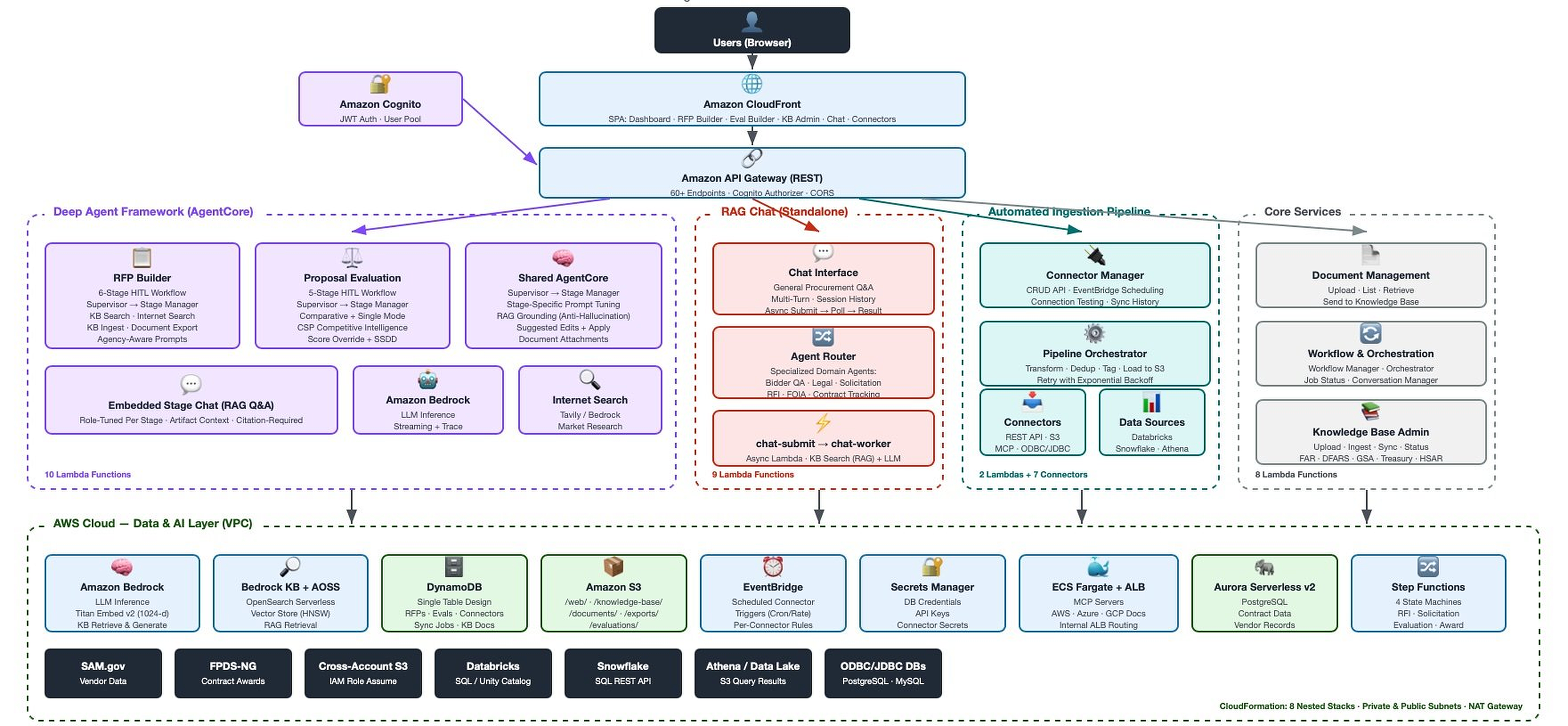
Figure 1: Agentic Procurement System Architecture Overview
Figure 1 illustrates the end-to-end architecture of the Agentic Procurement System across four purposefully designed layers as explained below:
- Layer 1 (End User Facing Front End): Edge & Auth – Amazon CloudFront with AWS Shield for DDoS protection. Amazon Cognito JWT auth (zero anonymous access). Amazon API Gateway as the unified entry point.
- Layer 2: Deep Agent Framework – Amazon Bedrock AgentCore manages agent lifecycle and routing through a Supervisor Agent to Stage Manager pattern. The Stage Manager injects role-tuned prompts, performs RAG grounding, and coordinates LLM generation.
- Layer 3: Serverless Compute – AWS Lambda functions for chat, workflow coordination, compliance, document management, evaluation, and specialized agents. Scales to zero on idle.
- Layer 4: Data & AI – Polyglot persistence within a more secure and private Amazon Virtual Private Cloud (Amazon VPC).
The table below describes the Amazon Service and how it is used within the solution:
| Service | Role |
|---|---|
| Amazon Bedrock | LLM inference + Titan Embed v2 (1024-dim embeddings) |
| Amazon OpenSearch Serverless | HNSW vector index for semantic search |
| Amazon DynamoDB | Single-table design for all application state |
| Amazon Aurora Serverless v2 | PostgreSQL for relational contract data |
| AWS Step Functions | Workflow orchestration |
| Amazon S3 | Frontend hosting, knowledge base docs, exports, uploads |
The entire platform spans 60+ API endpoints and operates fully serverless, enabling scaling while optimizing costs.
Multi-agent workflows: Human-in-the-loop by design
The following section describes how a deep / sub agent framework and agentic workflow is used with the RFx builder workflow. This workflow is used to create a comprehensive Request for Proposal type artifact.
RFx Builder: Six agentic workflow stages
The RFx Builder implements a six-stage workflow where the Supervisor Agent creates the RFP record and delegates each stage to the Stage Manager Agent for execution:
- Requirements analysis – Analyzes mission needs, generates structured requirements
- Market research – Researches relevant vendors, industry benchmarks, and competitive landscape
- Technical criteria – Drafts evaluation criteria and technical requirements with industry-standard language
- Legal and compliance framework – FAR/DFARS clauses are automatically identified and mapped. For U.S. Department of Housing and Urban Development (HUD) procurements, enforces Section 3 compliance floors, (National Environment Policy Act) NEPA screening gates, Davis-Bacon Act requirements, and appropriations-rider checks
- RFP document assembly – Assembles all sections into a cohesive solicitation document with cross-references
- Final review and export – Produces the finished document with full traceability and compliance certification
Each stage employs role-based AI personas. (For example, the Compliance Agent cites specific FAR parts; the Market Research Agent references historical contracts.) A procurement officer reviews, edits, and approves the requirements before advancement to next stage. The system is agency-aware: HUD procurements trigger specialized overlays for fair housing, Section 3, and HUD Acquistion Regulation (HUDAR) clause analysis.
The following section describes how a deep / sub agent framework and agentic workflow is used with the Evaluation builder workflow. This workflow is used to create a comprehensive evaluation for a single or multiple proposals received by the Agency.
Evaluation Builder: Five-stage assessment pipeline
The Evaluation Builder provides a structured, five-stage assessment pipeline that guides evaluators from initial criteria definition through final source selection. It combines AI-powered scoring with human oversight, agency-specific customization, and competitive intelligence via Model Context Protocol (MCP) servers to produce documented, defensible procurement decisions.
- Evaluation setup and criteria – Define evaluation parameters, scoring methodology, and weighted factors (supports agency-specific preset criteria with adjectival rubrics)
- Compliance check – Verify bidder proposals against mandatory requirements with pass/fail matrix. For HUD, auto-flag bidders missing Section 3 plans
- Technical evaluation – AI-powered per-bidder scoring with adjectival ratings and rationale per factor, grounded in KB citations
- Price and custom criteria – Cost realism analysis, custom scoring factors, and trade-off analysis with comparative and single-mode assessment
- Final ranking and SSDD – Composite scoring and automated generation of the source selection decision document with full audit trail
The Scoring Agent supports score override with mandatory rationale capture. When a human evaluator disagrees with the AI’s assessment, the system requires a written rationale that becomes part of the permanent evaluation record. This satisfies requirements for documented, defensible source selection decisions. Competitive intelligence using Model Context Protocol (MCP) servers provides additional context for technology evaluations.
Agentic development on AWS: Framework flexibility
AWS provides flexibility for agentic development. The AWS Strands Agents SDK offers a cloud-based approach with built-in tool use, agent cards for capability discovery, and orchestration patterns. Organizations can equally use LangGraph, CrewAI, or AutoGen on AWS with Amazon Bedrock as the inference backbone. Key patterns include:
- Agents as tools – Hierarchical delegation where specialized agents serve as callable tools for orchestrator agents
- Workflows – Sequential handoffs preserve enriched context across stage boundaries
- Swarms – Collaborative problem-solving through autonomous agent teams
- Graph – Directed Acyclic Graph (DAG)-based deterministic control for complex compliance decision trees
RAG architecture: Helping maintain accuracy in regulated environments
A hallucinated regulatory reference could invalidate an acquisition. The RAG architecture implements strict anti-hallucination controls:
- Retrieval-before-generation – Mandatory Knowledge Base (KB) retrieval before generation. If no relevant passages exceed the confidence threshold, the agent searches external sources or explicitly acknowledges the gap.
- Citation enforcement – Inline regulatory clause citations with post-generation validation against the knowledge base.
Four specialized Amazon Bedrock Knowledge Bases maintain authoritative procurement information:
| Knowledge Base | Content |
|---|---|
| Contract KB | Historical contract data, templates, and recommended practices |
| Policy KB | FAR, DFARS, HUDAR, Section 3, Davis-Bacon, Canadian PSPC/SSC |
| Product KB | Catalog information, pricing data, and market intelligence |
| Process KB | Workflow definitions, SOPs, and decision frameworks |
Semantic search uses Titan Embed v2 (1024-dim vectors) on Amazon OpenSearch Serverless with Hierarchical Navigable Small World (HNSW) indexing. Automated ingestion pipelines continuously update the knowledge bases.
Intelligent data discovery: Meeting data where it lives
Seven connector types enable ingestion without requiring a pre-built data lake:
- REST APIs – External government platforms and procurement databases
- Amazon S3 – Cloud storage document ingestion
- MCP – Cloud provider docs and external tools using Amazon Elastic Container Service (Amazon ECS) and AWS Fargate
- ODBC – Traditional relational databases, including legacy on-premises systems
- Databricks – Analytics platform integration
- Snowflake – Data warehouse connectivity
- Data lake – Existing data lake architectures
Amazon EventBridge schedules automated ingestion (extract – tag – deduplicate – chunk – sync). Agencies don’t need to consolidate data: Agents find it wherever it lives.
Security: Built for government standards
The solution is architected to meet government security standards through a defense-in-depth approach across network, identity, data, and infrastructure layers. It enforces zero trust networking, least-privilege access, encryption at rest, centralized secrets management, high availability, infrastructure as code, and DDoS protection to ensure a secure, auditable, and resilient operating environment.
- Zero trust – No direct internet inbound to compute; Amazon VPC with private subnets and NAT Gateway for controlled outbound
- IAM least privilege – Each AWS Lambda instance has a dedicated role with minimum required permissions
- Encryption at rest – S3 SSE, Amazon DynamoDB encryption, and Amazon OpenSearch Service across all data stores
- AWS Secrets Manager – Manages all credentials centrally; zero hardcoded secrets
- Multi-Availability Zone – Active-active configuration across two Availability Zones for high availability
- Infrastructure as Code – Full AWS CloudFormation templates (eight nested stacks) enabling repeatable, auditable deployments
- DDoS protection – Amazon CloudFront with AWS Shield integration
Observability: Agent transparency at scale
OpenTelemetry (OTEL)-compatible instrumentation with Amazon SageMaker MLflow for experiment tracking:
- Full trace capture – Inputs, outputs, tool invocations, and LLM calls using OTEL spans
- Experiment tracking – Compare agent versions, model configurations, and prompt strategies through Amazon SageMaker with MLflow
- GenAI evaluations – Safety, relevance, and fluency scoring using LLM-as-a-judge patterns
- Drift monitoring – Detect when KB content or model behavior shifts from baselines
- Reasoning trace – Structured records for audit trail agency resolution, overlay decisions, KB citations
Getting started
- Identify high-volume workflows – Focus on repetitive tasks such as solicitation generation or proposal evaluation
- Inventory existing data sources – Map data across on-premises, legacy, and cloud systems
- Define governance boundaries – Establish agent autonomy limits and HITL approval gates
- Start with a pilot – A single workflow stage demonstrates value while managing risk
- Scale incrementally – Add agents, KB content, and connectors as confidence grows
Conclusion
By combining Amazon Bedrock foundation models with multi-agent orchestration on AWS, organizations can build intelligent ecosystems that reduce manual effort, improve compliance accuracy, and accelerate cycle times while maintaining the human oversight that mission-critical operations demand.
Data doesn’t need to be centralized in advance. Agents can find it wherever it lives through seven connector types. Compliance is embedded in every interaction through RAG-grounded, citation-required responses. Human judgment remains central; every workflow stage requires explicit approval before advancing. Structured reasoning traces provide full explainability and accountability.
While this post demonstrates the pattern through procurement, the same architecture applies to any regulation-heavy, document-intensive business process, such as healthcare claims, financial compliance, legal review, or supply chain management.