Sold by: Trend Micro
Deployed on AWS
Security that's built for DevOps to automatically defend your AWS workloads and simplify compliance. Pay per instance starting at $0.01/hour. Proactive protection of elastic workloads against threats, malware and vulnerabilities.
4.1
Overview
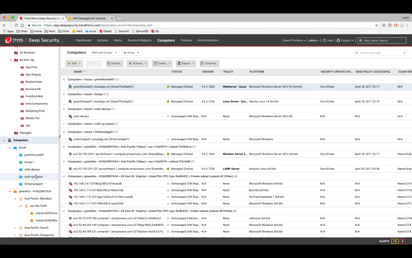
Video
Video 1
Video
Video 2
Security built to fit DevOps with robust API's and automated protection. Lock down servers with Application Control, protect Docker containers, and increase malware protection with behavioral analysis, and predictive machine learning. Get proactive protection for EC2 workloads with Trend Micro Deep Security. Secure hybrid environments with the Deep Security AMI and pay hourly per workload protected. Buy and deploy a Deep Security AMI and protect your physical, virtual or cloud resources with an agent or our industry leading virtual appliance, and pay for it all on your AWS bill.
Defend against threats, malware and vulnerabilities with a single product. With protection, starting at just $0.01 / hour, you can: Defend your network against attack with host-based intrusion detection and prevention; Stop patching live systems by shielding from vulnerability exploits; Protect Windows and Linux workloads from malware; Streamline the last mile of compliance with File and System Integrity Monitoring; and, get alerts about potential security events in system logs.
BYOL and SaaS versions of Deep Security are also available.
Security tips & tricks and technical resources available at <www.trendmicro.com/aws > or email us at aws.marketplace@trendmicro.com with any questions.
Highlights
- Secure Docker containers with DevOps friendly API security processes including automation security and lock down servers with application control built for the cloud.
- Accelerate compliance and streamline audit evidence gathering with a single security tool that delivers IPS, Application Control, Anti-malware, Predictive Machine Learning, Integrity Monitoring, Log Inspection, and Content Filtering.
- Prevent network threats and proactively protect against zero-day exploits with Intrusion Detection and Prevention (IDS/IPS).
Details
Sold by
Categories
Delivery method
Delivery option
AWS Quick Start - Trend Micro Deep Security
64-bit (x86) Amazon Machine Image (AMI)
Latest version
Operating system
AmazonLinux 2023
Deployed on AWS
New
Introducing multi-product solutions
You can now purchase comprehensive solutions tailored to use cases and industries.

Features and programs
Buyer guide
Gain valuable insights from real users who purchased this product, powered by PeerSpot.

Financing for AWS Marketplace purchases
AWS Marketplace now accepts line of credit payments through the PNC Vendor Finance program. This program is available to select AWS customers in the US, excluding NV, NC, ND, TN, & VT.

Pricing
Pricing is based on actual usage, with charges varying according to how much you consume. Subscriptions have no end date and may be canceled any time.
Additional AWS infrastructure costs may apply. Use the AWS Pricing Calculator to estimate your infrastructure costs.
Dimension | Cost/host/hour |
|---|---|
Any Micro, Small or Medium EC2 instance types | $0.01 |
Any Large EC2 instance types | $0.03 |
Any Xlarge or larger EC2 instance types | $0.06 |
Other Cloud - 1 Core | $0.01 |
Other Cloud - 2 Cores | $0.03 |
Other Cloud - 4+ Cores | $0.06 |
Data Center | $0.06 |
Amazon Workspace | $0.01 |
Vendor refund policy
We do not currently support refunds, but you can cancel at any time.
Custom pricing options
Request a private offer to receive a custom quote.

Legal
Vendor terms and conditions
Upon subscribing to this product, you must acknowledge and agree to the terms and conditions outlined in the vendor's End User License Agreement (EULA) .
Content disclaimer
Vendors are responsible for their product descriptions and other product content. AWS does not warrant that vendors' product descriptions or other product content are accurate, complete, reliable, current, or error-free.
Delivery details
64-bit (x86) Amazon Machine Image (AMI)
Amazon Machine Image (AMI)
An AMI is a virtual image that provides the information required to launch an instance. Amazon EC2 (Elastic Compute Cloud) instances are virtual servers on which you can run your applications and workloads, offering varying combinations of CPU, memory, storage, and networking resources. You can launch as many instances from as many different AMIs as you need.
Version release notes
Additional details
Usage instructions
To get started with Deep Security, navigate to https://<instance IP or hostname>:8080 to access the installer. See the Getting Started with Deep Security for AWS Marketplace guide for more details: https://help.deepsecurity.trendmicro.com/hc/en-us/article
Support
Vendor support
Need help? Contact our AWS security experts at aws.marketplace@trendmicro.com
Your purchase also includes 24x7 support from Trend Micro. You can log a support ticket right from the Deep Security console. aws.marketplace@trendmicro.com
AWS infrastructure support
AWS Support is a one-on-one, fast-response support channel that is staffed 24x7x365 with experienced and technical support engineers. The service helps customers of all sizes and technical abilities to successfully utilize the products and features provided by Amazon Web Services.
Updated weekly
By Trend Micro

By Rapid7

By Sophos
Sentiment is AI generated from actual customer reviews on AWS and G2
Functionality
Ease of use
Customer service
Cost effectiveness
Positive reviews
Mixed reviews
Negative reviews
AI generated from product descriptions
Intrusion Detection and Prevention
Host-based intrusion detection and prevention (IDS/IPS) capabilities to defend against network threats and zero-day exploits
Application Control
Application control functionality to lock down servers and secure Docker containers with DevOps-friendly API security processes
Malware Protection
Anti-malware protection with behavioral analysis and predictive machine learning for Windows and Linux workloads
Integrity Monitoring
File and System Integrity Monitoring to streamline compliance and audit evidence gathering
Vulnerability Exploitation Prevention
Vulnerability exploit shielding to prevent exploitation of unpatched systems without requiring live system patching
Extended Detection and Response (XDR) Technology
XDR technology with full coverage across endpoints, network, users, and cloud environments powered by proprietary Threat Intelligence and Detection Engine
Unlimited Data Ingestion and Retention
Unlimited data ingestion capability with 13 months of data storage for comprehensive investigation and threat visibility
24/7 Threat Hunting and Incident Response
Round-the-clock monitoring, triage, investigation, threat hunting, and incident response services delivered by security experts
Vulnerability and Exposure Management
Integrated vulnerability management and exposure management capabilities to identify and prioritize risks for remediation
Digital Forensics and Investigation
Unlimited end-to-end digital forensics and incident response capabilities regardless of investigation complexity or duration
Endpoint Detection and Response
Sophisticated EDR capabilities enabling detection, investigation, and response to multi-stage threats across all key attack vectors
Extended Detection and Response
Unified XDR platform detecting and responding to multi-stage threats across network, cloud, endpoint, identity, and email data sources
Managed Detection and Response
24/7 ransomware and breach prevention services delivered as a managed service with breach warranty and integration capabilities
Threat Prevention Technology
Prevention-first approach using sophisticated technologies to block a broad range of attacks across multiple vectors
Security Posture Management
Deployment capabilities with default-enabled strong protection and drift identification for security posture assessment
Standard contract
No
No
Customer reviews
reviewer2803446
Comprehensive security has protected critical servers and prevents exploits with virtual patching
Reviewed on Feb 18, 2026
Review provided by PeerSpot
What is our primary use case?
The usual use cases for Trend Micro Deep Security that I have been working with mostly involve server security, and like anti-virus, I use it for the endpoint. I will also have Trend Micro Deep Security solution for the servers. The good thing, as I compared it with other solutions related to server security in the form of anti-virus, is that Trend Micro Deep Security is very good. It has multiple features available, not only anti-malware but also an anti-ransomware feature as well. Apart from that, it acts as a firewall with IPS and IDS kind of features. IDS works as IDS with signatures. The main feature that other solutions didn't have is virtual patching, which provides the best help for vulnerabilities available on the server. Besides that, it has other modules like application control, which I can use to restrict the installation of new software. Multiple modules are available, and this again depends on the licenses and other factors. The customer who purchases must take all the licenses and implement them properly to gain from the solution. If I have taken the solution but have missed application control, it will not function. Therefore, the multiple modules team must evaluate, and the settings or configurations must be made according to best practices to help as a security tool and prevent many attacks.
What is most valuable?
The most valuable features of Trend Micro Deep Security first of all include anti-malware. Second, as I mentioned, virtual patching is very critical. If a customer has a business and needs to patch one of their critical servers, but due to business requirements, they cannot patch the systems immediately, this virtual patching will help the servers avoid exploit. Trend Micro Deep Security will cover it as a patch: when an attacker tries to exploit a particular CVE, it will block and secure the system from that exploit. Vulnerabilities will be virtually patched, making it the main and most helpful feature. Additionally, this anti-malware finds any malware or spyware, fulfilling all anti-malware functions. It also has a File Integrity module; if I provide a custom file path, it will give alerts if there are any changes to those particular files.
What needs improvement?
The areas of Trend Micro Deep Security that I think could be improved or enhanced include the dashboards in the Deep Security console because multiple modules exist. While the Deep Security console is a good product, I request that it should be understandable for laypersons when they see the dashboard. What risks are present should be highlighted; in the dashboards, it is visible under the File Integrity module that a certain number of events were detected, but improvements are needed.
Another aspect needing improvement is the dashboards themselves. Dashboards should be easily understandable for laypersons as well. Anyone working as an administrator should understand the dashboards; when I want to showcase them to executives, those executives do not know the inbuilt features or functionalities; they will only view the dashboards. By seeing the dashboards, executives should understand whether our servers are secure or if there are vulnerabilities, which should be showcased immediately, indicating reasons for risk.
For how long have I used the solution?
I have been working with Trend Micro Deep Security for around five years.
What do I think about the stability of the solution?
For the level of stability and reliability of Trend Micro Deep Security, I rate it a nine. Only a few changes and aspects, particularly regarding IOC, pose occasional challenges; however, these experiences differ from vendor to vendor. Sometimes, Trend Micro mentions certain files as genuine, while other solutions, like threat intel platforms and open-source tools, may classify certain hashes as malicious. Hence, in these cases, I find that Trend Micro can mark some incidents as false positives, leading to my rating of nine, which relates specifically to IOC aspects rather than the product itself.
What do I think about the scalability of the solution?
For scalability, I can give Trend Micro Deep Security a rating of ten. As I mentioned, I have not faced challenges, and regarding scalability, whatever the OS available, I have agents for multiple operating systems such as Windows and Red Hat, and they support agents for IBM AIX. I can manage all the servers, and I can even install an endpoint on regular PCs. Trend Micro also offers multiple solutions, now introducing Vision One and XDR , which allows integration with Deep Security for greater visibility from a security standpoint. Not only securing the server but also providing much more detailed information.
How are customer service and support?
I often communicate with the technical support team of Trend Micro Deep Security; to be frank, I have not faced any recent technical challenges, so I have not raised any issues. I mentioned earlier that I possess considerable experience with this solution, allowing me to resolve many issues independently. In earlier stages, I faced challenges and raised multiple technical calls, receiving perfect resolutions on time, and the issues were fixed.
For the technical support received, I would rate them an eight from one to ten.
Which solution did I use previously and why did I switch?
Before Trend Micro Deep Security, I was using solutions like Symantec and McAfee on the servers. After implementing it for one client, that client felt happy due to the many new modules available. I explained these to them and implemented them, which made the client feel their servers were secured using Trend Micro Deep Security.
How was the initial setup?
I participated in the initial setup and deployment of Trend Micro Deep Security.
The setup process I participated in for deploying Trend Micro Deep Security involved first opening the necessary ports. For any solution to implement, I need to identify what ports are required for communication. Since it is Trend Micro, I need a connection to the Trend Micro database, where signatures and IOC details get updated. I also need a custom port or can use a default port for the console, which can be decided while configuring, and those ports must be accessible for the administrator of Deep Security. Additionally, I require bi-directional communication from the agent to the console where I install the Trend Micro Deep Security agent on the server. For installing Trend Micro Deep Security agent, a requirement is that it should have one GB of free space; those prerequisites are necessary for every solution, and similarly, Trend Micro Deep Security has its prerequisites that I must ensure before going for installation. Trend Micro Deep Security is available in both on-premises and cloud-based formats. For the cloud-based version, the console will be deployed in the back-end, and I only install the agent and ensure communication towards that URL. If it is on-premises, as I mentioned, I need to open the ports internally and towards Trend Micro. Trend Micro refers to the cloud version as Workload.
I have faced no issues during the initial setup of Trend Micro Deep Security. No issues have arisen because I understand the prerequisite requirements. Before proceeding, I review that Trend Micro has vast documentation available for known issues, along with implementation guides, user guides, and admin guides. With this information, I did not face any challenges. The only occasional issue arises when the agent becomes corrupted; they provide a solution by uninstalling it or using the cut tool from Trend Micro to remove the agent. Afterward, I reboot the server and reinstall it. Other than that, I have not encountered significant difficulties.
What about the implementation team?
Normally, where I have seen, customers will engage in the RFP process for purchasing Trend Micro Deep Security. Vendors or third parties participate based on the RFP, and the decision depends on factors such as technical evaluation and various requirements.
Which other solutions did I evaluate?
I evaluated other options and other vendors before choosing Trend Micro Deep Security. As mentioned, in a few clients, other solutions were already present, but due to the features, modules, and functionality, a few customers migrated from other solutions to Trend Micro as well.
To be frank, I have not personally compared Trend Micro Deep Security with other vendors; customers have compared them and chosen.
What other advice do I have?
I often utilize documentation, guides, or manuals for Trend Micro Deep Security. As mentioned earlier, prerequisite documents are always available. If I proceed with upgrades as well, I check the release notes provided by Trend Micro, detailing the advantages, fixes from older versions, and known issues. Upgrade and installation guides are also accessible. When planning an upgrade, the upgrade guide specifies which version can be upgraded to and any installation details for later versions. There are numerous documents available, and as I mentioned, I ensure to go through those documents to perform upgrades, implementations, or configurations accordingly.
I am happy with the official documentation provided by Trend Micro.
I also work with a few more products including Zscaler and others from Trend Micro. At this moment, I collect reviews for Trend Micro InterScan Message Security, and I do work with that as well.
I gave this review an overall rating of nine.
Manish Kumar Twinkle
Security controls have protected servers from advanced attacks and now simplify daily monitoring
Reviewed on Feb 16, 2026
Review provided by PeerSpot
What is our primary use case?
Trend Micro Deep Security 's main use case is to protect our servers and containers.
What is most valuable?
The best feature of Trend Micro Deep Security is Application Control , where we can put it in lockdown mode, and applications that are already applied or installed will be executed, while new ones will be blocked automatically.
Trend Micro Deep Security is an advanced threat protection product that helps our servers prevent upcoming attacks and also logs inspections and firewall preventions, helping our servers in daily life by protecting them from advanced cyber attacks.
With the help of Application Control , we first scan the inventory of our applications that are installed on the server. After that, we get a scanned and checked inventory where all the executable files of the servers are present with the help of hashes. By putting application control in lockdown mode, all the applications that pre-exist in the file will execute at any time. However, when a new file or new update comes to the server, it will be denied due to the lockdown policy. If any attack comes, the new hashes will be found and blocked, making it a very good feature of Trend Micro Deep Security.
What needs improvement?
Trend Micro Deep Security requires us to depend on a third-party tool to block hashes, so we need add-on features to block hashes in Trend Micro Deep Security itself without depending on a third-party tool such as hash push.
For how long have I used the solution?
I have been using Trend Micro Deep Security for the last four years.
What do I think about the stability of the solution?
Trend Micro Deep Security is stable.
What do I think about the scalability of the solution?
Trend Micro Deep Security's scalability is good because it is a stable product. With the help of it, we do not need to migrate or change over time, as it will fix itself.
How are customer service and support?
In my opinion, we have very good articles for customer support, and most of the issues have been solved with the help of these articles. If we do not get any resolution from KB articles, we can create a case. According to my service experience with normal support, an engineer is assigned to the case in 12 hours, and we get a resolution as soon as possible.
Which solution did I use previously and why did I switch?
Previously, I was using Sophos Server Security and switched to Trend Micro Deep Security because Sophos Server Security got stuck in some cases, slowing down our servers.
What was our ROI?
Trend Micro Deep Security saves money. It is a costly product, but with the help of this, we secure our organization's infrastructure very much and also get real prevention with the help of these features.
What's my experience with pricing, setup cost, and licensing?
My experience with pricing is that it is really challenging because its pricing is very high. However, the setup cost is easier because on-premises deployment is straightforward, and licensing is based on nodes. The number of servers you have determines how many node licenses you must purchase.
Which other solutions did I evaluate?
Before choosing Trend Micro Deep Security, I evaluated other options such as CrowdStrike.
What other advice do I have?
Trend Micro Deep Security prevents advanced attacks from third parties or attackers, and it helps us get log analysis of our applications and operating system.
Trend Micro Deep Security has eight modules: anti-malware, web reputation, device control, log inspection, integrity monitoring, firewall, and IDS/IPS rules. It essentially provides virtual patching, preventing our servers from all channels. When a signature-type attack or pattern-type attack happens, anti-malware will block it. When a user goes through a browser, web reputation will block threats. When any person executes something with the help of a pen drive, device control will block it. When a firewall pre-existing rule is there, it will block malicious sites, URLs, and IPs. Additionally, with the help of IDS/IPS rules, it will virtually patch our application or system.
In our organization, we must monitor the logs to see what is blocked or we get notifications of alerts that something is being blocked or some files are being affected, so we get an analysis of that part.
We have also used Trend Micro XDR , so it reduces the alerts. However, I believe we must check manually to determine whether a file is genuine or not. It reduces alerts, but we must check and apply false positives with trusted vendors, trusted sources, or trusted destinations.
Because we need to achieve a 10 out of 10 score, one point I deducted was for its long-term support. It provides new patches of agents to upgrade in one to two months, which is why I took off that one point.
For server security, I would advise others to try Trend Micro Deep Security with the full features, as you will definitely see an increase in performance. This review has a rating of 9 out of 10.
PrashantSharma6
Virtual patching has protected hybrid workloads and now streamlines zero day response and compliance
Reviewed on Dec 03, 2025
Review provided by PeerSpot
What is our primary use case?
Trend Micro Deep Security serves as my main solution for server and workload protection, including intrusion detection and prevention for known and unknown threats, and integrity monitoring, which detects unauthorized changes to critical systems and configurations. Anti-malware and ransomware protection secures workloads from malicious files and processes, along with host-based firewall protection to control inbound and outbound traffic. I rely on Trend Micro Deep Security for day-to-day monitoring of alerts and events, applying security policies, updating security rules, ensuring compliance, and responding to incidents.
A specific example of how I use Trend Micro Deep Security in my daily work involves a critical vulnerability related to Apache Log4j that was recently announced. Before the patching, I checked the IPS module and had a virtual patch available. By enabling that rule for Log4j, all servers were protected from exploitation without waiting for vendor-released patches, preventing potential data breaches and downtime during the patching window.
I use zero-day exploit mitigation with Trend Micro Deep Security. Whenever a zero-day vulnerability is announced, Trend Micro Deep Security's virtual patching via the Intrusion Prevention System protects workloads before vendor patches can be applied, and ransomware protection is also available. My team manages hundreds of servers across on-premise and cloud environments, and when a critical vulnerability is announced, applying OS patches manually would take days and require downtime. As a Trend Micro Deep Security engineer, I have virtual patching via IPS that instantly protects all workloads and systems without scheduling maintenance windows, eliminating emergency patching chaos, preventing downtime, and allowing faster compliance reporting. This enables my team to focus on strategic tasks instead of manual patching. The centralized dashboard also makes work much easier.
In terms of automation, auto-deployment of agents integrates with cloud APIs and orchestration tools including Chef , Puppet , and Ansible to automatically install and configure the agents on new workloads. Policy automation applies protections based on tags or templates, ensuring that whenever a new server is created, it receives the right protection without manual intervention. Scheduled tasks automate malware scans, log inspections, and integrity checks at predefined intervals, and CI/CD pipeline integration allows checks to be embedded into DevOps workflows, ensuring containers and workloads are scanned before deployment.
What is most valuable?
The best features of Trend Micro Deep Security include virtual patching, which is IPS, and multi-layer protection that encompasses anti-malware, firewall, integrity monitoring, and log inspection. Furthermore, it offers cloud and hybrid support, centralized management, compliance assistance with built-in tools including PCI DSS, HIPAA, and GDPR, along with application control, scalability, and automation.
Trend Micro Deep Security has positively impacted my organization by reducing risk and response times while being cost-effective and saving on operational efficiency, compliance, audit readiness, scalability, and business agility, supporting both on-premise and container workloads.
Virtual patching via IPS protects all servers instantly, resulting in no downtime and eliminating overtime labor, saving around $50,000. Additionally, there is a reduced risk of breach. For improved efficiency, with Trend Micro Deep Security, I built 100 new cloud instances without needing manual agent installations and policy assignments, which would have taken hours and delayed securing workloads, ultimately increasing risk. With Trend Micro Deep Security automation, agent deployment occurs automatically via AWS and Azure integration, and policies are applied instantly based on tags, saving eight to ten hours per deployment cycle, allowing my team to focus on more strategic tasks instead of manual deployment and patching.
What needs improvement?
One area of improvement for Trend Micro Deep Security includes better connectivity with SIEM tools including Splunk and QRadar for centralized alerting and correlation.
Additional recommendations for improvements include policy optimization and enhanced reporting features.
For how long have I used the solution?
I have been using Trend Micro Deep Security for about five years.
What do I think about the stability of the solution?
Trend Micro Deep Security is quite stable for my organization.
What do I think about the scalability of the solution?
Its scalability is good, and it offers great flexibility for scaling.
How are customer service and support?
Customer support is sometimes delayed, but my overall experience with it is good.
Which solution did I use previously and why did I switch?
My organization previously used Symantec as a different solution.
We switched from Symantec because it was taken over by Broadcom, and we were not receiving proper customer support from Broadcom, which led us to make the change.
What was our ROI?
Regarding return on investment, my organization absolutely sees a positive return because we have reduced breach risks and cut operational costs through automation, which eliminates downtime during patching, making it a single platform that saves on licensing costs while improving compliance efficiency.
What's my experience with pricing, setup cost, and licensing?
My experience with pricing, setup costs, and licensing has been good, as it proves to be cost-effective and the licensing costs are comparatively lower than those of peers.
Which other solutions did I evaluate?
Before choosing Trend Micro Deep Security, we evaluated the Defender solution, but it was not as cost-effective, leading us to select Trend Micro Deep Security instead.
What other advice do I have?
I believe my company is a partner with Trend Micro. I have been contacted regarding an incentive or a gift card for this review. I recommend everyone use Trend Micro Deep Security, as it is the industry leader at this moment and provides better security. My review rating for Trend Micro Deep Security is eight.
Abhimanyu Das
Provides daily threat monitoring and fast response through integrated investigation tools
Reviewed on Nov 11, 2025
Review from a verified AWS customer
What is our primary use case?
Trend Micro Deep Security is used in our environment for monitoring and incident response to detect any malicious activity. We utilize the Intrusion Prevention System module, virtual patching, and application control features to manage and secure our applications effectively.
Incident response and monitoring through Trend Micro Deep Security are integrated with Trend Micro Vision One. When an alert is triggered, such as a workbench ID being created for detected malware activity, we receive the alert and begin our investigation in Vision One. We identify the source of the alert, verify associated indicators such as the SHA value, and determine whether the file is malicious. A detailed investigation is conducted to understand the threat, assess its impact, and implement preventive measures. If the file has not been quarantined automatically, we collect and submit it to Trend Micro for further analysis before assessing its severity.
On a daily basis, Trend Micro Deep Security supports our operational activities. We add exclusion files as needed, monitor all malware-related activity, and review application control data to ensure that only approved applications are whitelisted while any unauthorized or risky applications are blocked.
How has it helped my organization?
Trend Micro Deep Security helps organizations stay protected by offering a single, centralized platform that secures physical, virtual, cloud, and container environments from cyber threats and vulnerabilities. What sets it apart is how it brings together different layers of defense—like intrusion prevention, anti-malware, virtual patching, application control, and integrity monitoring—into one easy-to-manage solution. This approach not only helps prevent breaches but also reduces downtime through virtual patching, keeping systems safe even before traditional patches are deployed. When integrated with Trend Micro Vision One, it enhances visibility and speeds up incident detection and response with better context and threat intelligence. It also supports compliance by simplifying reporting and applying consistent security policies across all environments. In short, Trend Micro Deep Security strengthens overall protection, improves efficiency, and helps organizations stay compliant while maintaining strong performance across their hybrid and cloud setups.
What is most valuable?
Trend Micro Deep Security offers several powerful features, with the Intrusion Prevention System module standing out as one of the most valuable. Unlike a typical antivirus product, Deep Security functions more like an advanced AV or EDR solution. It not only provides protection but also assists in managing vulnerability patches. The IPS module delivers virtual patching that mitigates risks immediately, making it an especially effective tool for securing servers.
The virtual patching capability has been highly beneficial for our organization. On Windows platforms, not all vulnerabilities can be patched through standard updates, but the IPS module typically offers virtual patches to close those gaps. This helps maintain system stability and protection without requiring disruptive updates.
In addition to IPS, the platform includes strong features such as the anti-malware module, firewall, and application control modules—all of which enhance system security and help prevent unknown or suspicious activities. Web reputation capabilities further strengthen protection and assist our team in daily operations.
Trend Micro Deep Security has positively impacted our organization by supporting both Windows and non-Windows environments, including Linux and AIX. Its cross-platform compatibility simplifies deployment and monitoring. The product performed exceptionally well even on older systems such as Windows Server 2003, where many antivirus solutions often struggled.
From an operational perspective, Deep Security also improves compliance outcomes. Unlike many tools that require reinstallation for issue resolution, most problems can be fixed by reactivating the agent or using simple troubleshooting commands. Moreover, its integration with Trend Micro Vision One provides comprehensive visibility across the environment, helping our team maintain better oversight and security posture.
What needs improvement?
Trend Micro Deep Security performs well overall, but the anti-malware exclusion policy requires improvement, as adding exclusions is a complicated process. Everything else is good.
For how long have I used the solution?
I use Trend Micro Deep Security currently, and my day-to-day activity involves going through Trend Micro Deep Security. I have used it for a total of four years or more.
What do I think about the stability of the solution?
Trend Micro Deep Security has demonstrated excellent stability. Over the past four to five years, I have not encountered any downtime or reliability issues.
What do I think about the scalability of the solution?
Trend Micro Deep Security offers excellent scalability, allowing it to easily adapt to growth or changes within an environment. I have observed clients expand their deployment from around one hundred to as many as one thousand eight hundred servers without any disruptions or performance issues.
How are customer service and support?
I have had a positive experience with Trend Micro Deep Security’s customer support. The platform offers two types of support: normal and premium. I have used the premium support, which ensures immediate and efficient assistance. Even the normal support is far superior to that of other providers, such as Microsoft, whose response times are often much longer.
Which solution did I use previously and why did I switch?
Before using Trend Micro Deep Security, I worked with solutions such as Symantec, CrowdStrike, and Trellix. I switched to Trend Micro Deep Security because its implementation and management are more efficient, and its console is intuitive, making it easier to troubleshoot and handle issues.
How was the initial setup?
Setting up Trend Micro Deep Security was fairly easy with proper preparation. The process required ensuring that the system met all requirements and that the network was correctly configured. You had to install the manager, set up the database, open the necessary ports, and deploy agents on each machine. A few steps, such as verifying software authenticity and synchronizing system clocks, required attention. Overall, with the installation guide and a bit of planning, the setup went smoothly, and once everything was configured, the solution started protecting the environment seamlessly.
What about the implementation team?
I’ve had experience implementing Trend Micro Deep Security through both a vendor team and an in-house setup. The vendor team demonstrated solid expertise and handled the deployment efficiently, ensuring that all configurations and network prerequisites were properly met. On the other hand, managing the setup in-house provided deeper technical insight and more control over customization and fine-tuning. Both approaches were effective, but having hands-on involvement in the in-house implementation offered valuable learning and operational flexibility.
What was our ROI?
I have experienced a strong return on investment with Trend Micro Deep Security, as it has helped save both time and money. Several people I know have also invested in it, and they have found it equally beneficial in both aspects.
What's my experience with pricing, setup cost, and licensing?
Regarding the pricing, setup cost, and licensing for Trend Micro Deep Security, I do not have much firsthand experience since it is managed internally, but from what I know, it is good.
Which other solutions did I evaluate?
I did not evaluate any other options before choosing Trend Micro Deep Security.
What other advice do I have?
I highly recommend Trend Micro Deep Security to anyone considering it. If you have prior experience with security solutions such as Microsoft Defender, Symantec, or Trellix, you will appreciate its user-friendly interface and straightforward management. The platform stands out for its simplicity, efficient policy deployment, and excellent technical support. It is definitely worth trying to experience the difference compared to other tools.
Although our organization purchased Trend Micro Deep Security through another channel, I do not recall the exact source. Overall, I rate this solution a solid ten out of ten.
Abhishek Motla
Has protected legacy servers with strong virtual patching and improved incident visibility
Reviewed on Nov 04, 2025
Review from a verified AWS customer
What is our primary use case?
My main use case for Trend Micro Deep Security was that I worked as an implementation engineer, and I was responsible for managing the tool in the client environment, so it served as a main resource for that and a single point of contact.
I managed Trend Micro Deep Security in my client's environment by implementing the project and the policies based on their environment, such as when any server was going to upgrade or some activity was going to happen.
How has it helped my organization?
Trend Micro Deep Security has positively impacted my organization by being a mature tool and a stable platform, and its virtual patching capability is very strong, with good visibility and reporting features that I find beneficial.
When I mention good visibility and reporting, I have seen measurable improvements since using Trend Micro Deep Security. The visibility refers to the dashboard where I can see an overall summary of the environment in a single view, and if there is any critical alert, I can take action on that, such as checking with the consent team if a server abruptly shuts down or restarts.
What is most valuable?
The best features Trend Micro Deep Security offers include virtual patching, which is well-known to protect against zero-day vulnerabilities, integrity monitoring, which is useful for monitoring unauthorized config changes, and anti-malware and firewall that helps to reduce noise, along with cloud integration that assists in the auto-discovery of different workloads.
In my experience, virtual patching has been the most valuable feature because Trend Micro Deep Security is well-known for this capability, and it helps clients using legacy servers who do not want to upgrade as their applications require that functionality. Virtual patching helps us by providing the necessary security to protect those servers.
What needs improvement?
Trend Micro Deep Security can be improved in areas such as policy tuning, which takes time in a complex environment, along with slightly high pricing for smaller deployments, especially for SMBs, and the help documentation on their website can be simplified for new users to easily understand solutions to their issues, as I have observed that they can sometimes feel confused.
SMBs face challenges with higher pricing, compelling them to seek competitive solutions for better pricing. Regarding documentation, for example, if you check FortiGate, you can find good solutions for different issues, so Trend Micro Deep Security can also enhance that aspect.
For how long have I used the solution?
I have been using Trend Micro Deep Security for more than five years.
What do I think about the stability of the solution?
Trend Micro Deep Security is stable.
What do I think about the scalability of the solution?
The scalability of Trend Micro Deep Security is also acceptable.
How are customer service and support?
Customer support is very responsive and technically strong, and the ticket resolution time is very acceptable, as the engineers are knowledgeable and help resolve issues as soon as possible.
How would you rate customer service and support?
Positive
Which solution did I use previously and why did I switch?
Previously, I have worked on Symantec and WatchGuard, but when I started working on Trend Micro Deep Security, I found it to be very user-centric and helpful, requiring no excessive technical expertise to manage.
What was our ROI?
I have seen a return on investment with Trend Micro Deep Security because its deployment feature is very effective, and the single agent helps monitor multiple things while ensuring employees were not affected during the deployment, as the downtime was minimal, so much so that they did not notice when it happened.
What's my experience with pricing, setup cost, and licensing?
My experience with pricing, setup cost, and licensing is that pricing is a little high for smaller environments, but for larger organizations, it is acceptable. The setup cost is reasonable, and we work with a partner who assists with deployment along with Trend Micro Deep Security support.
Which other solutions did I evaluate?
Before choosing Trend Micro Deep Security, I evaluated other options and have used features from all the tools, including integrity monitoring, anti-malware, cloud, virtual patching, IPS, and IDS, so I have experience with all the features of this tool.
What other advice do I have?
My advice for others looking into using Trend Micro Deep Security is that they can proceed with the solution if they have a hybrid environment or a cloud environment, as it is suitable for all types of environments, and I would recommend it. My overall rating for this solution is 8.5 out of 10.
Which deployment model are you using for this solution?
Hybrid Cloud