
Sold by: CloudAMQP
Deployed on AWS
As the world's leading RabbitMQ and LavinMQ provider, CloudAMQP automates the entire setup, operation, and scaling of your servers. The platform is built for high availability and performance, with compliance for SOC2, GDPR, and HIPAA standards. With CloudAMQP, you get more than just a hosted message broker; you get proactive tools to keep your system running. The CloudAMQP control panel provides various tools for monitoring and alarms, allowing you to address performance issues promptly and automatically, before they impact your business. It's easy to set up custom alarms via email, webhooks, and external services.
4.4
Overview
Image
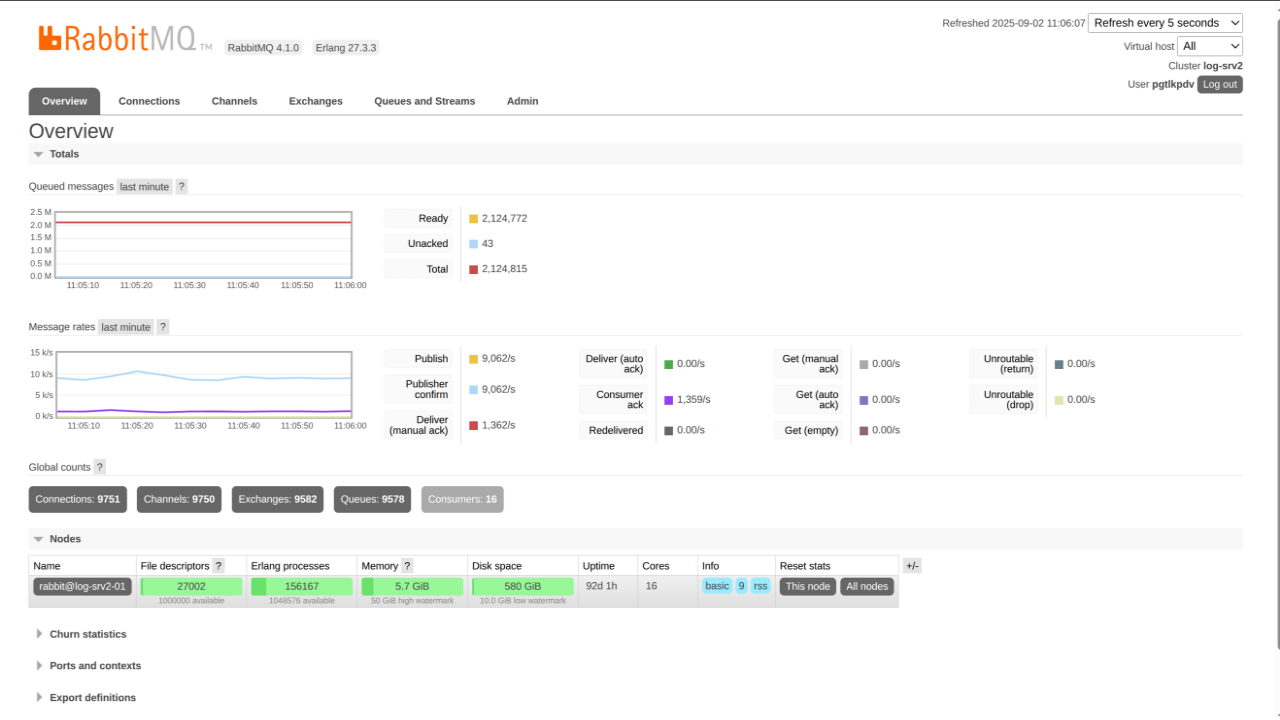
RabbiMQ managment interface
Image
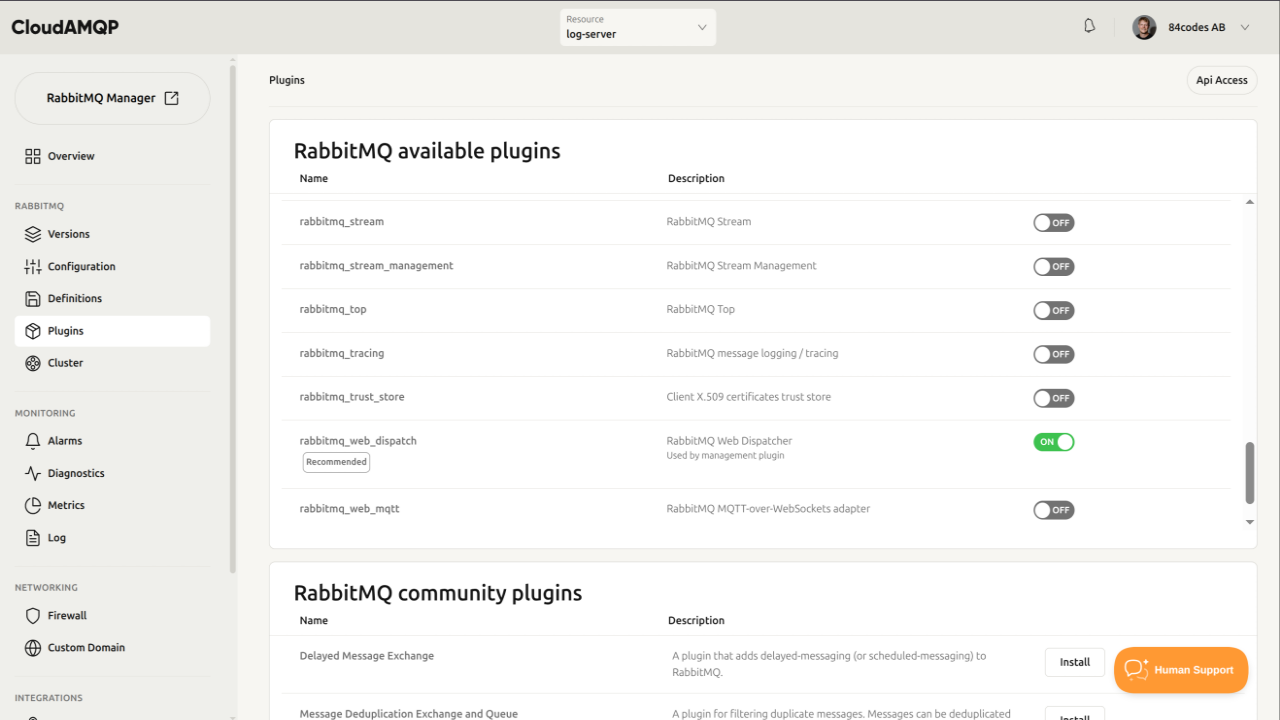
CloudAMQP control panel
Image
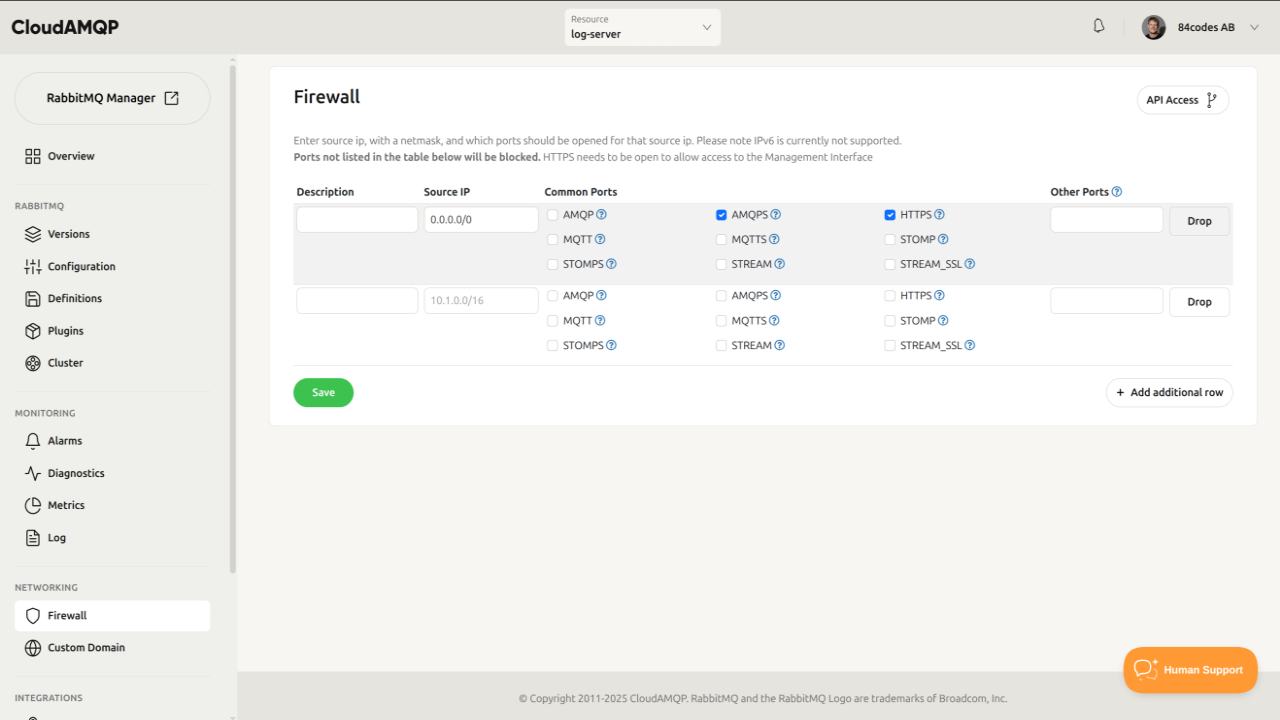
CloudAMQP control panel
Image
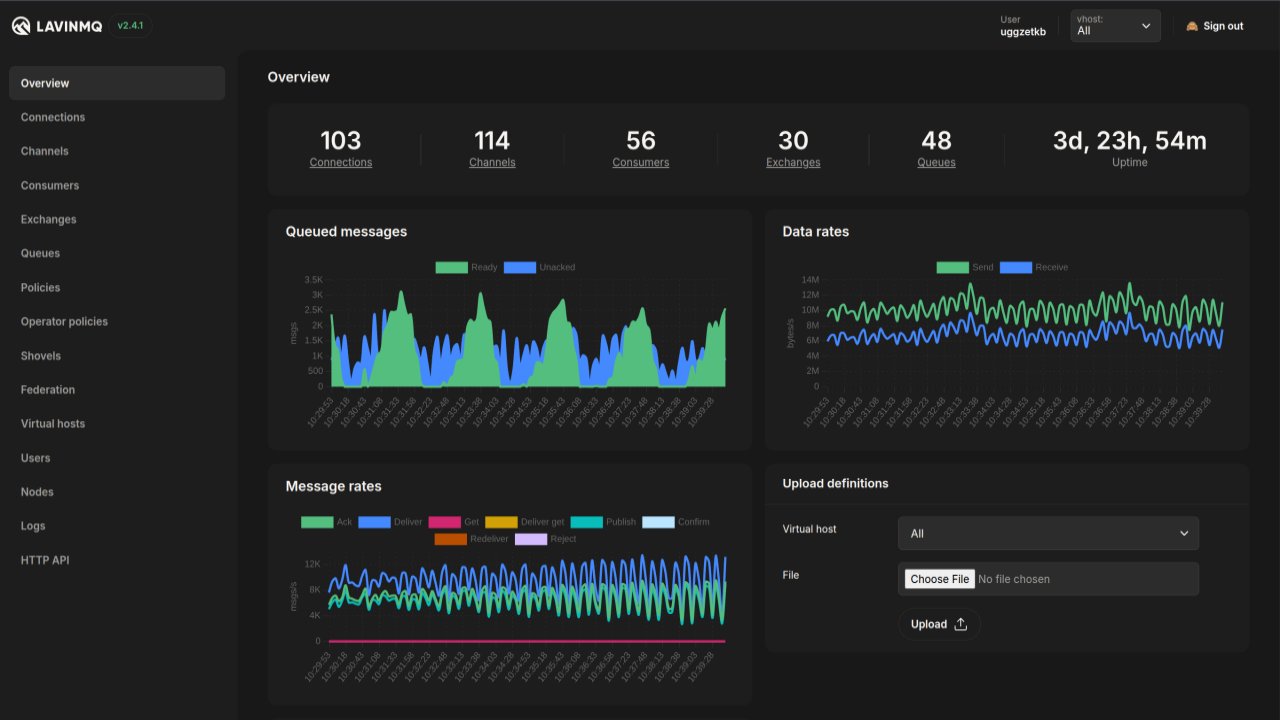
LavinMQ management interface

Video
Product video
Fully managed RabbitMQ and LavinMQ for AWS.
As the world's leading RabbitMQ and LavinMQ provider, CloudAMQP automates the entire setup, operation, and scaling of your servers. The platform is built for high availability and performance, with compliance for SOC2, GDPR, and HIPAA standards. With CloudAMQP, you get more than just a hosted message broker; you get proactive tools to keep your system running.
The CloudAMQP control panel provides various tools for monitoring and alarms, allowing you to address performance issues promptly and automatically, before they impact your business. It's easy to set up custom alarms via email, webhooks, and external services.
We offer two solutions tailored to your messaging needs. Choose RabbitMQ for a robust and flexible message broker, or LavinMQ, a modern, developer-friendly message broker that offers high performance and resource efficiency.
Highlights
- Fully managed RabbitMQ and LavinMQ servers at AWS.
- Convenient scaling, automated updates, and easy monitoring, all backed by our great support.
- SOC2, HIPAA and GDPR compliant.
Details
Sold by
Delivery method
Deployed on AWS
New
Introducing multi-product solutions
You can now purchase comprehensive solutions tailored to use cases and industries.

Features and programs
Financing for AWS Marketplace purchases
AWS Marketplace now accepts line of credit payments through the PNC Vendor Finance program. This program is available to select AWS customers in the US, excluding NV, NC, ND, TN, & VT.

Pricing
Pricing is based on actual usage, with charges varying according to how much you consume. Subscriptions have no end date and may be canceled any time.
Additional AWS infrastructure costs may apply. Use the AWS Pricing Calculator to estimate your infrastructure costs.
Dimension | Description | Cost/tier/hour |
|---|---|---|
Little Lemur | Little Lemur | $0.00 |
Tough Tiger | Tough Tiger | $0.026 |
Big Bunny | Big Bunny | $0.136 |
Roaring Rabbit | Roaring Rabbit | $0.41 |
Power Panda | Power Panda | $0.684 |
Awesome Ape | Awesome Ape | $1.369 |
Heavy Hippo | Heavy Hippo | $2.74 |
Loud Lion | Loud Lion | $4.796 |
Extra: VPC/PrivateLink per cluster | Extra: VPC/PrivateLink per cluster | $0.136 |
Sassy Squirrel | Sassy Squirrel | $0.067 |
Dimensions summary
You pay by the hour for metered usage, so costs reflect how long each instance runs. The named tiers (such as Little Lemur, Tough Tiger, Big Bunny, through Outstanding Orca) represent increasing cluster sizes and throughput capacity. Shared tiers suit development and small projects; dedicated tiers give you isolated brokers for higher throughput. You can add optional VPC/PrivateLink per cluster and extra disk per 100GB on top of a tier. One accumulated-costs dimension groups all usage into a single billed category.
Top-of-mind questions for buyers
Capacity depends on several factors: the messaging system, the number of nodes, routing type, message size, number of consumers and publishers, and the data center. Each tier is benchmarked rather than fixed. Dedicated tiers like Sassy Squirrel and larger place no artificial queue or message limits.
You pay per hour for the time an instance is available to you. If you delete an instance, charges stop immediately. Your monthly bill reflects only the hours each instance ran, so a tier running part of the month costs only for that portion.
These are optional add-ons billed on top of your tier. VPC/PrivateLink is charged per cluster. Extra disk is charged per 100GB block. Each add-on meters independently and appears alongside your tier hours. Your tier drives the main cost; add-ons raise the total only when enabled.
www.cloudamqp.com
Helpful?
Vendor refund policy
Service Level Agreement: 99.95% Availability. CloudAMQP will refund 50% of the cost for outage larger than that. Request of refund must be submitted in writing, within 30 days from the outage to which they refer, via email to contact@cloudamqp.com

Legal
Vendor terms and conditions
Upon subscribing to this product, you must acknowledge and agree to the terms and conditions outlined in the vendor's End User License Agreement (EULA) .
Content disclaimer
Vendors are responsible for their product descriptions and other product content. AWS does not warrant that vendors' product descriptions or other product content are accurate, complete, reliable, current, or error-free.
Delivery details
Software as a Service (SaaS)
SaaS delivers cloud-based software applications directly to customers over the internet. You can access these applications through a subscription model. You will pay recurring monthly usage fees through your AWS bill, while AWS handles deployment and infrastructure management, ensuring scalability, reliability, and seamless integration with other AWS services.
Resources
Support
Vendor support
If you need help, have a question, or are running into an issue with your RabbitMQ or LavinMQ instance, our expert support team is ready to assist. Email us at: support@cloudamqp.com .
AWS infrastructure support
AWS Support is a one-on-one, fast-response support channel that is staffed 24x7x365 with experienced and technical support engineers. The service helps customers of all sizes and technical abilities to successfully utilize the products and features provided by Amazon Web Services.
Updated weekly
By CloudAMQP

By Supported Images

By IBM Software
Top
25
In Application Servers, Data Integration
Top
10
In Data Integration
Top
10
In Device Connectivity
Sentiment is AI generated from actual customer reviews on AWS and G2
Functionality
Ease of use
Customer service
Cost effectiveness
Positive reviews
Mixed reviews
Negative reviews
AI generated from product descriptions
Automated Server Management
Fully managed setup, operation, and scaling of RabbitMQ and LavinMQ servers with automated updates
Monitoring and Alerting System
Control panel with monitoring tools and custom alarms configurable via email, webhooks, and external services
High Availability Architecture
Platform built for high availability and performance with support for both RabbitMQ and LavinMQ message brokers
Compliance Standards
SOC2, GDPR, and HIPAA compliance certifications
Performance Optimization
LavinMQ option providing modern, developer-friendly message broker with high performance and resource efficiency
Message Broker Architecture
Robust message broker designed to facilitate efficient communication between applications with support for multiple messaging protocols and patterns
Clustering and High Availability
Built-in clustering capabilities enabling seamless integration and data replication across nodes with support for high-throughput workloads and low latency
Security Features
Advanced security capabilities including user authentication, TLS encryption, and access control mechanisms for secure message transmission
Management and Monitoring
Management plugin providing real-time monitoring, configuration capabilities, and administrative oversight of the messaging environment
STIG Compliance Hardening
Pre-hardened image compliant with STIG security standards for enhanced security posture
Message Delivery Guarantee
Assured, once-only delivery of messages between applications with Store & Forward and Request & Response patterns
Multi-Platform and Multi-Cloud Support
Deployment across multiple platforms including Kubernetes, OpenShift, AWS, on-premises servers, Windows, UNIX, and Z/OS with BYOL support
Messaging Architecture Support
Support for point-to-point messaging, Publish and Subscribe with dynamic topics and subscriptions, and integration with Kafka-based Event Driven Architectures
End-to-End Encryption and Security
Message encryption at rest and during transportation across the network with end-to-end encryption, data confidentiality and integrity checking
High Availability and Disaster Recovery
Intelligent workload balancing, high availability and disaster recovery services at node, availability zone, and regional levels
Standard contract
No
No
Customer reviews
HemantKumar7
Reliable queues have handled heavy microservice traffic and prevent data loss in daily operations
Reviewed on May 19, 2026
Review from a verified AWS customer
What is our primary use case?
Our main use case for CloudAMQP is that we are using it for RabbitMQ operations as a message broker, with CloudAMQP managing RabbitMQ. Apart from that, we use it for microservice communication. In our use case, there are multiple consumers and applications. From the application side, a payload is uploaded, and multiple consumers communicate with this JSON, which is directly related to that particular application. We also use the RabbitMQ queue to process this data with the help of a synchronous technique.
We have a multiple microservice-based architecture, and a quick specific example of how CloudAMQP fits into our workflow is that we have different operations involving order management and notification management, along with transactions related to payment. Our application sends the event, and different microservices consume that particular data. CloudAMQP is able to handle a huge amount of data and can manage these operations automatically, ensuring there is no spike and no lag inside the application.
What is most valuable?
The best features CloudAMQP offers include its ability to handle load efficiently. Without it, if there is a lack of requests coming from multiple consumers, it stores the data in the queue, and the lag will clear after consumption from the consumer side, ensuring no messages drop from CloudAMQP. Additionally, it can run tasks in the background so that it does not block any user requests. CloudAMQP is able to handle the load, and if I want to scale, I can scale the RabbitMQ nodes without any downtime.
CloudAMQP has impacted our organization positively because it can handle a huge amount of data. I can have multiple RabbitMQ queues inside CloudAMQP and, as per my plan, purchase multiple queues that offer different capabilities. For example, the Tough Tiger plan allows sending a maximum of ten million messages per month with simultaneous connections of one hundred connections per queue, ensuring no traffic loss. For heavy environments, I can opt for Big Bunny queues, where I can handle one lakh messages per second if there is a huge amount of traffic. Additionally, I have a dedicated RabbitMQ broker as per my requirement, and according to my needs in CloudAMQP, there are different queue plans which I can select accordingly.
What needs improvement?
CloudAMQP can be improved, as sometimes while upgrading, for instance, if I am running a Big Bunny cluster and want to upgrade to Happy Hour, there is a lag or slowness while upgrading from one queue to another.
Apart from the upgrade lag, everything is working fine with excellent customer support. Regarding pricing, there are lots of pricing plans in CloudAMQP, allowing me to purchase based on my requirements.
For how long have I used the solution?
I have been using CloudAMQP for around three years.
What do I think about the stability of the solution?
In my experience, CloudAMQP is very much stable.
What do I think about the scalability of the solution?
The scalability of CloudAMQP is very much effective. I can directly scale the system with the UI.
My experience with scaling RabbitMQ nodes is positive. From the CloudAMQP UI, I can scale it as per my load and requirements, and I can manage it easily.
I would add that you can scale it by running multiple replicas, and if there is any traffic spike, it will handle the load as per your replica of your RabbitMQ queue, making it very much beneficial.
How are customer service and support?
The customer support is excellent. I would rate the customer support on a scale of one to ten as eight out of ten.
Which solution did I use previously and why did I switch?
I did not previously use a different solution, as this is the first one I am using.
How was the initial setup?
My experience with pricing, setup cost, and licensing is that it operates on a private cloud, not on-premises.
What was our ROI?
Since using CloudAMQP, my organization has seen a very significant return on investment because there is no data loss, and I can recover the system timely. In logistic operations, there are multiple issues; if my system is down, it causes transaction-related loss and revenue loss to the organization. There is a return on investment by using CloudAMQP.
I have seen a return on investment, as it helps in saving money and time.
Which other solutions did I evaluate?
Before choosing CloudAMQP, I evaluated other options, specifically Kafka, but as per my use case, CloudAMQP fits well.
What other advice do I have?
My advice for others looking into using CloudAMQP is that if you are choosing any message broker, you can go directly to CloudAMQP. However, before making a choice, at least check their plans according to your use case and do not blindly choose any plan. I would rate this product ten out of ten.
Which deployment model are you using for this solution?
Private Cloud
If public cloud, private cloud, or hybrid cloud, which cloud provider do you use?
Amazon Web Services (AWS)
Tharun K
Message queues have improved fuel station data flow and now provide faster front-end responses
Reviewed on May 13, 2026
Review from a verified AWS customer
What is our primary use case?
CloudAMQP is mainly used for message queuing and asynchronous communication between applications and services.
We have a hardware device which is made up of circuits, and it will communicate with the real-time dispenser unit in the fuel station. Once the data is taken from the fuel pump, it will transmit to the server. From the server, it will be queued in the AMQP and it will be displayed in the front end.
CloudAMQP is deployed in our organization on our private cloud.
What is most valuable?
The best features that CloudAMQP offers include handling server setup, RabbitMQ installations, upgrades, patching, maintenance, scaling, and backup. It is a fully managed RabbitMQ, allowing easy scaling without any downtime.
CloudAMQP offers strong monitoring and alerting features that make managing the RabbitMQ environment much easier, providing real-time visibility into the queues, messaging rates, consumers, and memory usage through an easy-to-use dashboard.
After using CloudAMQP, our efficiency has increased, and the data which is transferring from the fuel station has become easier and faster to communicate with our front-end application. The data which is queued in RabbitMQ is providing the fastest response to the front-end application.
What needs improvement?
CloudAMQP can be improved in a few ways, such as lowering the pricing at scale and keeping the pricing structure simpler. It should also have a better beginner experience, improvements in UI and UX, and we would appreciate more advanced analytics.
For how long have I used the solution?
I have been using CloudAMQP for one and a half years.
What do I think about the stability of the solution?
CloudAMQP is stable.
What do I think about the scalability of the solution?
CloudAMQP's scalability is good.
How are customer service and support?
We have never needed to reach out to customer support.
How was the initial setup?
The setup cost is low because the platform is fully managed, so teams don't need to spend much on infrastructure or DevOps resources. The setup process is quick and developer-friendly, often taking only a few minutes to get running.
What was our ROI?
I have seen a return on investment with time saved.
What's my experience with pricing, setup cost, and licensing?
CloudAMQP has a flexible pricing model with both free and paid plans that make it easy to start small and scale later.
Licensing is subscription-based with monthly billing, and while pricing can become expensive at higher scales, many teams feel the operational convenience and reliability justify the cost of production workloads.
What other advice do I have?
If you are considering CloudAMQP, my advice is to start with a small plan and learn RabbitMQ fundamentals such as queues, exchange, and routing keys early. CloudAMQP is excellent for microservices, background jobs, and event-driven systems because it reduces infrastructure and maintenance efforts significantly. Make good use of its monitoring and alerting features from the beginning and design your queues carefully for better scalability and performance. I would rate this product a ten out of ten.
Which deployment model are you using for this solution?
Private Cloud
If public cloud, private cloud, or hybrid cloud, which cloud provider do you use?
Amazon Web Services (AWS)
reviewer2796066
Automation has reduced manual queue checks and now workers scale with message load
Reviewed on Feb 01, 2026
Review provided by PeerSpot
What is our primary use case?
My main use case for CloudAMQP is using the clusters for queuing messages, and then the processor takes and processes them.
A specific example of how I use CloudAMQP in my daily workflow is that I have a worker that I needed to scale based on the number of messages stored in CloudAMQP queues. I created an automation that runs every 10 minutes to check the queues, and if the number of messages exceeds a specific threshold, my workers scale up. Once the messages are executed, the worker scales down.
What is most valuable?
The best features CloudAMQP offers include high scalability, fault tolerance, and the dashboard where I can see the number of messages in my queue.
Out of those features, I rely on the dashboard the most because it helps me check the visual queues and determine whether my workflow is working correctly and detecting the correct number of messages.
CloudAMQP has positively impacted my organization as I have built an automation for scaling, which has helped the organization benefit from workload distribution and faster processes.
In terms of process speed and workload distribution, I have noticed measurable improvements such as reduced processing times and fewer manual interventions. Before, I had to check manually every hour or two, but now the automation takes care of that.
What needs improvement?
CloudAMQP can be improved as the pricing is a bit high, and if that could be reduced, it would be a great tool.
For how long have I used the solution?
I have been using CloudAMQP for more than a year.
What do I think about the stability of the solution?
CloudAMQP is stable.
What do I think about the scalability of the solution?
The scalability of CloudAMQP is good.
How are customer service and support?
The customer support for CloudAMQP is good.
Which solution did I use previously and why did I switch?
I have not previously used a different solution; this was the only solution we are using.
What was our ROI?
I have seen a return on investment as the time has been saved by two to three hours.
Which other solutions did I evaluate?
Before choosing CloudAMQP, I did not evaluate other options.
What other advice do I have?
CloudAMQP is a good tool, and if you are able to accommodate the costing, it is useful. I would rate this product an eight out of ten.
Abhinav M.
Its better to switch to Cloud AMQP from RabbitMQ to save time and effort
Reviewed on Apr 14, 2024
Review provided by G2
What do you like best about the product?
Infra and operational tasks are handled by the service provider, because Cloud AMQP is a fully managed service. It handles the message volume very well. It scales effortlessly, although you have to pay accordingly. The demo went well, so we switched from RabbitMQ to this. It is easier to integrate and frequency of usage has increased since implementation. It is more reliable than RabbitMQ. Compliance, stringent protocols and protection from hacking are good features of this product.
What do you dislike about the product?
Cost will become a considerable factor once the message volume increases. Potential for downtime is still a lingering factor since it is on cloud, and infra is not in our control. Customer support is just okay.
What problems is the product solving and how is that benefiting you?
This Message Queue is definitely scalable, and it scales automatically without user intervention. It follows UK AND US communication protocols effectively. It has built-in failover mechanism to protect the message logs. The UI is good enough.
Suraj R.
One stop for all solutions
Reviewed on Jan 24, 2024
Review provided by G2
What do you like best about the product?
It was great, and very useful. Server management and monitoring at its best. It is easy to implement. Customer support is very good and responsive. It is easily integrated
What do you dislike about the product?
nothing as of yet, but can have more features in future.
What problems is the product solving and how is that benefiting you?
server management, monitoring, integration.