
Sold by: HailBytes
Deployed on AWS
Free Trial
Enterprise phishing simulation platform. One-click AWS deployment with email integration, campaign management, and analytics.
4.3
Overview
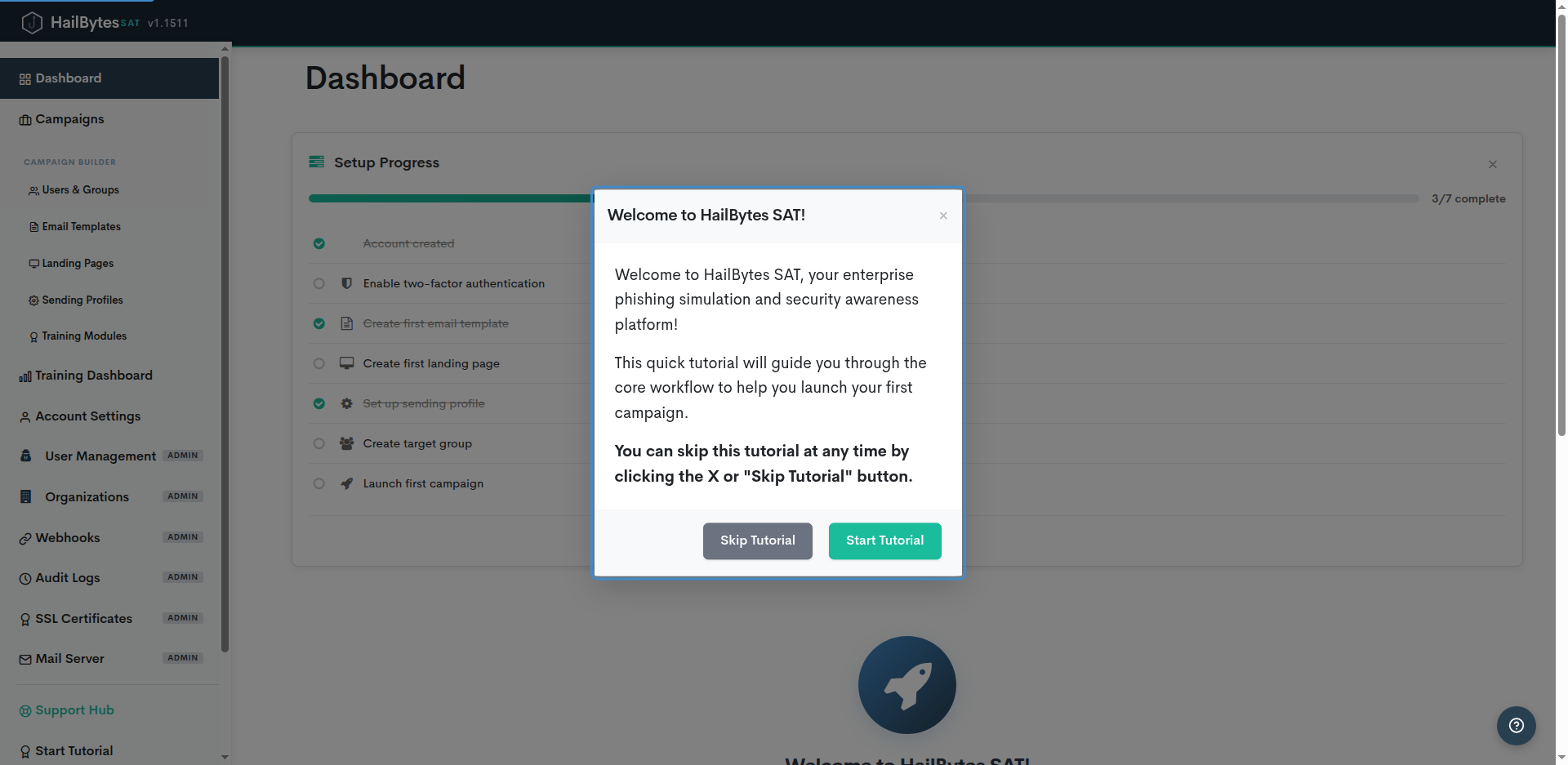
Image
SAT Onboarding
Image
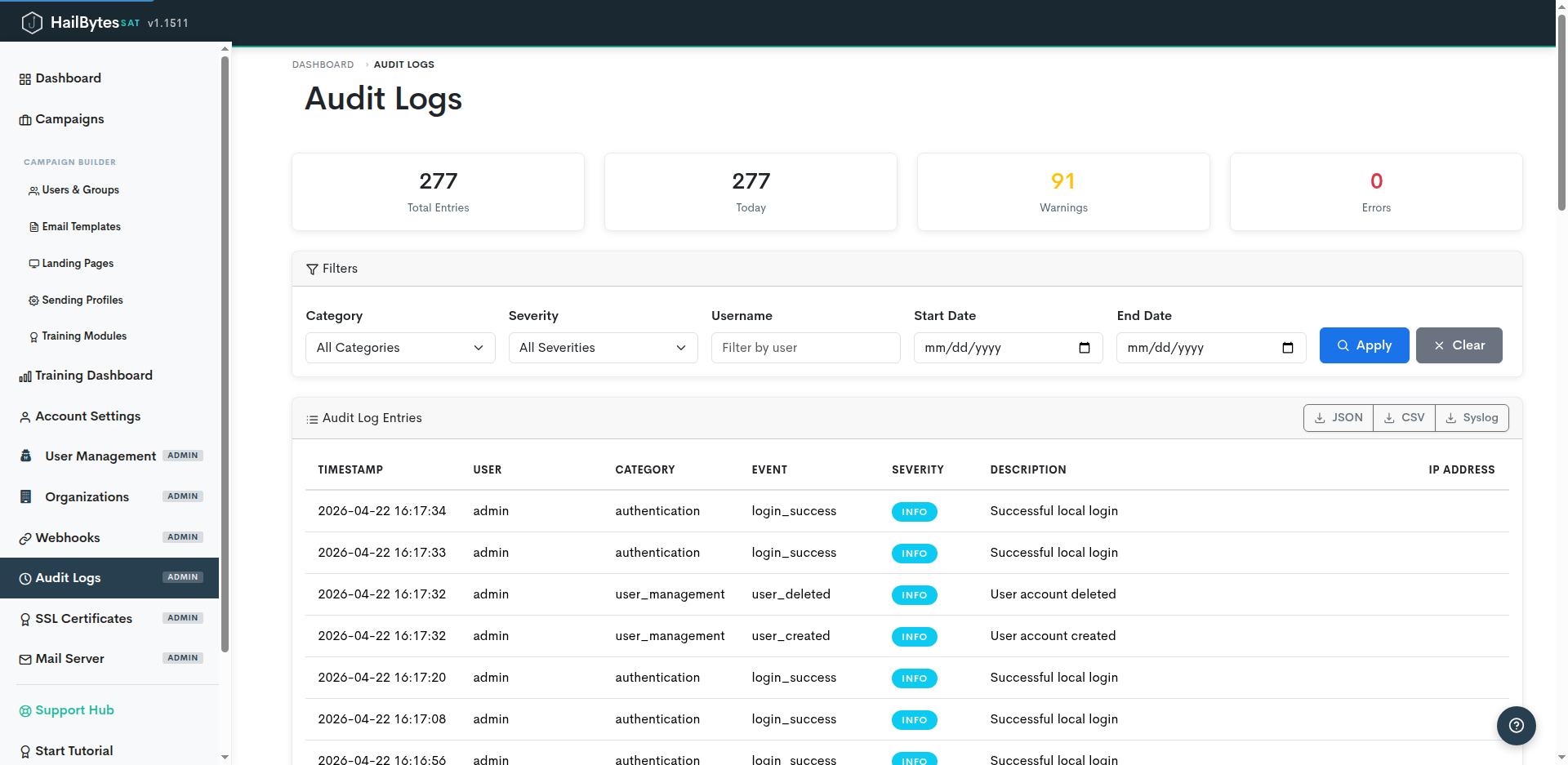
SAT Audit Logs
Image
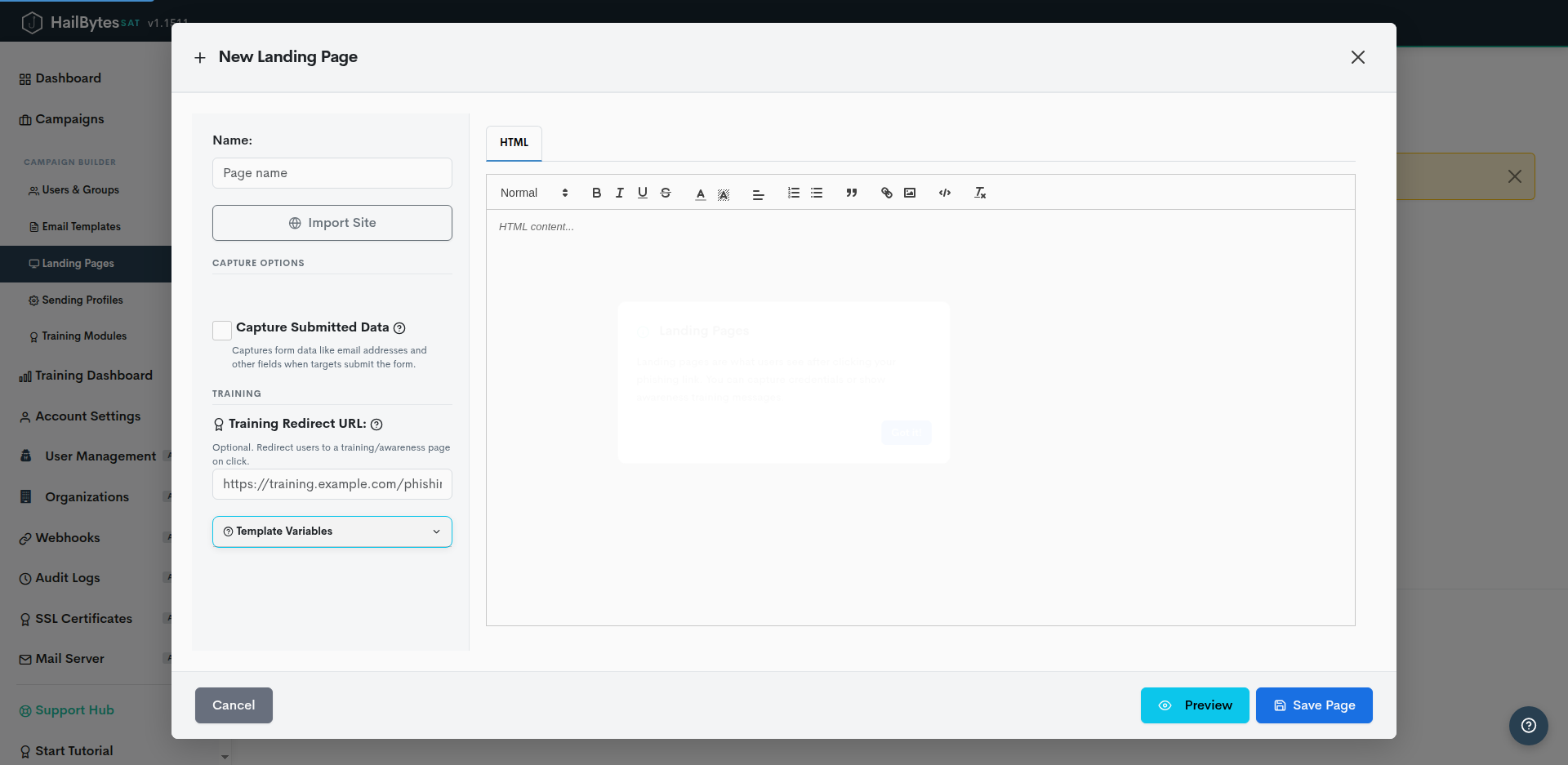
SAT Landing Page Editor
Video
Product video
Deploy Enterprise Phishing Simulation in Minutes
HailBytes SAT is a fully-managed, enterprise-grade phishing simulation platform that helps organizations test and improve their security awareness posture through realistic phishing campaigns.
What You Get
- Complete phishing simulation platform pre-configured and ready to use
- AWS-integrated deployment with EC2, RDS MySQL (optional), and Amazon SES
- Unlimited phishing campaigns with scheduling and automation
- Advanced analytics dashboard with real-time metrics
- Email template library with customization tools
- Landing page designer for capturing credentials (training)
- REST API for automation and integrations
- Standard support included (3-5 day response) - upgrade available
Perfect For
- Security teams running regular awareness training campaigns
- IT departments testing employee security awareness
- Compliance teams meeting security training requirements
- MSPs delivering phishing simulation services to clients
- Organizations of 50-10,000+ employees
Key Features
Campaign Management
- Create unlimited phishing campaigns
- Schedule campaigns for optimal timing
- Clone and reuse successful templates
- Multi-campaign dashboard
- Historical tracking and trending
Email Capabilities
- HTML email template designer
- Dynamic personalization (name, position, department)
- File attachments support
- Automatic tracking pixels
- Import from existing emails
- Amazon SES integration for high deliverability
Analytics & Reporting
- Real-time campaign metrics
- User interaction tracking (opens, clicks, data submission)
- Detailed timeline views
- Exportable reports (PDF, CSV)
- Trend analysis across campaigns
- Risk scoring by department/user
Integration & Automation
- Complete REST API
- Webhook notifications
- LDAP/Active Directory sync
- SAML/SSO authentication
- CI/CD integration support
Pricing
- $0.24 per vCPU/hour - Simple, transparent pricing
- 2 vCPU minimum, 8GB memory - Right-sized for most organizations
- ~$350/month starting cost - Database, storage, and networking included
- 30-day free trial available - Test with no commitment
- Standard support included - Professional and Enterprise support available as add-ons
Deployment Details
Infrastructure Included
- Compute: EC2 instance (t3.medium or larger)
- Database: RDS MySQL (optional) (DB included in VM)
- Email: Amazon SES integration (separate SES costs apply)
- Storage: EBS volumes for data persistence
- Networking: VPC, security groups, load balancer optional
Setup Time
- 5-10 minutes automated CloudFormation deployment
- Pre-configured security groups and IAM roles
- Production-ready out of the box
- Fully managed infrastructure
Security & Compliance
- SOC 2 Type II compliant infrastructure
- Data encryption at rest and in transit
- Private VPC deployment
- Customizable security groups
- Audit logging enabled
- GDPR/CCPA compliant data handling
Why HailBytes SAT?
vs. SaaS Phishing Platforms
- 50-70% cost savings vs. KnowBe4, Proofpoint, or Cofense
- Complete data ownership - all data stays in your AWS account
- No per-user licensing - unlimited users included
- Full customization - modify templates, workflows, branding
Getting Started
- Subscribe on AWS Marketplace (uses your AWS committed spend)
- Deploy using our CloudFormation template (5-10 minutes)
- Configure your first campaign using our template library
- Launch and monitor results in real-time
Technical Requirements
- AWS account with EC2, RDS, SES permissions
- Minimum: 2 vCPUs, 8GB RAM
- Recommended: 4-8 vCPUs for large organizations (500+ employees)
Highlights
- One-click AWS deployment
- Unlimited phishing campaigns with advanced analytics
- 30-day free trial with Standard support included
Details
Sold by
Categories
Delivery method
Delivery option
64-bit (x86) Amazon Machine Image (AMI)
Latest version
Operating system
Ubuntu 24.04
Deployed on AWS
New
Introducing multi-product solutions
You can now purchase comprehensive solutions tailored to use cases and industries.

Features and programs
Buyer guide
Gain valuable insights from real users who purchased this product, powered by PeerSpot.
Financing for AWS Marketplace purchases
AWS Marketplace now accepts line of credit payments through the PNC Vendor Finance program. This program is available to select AWS customers in the US, excluding NV, NC, ND, TN, & VT.

Pricing
Free trial
Try this product free for 30 days according to the free trial terms set by the vendor. Usage-based pricing is in effect for usage beyond the free trial terms. Your free trial gets automatically converted to a paid subscription when the trial ends, but may be canceled any time before that.
Pricing is based on actual usage, with charges varying according to how much you consume. Subscriptions have no end date and may be canceled any time. Alternatively, you can pay upfront for a contract, which typically covers your anticipated usage for the contract duration. Any usage beyond contract will incur additional usage-based costs.
Additional AWS infrastructure costs may apply. Use the AWS Pricing Calculator to estimate your infrastructure costs.
Dimension | Cost/hour |
|---|---|
m4.large Recommended | $0.48 |
t3.xlarge | $0.48 |
t3.large | $0.48 |
t3.medium | $0.48 |
t3.2xlarge | $0.48 |
Vendor refund policy
Contact us at david@hailbytes.com if you're unhappy with this product for any reason and we'll resolve your issue.

Legal
Vendor terms and conditions
Upon subscribing to this product, you must acknowledge and agree to the terms and conditions outlined in the vendor's End User License Agreement (EULA) .
Content disclaimer
Vendors are responsible for their product descriptions and other product content. AWS does not warrant that vendors' product descriptions or other product content are accurate, complete, reliable, current, or error-free.
Delivery details
64-bit (x86) Amazon Machine Image (AMI)
Amazon Machine Image (AMI)
An AMI is a virtual image that provides the information required to launch an instance. Amazon EC2 (Elastic Compute Cloud) instances are virtual servers on which you can run your applications and workloads, offering varying combinations of CPU, memory, storage, and networking resources. You can launch as many instances from as many different AMIs as you need.
Version release notes
HailBytes SAT v1.2077 - May 20, 2026
This release expands identity and compliance capabilities, adds multi-channel phishing simulation, broadens integration coverage, and modernizes the platform foundation.
Identity and access management adds SCIM 2.0 provisioning for automated user lifecycle, SAML and OIDC SSO with Microsoft Entra ID, Google, and Okta (including OIDC discovery), plus MFA/TOTP and tenant-aware admin workflows.
Compliance and reporting introduces compliance framework mapping across 20 modules covering PCI-DSS, HIPAA, SOC 2, ISO 27001, and LATAM frameworks. New evidence packs and signed PDF certificates of completion support audit needs. Remedial training assignment with repeat-offender risk scoring, historical risk snapshots, and trend reporting round out the reporting improvements.
Phishing and training expands beyond email with Twilio-powered SMS (smishing) and voice (vishing) simulations, QR-code lures, and AutoPhish template/page/group pools. New role-based training tracks for developers, finance, healthcare, and executive audiences include recurring campaigns, quiz tracking, and certificates. The built-in module and template library has been expanded.
Multi-tenant and MSP capabilities add cross-tenant rollups for activity, risk, and engagement across customer environments, plus system-level library flags and cloned-template governance.
SIEM and ticketing integrations add Microsoft Sentinel and Splunk for SIEM forwarding, and ServiceNow, Jira, and PagerDuty for ticketing workflows.
Email security integrations add Microsoft 365 Advanced Delivery and Google Workspace simulation support, plus Proofpoint TAP and Mimecast compatibility. User-reported phishing introduces an Outlook add-in, Gmail phish-report ingest, and a phishing-report slash command.
Data export adds scheduled exports to Amazon S3, Azure Blob Storage, and SFTP destinations.
Platform and operations modernizes the frontend with ES modules bundled via webpack and a Vitest unit-test harness, replacing the legacy gulp pipeline. Self-hosted opt-in analytics replace Mixpanel via a first-party event pipeline. Spanish and Brazilian Portuguese localization is now supported. Instance export and import enables backups and high-availability patching parity. An automated release pipeline publishes from main with generated patch notes, and first-time admin onboarding is smoother.
Upgrade notes: PostgreSQL is the only supported database engine. Migrations run automatically on startup; back up your PostgreSQL data before upgrading. Analytics remain opt-in and collect no data unless explicitly enabled.
Additional details
Usage instructions
HailBytes Security Awareness Training - v1.2077
== 1. First boot (2-3 minutes) == After launching the AMI, allow 2-3 minutes for hailbytes-sat, nginx, and PostgreSQL to initialize.
- SSH in: ssh -i your-key.pem ubuntu@<public-ip>
- The auto-generated admin password is printed in the SSH login banner and stored at /home/ubuntu/hailbytes-sat-initial-credentials.txt (delete after first login).
- Open the admin UI: https://<public-ip>:3333
- Log in as "admin" with that password. You will be forced to set a new password and are strongly encouraged to enable TOTP MFA on first login.
- Verify the service: curl -k https://<public-ip>:3333/api/ready curl -k https://<public-ip>:3333/api/instance/schema-version
== 2. Launch your first campaign ==
- Sending Profile - add an SMTP profile (AWS SES recommended). Use the in-app email-warming guide to ramp sender reputation gradually.
- Email Template - HTML editor with variable substitution: {{.FirstName}} {{.LastName}} {{.Email}} {{.Position}} {{.URL}} {{.RID}}.
- Landing Page - build a credential-capture or training page, or clone an existing site via the import URL field.
- Target Group - add recipients manually, import via CSV, or sync from LDAP / Active Directory / SCIM 2.0.
- Campaign - select template, landing page, sending profile, and targets; schedule or send immediately.
- Results - opens, clicks, submissions, and user-reported phish appear in real time. Export CSV or push events to SIEM via webhook.
== 3. AWS SES integration ==
- Verify your sending domain in AWS SES.
- Move SES out of sandbox (request production access).
- In SAT, create a Sending Profile: Host: email-smtp.<region>.amazonaws.com Port: 587 (STARTTLS) Auth: your SES SMTP credentials
- Send a test email, then ramp volume per the warming guide. EU customers: us-east-1 SES is not GDPR-appropriate -- use eu-west-1 or eu-central-1.
== 4. Network & security ==
- Admin UI: TCP 3333 (HTTPS) - restrict by Security Group to admin IPs.
- Phish srv: TCP 80/443 (nginx, SSL/TLS) - open to the public Internet.
- SSH: TCP 22, key-only auth - restrict by Security Group.
- AES-256-GCM at rest for all PII; key in /etc/hailbytes-sat/.
- Comprehensive audit logging with IP and user-agent tracking.
- UFW blocks all other ports by default.
== 5. High availability (optional) == For multi-AZ active-active behind an Application Load Balancer with RDS Multi-AZ Postgres and ElastiCache Redis:
- CloudFormation: deploy/aws/cloudformation-ha.yaml
- Cloud Shell: deploy/aws/provision-ha.sh
- Runbook: docs/AWS_HA_DEPLOYMENT.md HA patching helpers ship at: /opt/hailbytes/bin/ha-pre-patch-backup.sh /opt/hailbytes/bin/ha-post-patch-verify.sh
== 6. Backup & restore ==
- Export a full instance bundle (DB + uploads + config metadata): GET /api/instance/export -> .tar.gz
- Restore to a matching-version SAT host: POST /api/instance/import?confirm=replace-all-data=true The bundle records a SHA-256 fingerprint of the encryption key so a host with the wrong key is rejected before any data is written.
== 7. Service operations ==
- Status: sudo systemctl status hailbytes-sat
- Logs: sudo journalctl -u hailbytes-sat -f
- Restart: sudo systemctl restart hailbytes-sat If the UI is unreachable, wait 3 minutes after launch and confirm Security Group rules allow inbound 3333, 80, and 443.
== 8. Support ==
- Support portal: https://support.hailbytes.com (Entra ID SSO, SLA tracking, encrypted file storage, ticket dashboard)
- Email: support@hailbytes.com
- Documentation: https://hailbytes.com/sat/ For AWS-infrastructure issues (EC2, networking, SES, IAM), open a case through AWS Support on your account.
Resources
Vendor resources
Support
Vendor support
Support Resources
- Email: support@hailbytes.com
- Documentation: https://hailbytes.com/documentation/
- Product Page: https://hailbytes.com/sat/
- Support Plans: https://hailbytes.com/support-pricing/
Questions? Visit https://hailbytes.com or email sales@hailbytes.com
AWS infrastructure support
AWS Support is a one-on-one, fast-response support channel that is staffed 24x7x365 with experienced and technical support engineers. The service helps customers of all sizes and technical abilities to successfully utilize the products and features provided by Amazon Web Services.
Updated weekly

By Proofpoint

By NetSPI
Top
10
In eLearning, Application Stacks
Top
10
In Data Security and Governance
Top
10
In Assessments
Sentiment is AI generated from actual customer reviews on AWS and G2
Functionality
Ease of use
Customer service
Cost effectiveness
Positive reviews
Mixed reviews
Negative reviews
AI generated from product descriptions
Campaign Management and Scheduling
Supports creation of unlimited phishing campaigns with scheduling, cloning of templates, multi-campaign dashboard, and historical tracking with trend analysis capabilities.
Email Template and Personalization
Includes HTML email template designer with dynamic personalization using name, position, and department fields, file attachment support, automatic tracking pixels, and Amazon SES integration for email delivery.
Analytics and Reporting
Provides real-time campaign metrics with user interaction tracking including opens, clicks, and data submission, detailed timeline views, exportable reports in PDF and CSV formats, and risk scoring by department or user.
Integration and Automation
Offers complete REST API with webhook notifications, LDAP/Active Directory synchronization, SAML/SSO authentication, and CI/CD integration support.
Security and Compliance
Implements SOC 2 Type II compliant infrastructure with data encryption at rest and in transit, private VPC deployment, customizable security groups, audit logging, and GDPR/CCPA compliant data handling.
AI-Driven Threat Detection
Utilizes artificial intelligence to detect and prevent advanced email attacks, phishing, credential theft, ransomware, business email compromise, and cloud account takeover threats.
Unified Cross-Channel Visibility
Provides centralized dashboard with holistic view of user interaction and threat telemetry across cloud, email, endpoint, and web channels in a cloud-native interface.
Automated Incident Response
Enables automated remediation and consistent, scalable incident response to sophisticated email attacks with reduced manual triage requirements.
Behavioral and Content Analysis
Correlates user activity, behavior patterns, and content analysis with threat intelligence and data movement to identify and prevent data loss and insider threats in real time.
Data Protection and Privacy Controls
Implements anonymization of user data, content snippet masking, and regional data residency management to protect user privacy while defending against data loss scenarios.
Penetration Testing Service
Penetration Testing as a Service (PTaaS) platform combining security professionals with AI and automation, delivering 50+ pentest types with streamlined workflows and accelerated remediation.
Attack Surface Management
Continuous visibility into internal and external attack surfaces with capabilities to discover unknown assets, identify exposure gaps, and prioritize remediation based on real-world risk contextualization.
Red Team and Adversary Simulation
Red team engagements simulating real-world adversaries to test people, processes, and technology, chaining vulnerabilities across identity, application, cloud, and infrastructure layers to demonstrate breach scenarios.
Specialized Security Assessment Teams
Dedicated teams specializing in application, cloud, infrastructure, identity, and mainframe security with proprietary testing frameworks and tooling for deeper technical validation.
AI-Accelerated Security Workflows
AI-accelerated platform experience enabling critical security workflows with reduced complexity, translating vulnerabilities into business and regulatory risk insights with real-time reporting and remediation guidance.
Validated by AWS Marketplace
FedRAMP
GDPR
HIPAA
ISO/IEC 27001
PCI DSS
SOC 2 Type 2
No security profile
-
-
-
-
-
No security profile
Standard contract
No
No
Customer reviews
Faiza Haddadi
Academic phishing simulations have deepened my social engineering skills and awareness training
Reviewed on Jun 16, 2026
Review provided by PeerSpot
What is our primary use case?
I used Gophish for a project last August, a phishing attack simulation, and I reused it recently because a student found the project I did on GitHub and wanted to do the same project, so he asked me some questions, and I reused it at that time.
My main use case for Gophish is in a phishing attack simulation project where the idea is to learn and understand social engineering and how to simulate phishing attacks when you're in a Red Team. I also created a slide deck that explains how to recognize a phishing attack, showing some of the results of the three campaigns, and then at the end, I provided some advice to people to avoid falling for those kinds of phishing attacks.
What is most valuable?
The best features that Gophish offers, the ones that impressed me the most during my use, are mainly two things. The fact of having templates makes the task easier instead of creating an email and copy-pasting for each person every time. Here , you can create campaigns and send them, and you can create a CSV file, for example, and send directly to all the people you list there, so it saves time.
Also, the dashboard gives a direct view of the clicks and the number of people who received the email, making it very illustrative and saving from having to compile the results manually, delivering them in Excel tables or whatever; it is directly visible in the application, and it is easier to read that way.
Gophish has had a positive impact on my learning and my academic path in cybersecurity as it allowed me to understand and go deeper into the concepts of social engineering and phishing attacks. It gave me experience because this is a project I completed and published on GitHub , and there were even other students who were interested and contacted me for information. This is a project that I added to my CV, and I am very happy, not just because I added it to my CV but because it allowed me to learn things.
What needs improvement?
In my opinion, Gophish could be improved to better meet my needs or those of other users, but I did not really encounter any problems, so I found the tool well designed. Since I did not use it in a real environment, I do not really know how it goes if you want to use real email addresses, so on that point, I cannot really give my opinion.
I do not really have any improvements in mind at the moment, but offering ready-made templates that we could use or examples of emails that we could directly use would be beneficial.
For how long have I used the solution?
This is my first year of my master's degree, and I have a bachelor's degree in computer science, so three years in general computer science, and this is my first year specializing in cybersecurity.
What do I think about the stability of the solution?
I have not noticed Gophish being unstable during my use; I did not encounter any bugs or unexpected interruptions during my projects.
What do I think about the scalability of the solution?
Regarding Gophish's scalability, the maximum I did was three campaigns with 10 people per campaign, making 30 people. I did not test it with a larger number of people because it was just in an academic context, so I did not want to go beyond a lot of people.
How are customer service and support?
I did not really encounter any specific problems with Gophish's customer support or online documentation; I found it rather easy to use.
Which solution did I use previously and why did I switch?
Before using Gophish, I did not test other similar solutions; I chose Gophish because I had downloaded a list of cybersecurity projects to do, and among those projects, there was a phishing attack simulation project suggesting the use of Gophish. That is how I discovered Gophish, and I did not think about looking for or using other tools since Gophish met my needs.
How was the initial setup?
Regarding my use of Gophish in this academic context, I found it extremely easy to use; you do not need to be a technical person with special skills to be able to handle it. In maybe an hour or two, I understood how to use it, how to create templates, how it works with landing pages and dashboards. It is really useful and very easy to use, so I recommend it both for cybersecurity students like me and for security professionals.
What about the implementation team?
My university does not have a commercial relationship with the vendor of Gophish other than as a user; we are not a partner or anything like that. This is a personal project that I developed by myself to improve my skills, but there is no partnership with the university.
What was our ROI?
I have noticed a return on investment in terms of time saved and skills acquired thanks to my use of Gophish. It is thanks to this tool that I was able to carry out these phishing attack simulations, understand how it works, see concrete results, and even make a small slide deck that explains this little project and includes advice that I might present in the future to some users.
What's my experience with pricing, setup cost, and licensing?
Regarding the price, setup cost, and licensing of Gophish, I do not remember having to pay to use it. It is a completely free tool if I am not mistaken. Unless there are features that were paid and that I did not choose, but as far as I remember, I did not pay anything.
What other advice do I have?
In my opinion, the one I found most interesting was the one from CROUS because generally when students arrive here in France and they see this, they have to pay quickly since phishing attacks usually use an urgent tone. Since these students are afraid of losing their CROUS housing, they might quickly pay, just click on the link and proceed with the payment without necessarily realizing that it is a scam, especially since generally, people who come from certain African countries do not really have this concept of scam and phishing.
The project is purely academic; I did it with fake email addresses that I managed with Mailpit. I created fake emails that do not exist, for people who do not exist, and I was the one who clicked on these emails myself, opened them, or accessed the links in the attachments of each email. Again, it was purely for academic purposes so I could learn because otherwise, with real email addresses, I cannot really do that, and also it is a bit complicated with Gmail. I preferred to do it with Mailpit and fake email addresses.
Regarding campaign management and the use of templates, Gophish's interface seemed very intuitive to me from the start; everything was clear and self-explanatory. You have buttons for each thing, and it does not really require super advanced knowledge; it is very easy to handle.
I do not really have any improvements in mind at the moment, but offering ready-made templates that we could use or examples of emails that we could directly use would be beneficial.
I do not have any particular advice for other people who want to use Gophish in an academic or professional context; I would tell them to go for this tool because it is really easy to get started with. You do not need to be an expert to use it, and it helps a lot with dashboards and templates. My overall rating for this product is 9 out of 10.
VINICIUS DA SILVA
Practical phishing campaigns have raised staff awareness but still need more languages and SaaS access
Reviewed on Jun 12, 2026
Review from a verified AWS customer
What is our primary use case?
My main use case for Gophish is for employee awareness within the company, and I use it for phishing campaigns.
I create emails to raise employee awareness and send them to see if employees end up clicking. If they click, I reach out to them after finishing the campaign and conduct awareness work so they do not fall for phishing.
I configure Gophish within our Office 365 and proceed with the campaigns, sending emails similar to Microsoft's, emails similar to service providers', and I analyze the results. If someone falls for it, I then handle awareness together with that person.
What is most valuable?
The main point of Gophish is the automated sending, as I can send to several email addresses at once by uploading a list of emails.
I also consider the SMTP configuration of the server from which I send the emails to be a differentiator because it is very simple to do.
With Gophish, I am able to work in a more appropriate way on phishing awareness, and I am also able to make employees aware in an easy and appropriate way because they see how a phishing attack works in a real way. This allows them to become aware in a more practical way.
I did notice a measurable change as employees are more aware of phishing and the number of incidents has decreased because they now know how phishing works.
What needs improvement?
Gophish can be improved by adding more languages and maybe a web version for it, a SaaS platform.
I rate it a seven because of the improvements I mentioned. I think if it were a SaaS platform and had more languages, including Brazilian Portuguese, it might be a ten.
For how long have I used the solution?
I have been using Gophish for around three years.
What do I think about the stability of the solution?
Gophish is stable.
What do I think about the scalability of the solution?
Gophish's scalability is good today and does not cause problems, and I can work with it.
How are customer service and support?
I have never needed to use Gophish's customer support.
Which solution did I use previously and why did I switch?
I did not use another solution and only use Gophish.
How was the initial setup?
My experience with pricing, setup costs, and licensing has been great. There are no costs since Gophish is publicly licensed software, and it was easy to implement because there are no costs.
What about the implementation team?
We do not have any business relationship with this vendor besides being a customer.
What was our ROI?
I have gotten a return on investment.
What's my experience with pricing, setup cost, and licensing?
There are no costs since Gophish is publicly licensed software, and it was easy to implement because there are no costs.
Which other solutions did I evaluate?
I evaluated some options on the market before choosing Gophish, but the cost was very high. I chose Gophish because it has a relatively low cost and features that are more appropriate for what I need on a daily basis.
What other advice do I have?
My advice to others who are thinking about using Gophish is to use it because it is a very practical tool for running phishing tests, it is very easy to configure, and it is free. I would rate this product a seven out of ten.
reviewer2850027
Targeted phishing simulations have strengthened security awareness and improved reporting rates
Reviewed on Jun 09, 2026
Review from a verified AWS customer
What is our primary use case?
My main use case for Gophish is phishing campaigns. A quick specific example of how I use Gophish for phishing campaigns is for security awareness and training.
I use it for tracking responses, ratings, and also analyze statistics regarding my main use case.
What is most valuable?
The best features Gophish offers are that it is user-friendly and easy to use. Its user-friendly interface helps me in my daily work by making setup quicker.
Gophish has impacted my organization positively in terms of security awareness. I have noticed fewer phishing incidents and more responses towards reporting phishing emails as specific improvements.
What needs improvement?
Including more templates would be nice, and it would be beneficial to elaborate more on the user manual on how to use Gophish as some users have been struggling in using the tool.
Gophish can be improved by elaborating more and putting more screenshots in providing user manuals and user instructions for users to make installation easier. I think including more phishing templates would be a needed improvement. Other improvements Gophish needs include having the setup instructions be more detailed and clear.
For how long have I used the solution?
I have been using Gophish for more than one year.
What do I think about the stability of the solution?
In my experience, Gophish is stable.
What do I think about the scalability of the solution?
The scalability of Gophish is good.
How are customer service and support?
The customer support needs improvement.
Which solution did I use previously and why did I switch?
I previously used other solutions before Gophish, and I switched to it because it is open-source and easy to use, which saves us costs.
How was the initial setup?
I did not purchase Gophish through the AWS Marketplace ; I have installed it manually, only as a server. It is easier to install compared to other simulating tools.
What was our ROI?
I have seen a return on investment in terms of time saved; building phishing campaigns is much more straightforward, and the setup was acceptable, but with more instructions on the user manual, that would be quicker.
What's my experience with pricing, setup cost, and licensing?
My experience with pricing, setup cost, and licensing is that overall, it was good compared to other competitors.
Which other solutions did I evaluate?
Before choosing Gophish, I evaluated options such as King Fisher, Evilginx, and the B4, but I found that Gophish was an open-source and readily available tool with very little costs and also the flexibility of using my own templates.
What other advice do I have?
Regarding Gophish's AI capabilities, I find its governance and security overall acceptable. Regarding Gophish's AI capabilities, I think the accuracy and reliability of output are good. I would recommend others looking into using Gophish to use it for performing their security awareness and campaigns because it is easier to install compared to other simulating tools.
Providing more details and videos on proper tutorials would be helpful. I found this interview to be good; it is well-calibrated and conducted effectively. I would rate this review an 8 out of 10.
Which deployment model are you using for this solution?
Private Cloud
If public cloud, private cloud, or hybrid cloud, which cloud provider do you use?
Amazon Web Services (AWS)
Alaaeddine Elhaoua
Targeted phishing simulations have improved staff awareness and provide measurable risk insights
Reviewed on May 31, 2026
Review provided by PeerSpot
What is our primary use case?
Our company offers a service for clients to test their employees' abilities to detect phishing emails. Companies from government or private sector come to us expressing concerns that their employees might fall for phishing attacks. We then test them and afterwards provide training on how to spot these phishing attacks. To facilitate this testing, we utilize our own platform developed using Gophish as the simulator for these phishing attacks.
Setting up a phishing simulation for a client using Gophish typically starts with defining the objectives of the client, which varies from one client to another. We determine if we are testing awareness of credential harvesting, malicious links, or attachment-based attacks. After figuring that out, we create the target user groups, design or customize the phishing email template, and configure a landing page that simulates the intended scenario. We then set up the sending profile, schedule the campaign, and launch it to the selected users. During the campaigns, Gophish allows us to gather data that we visualize using our own platform, including interactions, how many people opened the email, who opened it, how many clicked the phishing link, how many reported the email as phishing, and how many submitted their credentials. We can even see those credentials to ensure that the submission is genuine, as sometimes individuals realize it is phishing and enter dummy credentials. After completing the campaign, we analyze the results, identify trends and high-risk groups, and provide a report, as our platform features automated reports with graphs and recommendations for awareness training opportunities for our clients.
What is most valuable?
In our workflow, Gophish serves as the core phishing simulation engine, and we build additional functionality around it to meet client requirements. It handles campaign creation, email delivery, landing pages, and tracking reliably, allowing us to focus on reporting, campaign management, user experience, and client-specific features. Its API and flexibility make it easy to integrate into a broader security awareness platform, which helps streamline campaign execution and reporting for both us and our clients.
Some of the best features Gophish offers include easy campaign creation with customizable email templates and landing pages, detailed tracking and reporting, including email opens, link clicks, credential submissions, and reported emails. Additionally, we can see what device users employed, for instance, whether they used an iPhone, mobile phone, or laptop, and which browser they used. This information helps us understand which browsers can open such emails while others may detect phishing attempts and block them. Other good features include user and group management, RESTful API support, well-documented processes, scheduled campaign management, the open-source aspect, high customizability, and simple deployment and administration.
The feature I rely on most and find most valuable in my day-to-day work is Gophish's reporting and tracking capability. Being able to see who opened an email, clicked a link, submitted credentials, or reported a phishing attempt provides clear and measurable insights into the organization's security awareness. These metrics help demonstrate risk levels, identify areas needing additional training, and show improvements over time. For example, if we conduct one campaign with a client, then provide training for those who failed, we can later run another campaign and evaluate who has improved or who still needs help. These metrics again assist in demonstrating risk levels, identifying training needs, and tracking improvements, making simulations much more actionable than merely sending test emails.
What needs improvement?
While I mentioned that one of the best features of Gophish is its reporting and analytics capabilities, I believe it requires more focus to become even better. The built-in reports offer essential metrics, but organizations often need more advanced dashboards, trend analysis, benchmarking, and executive-level reporting. Another improvement would be deeper integration with security awareness training platforms so users who fail simulations can be automatically enrolled in relevant training, which is what we do with our own platform. However, if this feature were part of basic Gophish, more users would have access to such functionality.
For how long have I used the solution?
I have been using Gophish for a bit over a year now.
What do I think about the stability of the solution?
Gophish is stable and very reliable, and it has never let us down.
What do I think about the scalability of the solution?
Gophish's scalability is good for small to medium-sized organizations and typical phishing awareness programs. It can manage multiple campaigns, user groups, and an increasing number of participants when deployed on appropriately sized infrastructure.
How are customer service and support?
We have never had to reach out for customer support due to the excellent documentation available for Gophish.
Which solution did I use previously and why did I switch?
Gophish was the first solution we adopted.
How was the initial setup?
Gophish integrates well with other tools in our environment because it provides RESTful APIs, allowing campaign data, results, and user information to be exchanged with external systems. We use it as our phishing simulation engine while integrating it with our custom dashboards, reporting workflows, and user management processes. This flexibility makes it easier to incorporate Gophish into a broader security awareness and reporting ecosystem, aligning with our working methods.
It was very easy for our team to learn and adopt Gophish due to its straightforward interface and clear workflow for creating campaigns, managing user groups, and reviewing results. Most team members achieved productivity with minimal training thanks to the excellent documentation and well-documented APIs, making it accessible with just a little reading.
What was our ROI?
Regarding return on investment, there is not a typical ROI since Gophish is free and accessible to anyone. The investment is mainly in the time and effort required to learn and integrate it into systems. In terms of relevant metrics, it does not reduce the need for more employees but rather replaces other paid tools, which is advantageous, as it delivers cost savings compared to commercial tools.
What's my experience with pricing, setup cost, and licensing?
My experience with Gophish regarding pricing, setup cost, and licensing has been entirely positive, as it is completely open-source and free to use, which significantly reduces licensing costs compared to commercial phishing simulation platforms.
Which other solutions did I evaluate?
Before choosing Gophish, we evaluated other options, including commercial platforms such as KnowBe4 , which offer more advanced enterprise features and training content. However, Gophish's open-source nature and high customizability made it the better choice for our needs to integrate into our platform rather than simply using a standalone tool.
What other advice do I have?
When using Gophish for simulations, handling user privacy and data security is essential. Access to campaign data is restricted to authorized personnel, and the collected information serves solely for security awareness and training purposes. Typically, our landing pages and forms do not request passwords, and even for tests where passwords may be needed, Gophish can automatically hash them. The admin cannot view the passwords, but Gophish indicates their strength, categorizing them as strong, medium, or weak.
I would describe Gophish's performance and reliability during large campaigns or high user loads as very reliable and performing well. I acknowledge there are limitations on the number of emails that can be sent simultaneously, leading to the emails being split into separate groups for sending. However, that is not an issue for us, as what we want Gophish to do is not particularly time-sensitive; we do not need all the emails to go out at one specific time. The reliability remains very good overall.
There have not really been any significant challenges we have faced using Gophish, as it is very well-documented and we have implemented it through our own dashboard and reporting system. We primarily needed it to perform its core functions: sending emails, ensuring everyone receives correct templates and landing pages, and reporting accurate data. Gophish accomplishes that very well, with no major challenges.
Gophish supports compliance and regulatory requirements for our organization and clients indirectly, as many government agencies and private companies are mandated to conduct internal training to prevent accidental data leaks or phishing. Our company performs the testing to ensure employees are educated and, if they fail, we provide them training, with Gophish facilitating the assessment process.
We receive mostly positive feedback regarding Gophish, but it is worth noting that we run Gophish alongside our own platform. Our clients and users do not distinguish between Gophish and our platform, as they only recognize our reliable system. Therefore, they generally provide positive feedback, reinforcing that notion.
Gophish helps meet our clients' organizational security goals by assisting in identifying weak points in their teams and facilitating training to prevent information leakage or account hacking.
My advice for others considering Gophish is to thoroughly read the documentation. Many people skip this step and expect the tool to provide everything without understanding how to use it. Gophish offers great documentation, and those who take the time to read it will find it immensely helpful. I would rate this product an 8 out of 10.
Sarthak Shah
Quarterly simulations have improved phishing awareness and guide targeted staff training
Reviewed on May 31, 2026
Review provided by PeerSpot
What is our primary use case?
As Gophish is an open-source tool, we prefer to use it because it is free and does not retain any personal data. We run a campaign on Gophish , which is usually designed by our own developer team, using our own template, email headers, and then choosing the filters for on-click emails and credential uploads. This is how we run a campaign every quarter using Gophish and send an email to all employees. We determine how many of them have clicked on the email and how many of them have entered their credentials on the login page.
I have an example to share here. The last time we did a Gophish simulation, it was with a newsletter template. The scenario was that a company is launching a new newsletter, and employees could apply or subscribe to it by entering their company email ID. This is how employees get trapped and how they risk exposing the company to cyber attacks. We use Gophish to understand how many employees are still not aware of phishing attacks overall. After that, we provide them with phishing prevention practices and training.
What is most valuable?
Gophish is one of the easiest tools that I can see available online, and a significant advantage is that it is free of cost and open source. Even if I need some customization, I can use Gophish and do whatever I want with the tool. I can also design my own campaign according to my own requirements with my developer teams, and we can run this very efficiently and clearly in any organization. It is very easy to use.
The best features Gophish offers are no limit on the number of employees I can target. Many other tools limit the number of employees because many organizations have a huge number of employees. I have used Gophish for many employees and I did not find any limitation. Secondly, I do not have any restriction over my template or design. Gophish allows us to put every design and everything that we want.
Gophish has really helped me find what category or what department of the company usually has more employees entering their data, clicking on emails, or opening emails. We found that we need more training in certain departments. For example, in the finance department, people do not understand phishing. We can provide them more training about phishing simulation and related awareness. By this, we also get many insights and it was really helpful for us to understand the requirements of cybersecurity and phishing simulation.
What needs improvement?
Currently, we do not think Gophish requires much improvement other than a better graphical user interface. Gophish still has an older or outdated design or GUI. They can work on the GUI more significantly.
Because I think with the technicalities and everything, it is perfect, but just because of the UI and other aspects, I would appreciate seeing more usability. For example, if we could also use it from a phone and add new templates or new ideas, that would be beneficial.
For how long have I used the solution?
I have been using Gophish for a particular time frame because we usually perform this activity quarterly in our organization so that we can assess how employees are aware of phishing attacks and all phishing emails.
What other advice do I have?
Gophish does not have standard templates available. We can use it from the browser itself, but we prefer to use our own templates to use it on a mass scale because the available templates are very basic. Employees can easily understand that it is a phishing attempt when using the standard templates. We use our own techniques to create real phishing scenarios for employees.
I do not think there will be any security concerns or any negative impact because it is an open-source tool and we can use it the way we want.
Gophish is a very good tool to use, and I would recommend it to others. My review rating for this product is 8 out of 10.