
Sold by: Madarson IT
Deployed on AWS
AWS Free Tier
This product has charges associated with it for Docker optimization, RDP GUI configuration, and Cockpit web management setup. Pre-configured Ubuntu 24.04 LTS AMI with Docker, Cockpit web management, and RDP desktop access - deploy containerized apps in minutes without manual setup.
Overview
Image
Docker

Image
Ubuntu 24.04 LTS with Docker, RDP|GUI && Cockpit
Image
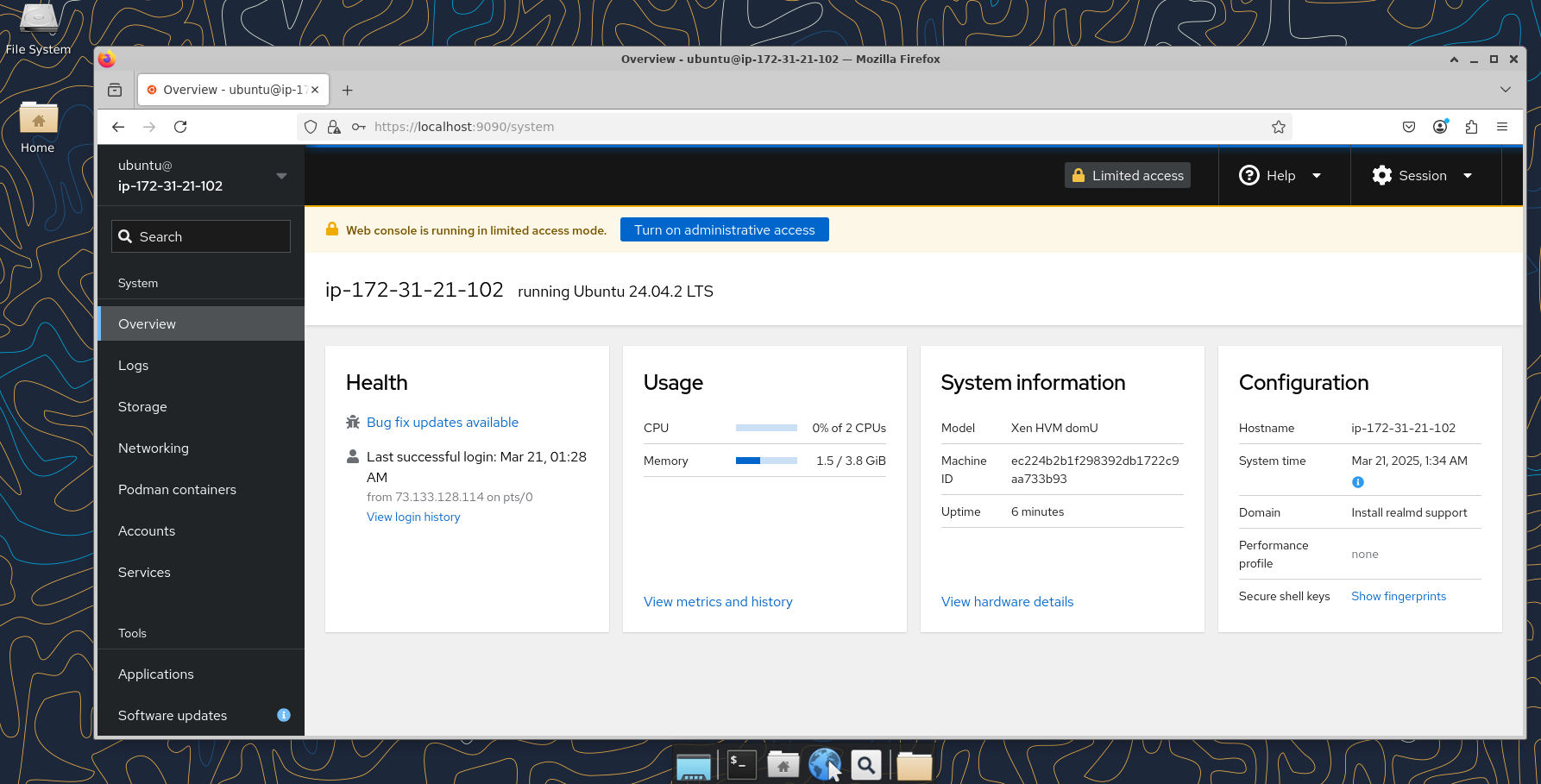
Access docker via Cockpit GUI
Pre-Configured Ubuntu 24.04 LTS with Docker, RDP Desktop, and Cockpit Web Management
This is a repackaged open-source software product. Additional charges apply for Docker optimization, RDP GUI configuration, and Cockpit web management setup.
Madarson IT's Ubuntu 24.04 LTS AMI delivers a production-ready environment with Docker, xrdp remote desktop, and Cockpit web-based server administration pre-installed and optimized. Launch your EC2 instance and begin deploying containerized applications without spending time on manual installation and configuration.
Prerequisites and Requirements
- Minimum Instance Type: t3.medium or larger (2 vCPUs, 4 GB RAM recommended)
- Root Volume: 20 GB minimum (SSD recommended)
- Security Group Ports: Open TCP 22 (SSH), TCP 3389 (xrdp/RDP), and TCP 9090 (Cockpit web interface)
- Key Pair: Required for initial SSH access
Key Features
- Ubuntu 24.04 LTS - The latest long-term support release from Canonical with regular security updates and five years of maintenance through 2029.
- Pre-installed Docker Engine - Docker daemon configured and running on launch. Deploy, manage, and scale containers immediately.
- Optimized Docker Configuration - The Docker daemon is pre-configured with log rotation enabled, overlay2 storage driver, and resource-aware settings to reduce overhead on smaller instances.
- Cockpit Web Management - Access a real-time web dashboard at https://:9090 for system monitoring, Docker container management, service control, and log viewing - no SSH required.
- xrdp Remote Desktop - Full graphical Ubuntu desktop accessible via any standard RDP client on port 3389, enabling GUI-based workflows.
- Security Hardening - SSH root login disabled, unattended-upgrades enabled for automatic security patches, and UFW firewall configured to restrict access to essential ports only.
Deployment Steps
- Launch the AMI on a t3.medium or larger instance with a key pair attached.
- Configure your security group to allow inbound TCP on ports 22, 3389, and 9090.
- SSH into the instance using your key pair to retrieve initial credentials.
- Access Cockpit at https://:9090 using your system credentials.
- Connect via RDP on port 3389 using any standard Remote Desktop client.
- Run "docker ps" to verify the Docker daemon is active and ready for container deployment.
Use Cases
- Startup Container Deployment - A small development team deploys a Node.js API and Nginx reverse proxy in Docker containers on a single t3.medium instance, managing everything through Cockpit's web interface without dedicated DevOps staff.
- Microservices Development - Run multiple isolated services on EC2 for integration testing before pushing to production orchestration platforms.
- Remote System Administration - Monitor CPU, memory, storage, and Docker container health through Cockpit dashboards without maintaining SSH sessions.
- CI/CD Staging Environments - Spin up disposable containerized environments for automated testing pipelines.
- GUI-Based Development - Developers who prefer graphical IDEs connect via RDP to work directly on the Ubuntu desktop with Docker available locally.
Why Choose This Madarson IT Image?
- Save Setup Time: Docker, Cockpit, xrdp, and security hardening are pre-configured - eliminating manual installation steps that typically require 30+ minutes on a bare Ubuntu image.
- Secure by Default: SSH root login is disabled, automatic security updates are active, and UFW restricts traffic to only the ports your applications need.
- Long-Term Reliability: Ubuntu 24.04 LTS receives security patches and updates from Canonical through 2029.
- Web-Based Management: Cockpit provides container lifecycle management, real-time resource monitoring, and service administration without command-line expertise.
AWS Integration
This AMI runs natively on Amazon EC2 and integrates with AWS security groups for network access control, Amazon EBS for persistent storage, and AWS Systems Manager for fleet management. Use IAM roles to grant containers secure access to other AWS services.
About Madarson IT
Madarson IT specializes in security-hardened and customized cloud images published across AWS, GCP, and Azure Marketplaces. Every image is validated before publishing and regularly updated to incorporate the latest security patches.
Disclaimer: The trademarks mentioned in this offering are owned by the respective companies. Madarson IT does not provide licenses for any third-party product.
Highlights
- Security-Hardened Configuration - SSH root login disabled, UFW firewall restricts traffic to ports 22, 3389, and 9090 only, unattended-upgrades enabled for automatic security patches, and Docker daemon configured with log rotation and overlay2 storage driver. These pre-applied measures reduce your attack surface from the first boot without manual hardening steps.
- Cockpit Web Management and RDP Desktop Access - Monitor CPU, memory, storage, and Docker containers in real-time through Cockpit at port 9090. Connect via any standard RDP client on port 3389 for full graphical Ubuntu desktop access. Manage your entire server without maintaining SSH sessions or command-line expertise.
- Production-Ready Docker on Ubuntu 24.04 LTS - Docker Engine is pre-installed and running on launch with optimized daemon settings. Deploy containerized applications immediately on instances as small as t3.medium. Ubuntu 24.04 LTS provides five years of security updates from Canonical through 2029, ensuring long-term stability for your workloads.
Details
Sold by
Delivery method
Delivery option
64-bit (x86) Amazon Machine Image (AMI)
Latest version
Operating system
Ubuntu 24.04
Deployed on AWS
New
Introducing multi-product solutions
You can now purchase comprehensive solutions tailored to use cases and industries.

Features and programs
Financing for AWS Marketplace purchases
AWS Marketplace now accepts line of credit payments through the PNC Vendor Finance program. This program is available to select AWS customers in the US, excluding NV, NC, ND, TN, & VT.

Pricing
Pricing is based on actual usage, with charges varying according to how much you consume. Subscriptions have no end date and may be canceled any time.
Additional AWS infrastructure costs may apply. Use the AWS Pricing Calculator to estimate your infrastructure costs.
If you are an AWS Free Tier customer with a free plan, you are eligible to subscribe to this offer. You can use free credits to cover the cost of eligible AWS infrastructure. See AWS Free Tier for more details. If you created an AWS account before July 15th, 2025, and qualify for the Legacy AWS Free Tier, Amazon EC2 charges for Micro instances are free for up to 750 hours per month. See Legacy AWS Free Tier for more details.
Dimension | Cost/hour |
|---|---|
m5a.large Recommended | $0.05 |
t3.micro | $0.05 |
t2.micro | $0.025 |
m5a.12xlarge | $1.20 |
c3.4xlarge | $0.40 |
g3.8xlarge | $0.80 |
r5a.16xlarge | $1.60 |
c5a.4xlarge | $0.40 |
t3.small | $0.05 |
m5a.xlarge | $0.10 |
Dimensions summary
You pay by the hour for the software running on your chosen Amazon EC2 instance. Each dimension maps to a specific instance type, so pricing scales with the compute size you select. General-purpose (t2, t3, m3, m4, m5a, m6a), compute-optimized (c3, c5, c5a), memory-optimized (r3, r5a, r6a), storage-optimized (i2, i3, i4i, d3), and GPU-accelerated (g2, g3, g3s, g5, p2, p3) families are all available. Larger instances within a family carry higher hourly rates. You choose the instance that fits your workload, and billing tracks actual hours of use.
Top-of-mind questions for buyers
You pay the hourly software rate for each running hour on the EC2 instance you selected. Stopped or powered-off instances do not accrue software charges. AWS may still bill underlying storage for stopped instances, but the software licence meters running time only.
You get a security-hardened Ubuntu 24.04 LTS image bundled with a container runtime, remote desktop access, and a web-based server management console. Images are validated and updated with security patches. The hourly rate covers this software running on your chosen instance.
Each dimension maps to one EC2 instance type. Larger instances with more compute, memory, storage, or GPU carry higher hourly software rates. You pick the instance that fits your workload, and the rate reflects that instance size. Underlying AWS infrastructure charges bill separately.
madarsonit.com
Helpful?
Vendor refund policy
There is no refund policy for this image.

Legal
Vendor terms and conditions
Upon subscribing to this product, you must acknowledge and agree to the terms and conditions outlined in the vendor's End User License Agreement (EULA) .
Content disclaimer
Vendors are responsible for their product descriptions and other product content. AWS does not warrant that vendors' product descriptions or other product content are accurate, complete, reliable, current, or error-free.
Delivery details
64-bit (x86) Amazon Machine Image (AMI)
Amazon Machine Image (AMI)
An AMI is a virtual image that provides the information required to launch an instance. Amazon EC2 (Elastic Compute Cloud) instances are virtual servers on which you can run your applications and workloads, offering varying combinations of CPU, memory, storage, and networking resources. You can launch as many instances from as many different AMIs as you need.
Version release notes
Ubuntu 24.04 LTS with Pre-configured Docker, RDP|GUI && Cockpit Web-Based Management
Additional details
Usage instructions
Allow inbound SSH access in your security group (TCP port 22) To connect to your instance using the Amazon EC2 console: Open the Amazon EC2 console at https://console.aws.amazon.com/ec2/ .
In the navigation pane, choose Instances. Select the instance and choose Connect. Choose the EC2 Instance Connect tab. For Connection type, choose Connect using EC2 Instance Connect. Access the ec2 with the default username: "ubuntu" For GUI|RDP Access: Allow inbound TCP port 3389 (RDP) Create a password for ubuntu user for RDP login using the CLI command: "sudo passwd ubuntu" Launch RDP program and enter the ubuntu credentials Access docker via Cockpit GUI: Additionally, subscribers can manage docker containers through the Cockpit web interface by opening TCP port 9090 in their security group. Access Cockpit at https://<Your-Server-IP>:9090 for an intuitive container management experience.
Resources
Vendor resources
Support
Vendor support
Madarson IT Support
For technical assistance, configuration questions, or troubleshooting with this Ubuntu 24.04 LTS Docker AMI, contact our support team at info@madarsonit.com . Visit madarsonit.com for additional product information.
Support Scope
- Assistance with initial instance launch and connectivity (SSH, RDP, Cockpit access)
- Docker daemon configuration and container deployment questions
- Cockpit web interface access and functionality
- Security group and port configuration guidance
- Troubleshooting xrdp remote desktop connections
Getting Started
- Launch the AMI on a t3.medium or larger EC2 instance
- Open TCP ports 22 (SSH), 3389 (RDP), and 9090 (Cockpit) in your security group
- SSH into the instance with your key pair to retrieve credentials
- Access Cockpit at https://:9090
- Connect via RDP client on port 3389
For private offers, custom configurations, or volume licensing discussions, reach out to info@madarsonit.com .
AWS infrastructure support
AWS Support is a one-on-one, fast-response support channel that is staffed 24x7x365 with experienced and technical support engineers. The service helps customers of all sizes and technical abilities to successfully utilize the products and features provided by Amazon Web Services.
Similar products

This product has charges associated with it for RDP and Docker optimization. Pre-configured Ubuntu 24.04 LTS desktop AMI with Docker and xrdp ready to use, built for teams deploying containerized apps via remote GUI access.

This product has charges associated with it for Docker, RDP GUI and cockpit web optimization.
Pre-configured Ubuntu 22.04 LTS AMI with Docker, xrdp remote desktop, and Cockpit web management - ready to deploy containers in minutes without manual setup.

This product has charges associated with it for RDP and Docker optimization. Launch Docker containers and connect via remote desktop in minutes with this pre-configured Ubuntu 22.04 LTS AMI - ideal for developers without dedicated DevOps staff.

This product has charges associated with it for Podman, Buildah, Skopeo, RDP, and Cockpit optimization. Madarson IT pre-configured Ubuntu 24.04 LTS AMI with Podman, Buildah, Skopeo, RDP, and Cockpit for secure, rootless container management and deployment.
Customer reviews
No customer reviews yet
Be the first to review this product . We've partnered with PeerSpot to gather customer feedback. You can share your experience by writing or recording a review, or scheduling a call with a PeerSpot analyst.