
Sold by: Cloud Infrastructure Services
Deployed on AWS
AWS Free Tier
This is a repackaged open source software product wherein additional charges apply for a web console, directory authentication, optimised configuration and validated changes with automatic rollback feature.
4.2
Overview
Image
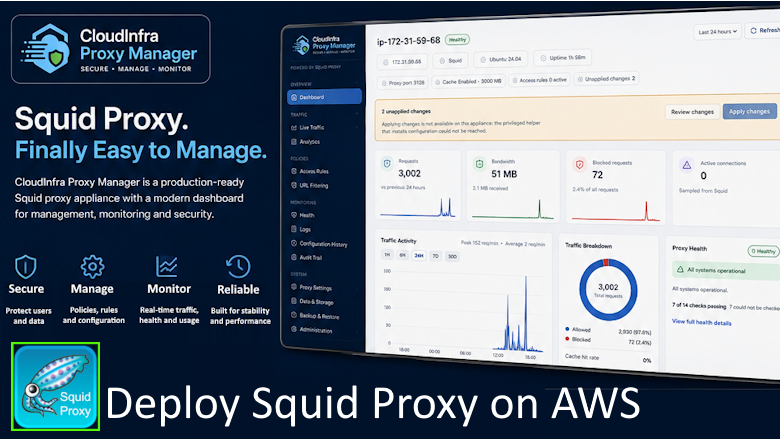
Squid Proxy with Web Console
Image
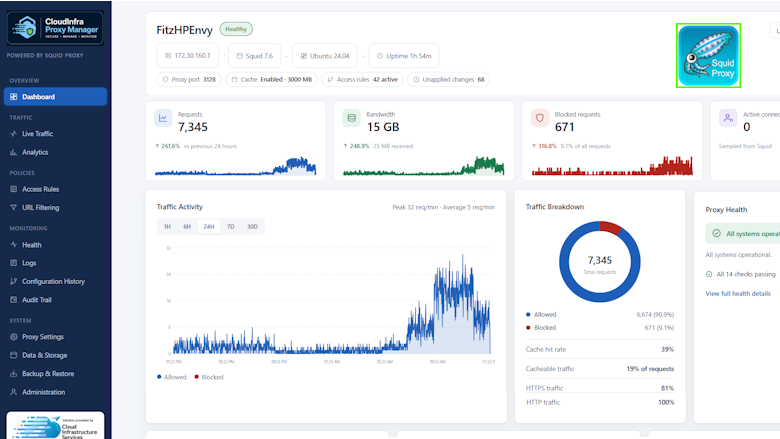
Fully Manage Squid from Web Console
Image
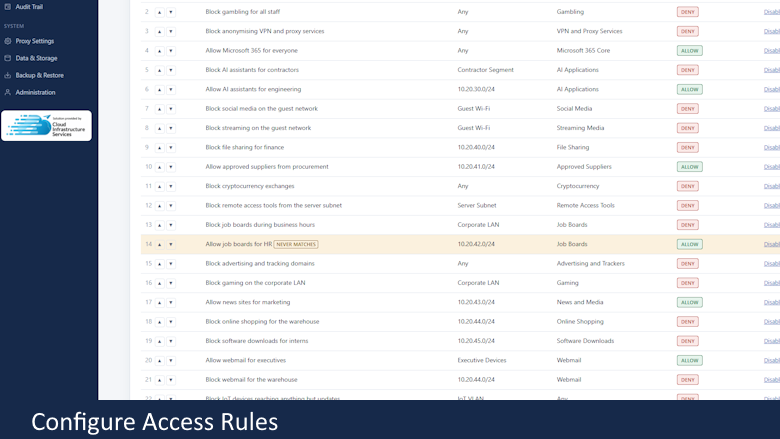
Easily setup access rules, allow or deny.
Image
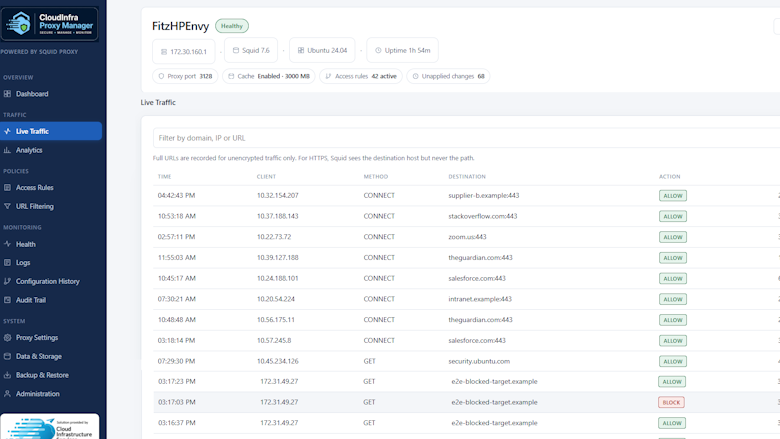
Live Traffic Monitoring
Image
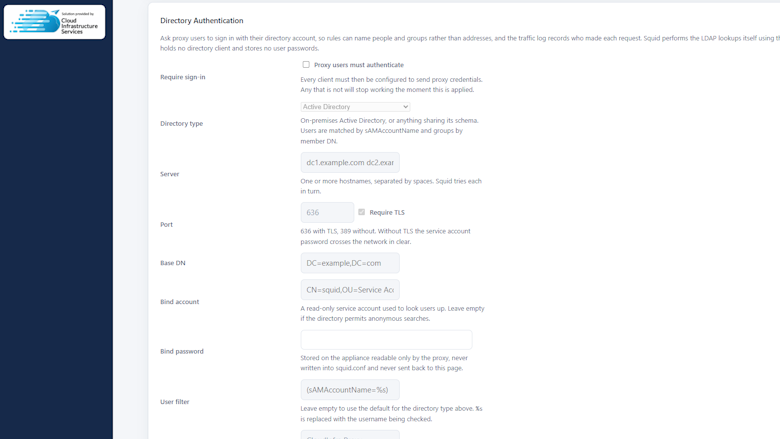
Squid Active Directory Authentication
Image
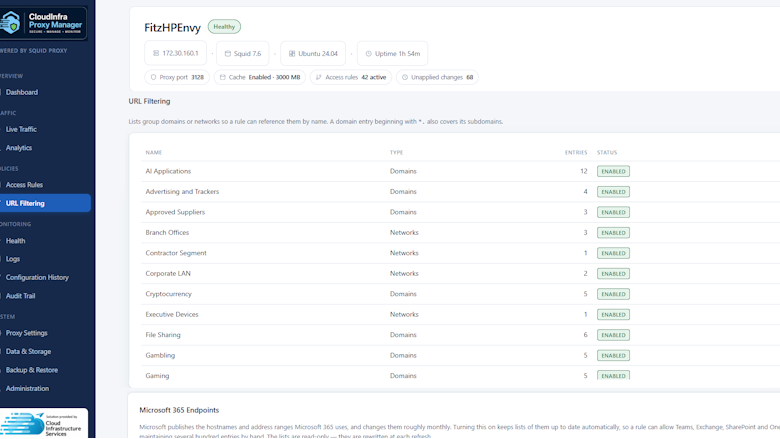
URL Filtering - Allow or Deny by IP or Group
Image
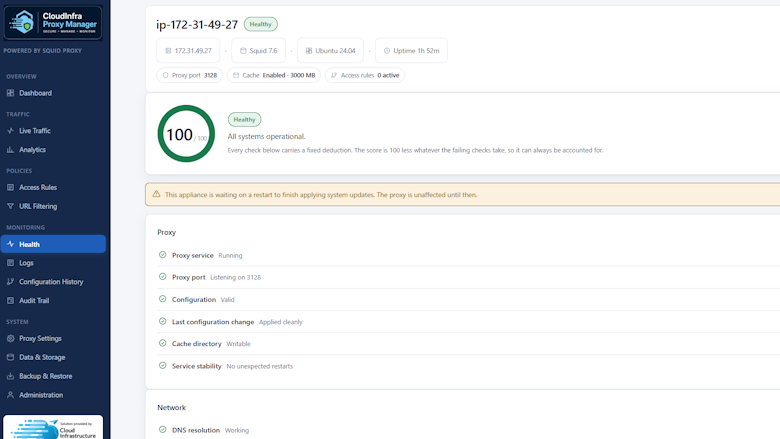
Squid Health Monitoring
Squid Proxy Server with Web Console and Directory Authentication
Squid Proxy Server is a caching forward proxy for HTTP and HTTPS, packaged as an appliance with a web console (CloudInfra Proxy Manager) so it can be run without editing configuration files by hand. Production-ready Squid Proxy Server with a modern web dashboard for access control, URL filtering, traffic monitoring, reporting, caching, health monitoring and configuration management.
Squid Proxy with Web Gui - CloudInfra Proxy Manager Features:
Squid 7.6 compiled from source on Ubuntu 24.04 LTS, with a management console on port 8443 and the proxy on port 3128.
Access rules. Allow or deny by client address, network, directory user or directory group, against a domain, a network or a named list. Rules are evaluated in order and the console shows you the order.
URL filtering. Keep named lists of domains and networks and reuse them across rules, so one edit updates every rule that refers to the list.
Directory authentication. Active Directory, Entra Domain Services or OpenLDAP, over LDAPS on port 636 or StartTLS on port 389. StartTLS fails rather than falling back to clear text. Install your directory certificate authority from the console so the connection validates.
Microsoft 365 endpoints. Microsoft publishes the address ranges its services use, and the appliance keeps that list current so those policies do not go stale.
Certificate management. Replace the console certificate with your own from the console and the browser warning goes away. The pair is checked before anything is written, takes effect without a restart, and the previous certificate is restored if the new one fails to load.
Web caching & bandwidth. Squid is a caching proxy, and the cache is fully configurable from the console: enable or disable it, set the cache size on disk, the memory cache, and the maximum object size.
Safe changes. Every change is parsed by the proxy engine itself before installation, the running configuration is snapshotted, and the proxy is health checked afterwards. If it fails, the snapshot is restored automatically.
Traffic reporting. Requests, allowed and blocked counts, cache hit rate, top destinations and top clients, all computed from the proxy own log.
Health Monitoring. Monitor the status of your Squid proxy such as proxy service, listener, configuration validity, log rotation, cache, disk, DNS, pending security updates & more.
Backups, an audit log and configuration history are included.
Common Use Cases for Squid Proxy
Controlled outbound access from private subnets. Give workloads with no direct route to the internet one audited way out. You decide what they may reach, and every request is logged in one place. Clients are pointed at the proxy deliberately, so nothing is intercepted without your knowledge.
Web filtering for staff, by directory group. Connect the appliance to your Active Directory and write rules that name groups rather than addresses. One policy for marketing, another for engineering, and each rule reads back as a sentence before you apply it.
Microsoft 365 access without maintaining address lists. Microsoft publishes the ranges its services use and changes them regularly. The appliance keeps that list current, so a Microsoft 365 policy does not quietly go stale.
Cutting repeated download traffic. Package mirrors, container layers and installers pulled by many machines are served from cache the second time, which reduces both the wait and the egress bill.
Squid Proxy First Boot
The TLS certificate and the administrator password are generated on your instance the first time it starts, so no two instances share them. The password is written to the instance console and to a file on the instance, and you are required to change it at first sign in.
Squid Config
The console manages access rules, URL lists, directory authentication and the apply pipeline. Squid itself does a great deal more, and none of it is locked away. The file /etc/squid/local.conf is yours: the console never generates it, never overwrites it, and a rollback never touches it, so anything you put there survives every update. Cache peers, refresh patterns, custom authentication parameters, denial pages and performance tuning all belong there. Access rules are the one exception and should be created in the console, because Squid evaluates them in order and local.conf is read after the default deny.
Highlights
- Manage the proxy from a web console. Build access rules, URL filter lists and Microsoft 365 endpoint policies without editing a configuration file by hand.
- Authenticate users against Active Directory, Entra Domain Services or OpenLDAP over LDAPS or StartTLS, then write rules that name individual users and directory groups.
- Every change is parsed by the proxy engine itself, snapshotted, then rolled back automatically if the proxy fails its health check, so a bad edit cannot take the service down.
Details
Categories
Delivery method
Delivery option
64-bit (x86) Amazon Machine Image (AMI)
Latest version
Operating system
Ubuntu 24.04
Deployed on AWS
New
Introducing multi-product solutions
You can now purchase comprehensive solutions tailored to use cases and industries.

Features and programs
Buyer guide
Gain valuable insights from real users who purchased this product, powered by PeerSpot.
Financing for AWS Marketplace purchases
AWS Marketplace now accepts line of credit payments through the PNC Vendor Finance program. This program is available to select AWS customers in the US, excluding NV, NC, ND, TN, & VT.

Pricing
Pricing is based on actual usage, with charges varying according to how much you consume. Subscriptions have no end date and may be canceled any time.
Additional AWS infrastructure costs may apply. Use the AWS Pricing Calculator to estimate your infrastructure costs.
If you are an AWS Free Tier customer with a free plan, you are eligible to subscribe to this offer. You can use free credits to cover the cost of eligible AWS infrastructure. See AWS Free Tier for more details. If you created an AWS account before July 15th, 2025, and qualify for the Legacy AWS Free Tier, Amazon EC2 charges for Micro instances are free for up to 750 hours per month. See Legacy AWS Free Tier for more details.
Dimension | Cost/hour |
|---|---|
t2.medium Recommended | $0.05 |
t2.micro | $0.05 |
t3.micro | $0.05 |
m3.medium | $0.05 |
m3.large | $0.05 |
m3.xlarge | $0.05 |
m3.2xlarge | $0.05 |
m4.large | $0.05 |
m4.xlarge | $0.05 |
m4.2xlarge | $0.05 |
Dimensions summary
You pay by the hour for each running instance, with no upfront commitment. Pricing scales with the EC2 instance type you pick. The listing offers a wide range of instance sizes, from small burstable types to large compute, memory, storage, and GPU-optimized machines, plus bare-metal options. Each choice bills at its own hourly software rate for the same proxy software. Larger instances carry more CPU, memory, or storage capacity, so cost tracks the compute power you select. Add AWS infrastructure charges separately. Choose the instance that matches your traffic and caching needs, then adjust as demand changes.
Top-of-mind questions for buyers
Each rate maps to one running EC2 instance of the type you pick. The rate covers the proxy software running on that instance. Different instance types carry different CPU, memory, storage, and GPU capacity, so the hourly software charge reflects the machine size you deploy.
The hourly software charge applies only while the instance runs. A stopped instance does not accrue software charges. Stopped instances may still incur AWS storage fees for attached disks, but the software meter counts running hours only. Restarting resumes hourly billing.
You can run several instances behind a network load balancer, but each is configured separately. Central multi-appliance management is not yet available. Each running instance bills at its own hourly software rate, so total cost is the sum of every active instance.
cloudinfrastructureservices.co.uk
Helpful?
Vendor refund policy
We do not currently support refunds, but you can cancel at any time.

Legal
Vendor terms and conditions
Upon subscribing to this product, you must acknowledge and agree to the terms and conditions outlined in the vendor's End User License Agreement (EULA) .
Content disclaimer
Vendors are responsible for their product descriptions and other product content. AWS does not warrant that vendors' product descriptions or other product content are accurate, complete, reliable, current, or error-free.
Delivery details
64-bit (x86) Amazon Machine Image (AMI)
Amazon Machine Image (AMI)
An AMI is a virtual image that provides the information required to launch an instance. Amazon EC2 (Elastic Compute Cloud) instances are virtual servers on which you can run your applications and workloads, offering varying combinations of CPU, memory, storage, and networking resources. You can launch as many instances from as many different AMIs as you need.
Version release notes
New Squid proxy web console to fully manage squid via web console. Install the latest image.
Additional details
Usage instructions
SSH into the EC2 instance with the following username: ubuntu
Instructions for connecting to Linux instances via SSH can be found on: https://docs.aws.amazon.com/AWSEC2/latest/UserGuide/ec2-key-pairs.html
Once logged in, read our getting started guide on the following URL: https://proxydocs.cloudinfrastructureservices.co.uk/getting-started/quickstart/
Support
Vendor support
Support & Documentation
For email support on using Squid contact us directly via the following page: https://cloudinfrastructureservices.co.uk/contact-us/
For usage documentation on using Squid proxy refer to:
AWS infrastructure support
AWS Support is a one-on-one, fast-response support channel that is staffed 24x7x365 with experienced and technical support engineers. The service helps customers of all sizes and technical abilities to successfully utilize the products and features provided by Amazon Web Services.
Updated weekly

By Cloud Infrastructure Services

By Tidal Media Inc

By Diladele B.V.
Sentiment is AI generated from actual customer reviews on AWS and G2
Functionality
Ease of use
Customer service
Cost effectiveness
Positive reviews
Mixed reviews
Negative reviews
AI generated from product descriptions
Caching Proxy Engine
Squid 7.6 compiled from source with configurable cache size on disk, memory cache, and maximum object size for HTTP and HTTPS traffic
Directory Authentication
Support for Active Directory, Entra Domain Services, or OpenLDAP authentication over LDAPS on port 636 or StartTLS on port 389 with certificate validation
Access Control and URL Filtering
Rule-based access control by client address, network, directory user or group with named lists for domains and networks that can be reused across rules
Configuration Validation and Rollback
Automatic parsing of changes by proxy engine, configuration snapshots, health checks after deployment, and automatic restoration to previous state if proxy fails validation
Traffic Monitoring and Reporting
Request counting, allowed and blocked traffic metrics, cache hit rate calculation, top destinations and clients identification computed from proxy logs
Protocol Support
Supports HTTP, HTTPS, FTP, Gopher, SSL, and WAIS protocols for comprehensive proxy functionality
Content Caching Mechanism
Implements content caching to deliver data from closest servers, reducing system load and improving object retrieval efficiency
Access Control and Authorization
Provides rich access control, authorization, and logging environment for web proxy and content serving applications
Traffic Optimization
Includes rich set of traffic optimization options enabled by default for performance enhancement
Reverse and Forward Proxy Architecture
Functions as modular, high-performance reverse proxy and forward proxy server with caching capabilities
HTTPS Decryption and SSL Inspection
Deep HTTPS decryption and SSL inspection capability to filter encrypted web traffic against security policies, preventing malicious downloads, explicit content, and policy violations.
Active Directory Integration
Integration with Active Directory, LDAP, and RADIUS authentication systems to apply granular per-user and per-group filtering policies using existing directory infrastructure.
Web Filtering and Content Blocking
Web filtering proxy appliance based on Squid that blocks illegal or potentially malicious file downloads, removes advertisements, prevents access to specified website categories, and blocks resources with explicit content.
Centralized Policy Management
Centralized web-based administrative interface for defining differentiated access levels across departments, roles, and device groups without requiring additional client software.
Multi-Platform Deployment
Pre-configured deployment on AWS as an AMI running Ubuntu 26.04 and Squid 7.6, with support for Azure, VMware, and Hyper-V environments for hybrid infrastructure scenarios.
Standard contract
No
Customer reviews
Garfield Carneiro
Centralized proxy access has secured our air‑gapped servers and simplifies controlled internet use
Reviewed on Aug 03, 2026
Review provided by PeerSpot
What is our primary use case?
My main use case for Squid Proxy Cache Server is that we have machines behind an internet firewall which do not have access to the internet. The only way these machines can access anything outside, for example, Java packages or Maven packages, is via Squid Proxy Cache Server. These machines are called air-gapped servers, and air-gapped servers do not have access to the internet. If they do not have access to the internet but still want to access the internet, then Squid Proxy Cache Server is a good way to connect to the internet and download those packages. Currently, we are using it as a security tool. Not every machine needs to connect to the internet. Only a handful of machines need to connect, or in this case, Squid Proxy Cache Server needs to connect to the internet.
Although Squid Proxy Cache Server was earlier used in a pre-internet environment where not every machine was connected to the internet, it is still surviving now because it is the only mechanism where we can emulate firewalling. Not every machine needs to connect to the internet. Our product is based out of a data center, so machines go via Squid Proxy Cache Server. Unique scenarios or challenges include having to enable something called ACLs. Most people just install Squid Proxy Cache Server and think that it is all done, but there is a specific Access Control List that you have to enable so all servers or your subnet will start accessing Squid Proxy Cache Server. If you do not enable this, then the machines will not get access to the internet.
In our case, we only use it for Maven proxy servers or Maven cache. We use the Maven cache after Squid Proxy Cache Server. So, any application that needs a Java package comes to the Maven cache server, then it goes to Squid Proxy Cache Server, and then it goes to the internet. We are limiting what we are allowing through the proxy.
What is most valuable?
The best features Squid Proxy Cache Server offers in my experience include how easy it is to install and configure. It has been available for almost every Linux distribution for the last twenty to thirty years. Although these days it is not as widely used as other networking tools, the advantage that it gives is that not every machine needs to have access to the internet. Another part that I really appreciate about it is the logs. The logs allow you to see what every machine is accessing. I think that is one of the best features of Squid Proxy Cache Server. You can actually see if a request is going to a particular domain and what is being served by Squid Proxy Cache Server. The only limitation there is that HTTPS traffic cannot be decrypted. Anything that happens inside an HTTPS tunnel is not shown to Squid Proxy Cache Server, which is appropriate security and how HTTPS was supposed to work.
One of the features that I find useful in Squid Proxy Cache Server is that you can host multiple Squid Proxy Cache Server instances behind a load balancer, and you can have a cache mechanism. You can have a parent domain hierarchy in Squid Proxy Cache Server. If the child is not able to find a certain website, it goes to the parent. Those things are also available in Squid Proxy Cache Server, though they are rarely used today. You can chain Squid Proxy Cache Server instances together to create one more cache and have busy servers and less busy servers. There is something called a cache miss and a cache hit. A good proxy server has a higher number of cache hits and a lower number of cache misses. All those things are very well documented inside the logs as well. That is another unique feature of Squid Proxy Cache Server.
Squid Proxy Cache Server has positively impacted my organization because, as I mentioned, I do not have to enable internet access for each and every machine. They have to go via Squid Proxy Cache Server. So that has increased my security bar for the network. This approach has led to more peace of mind and best practices. Only one server has to access the internet. On the firewall, you have to allow only Squid Proxy Cache Server. The rest are all clients to that Squid Proxy Cache Server. So that takes care of your major security headache.
What needs improvement?
I cannot think of how Squid Proxy Cache Server can be improved. It has everything built-in, from Active Directory integration to centralized logging. It has been a proxy cache server for so many years. I do not think you can perfect it anymore or that there is any more work left. It is the de facto proxy server for a reason.
If I had to add more about needed improvements for Squid Proxy Cache Server, a UI built on top of Squid Proxy Cache Server where I can see the logs in real-time would be great, but it is not really a priority for anyone. You can have Squid Proxy Cache Server logs going to a syslog or a Splunk server and then you can see it in real-time. You really do not need to worry about it. Another good feature would be if the logs could be in JSON format. Then Elasticsearch, Splunk, and everyone could parse it easily.
For how long have I used the solution?
I have been using Squid Proxy Cache Server ever since two thousand three or ever since I started my career. In earlier days, it was used as a caching and an HTTP proxy. We used to have only a very few machines that were connected to the internet. Unlike these days where every laptop is connected to the internet, in earlier days, only a few machines used to connect to the internet, and that internet was via Squid Proxy Cache Server. We have been using it for almost twenty years now.
What do I think about the stability of the solution?
Squid Proxy Cache Server is one hundred percent stable.
What do I think about the scalability of the solution?
Regarding Squid Proxy Cache Server's scalability, you can have a parent and a child Squid Proxy Cache Server instances, or you can put Squid Proxy Cache Server behind a load balancer. Depending on how you want to do it, it is all available for you.
How are customer service and support?
The customer support for Squid Proxy Cache Server is not needed because it is an open-source product. You do not need customer care support for Squid Proxy Cache Server. If you know how to run most open-source products, this is the product. If you can run Linux and install packages on Linux, this is a good way to go. There is no support needed. There is an open-source community available on the internet, or the manual pages themselves are very helpful.
Which solution did I use previously and why did I switch?
I previously used a different solution before Squid Proxy Cache Server, where all machines were connecting to the internet.
What's my experience with pricing, setup cost, and licensing?
My experience with Squid Proxy Cache Server regarding pricing, setup cost, and licensing is that it is an open-source product. There is no pricing, setup cost, or licensing cost. You use it and if you do not want it, you shut it down. It is as easy as that. Using Squid Proxy Cache Server is as easy as using Linux.
Which other solutions did I evaluate?
Before choosing Squid Proxy Cache Server, I evaluated other options such as SSHD as a SOCKS server and Apache as a proxy server. But those are very hard to configure. Squid Proxy Cache Server is the de facto proxy cache server. I do not need to explain much. If you just search for "proxy server," you are most probably going to find that Squid Proxy Cache Server is the right one.
What other advice do I have?
I use the logs from Squid Proxy Cache Server only for troubleshooting. For example, why is a certain IP address not able to get a certain package or what is a certain IP address doing? The logs are mostly in an access log format and it is very easy to read and see what each and every machine is trying to access.
I rate Squid Proxy Cache Server a nine out of ten.
I rate it a nine because I do not think any software is ten out of ten. Every software has a chance to improve. No software is perfect.
Integrating AI with Squid Proxy Cache Server is a really great ask and would be a great feature.
Regarding Squid Proxy Cache Server's AI capabilities, it just works out of the box. You do not have to worry too much about it. It has sensible defaults inside it. You just have to tweak those sensible defaults if you are having high traffic.
My advice to others looking into using Squid Proxy Cache Server is to go ahead and install it. The sensible defaults will take care of most of the security items. You really do not have to worry about it.
For twenty-three years, I thought I would not be using Squid Proxy Cache Server. I thought the days of Squid Proxy Cache Server were dead, obsolete, and that it was not needed. But it does serve its purpose in today's age as well.
Ammar Khan
Secures internet access and improves caching but still needs stronger integrated security controls
Reviewed on Jul 22, 2026
Review provided by PeerSpot
What is our primary use case?
In my career, I have been using Squid Proxy Cache Server for almost five years. I was working in a news channel in media before two years ago. When I was there, we deployed Squid Proxy Cache Server for media-related pictures and file-related contents.
We use Squid Proxy Cache Server primarily to secure our network. No device, no user, and no desktop is allowed to use the internet bypassing the proxy. This is all about the forward proxy. The first thing in our mind at that time was to secure our network when our devices and users connect to the internet. We introduced Squid Proxy for that to minimize security risks. We also used it for the reverse proxy to mitigate incoming attacks when someone visits websites and other services. The traffic connects directly to our servers and passes through our reverse proxy server. Secondly, we planned to have a cache to speed up our productivity between servers and user data, so we also configured caching settings in the proxy server, which provides a great benefit to productivity by saving bandwidth.
What is most valuable?
What I appreciate the most about Squid Proxy Cache Server is that both of its features are very beneficial for any IT company, whether it should be a media company, a finance company, or any other sector. This offers the benefit and the secure option that no employee or user should go directly to the internet. It is very useful to use a proxy server and securely connect to the internet because the forward proxy always saves you. Any user connecting from internally is protected from outside attacks since we are using a forward proxy server.
For Squid Proxy Cache Server, we use it primarily to secure our network. No device, no user, and no desktop is allowed to use the internet bypassing the proxy. The first thing in our mind at that time was to secure our network when our devices and users connect to the internet. We introduced Squid Proxy for that to minimize security risks. We also used it for the reverse proxy to mitigate incoming attacks when someone visits websites and other services. The traffic connects directly to our servers and passes through our reverse proxy server. Secondly, we planned to have a cache to speed up our productivity between servers and user data, so we also configured caching settings in the proxy server, which provides a great benefit to productivity by saving bandwidth.
What needs improvement?
As for what I dislike about Squid Proxy Cache Server, there is nothing specifically to dislike. However, currently, we are using Fortinet and Sophos firewalls, which have built-in proxy servers. I have seen that they are enriched in security, with maximized security levels featuring DLP, IPS, IDS, and SSL inspection. They come with various security features, and thus, the security is a bit higher in these products.
As of right now, Squid Proxy Cache Server does not have this sort of security, so I would like to see better security in Squid Proxy Cache Server. I think Squid Proxy Cache Server is an open-source server. At that time, we had not deployed those features, but I think you can have them in Squid Proxy Cache Server too.
To make Squid Proxy Cache Server better, we can integrate some other products that introduce security. We can enrich the firewall and enhance SE Linux and file-level control. We can introduce SSL inspection and create or deploy IPS and some DLP-related features into it. If it remains open source, all those improvements will be much better.
For how long have I used the solution?
In my career, I have been using Squid Proxy Cache Server for almost five years.
What do I think about the stability of the solution?
Regarding stability, it was very good. We did not face any kind of crash or network failure issue. Once in a blue moon, we have faced an issue related to cache, as users and device owners complained about the network not working. We checked the proxy server, and the cache server was not working properly because it had reached its maximum capacity. After clearing and purging it, it started to work well again.
What do I think about the scalability of the solution?
In terms of scalability, Squid Proxy Cache Server is always scalable as much as you want. If you have deployed it behind a SAN storage device, you can maximize its capacity. If you notice trouble related to RAM, CPU, or storage size, you can scale it as much as you want.
How are customer service and support?
There was not any sort of technical support for Squid Proxy Cache Server when we were using it. We did not have any technical support or any SLA from any company. We were managing it on our own, and it was totally open-source.
How was the initial setup?
The deployment of Squid Proxy Cache Server is easy and very enjoyable.
Which other solutions did I evaluate?
I have used an alternative, and the deployment of Squid Proxy Cache Server is easy and very enjoyable.
What other advice do I have?
I would rate Squid Proxy Cache Server a seven out of ten overall, considering its working, scalability, and durability. The scalability and reliability worked well for Squid Proxy Cache Server, so I would rate it an eight out of ten. However, I would rate it a little lower in security because it does not come with the required security features. I give Squid Proxy Cache Server an overall rating of seven out of ten.
Nasser Alhashim
Gaining control over employee web access has reduced unnecessary bandwidth usage
Reviewed on Jul 22, 2026
Review provided by PeerSpot
What is our primary use case?
I completed one project with my virtual lab using Squid Proxy Cache Server. I started using Squid Proxy Cache Server approximately four months ago, in April or March. I created a virtual lab with a virtual company that has users, and I used Squid Proxy Cache Server to block them from entering certain internet websites. The main use case for Squid Proxy Cache Server was to control web access. I chose Squid Proxy Cache Server because it is open source and free, which are the features I appreciate most about it.
What is most valuable?
The overall main benefits I experienced from using Squid Proxy Cache Server are the ability to control employee web browsing. I can manage which websites employees are permitted to access. This prevents them from consuming excessive bandwidth on the company network.
What needs improvement?
The configuration of Squid Proxy Cache Server was somewhat difficult for someone new to the product. I received assistance from AI during setup, but a new user would find it challenging.
When dealing with websites that use SSL, you need to create a CA certificate and install it on every device in your company to experience the full benefits of the configuration process.
The setup process is complex for someone new to Squid Proxy Cache Server.
For how long have I used the solution?
I started using Squid Proxy Cache Server approximately four months ago, in April or March.
What do I think about the stability of the solution?
I did not experience any stability or performance issues. Squid Proxy Cache Server worked perfectly, and the users in my virtual lab could not access restricted sites, so it performed its job as intended.
What do I think about the scalability of the solution?
I did not attempt to scale Squid Proxy Cache Server.
How are customer service and support?
I was not aware of the technical support team or the process for escalating questions because this was only a virtual lab for training purposes.
Which solution did I use previously and why did I switch?
I did not use a different proxy product prior to Squid Proxy Cache Server.
How was the initial setup?
Installing Squid Proxy Cache Server was very easy. I used it for free for training purposes. I implemented it as a package with pfSense during the initial setup process.
What about the implementation team?
I received help and had assistance during setup.
Which other solutions did I evaluate?
I did not evaluate any other solutions.
RaphaelDias
Blocking distracting sites has improved daily security and kept my team focused at work
Reviewed on Jul 20, 2026
Review provided by PeerSpot
What is our primary use case?
Although I am not using Squid Proxy Cache Server lately, I used it for approximately five to seven years.
My main use case for Squid Proxy Cache Server was during the time when I was using pfSense, so I set up a configuration that was very important for me to have Squid Proxy configured.
I used Squid Proxy Cache Server mainly for site blocking to provide complete security coverage, which helped me deal with the issue of access and analysis of different clients within the company, and I used it daily within a scenario together with pfSense.
At the time I used Squid Proxy Cache Server, it was implemented on a local network consisting of a physical machine that had several Docker containers, and inside it, pfSense handled all the ACL control together with Squid Proxy Cache Server.
How has it helped my organization?
Squid Proxy Cache Server had a positive impact on my organization by helping with productivity, as it ensured quality of access and improved the quality and performance of my staff greatly.
What is most valuable?
The best features that Squid Proxy Cache Server offers are the block list via ACL, which helps tremendously, and the basic installation with pfSense that I used frequently, along with the very interesting log recording functionality.
The features such as the block list via ACL and log recording made my work easier by allowing employees to have better quality of performance in terms of blocking, which helped people stay more focused and integrated in what they had to do without getting distracted by sites or networks they should not access.
What needs improvement?
Squid Proxy Cache Server could be improved by covering more aspects, having more updates, and providing a more up-to-date version of lists and logs that I can distribute to other places, thereby making its monitoring more complete.
For how long have I used the solution?
I have been working in my current field for more than fifteen years.
What do I think about the stability of the solution?
In my experience, Squid Proxy Cache Server is stable.
What do I think about the scalability of the solution?
I find the scalability of Squid Proxy Cache Server to be very good.
How are customer service and support?
I have never needed customer support for Squid Proxy Cache Server.
Which solution did I use previously and why did I switch?
I did not previously use a different solution before Squid Proxy Cache Server.
Which other solutions did I evaluate?
I did not evaluate other options before choosing Squid Proxy Cache Server, as it came up first when I researched, and I already had the integration, which made it much easier to use.
What other advice do I have?
Squid Proxy Cache Server is worth using. I give this product a rating of ten out of ten.
Raphael Dias
Daily access control has boosted staff focus and has improved productivity and security
Reviewed on Jul 20, 2026
Review provided by PeerSpot
What is our primary use case?
I have been working in my field for more than 15 years. I used Squid Proxy Cache Server for approximately 5 to 7 years, though I am not using it lately. My main use case for Squid Proxy Cache Server was when I used pfSense, and it was very important for me to have Squid Proxy configured. I mainly used it for website blocking to provide full security coverage, particularly focusing on the matter of accesses and analysis of different clients within the company, and I used it daily within a scenario together with pfSense.
How has it helped my organization?
Squid Proxy Cache Server had a positive impact on my organization by being the main factor helping with productivity. By doing this control and handling the quality of accesses, the quality and performance of the staff got much better.
What is most valuable?
I think the best features that Squid Proxy Cache Server offers are the block list via ACL, which helps a lot, the basic installation with pfSense that I used frequently, and the interesting log records, which are very helpful for us. The features such as the block list via ACL and log recording made our work easier by helping to ensure that employees had better quality of performance in terms of blocking, so people stay more focused and more engaged in what they have to do and do not get distracted with sites or networks they should not be accessing.
What needs improvement?
In my opinion, Squid Proxy Cache Server can be improved by covering more issues, having more updates, and providing a slightly more updated version of lists and logs and information that we can distribute to other places for a more complete monitoring of it.
For how long have I used the solution?
I have been working in my field for more than 15 years.
What do I think about the stability of the solution?
Squid Proxy Cache Server is stable in my experience.
What do I think about the scalability of the solution?
In my opinion, the scalability of Squid Proxy Cache Server is very good.
Which solution did I use previously and why did I switch?
I did not previously use a different solution before Squid Proxy Cache Server.
How was the initial setup?
When I chose Squid Proxy Cache Server, I did not evaluate other options because it came up first during my research, and I already had the integration, which made it much easier to use.
What about the implementation team?
At the time when I used Squid Proxy Cache Server, it was implemented on a local network, on a machine that had several Docker containers, and inside it, there was pfSense which handled all the ACL control along with Squid Proxy Cache Server.
What was our ROI?
I did not observe any practical result in terms of monetary values after implementing Squid Proxy Cache Server because I always used it as open source, together with pfSense, which is also open source. Everything was configured manually, and I did not have much improvement in terms of cost because there were none.
What other advice do I have?
I think the best features that Squid Proxy Cache Server offers are the block list via ACL, which helps a lot, the basic installation with pfSense that I used frequently, and the interesting log records, which are very helpful for us. My advice to other people thinking about using Squid Proxy Cache Server is that you can use it because it is worth it. I would rate this product a 10 out of 10.