Sold by: Ox Security
Deployed on AWS
OX rewires your security program for the Mythos Age by moving your control surface upstream to the prompt. OX AI Native Application Protection Platform includes an AI context lake that connects AI-user governance, code security, cloud enforcement, and agentic pentesting across the entire ADLC. Every finding carries its full lineage from the prompt that caused it to the runtime it threatens.
We govern the AI writing your code, prove what is actually exploitable, and fix it at the source. For new deployments, that means one platform replaces point-tool sprawl. For existing stacks, OX layers governance on top and makes your tools smarter through continuous learning. Self-improving security for an age of self-improving attackers.
4.5
Overview
Image
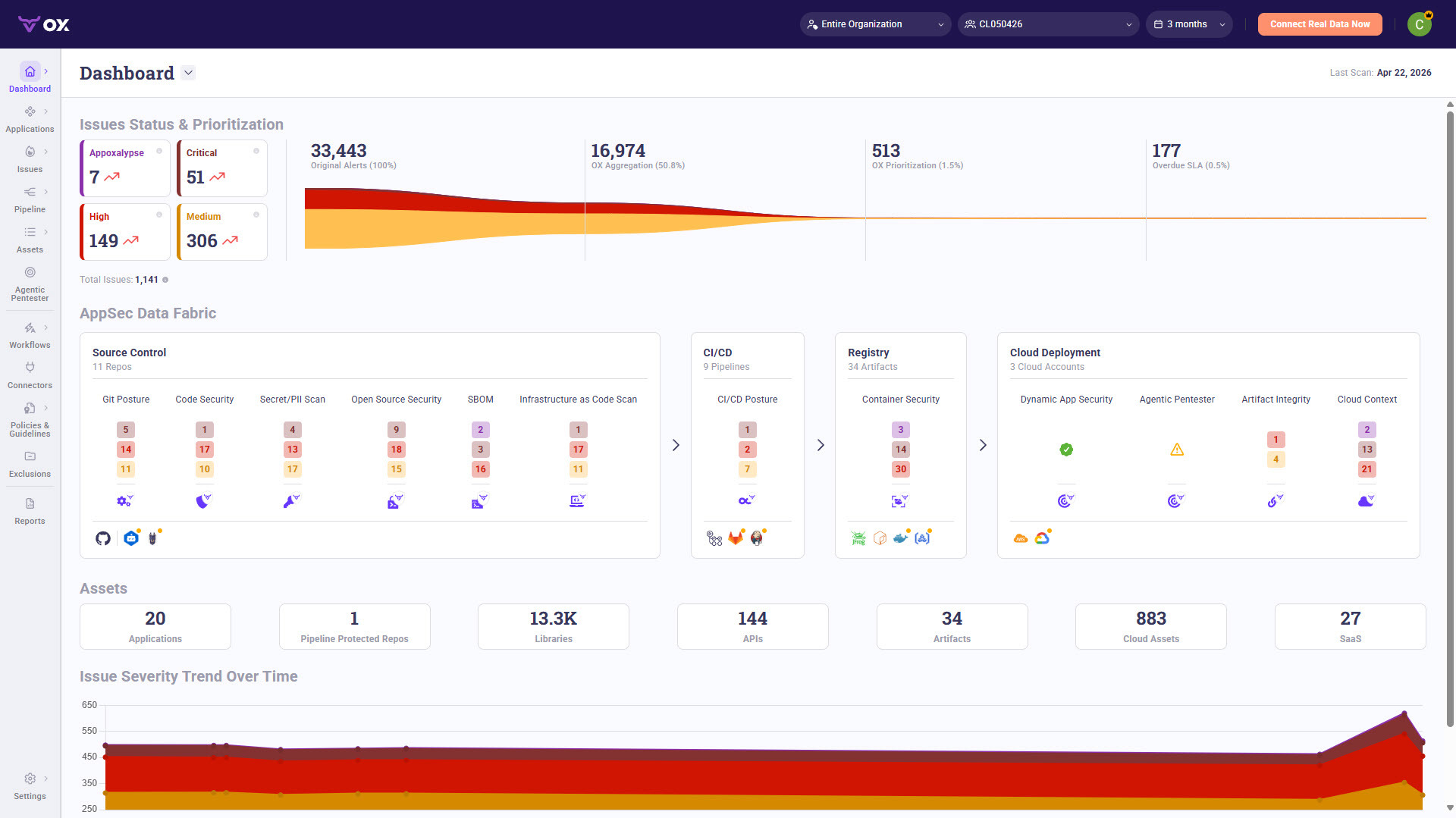
OX Platform
Image
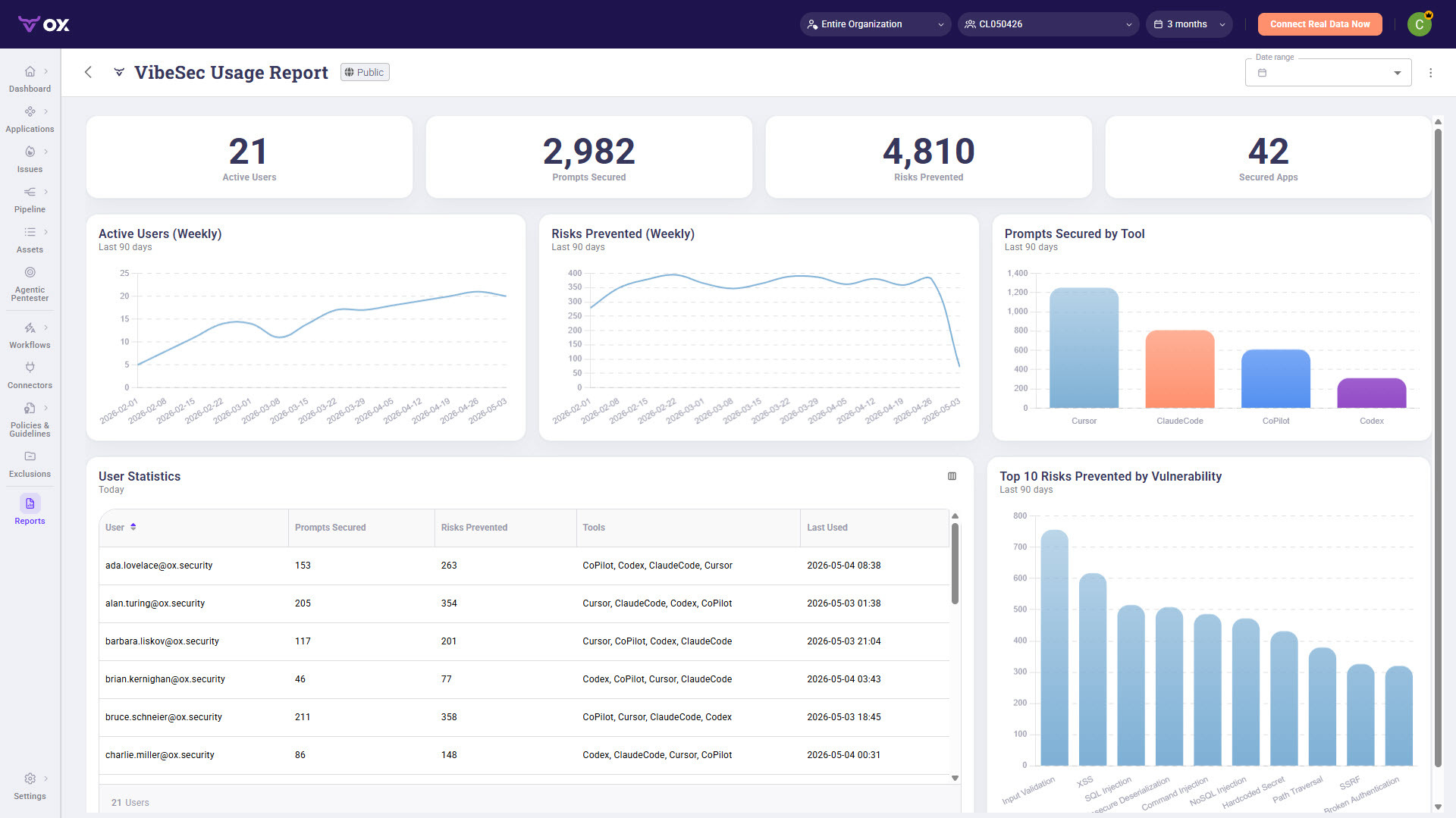
OX Vibesec
Image
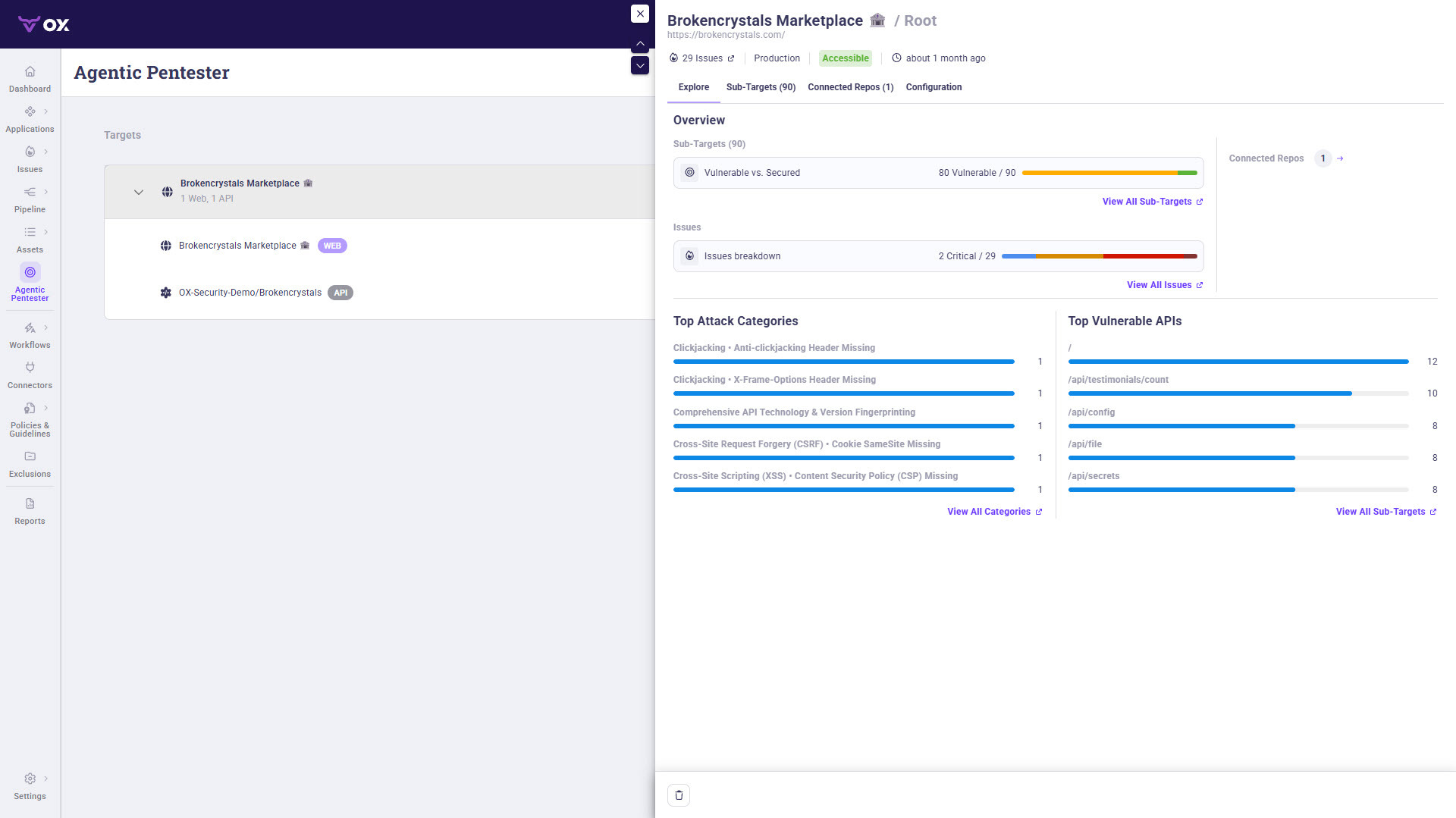
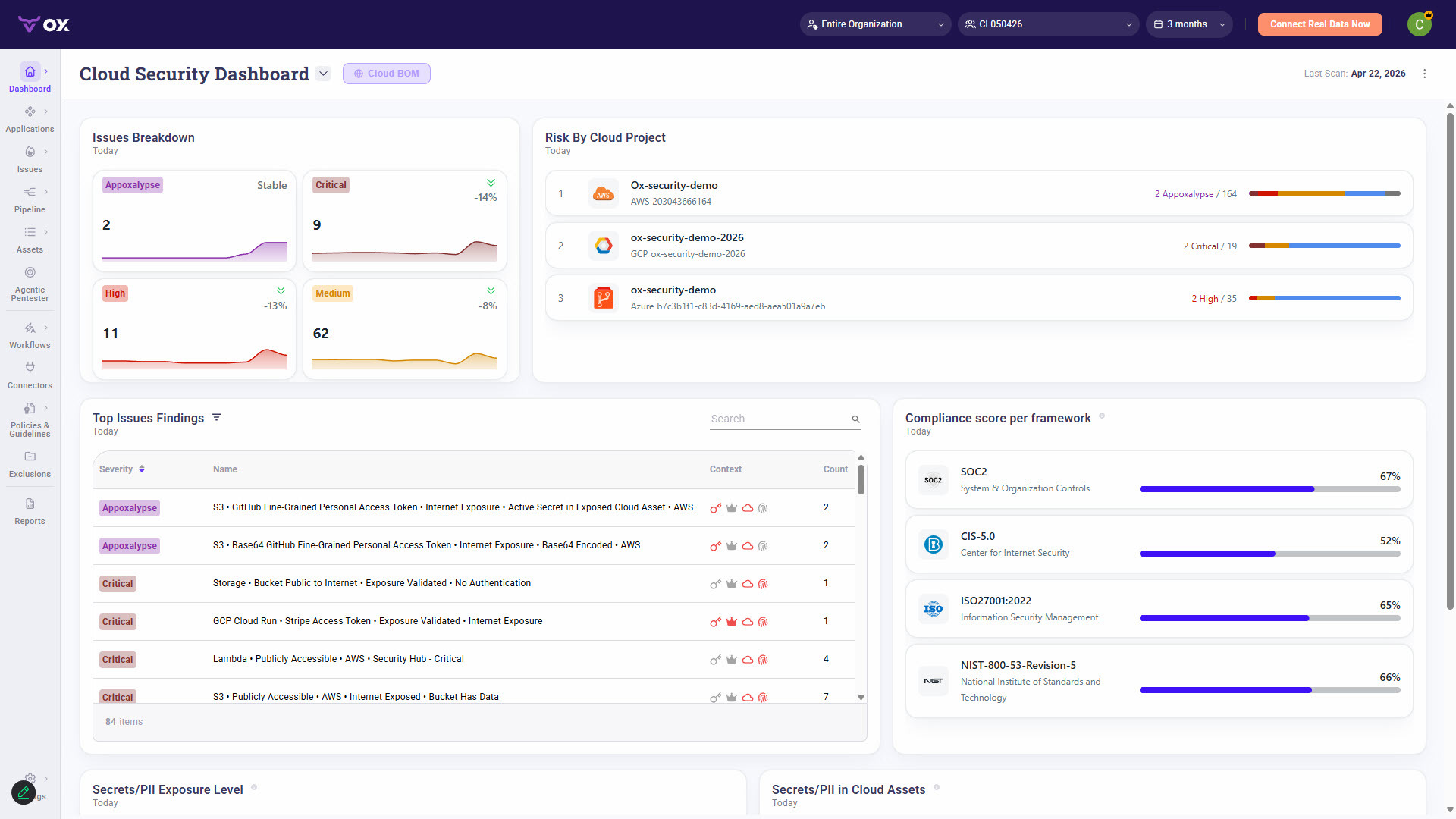
OX Agentic Pentester
Image
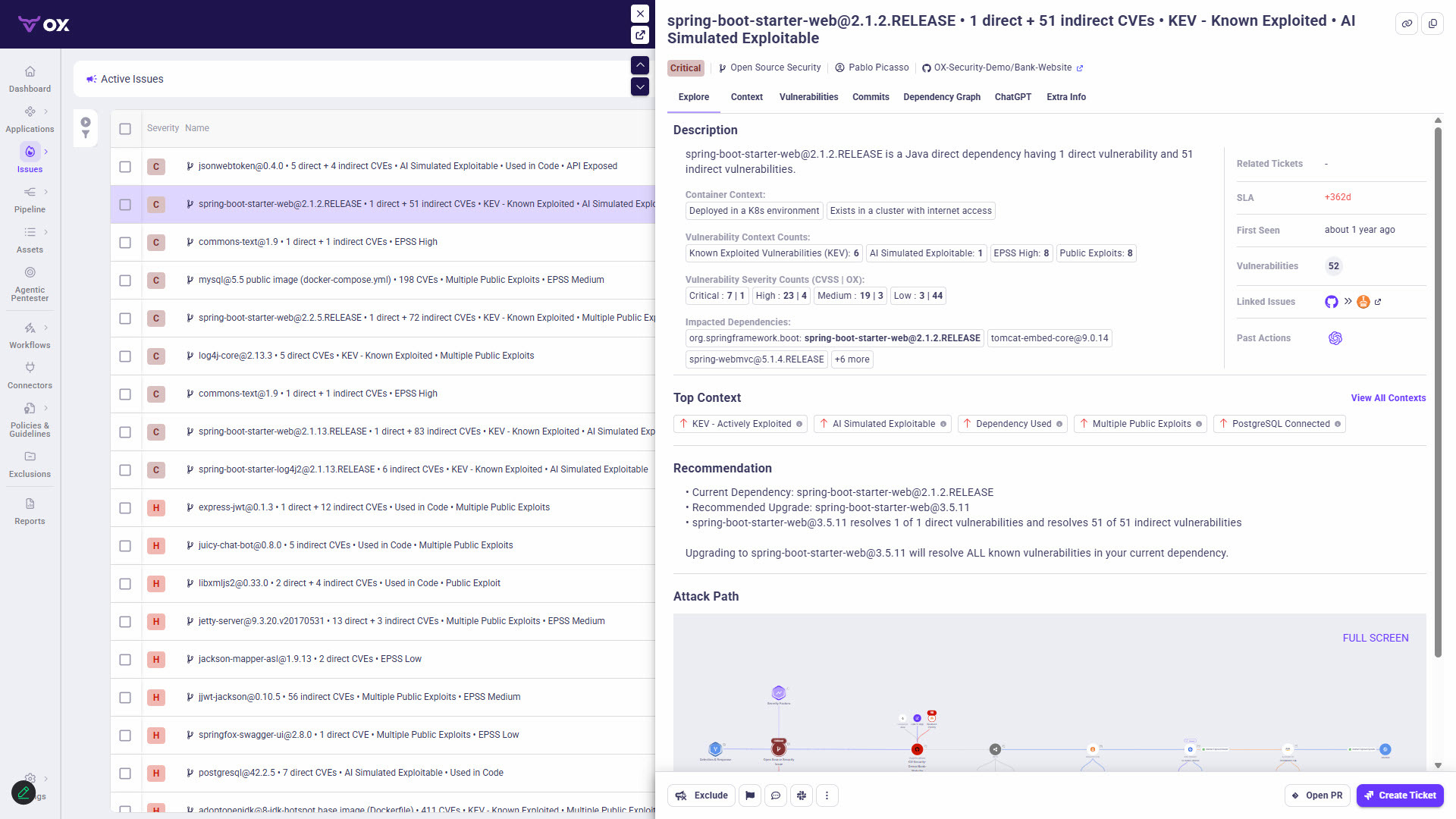
OX Cloud
Image
OX Code
OX rewires your security program for the Mythos Age: the era where AI writes the code, chains the exploits, and moves faster than human-built defenses can track. OX is an AI Native Application Protection Platform (AINAPP) unifying security from Prompt to Runtime. It moves your control surface upstream to the prompt, preventing and governing risk at the source instead of chasing it downstream in runtime. OX Mind and OX AI Context Lake connect AI-user governance, code security, cloud and runtime enforcement, and agentic pentesting into one system that shares context across the entire Agentic Development Lifecycle (ADLC), replacing fragmented point tools with a single platform. The platform runs on four connected pillars:
OX VibeSec: Prevents unsafe AI decisions at the point of creation and governs every AI user in the organization, not just developers using coding assistants. Full visibility into which agents, MCPs, skills, and packages run, with what permissions, against what data. OX Code: Separates exploitable risk from theoretical noise using evidence from your actual deployment, threat model, and threat intelligence. OX Cloud: Prevents misconfigurations and enforces runtime boundaries that code and agents cannot cross, watching what actually runs in production. OX Agentic Pentester: Continuously simulates adversarial agent behavior to prove exploit paths back to their exact source, feeding what it finds back into OX VibeSec to sharpen governance.
OX connects to your existing stack and traces every finding back to its origin (the prompt, the AI user, or the endpoint that created it), then fixes issues at the source rather than flagging them after the fact. For new deployments, OX consolidates governance, code security, cloud enforcement, and pentesting into one platform. For existing stacks, OX layers governance on top and makes current tools smarter through continuous learning, so the same issue never gets created twice. Visit https://ox.security for more information.
Highlights
- Govern the AI user, prevent at the prompt: OX VibeSec governs the AI user ecosystem - agents, MCPs, skills, packages, and the code they generate - steering code as it's generated in real time, blocking insecure patterns and risky open source before they enter the build. Unsafe code never gets written.
- Prove what's actually exploitable: OX Code provides full-spectrum coverage across SAST, SCA, SBOM, secrets, IaC, containers, and APIs, with reachability analysis and an evidence engine validating every finding from API entry point through execution path to business impact. OX Cloud enforces runtime boundaries that code and agents cannot cross.
- Validate continuously at agent velocity: OX Agentic Pentester autonomously probes the running system the way an attacker would - chaining across layers, testing privilege escalation and business logic - proving exploit paths back to their exact source and feeding findings back to sharpen governance.
Details
Sold by
Delivery method
Deployed on AWS
New
Introducing multi-product solutions
You can now purchase comprehensive solutions tailored to use cases and industries.

Features and programs
Buyer guide
Gain valuable insights from real users who purchased this product, powered by PeerSpot.
Financing for AWS Marketplace purchases
AWS Marketplace now accepts line of credit payments through the PNC Vendor Finance program. This program is available to select AWS customers in the US, excluding NV, NC, ND, TN, & VT.

Pricing
Pricing is based on the duration and terms of your contract with the vendor. This entitles you to a specified quantity of use for the contract duration. If you choose not to renew or replace your contract before it ends, access to these entitlements will expire.
Additional AWS infrastructure costs may apply. Use the AWS Pricing Calculator to estimate your infrastructure costs.
Dimension | Description | Cost/12 months |
|---|---|---|
OX AppSec Security | OX Security Platform - All Modules - 100 users | $100,000.00 |
Dimensions summary
This listing has one pricing dimension: a contract license covering all platform modules for 100 users. You pay a single fee for the packaged platform rather than choosing separate tiers or add-ons. Pricing is based on the number of active developers, meaning anyone in your connected source control who committed code in the past 90 days or is expected to contribute during the term. All four platform pillars are included in this one package, so there are no separate module fees to select or scale independently.
Top-of-mind questions for buyers
A developer is anyone registered in your connected source control system who committed code in the past 90 days, or who is expected to contribute during the licensing period. The 100-user count reflects these active developers, not total employees or seats that sit unused.
The package covers all four platform pillars in one license. You get prevention for AI-generated code, code scanning across SAST, SCA, SBOM, secrets, IaC, containers and APIs, cloud posture and runtime enforcement, and continuous agentic penetration testing. No modules are billed or scaled separately.
The subscription runs for the ordered term and renews automatically for successive one-year terms unless either party gives 60 days notice of non-renewal. Unless your order states otherwise, renewal fees increase by 5% per year from the expiring term's fees.
www.ox.security+2
Helpful?
Vendor refund policy
All fees are non-cancellable and non-refundable except as required by law.
Custom pricing options
Request a private offer to receive a custom quote.

Legal
Vendor terms and conditions
Upon subscribing to this product, you must acknowledge and agree to the terms and conditions outlined in the vendor's End User License Agreement (EULA) .
Content disclaimer
Vendors are responsible for their product descriptions and other product content. AWS does not warrant that vendors' product descriptions or other product content are accurate, complete, reliable, current, or error-free.
Delivery details
Software as a Service (SaaS)
SaaS delivers cloud-based software applications directly to customers over the internet. You can access these applications through a subscription model. You will pay recurring monthly usage fees through your AWS bill, while AWS handles deployment and infrastructure management, ensuring scalability, reliability, and seamless integration with other AWS services.
Resources
Vendor resources
Support
Vendor support
OX Security Support- support@ox.security OR
AWS infrastructure support
AWS Support is a one-on-one, fast-response support channel that is staffed 24x7x365 with experienced and technical support engineers. The service helps customers of all sizes and technical abilities to successfully utilize the products and features provided by Amazon Web Services.
Updated weekly
By Ox Security
By Sonatype

By Checkmarx
Top
25
In Continuous Integration and Continuous Delivery
Top
25
In Software Development
Top
10
In Testing
Sentiment is AI generated from actual customer reviews on AWS and G2
Functionality
Ease of use
Customer service
Cost effectiveness
Positive reviews
Mixed reviews
Negative reviews
AI generated from product descriptions
AI User Governance and Control
Governs AI user ecosystem including agents, MCPs, skills, and packages with real-time steering of code generation, blocking insecure patterns and risky open source dependencies before they enter the build process.
Prompt-to-Runtime Security Tracing
Traces every security finding back to its origin point including the prompt, AI user, or endpoint that created it, enabling fixes at the source rather than post-deployment flagging.
Evidence-Based Vulnerability Validation
Provides full-spectrum coverage across SAST, SCA, SBOM, secrets, IaC, containers, and APIs with reachability analysis and evidence engine validating findings from API entry point through execution path to business impact.
Autonomous Adversarial Agent Testing
Continuously simulates adversarial agent behavior through autonomous probing that chains across layers, tests privilege escalation and business logic, and proves exploit paths back to their exact source.
Unified Context Lake Integration
Connects AI-user governance, code security, cloud and runtime enforcement, and agentic pentesting through a shared AI context lake across the entire Agentic Development Lifecycle, replacing fragmented point tools.
Policy Enforcement and Governance
Define and enforce policies across vulnerabilities, malware, licenses, and component quality with continuous monitoring and prioritization of newly discovered risks.
Software Bill of Materials Management
Generate, manage, and share SBOMs and AI-BOMs; maintain VEX information for vulnerability status tracking; and streamline license compliance workflows with centralized reporting.
AI-Assisted Dependency Intelligence
Integrate policy-aware open source intelligence into AI coding assistants through Guide MCP Server to enable safer dependency decisions before components enter the build.
Automated Remediation and Dependency Updates
Automate identification of safe upgrade opportunities, validate changes, and create remediation pull requests through Agent P to reduce manual maintenance efforts.
Container Image and AI Model Governance
Discover and govern open source in container images with continuous monitoring and policy-driven enforcement; govern AI/ML models with model-level license visibility and control.
Static Application Security Testing
Identifies vulnerabilities and weaknesses in custom code with support for 25+ languages and frameworks, scanning uncompiled code and re-scanning only new or modified code.
Software Composition Analysis
Identifies and prioritizes open source vulnerabilities, takes inventory of open source components and dependencies, and evaluates risks of open source licenses with severity metrics and remediation guidance.
Infrastructure as Code Analysis
Detects security misconfigurations in IaC templates using KICS to prevent errors such as open storage buckets, insecure databases, and excessive privileges before deployment.
Real-time IDE Security Scanning
Provides real-time vulnerability identification during IDE development for both human-generated and AI-generated code, detecting vulnerabilities, unmasked secrets, vulnerable container images, and malicious open source packages.
Agentic-AI Remediation
Generates remediated code suggestions using Agentic-AI that accesses proprietary databases and customized AI models, allowing developers to accept changes or interact with the AI agent for vulnerability remediation guidance.
Standard contract
No
No
No
Customer reviews
Ravishankar Prakash
Integrated workflows have transformed security reviews and provide end-to-end risk visibility
Reviewed on Oct 30, 2026
Review from a verified AWS customer
What is our primary use case?
My main use case for Ox Security is that it is a very powerful and comprehensive tool that meets most best practices for web app security testing. Ox Security delivers comprehensive security testing and assessment capabilities, addressing the key requirements of a security-mature organization. Its intuitive dashboard provides a centralized and unified approach to issue management, ensuring streamlined tracking and resolution. A versatile set of plugins enables seamless integration with various ticketing systems for issue management as well as the import of findings from other security tools. The majority of these integrations are fairly simple to implement. A particularly valuable feature is the pipeline functionality, which allows the creation of customized workflows based on scan results, making prevention and notification processes highly adaptable. Additionally, Ox Security is backed by a well-structured and responsive support team, which ensures continuous availability and prompt handling of all inquiries and feedback.
The pipeline functionality of Ox Security has helped my team specifically by providing end-to-end security visibility, covering the entire development lifecycle from code writing and storage to security testing, deployment, and infrastructure management. With all the functionality integrated into a single, well-organized platform, issue management becomes seamless. The tool dynamically recalculates issue priorities based on insights gathered throughout the development and deployment process, ensuring context-aware risk assessment. Its powerful pipeline system enables automated notification to relevant teams based on issue origin and type while also enforcing security policies by blocking new code when prohibited issue types are detected.
Regarding my main use case, Ox Security also allows my DevSecOps team, myself, and my development team to concentrate our efforts on real issues instead of just ticking boxes.
How has it helped my organization?
Ox Security has positively impacted my organization by tackling the core challenge of ensuring a consistent and holistic approach to application security throughout the entire software lifecycle. Traditionally, my teams had to juggle disparate tools, analyze complicated vulnerability reports, and struggle to align security measures with fast-paced development timelines. Ox Security as an ASPM solution consolidates these efforts into a single, integrated platform. No more switching between multiple dashboards. No more guesswork on which vulnerabilities to fix first and no more miscommunication between development and security teams. I also love that the integrated end-to-end visibility dramatically enhances our efficiency. It also ensures that potential issues are flagged at the earliest stages, allowing the team to quickly address them before they compound into bigger problems. By simplifying our security workflows, Ox Security not only frees up valuable engineering time but also significantly reduces the risk of introducing critical vulnerabilities into production. The result is faster, more secure product releases, greater peace of mind, and the ability to maintain a stronger security posture as we continue to grow.
Since implementing Ox Security, it has helped us improve visibility into vulnerabilities and prioritize remediation more effectively. I estimate that it saves my team around 20% to 30% of the time spent on manual security reviews while helping us identify and address issues earlier in the development processes. It has also improved our overall application security and reduced the risk of vulnerabilities reaching production.
What is most valuable?
The best features that Ox Security offers include real-time visibility and actionable intelligence. Also, I love the intuitive interface and seamless integrations.
Regarding the features of Ox Security, I love the pipeline functionality, which allows the creation of customized workflows based on scan results, making prevention and notification processes highly adaptable. I also love the visibility it provides, which is end-to-end security visibility covering the entire development lifecycle from code writing and storage to security testing, deployment, and infrastructure management. I also love its powerful pipeline system, which enables us to automate notifications to relevant teams based on issue origin and type while also enforcing security policies by blocking new code when prohibited issue types are detected. The intuitive interface makes it easy to pinpoint vulnerabilities early, prioritize critical issues, and streamline remediation processes. The seamless integration with existing DevOps tools ensures that security insights flow naturally into development workflows without creating bottlenecks. I also love the real-time visibility and actionable intelligence. It fosters a security-first mindset, boosting both the confidence of my development team and the overall resilience of our applications.
Regarding Ox Security's AI capabilities, I find its governance and security capabilities to be very strong, particularly in helping us identify risks and maintaining visibility across the software development process. I also value the focus on data protection, access control, and responsible use of AI.
The AI capabilities are generally accurate and reliable, especially in helping us identify vulnerabilities and highlighting potential risks very easily. They help us reduce manual effort and speed up security reviews.
What needs improvement?
One area that Ox Security could improve is the dashboard customization and reporting.
Regarding what I would like to see improved with dashboard customization and reporting, it would be helpful to have more flexible reporting options and clearer insights into vulnerability trends. I would also like to see deeper integrations with development tools and more straightforward configurations to make daily security workflows even smoother.
I would also like to see more automation in vulnerability prioritization and remediation, with clear recommendations on which issues need immediate attention.
For how long have I used the solution?
I have been using Ox Security for about four years.
What do I think about the stability of the solution?
Ox Security has been very stable and dependable in our environment because it provides consistent vulnerability monitoring and security visibility without major disruptions.
What do I think about the scalability of the solution?
Ox Security scales well as our environment grows. It supports additional repositories, applications, and development teams without major performance issues. This makes it suitable for expanding security needs in our organization.
How are customer service and support?
For me, the customer support has been generally good and very professional. The team has been very responsive, helpful, and able to provide guidance when we encountered configuration or integration issues. I would rate the customer support nine out of ten.
Which solution did I use previously and why did I switch?
We previously used Snyk, that is S-N-Y-K, for application security and vulnerability scanning. We generally moved to Ox Security because we wanted better visibility across the software development lifecycle, more centralized risk prioritization, and a stronger ability to identify and address vulnerabilities earlier.
How was the initial setup?
The deployment of Ox Security was relatively fair and straightforward. Ox Security integrated with our AWS environment, although the initial configuration and connecting all relevant repositories and security tools required some technical effort.
The configuration process was fairly smooth. Setting up integrations and adjusting security policies required some initial effort, but the platform was manageable overall.
Ox Security integrates reasonably with our AWS environment, providing useful visibility into security risks across our development workflows. The integration is helpful, although deeper native integration and more flexible configuration would make it even better.
What was our ROI?
I have seen a positive return on investment with Ox Security. It has helped us reduce manual security review time by approximately 20% to 30%, allowing our existing team to focus on other important tasks without adding extra staff. Earlier vulnerability detection has also reduced the effort required for remediation and improved overall security efficiency.
What's my experience with pricing, setup cost, and licensing?
The procurement process was fairly straightforward, with no issues along the way. The product requirements and licensing options were clear enough to support our evaluation, although having more transparent pricing and flexible licensing options would make the budgeting and purchasing decision much easier.
The metering and billing process is generally manageable, but I would appreciate more transparency around usage calculations and licensing costs.
The pricing and licensing of Ox Security were reasonable for the security value the platform provides for us. Setup required some initial technical effort, but there were no major complications.
Which other solutions did I evaluate?
Before choosing Ox Security, I evaluated options like Mend.io and Checkmarx.
What other advice do I have?
I would rate Ox Security a five out of five.
The reason why I rate it a five out of five is that it provides strong vulnerability detection, clear security visibility, and I also love the ability to prioritize risks before they reach production. What stood out most was how it helps my team work more efficiently and take a more proactive approach to application security.
For an organization looking to improve application security and also gain better visibility into vulnerabilities, I advise that you take time to configure the integrations properly and establish clear risk priorities from the beginning. It offers good value, especially for teams managing complex development environments.
If public cloud, private cloud, or hybrid cloud, which cloud provider do you use?
Amazon Web Services (AWS)
Yossi Shmulevitch
Experience has raised visibility into vulnerabilities but still demands deeper customization options
Reviewed on Jul 17, 2026
Review from a verified AWS customer
What is our primary use case?
I worked with Ox Security as a service provider, not as a representative, but as a user. I use it in my employee capacity, providing services to companies in Israel, and one of them is an insurance company where we use this product to improve its security posture.
Ox Security use cases include vulnerability management and understanding the company's security posture, as well as addressing the security state of our customer's cloud-native pipelines.
What is most valuable?
As a service provider, I believe the biggest advantage of Ox Security is its simplicity and the clarity of the issues, along with a very good dashboard showing the state of the company. I see degradation in critical issues and high issues over time when using the product for a prolonged period, so the dashboard is very inclusive and clear about the state of security.
Automated vulnerability management in Ox Security makes our security posture much better.
What needs improvement?
I'm not sure about flexibility because I didn't try it, so I can't comment on that, but as far as I understand, most of Ox Security is not personalized. I think that most of the tool is quite deterministic and cannot be personalized if you ask about customization.
Personalization and customization should be tackled as improvements that could be made.
Regarding missing features, I think that customization should be addressed, and it would also help if disputable issues could be shown rather than simply dismissing them or not displaying them at all.
For how long have I used the solution?
I do not have extensive experience with Ox Security, as I started working with it approximately six months ago.
What do I think about the stability of the solution?
I would say Ox Security is about ninety-nine percent stable. We had some issues on one occasion where we saw a huge jump in the graph due to a bad deployment, but that happened just once in the past six months, so it is not representative.
What do I think about the scalability of the solution?
Ox Security is highly scalable without limitations in this regard.
How are customer service and support?
I find the customer service from Ox Security to be very helpful and attentive. If I had to rate the customer service from zero to ten, I would give it a ten.
What was our ROI?
As for return on investment, I don't know the pricing of the product, but based on what I understand from the customer, it seems quite honest. I work mostly on the technical side and the security posture rather than the pricing, so I won't be very conclusive regarding ROI itself.
What other advice do I have?
Regarding threat detection capability, I think that Ox Security is not used for that matter. The CISO mainly focuses on dev sec ops rather than runtime security or real-time security.
I figure that the most important metrics for the analytics feature are the critical issues dashboard, which helps understand whether there is a leak of a secret or a very critical vulnerability that is not being used. Another important aspect is the integration with other products like JFrog and X-ray, which shows not all the findings but mostly focuses on what Ox Security considers the most important issues. For instance, we found some issues that were flagged by JFrog, but Ox Security dismissed them, leading to discussions about whether those issues are real, as there are often false positives in the security world, as well as considerations about the attack surface for each vulnerability and whether these are truly critical issues or not.
I work extensively with JFrog X-ray, which is my major tool for another customer. I believe that JFrog is more pinpointing, and I have some integration with JFrog with the build system, the CI/CD and X-ray vulnerabilities meter. It's quite useful, but I think that they serve different purposes; JFrog comes mostly from the artifact management side and less from security. Ox Security is mostly focused on the DevSecOps and areas that cannot be detected. In terms of vulnerability management, Ox Security has strong integration, but sometimes there are vulnerabilities that are disputed or dismissed, which creates an interesting intersection between the two products.
From what I talked about with the DevOps team, deployment is quite straightforward.
My overall review rating for Ox Security is zero.
Which deployment model are you using for this solution?
Public Cloud
If public cloud, private cloud, or hybrid cloud, which cloud provider do you use?
Amazon Web Services (AWS)
Francisco Pulido
Centralized visibility has reduced vulnerability noise and prioritizes real exploit risks
Reviewed on Mar 20, 2026
Review from a verified AWS customer
What is our primary use case?
My main use for Ox Security is having a centralized way of aggregating all of the vulnerabilities that I may encounter within different applications and different stages of the software life cycle we use, and to provide context to those vulnerabilities.
Ox Security helps me daily in my workflow since it raises vulnerabilities found in our repositories, in our generated images, and in our cloud environments. An example of usage would be the integration we have into our CI/CD pipelines to help us with SAST and SCA vulnerabilities along with other scanners.
We use Ox Security as a main hub for our vulnerabilities, in the same way that AWS Security Hub would behave.
What is most valuable?
The best features Ox Security offers in my experience are its ability to provide context to a vulnerability and determine if a vulnerability is likely to be exploited or not.
Ox Security delivers context through a mix of several things, including dashboards and its prioritization scoring system. Basically, if you have some configuration and your software is vulnerable to some kind of vulnerability, but that exact code doesn't execute the vulnerable code itself, it determines that the risk is unlikely to be exploited, for example.
Ox Security has positively impacted my organization by helping to reduce the amount of noise we received from vulnerabilities because of the prioritization scoring it has and all of the context it provides.
Regarding measurable outcomes, I would say that it has reduced the amount of noise by about forty percent. We didn't have that much noise before, so around a forty percent decrease in noise has helped us reduce the amount of hours we have to spend reviewing each vulnerability.
What needs improvement?
The main pain point I have with Ox Security as a tool is the user interface, which can feel quite complex when navigating large datasets. It's not as developer-focused as other tools.
More customization options for dashboards would be a nice to have regarding the needed improvements.
For how long have I used the solution?
I have used Ox Security for about six months.
What do I think about the stability of the solution?
Ox Security is stable.
What do I think about the scalability of the solution?
Regarding scalability, we didn't face any issue when deploying Ox Security in all of our clouds and repositories and CI/CD pipelines. I would say its scalability is good enough.
How are customer service and support?
Customer support for Ox Security is generally good, but they may take a few days to answer sometimes.
I would rate the customer support a seven on a scale of one to ten.
How would you rate customer service and support?
Positive
Which solution did I use previously and why did I switch?
We didn't use anything before Ox Security.
How was the initial setup?
My experience with pricing, setup cost, and licensing was quite straightforward. Ox Security does not have a public pricing tier, and I had to contact them through sales, but they were really helpful with setting everything up and providing an amount.
What was our ROI?
I do not have a specific metric, but we have saved a lot of time while using Ox Security because our time to respond to vulnerabilities has decreased significantly and also because of the reduced noise received.
Which other solutions did I evaluate?
Before choosing Ox Security, we evaluated Aikido as well.
What other advice do I have?
My advice to others looking into using Ox Security is that its strength relies on the aggregation of several tools. If a company is struggling with managing several tools just to get a better understanding of how their security posture is, tools like Ox Security are a must. I would rate this product an eight overall.
Which deployment model are you using for this solution?
Public Cloud
If public cloud, private cloud, or hybrid cloud, which cloud provider do you use?
Amazon Web Services (AWS)