
Sold by: Polign
Deployed on AWS
Free Trial
A vector and hybrid search database that runs on your own object storage. It's server-less, durable storage (backed with object store), and at a fractional usage cost.
Overview
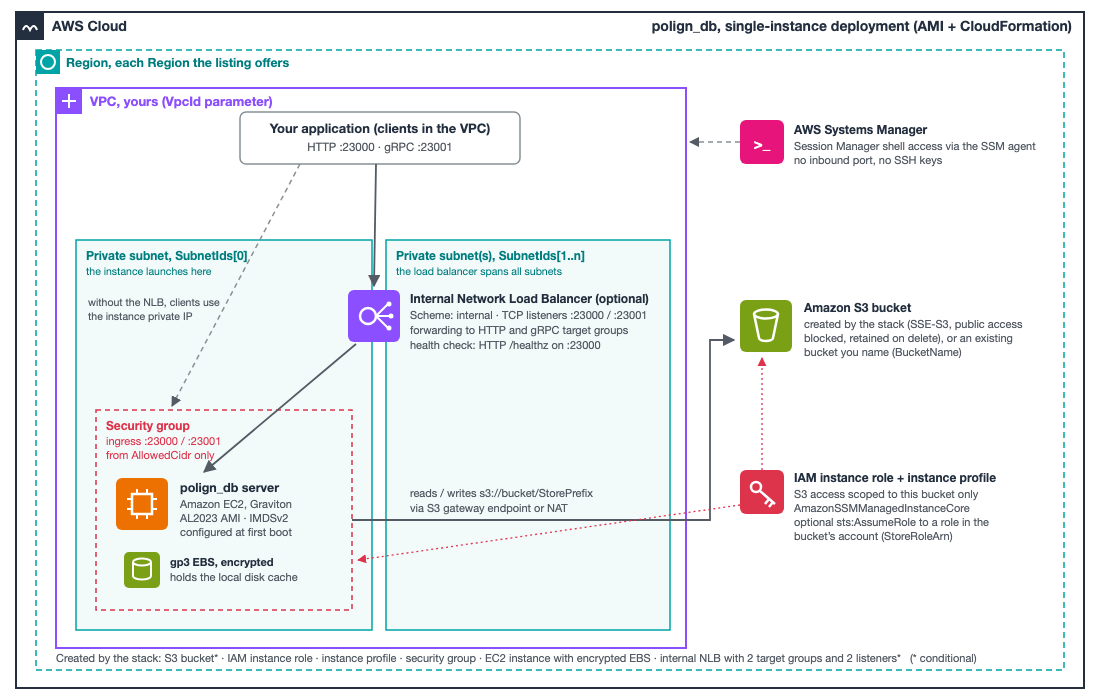
polign_db - Memory Infrastructure for AI Agents
polign_db is a vector and hybrid search database that runs entirely on your own object storage. Lightweight stateless nodes spawn in moments, keep your hot memory cached close to the query, and scale down to zero when idle. So you pay only for the compute you actually need it.
The Problem
AI agents put demands on a database that the current generation of vector stores was not built for:
- Memory availability: Most stores keep data on local or third-party servers. If the service goes down, your agent's memory is inaccessible.
- Runaway costs: Agent memory is mostly cold, yet traditional stores keep it in expensive always-on infrastructure and bill you per query around the clock.
- Data sovereignty: Sensitive memory should not have to move into third-party infrastructure you do not control.
How polign_db Solves It
The entire loop runs inside your own premises, cloud, or VPC with no third-party hop.
- Your bucket is the system of record: Everything sits in an S3, GCS, or MinIO bucket you own, under your own account and keys. Every node serves the same consistent collections from the moment it starts.
- Hot cache for fast recalls: Each node keeps your hot memory cached locally, so searches are answered at in-memory speed without a round trip to the bucket.
- Scale to zero: Nodes are stateless and lightweight. Spawn more to scale up, wind them down to zero when idle. The bucket stays the single durable copy.
- No per-query costs: The bucket is only touched for writes and the occasional cold read, which is where per-query costs disappear.
Key Capabilities
- Vector + hybrid search: Semantic search, keyword search, and hybrid fusion with metadata filtering
- Multiple deployment modes: Run one node on a single host or a fleet as a cluster
- Framework agnostic: Works with any AI agent framework
- Multiple access methods: HTTP API, gRPC API, Python SDK, and CLI
- Production-ready operations: TLS support, API key management, systemd service deployment, scale-out node replacement, and tunable HNSW parameters per collection
- Bring your own bucket: Cross-account IAM role trust policies, and full control over your storage
AWS Integration
polign_db is designed to work natively with Amazon S3 as its durable storage layer. Deploy stateless nodes on EC2 instances (including cost-effective Spot and Graviton instances), scale them independently of your storage, and keep all data within your own AWS account and VPC. No data ever leaves your infrastructure.
Proven at Scale
Benchmarked with 100 million vectors, and live demos. (demo.polign.com) polign_db serves 12.5 million Wikipedia passages from object storage, demonstrating production-grade semantic search at a fraction of the cost of traditional vector databases.
Get Started
polign_db is available as a self-hosted server binary with access via gRPC and HTTP, Python SDK and client libraries. Connect with the Polign team for design-partner conversations and commercial terms.
Highlights
- Your Bucket Is the System of Record: polign_db runs entirely on object storage you own - S3, GCS, or MinIO - under your account and keys. No data leaves your VPC or premises. Stateless nodes cache hot memory locally for in-memory search speed, while the bucket handles durable storage. Scale nodes to zero when idle and pay only for compute you actually use, with no per-query costs against your bucket.
- Vector and Hybrid Search Built for AI Agents: Combine semantic search, keyword search, and hybrid fusion with metadata filtering. Works with any AI agent framework via HTTP API, gRPC API, Python SDK, or CLI. Production-ready with TLS support, API key management, tunable HNSW parameters per collection, and multiple deployment modes from single-node to full cluster.
- Proven at Scale on AWS: Benchmarked with 100 million vectors and serving 12.5 million Wikipedia passages from object storage at a fraction of traditional vector database costs. Deploy on EC2 instances including cost-effective Spot and Graviton options. Nodes are lightweight and stateless - spawn in moments to scale up, wind down to zero when idle.
Details
Sold by
Delivery method
Delivery option
Single-instance deployment
Latest version
Operating system
AmazonLinux 2023
Deployed on AWS
New
Introducing multi-product solutions
You can now purchase comprehensive solutions tailored to use cases and industries.

Features and programs
Financing for AWS Marketplace purchases
AWS Marketplace now accepts line of credit payments through the PNC Vendor Finance program. This program is available to select AWS customers in the US, excluding NV, NC, ND, TN, & VT.

Pricing
Free trial
Try this product free for 14 days according to the free trial terms set by the vendor. Usage-based pricing is in effect for usage beyond the free trial terms. Your free trial gets automatically converted to a paid subscription when the trial ends, but may be canceled any time before that.
This product is available free of charge. Free subscriptions have no end date and may be canceled any time.
Additional AWS infrastructure costs may apply. Use the AWS Pricing Calculator to estimate your infrastructure costs.
Dimensions summary
The software itself is free to run during early access, so you pay no license or metered software fee. These seven dimensions are hourly rates for the AWS EC2 instance you run polign_db on. They fall into three families: t4g.medium is a general-purpose burstable size; m7g options (large, xlarge, 2xlarge) are general-purpose; and r7g options (large, xlarge, 2xlarge) are memory-optimized. Within each family, price scales with instance size. You choose an instance based on your workload, then pay only for the hours it runs. Idle nodes can scale to zero.
Top-of-mind questions for buyers
You pay the hourly rate for the AWS EC2 instance that runs polign_db. The software carries no license fee or metered software charge during early access. Your cost is the compute you choose, plus your own object storage bucket, which bills separately through AWS.
The hourly rate applies only while the instance runs. Serving nodes are stateless caches you can tear down when traffic stops, so a sleeping collection accrues no instance charge. Your bucket still holds the data and bills at object-storage rates. Restart a node and it reloads from the bucket.
The r7g family carries more RAM per vCPU, which suits keeping index data hot in memory. The m7g family balances compute and memory for mixed workloads. The t4g.medium is a smaller burstable size for light or intermittent traffic. Within each family, larger sizes add vCPU and memory at a higher hourly rate.
polign.com+2
Helpful?
Vendor refund policy
Hourly usage: We do not offer refunds for hourly usage fees, as a free trial is available to evaluate the product before purchase.
Annual subscriptions: Refund requests within 14 days of purchase will be honored on a prorated basis. To request a refund, contact us at support@polign.com with your AWS account ID and order details.
For purchases made via private offer, refund terms are as specified in the offer agreement.

Legal
Vendor terms and conditions
Upon subscribing to this product, you must acknowledge and agree to the terms and conditions outlined in the vendor's End User License Agreement (EULA) .
Content disclaimer
Vendors are responsible for their product descriptions and other product content. AWS does not warrant that vendors' product descriptions or other product content are accurate, complete, reliable, current, or error-free.
Delivery details
Single-instance deployment
Deploys polign_db on a single Graviton EC2 instance, backed by an Amazon S3 bucket in your own account. The bucket is the database: vectors, indexes, and the write log all live there, and the instance is a stateless serving tier in front of it. Replacing the instance loses nothing.
The stack creates everything the product needs to run:
-
An EC2 instance running polign_db, configured on first boot from the stack parameters. The image ships no credentials and no bucket name of its own.
-
An S3 bucket with default encryption and public access blocked, or an existing bucket you name. A bucket the stack creates is retained when you delete the stack, so your data outlives the deployment.
-
An IAM instance role scoped to that one bucket, plus AWS Systems Manager access so you can open a shell without an inbound port. For a bucket in another AWS account, the instance assumes a role you name over there and signs with the short-lived credentials it returns, so no keys are stored either way.
-
A security group that allows the HTTP (port 23000) and gRPC (port 23001) APIs only from the CIDR you supply. The template refuses 0.0.0.0/0.
-
An optional internal Network Load Balancer, which gives you a stable DNS name that survives replacing the instance.
The polign_db data plane is unauthenticated by design. It is meant to sit behind your own service, which already knows who its callers are, so the security group is the boundary. Scope it to your VPC.
When the stack finishes, its outputs give you the HTTP and gRPC endpoints, the store location, and a Session Manager command for shell access. Collections are created on first write, taking their dimension from the first vector. A deployment takes about ten minutes.
CloudFormation Template (CFT)
AWS CloudFormation templates are JSON or YAML-formatted text files that simplify provisioning and management on AWS. The templates describe the service or application architecture you want to deploy, and AWS CloudFormation uses those templates to provision and configure the required services (such as Amazon EC2 instances or Amazon RDS DB instances). The deployed application and associated resources are called a "stack."
Version release notes
polign_db 0.6.1 (arm64, Amazon Linux 2023)
Adds server telemetry and optional confidential mode, and includes the 0.6.0 query, durability, and deployment improvements.
BEFORE YOU UPGRADE
Server telemetry now defaults on and sends a heartbeat at startup and every ten minutes. It reports version, OS/architecture, a random install ID, successful-search counts, and aggregate vector counts. It sends no bucket names, ARNs, namespace names, credentials, or query data. To opt out, append -telemetry=false to POLIGN_EXTRA_ARGS in /etc/polign/server.env and restart polign-server. Encryption or -confidential always disables telemetry. The AMI persists each instance's install ID under /var/lib/polign; no install ID or credential is baked into the image. Update checks remain opt-in.
When upgrading from 0.5.x, review custom POLIGN_EXTRA_ARGS for removed flags. Use -store for shared storage and -read-only for replicas. polign-apikey and polign-import now use -store; polign-persistor retains -stores. Review the 0.6.0 changelog for the full list and changed cache and overlay defaults.
NEW AND FIXED
- Optional HTTP write tokens let supported reads on another node wait for acknowledged writes to become visible. Persisted tokens survive WAL garbage collection. This is opt-in and does not provide snapshot isolation.
- Published index manifests carry vector counts for cold telemetry. Older manifests report an unknown count until an updated producer republishes them; standalone persistors should be upgraded as well.
- Confidential mode requires a client-side encryption keyring, refuses plaintext snapshots, disables telemetry, and rejects update checks.
- GCS SDK metric export is disabled to respect telemetry controls.
Data-plane authentication is enabled by default. First boot generates the initial data key at /var/lib/polign/data-key (0600). Retrieve it through SSM. Keep the security group scoped to your VPC; do not expose ports 23000 or 23001 directly to the internet.
Additional details
Usage instructions
polign_db runs against an S3 bucket in your account. The bucket is the database: vectors, indexes, and the write log all live there, and the instance is a serving tier in front of it. Replacing the instance loses nothing.
The image ships no credentials and no bucket name, so a launch has to supply both. The CloudFormation template that comes with this product does all of this for you. To launch the AMI directly, do the following.
CONFIGURE THE STORE Either one works, and first boot reads them in this order:
- Instance tag polign:store = s3://your-bucket/db, with instance metadata tags enabled on the launch.
- Or /etc/polign/server.env written before first boot (cloud-init write_files) containing POLIGN_STORE=s3://your-bucket/db
With no store configured, first boot stops with a message saying exactly that and the server does not start. polign_db never creates a bucket, so the bucket must already exist.
INSTANCE ROLE Attach a role granting, on your bucket: s3:GetObject, s3:PutObject, s3:DeleteObject, s3:AbortMultipartUpload, s3:ListMultipartUploadParts on arn:aws:s3:::your-bucket/*, plus s3:ListBucket, s3:GetBucketLocation, s3:ListBucketMultipartUploads on arn:aws:s3:::your-bucket. Add AmazonSSMManagedInstanceCore for shell access without an inbound port. The region comes from instance metadata.
For a bucket in another AWS account, set POLIGN_STORE_ROLE_ARN (and POLIGN_STORE_EXTERNAL_ID if that role requires one) to a role in the bucket's account that this instance may assume. The tags polign:store-role-arn and polign:store-external-id work too. No keys are stored on the instance either way.
SECURITY GROUP The APIs listen on 23000 (HTTP) and 23001 (gRPC). The polign_db data plane is unauthenticated by design: it is meant to sit behind your own service, which already knows who its callers are. The security group is the boundary. Scope it to your VPC and never open these ports to 0.0.0.0/0.
VERIFY From a host inside the allowed CIDR, with ENDPOINT set to http://INSTANCE-PRIVATE-IP:23000
curl "$ENDPOINT/healthz"
curl -X PUT "$ENDPOINT/v1/collections/docs/vectors/a" -d '{"values":[1,0,0],"metadata":{"label":"first"}}'
curl -X POST "$ENDPOINT/v1/collections/docs/query" -d '{"values":[0.9,0.1,0],"k":5}'
A collection is created on first write, taking its dimension from the first vector. The Python SDK (pip install polign) speaks the same API.
OPERATE Shell access: aws ssm start-session --target INSTANCE-ID. Configuration lives in /etc/polign/server.env; edit it and run sudo systemctl restart polign-server. Logs: journalctl -u polign-server. Index maintenance runs in-process every 30 minutes.
SUPPORT Email support@polign.com with the region, the instance id, and the output of polign-server -version.
Support
Vendor support
For support with polign_db, please contact the polign team through the website at https://polign.com for assistance with deployment, configuration, troubleshooting, and general usage questions.
Support covers topics including:
- Installation and setup of polign_db nodes
- Configuration of object storage backends (S3, GCS, MinIO)
- Vector and hybrid search functionality
- Python SDK, HTTP API, gRPC API, and CLI usage
- Cluster deployment and scaling
- TLS configuration and API key management
- Performance tuning and HNSW parameter optimization
- AWS integration including EC2 deployment and IAM role trust policies
For refund requests or billing inquiries related to your AWS Marketplace subscription, please reach out to the polign team directly or through AWS Marketplace support channels.
AWS infrastructure support
AWS Support is a one-on-one, fast-response support channel that is staffed 24x7x365 with experienced and technical support engineers. The service helps customers of all sizes and technical abilities to successfully utilize the products and features provided by Amazon Web Services.
Similar products

QuestDB is a high-performance, open-source database for time series data. It focuses on fast ingest, blazingly fast queries and superior developer experience with SQL and open formats such as Apache Parquet. QuestDB is designed from the ground up to operate as close to the hardware as possible, eliminating ingestion bottlenecks and lowering overall hardware requirements.
Distributed PostgreSQL for modern transactional applications that require built-in resilience, seamless read and write scalability and flexible global deployment architectures

PMM is an award-winning database monitoring tool built by Percona.
DolphinDB is a high-performance distributed time-series database that integrates a powerful programming language and an ultra-speed high-capacity streaming data analysis system to provide a one-stop solution for fast storage, retrieval, analysis and computing of large amounts of structured data. DolphinDB is suitable for quantitative finance and industrial IoT applications.
Community edition license can be downloaded from https://www.dolphindb.com/downloads/dolphindb_lic.zip. To get an enterprise trial license, submit your request at www.dolphindb.com.
Customer reviews
No customer reviews yet
Be the first to review this product . We've partnered with PeerSpot to gather customer feedback. You can share your experience by writing or recording a review, or scheduling a call with a PeerSpot analyst.