
Sold by: Sigmodata
Deployed on AWS
Free Trial
Strip PII from text before it reaches your LLM, data warehouse or logs. Detects about 18 entity types and applies replace, mask, redact, hash or encrypt per type. Runs inside your AWS account, so no text is sent to a third-party API.
Overview
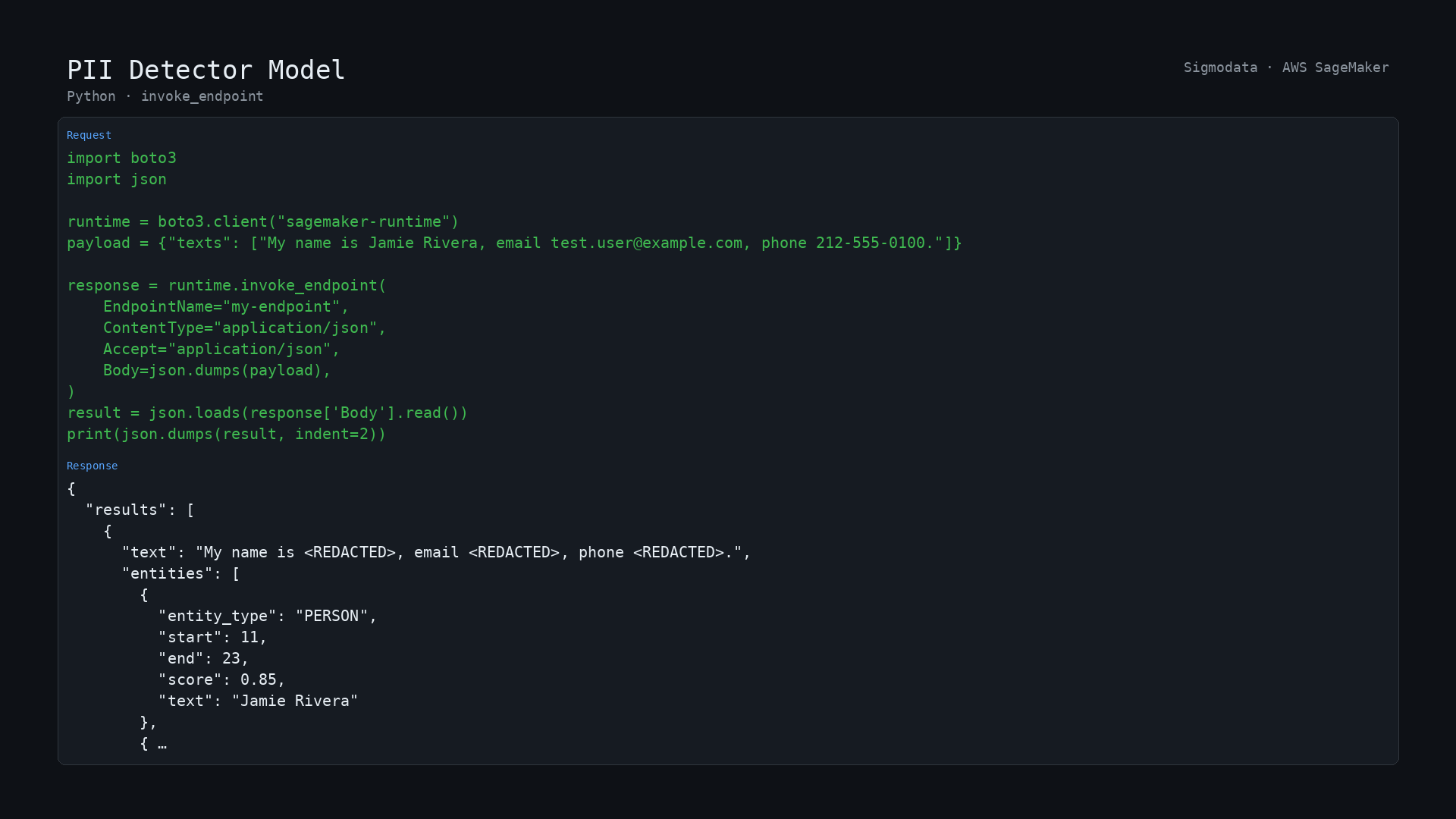
Image
Python predict
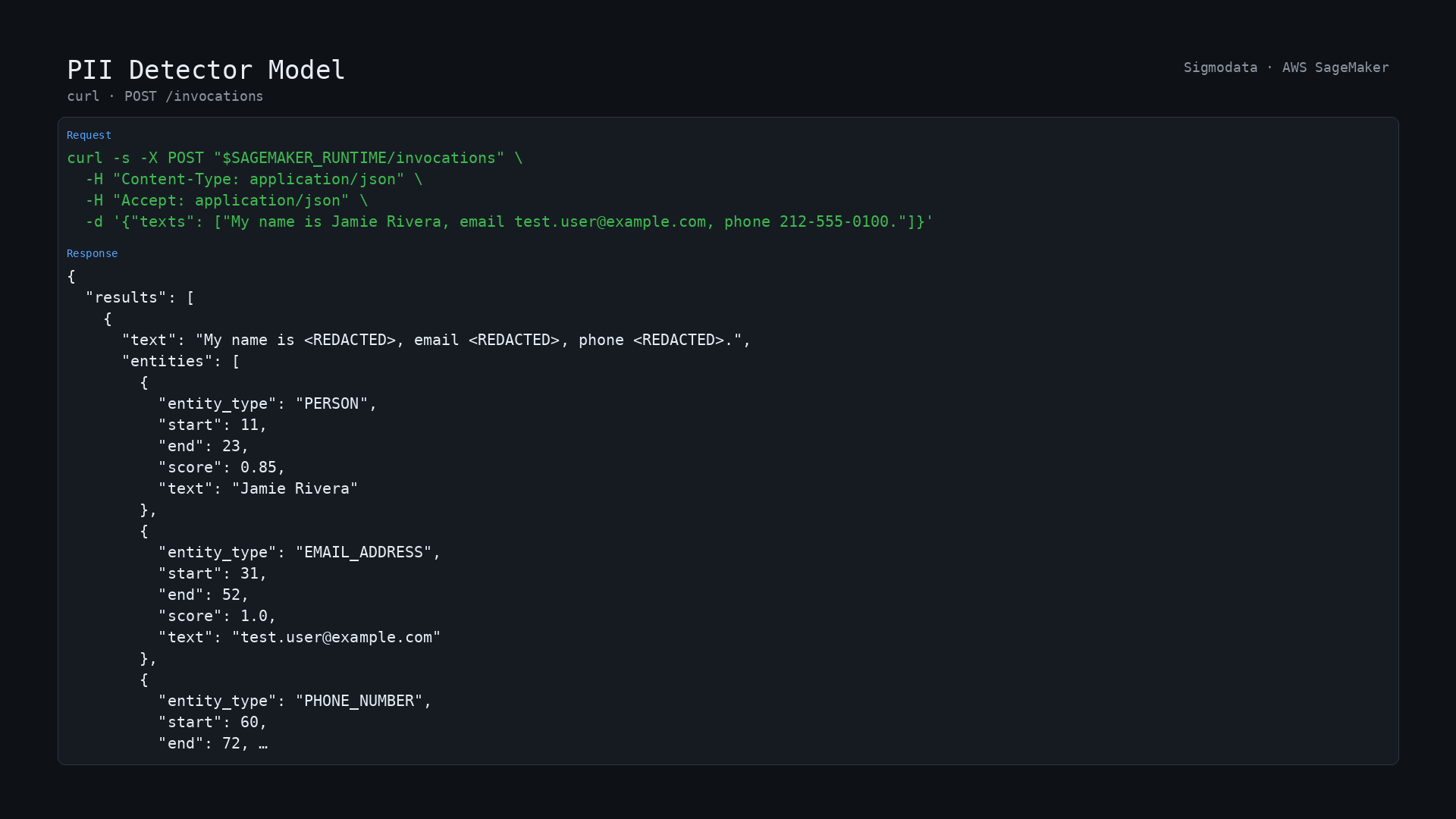
Image
POST /invocations
Runs inside your own AWS account: your text is processed on a SageMaker endpoint you control, inside your VPC, and is never sent to a third-party API.
This SageMaker model package detects and anonymizes personally identifiable information (PII) in text. Built on Microsoft Presidio (Analyzer + Anonymizer) with spaCy en_core_web_lg, it identifies around 18 entity types by default - person names, email addresses, phone numbers, US Social Security numbers, credit card numbers, IBAN codes, IP addresses, URLs, crypto wallet addresses, and more - and lets you choose a different action for each: replace with a placeholder, mask with asterisks, redact entirely, hash (one-way, optionally with a caller-supplied salt for a stable join key), or encrypt (reversible, with a caller-supplied key that is never stored server-side).
Unlike a hosted PII API, this model runs entirely inside your own AWS account and VPC - the text you send it is never transmitted to an external service. That in-VPC data residency is the reason to run it here. GPU is not used; deploy on a CPU instance.
This listing is the SageMaker path (API only). For a self-hosted HTTP API, a point-and-click portal, CSV upload, an S3 batch queue, and POST /decrypt, use the PII Detector Server AMI.
Supports real-time inference and SageMaker batch transform, with JSON and CSV input/output. Common uses include redacting PII from support tickets, logs, and data exports before they reach a data warehouse or an LLM, and compliance workflows where sending customer text to a third-party PII API is not an option.
We welcome your feedback at support@sigmodata.com .
Model and training data
Stock Presidio Analyzer + Anonymizer (MIT) with spaCy en_core_web_lg. Sigmodata did not fine-tune a detector for this version. The spaCy model is the public English large pipeline; regex and checksum recognizers (email, SSN, credit card, IBAN, IP, URL) are Presidio's defaults. The image runs in network isolation on SageMaker, so no data leaves your account.
Known limitations
- English only. Other languages are not supported.
- Organization, location, and date/time detection use general-purpose spaCy NER and are noisier than the checksum-backed types.
- Full postal-address detection is not a built-in capability.
- Phone recall on mixed international formats is weaker than on US-format numbers.
- Encrypt is supported, but this endpoint does not decrypt. Keep the caller-supplied key and the rewrites array and run Presidio's DeanonymizeEngine yourself, or use the PII Detector Server AMI (POST /decrypt).
Measured performance
- Evaluated on 1,505 held-out synthetic texts generated with presidio-evaluator (PresidioSentenceFaker). A prediction counts as correct when its character span overlaps the gold span of the same type (not an exact-span match).
- Strongest types (F1): EMAIL_ADDRESS 1.00, IBAN_CODE 1.00, US_SSN 0.97, IP_ADDRESS 0.94, URL 0.91, CREDIT_CARD 0.86, PERSON 0.81.
- Weaker types, not gated for this release: ORGANIZATION 0.52, LOCATION 0.48, DATE_TIME 0.37.
- Local CPU container of this image: about 180 texts per second at a batch size of 25 (6 ms median for a single short sentence).
- Live SageMaker realtime on ml.m5.large (single instance, sequential client, us-east-2): median 226 ms per short text (p90 234 ms); about 51 texts per second at a batch size of 25. Confirm on your endpoint if latency is tight.
Highlights
- Strip about 18 PII entity types (names, emails, SSNs, credit cards, IBANs, IPs) before text reaches your LLM, warehouse or logs
- Choose replace, mask, redact, hash or encrypt per entity type, and run it entirely inside your own VPC
- F1 1.00 for emails and IBANs, 0.97 for US SSNs, 0.86 for credit cards on 1,505 held-out texts; weaker on organizations, locations and dates
Details
Sold by
Categories
Delivery method
Latest version
Deployed on AWS
New
Introducing multi-product solutions
You can now purchase comprehensive solutions tailored to use cases and industries.

Features and programs
Financing for AWS Marketplace purchases
AWS Marketplace now accepts line of credit payments through the PNC Vendor Finance program. This program is available to select AWS customers in the US, excluding NV, NC, ND, TN, & VT.

Pricing
Free trial
Try this product free for 5 days according to the free trial terms set by the vendor.
Pricing is based on actual usage, with charges varying according to how much you consume. Subscriptions have no end date and may be canceled any time.
Additional AWS infrastructure costs may apply. Use the AWS Pricing Calculator to estimate your infrastructure costs.
Dimension | Description | Cost/host/hour |
|---|---|---|
ml.m5.large Inference (Batch) Recommended | Model inference on the ml.m5.large instance type, batch mode | $0.10 |
ml.m5.large Inference (Real-Time) Recommended | Model inference on the ml.m5.large instance type, real-time mode | $0.10 |
ml.c5.large Inference (Real-Time) | Model inference on the ml.c5.large instance type, real-time mode | $0.10 |
ml.c5.xlarge Inference (Batch) | Model inference on the ml.c5.xlarge instance type, batch mode | $0.10 |
ml.c5.xlarge Inference (Real-Time) | Model inference on the ml.c5.xlarge instance type, real-time mode | $0.10 |
ml.m5.xlarge Inference (Batch) | Model inference on the ml.m5.xlarge instance type, batch mode | $0.10 |
ml.m5.xlarge Inference (Real-Time) | Model inference on the ml.m5.xlarge instance type, real-time mode | $0.10 |
Dimensions summary
You pay by the hour for each inference instance you run, billed per host-hour. Pricing splits two ways: by instance size and by inference mode. The ml.m5.large and ml.m5.xlarge are general-purpose instances; the ml.c5.large and ml.c5.xlarge are compute-focused. Each runs on CPU, since no GPU is used. Real-time mode serves single requests on a live endpoint; batch mode processes larger sets at once. Not every instance offers both modes. Choose the instance and mode that fit your workload, and your cost scales with how many host-hours you run.
Top-of-mind questions for buyers
A host-hour is one hour of one running inference instance. You pay for each instance you keep active, rounded by usage time. Charges accrue while the endpoint runs, not by the number of texts processed. Run two instances for one hour and you pay two host-hours.
Real-time mode runs a live endpoint that serves single requests, so you pay for every hour it stays up. Batch mode processes larger sets at once through SageMaker batch transform, so you pay only while the batch job runs. Real-time suits continuous traffic; batch suits scheduled, grouped workloads.
No. All instances run the same model on CPU, since no GPU is used. Instance choice affects speed and host-hour cost, not detection quality. Pick a size based on throughput and latency needs. The ml.c5 instances are compute-focused; the ml.m5 instances are general-purpose.
www.sigmodata.com
Helpful?
Vendor refund policy
No refunds offered but you may cancel at any time

Legal
Vendor terms and conditions
Upon subscribing to this product, you must acknowledge and agree to the terms and conditions outlined in the vendor's End User License Agreement (EULA) .
Content disclaimer
Vendors are responsible for their product descriptions and other product content. AWS does not warrant that vendors' product descriptions or other product content are accurate, complete, reliable, current, or error-free.
Delivery details
Amazon SageMaker model
An Amazon SageMaker model package is a pre-trained machine learning model ready to use without additional training. Use the model package to create a model on Amazon SageMaker for real-time inference or batch processing. Amazon SageMaker is a fully managed platform for building, training, and deploying machine learning models at scale.
Deploy the model on Amazon SageMaker AI using the following options:
Version release notes
Initial release.
- Detect ~18 default PII entity types (Microsoft Presidio + spaCy)
- Per-entity-type operator: replace, mask, redact, hash, or encrypt
- JSON and CSV input/output, real-time and batch transform
- CPU only - no GPU instance tier
Additional details
Inputs
- Summary
A JSON object with a "texts" array of strings to scan (or a CSV file, one text per line, for batch transform). Optional "entities" allowlist, "operators" map, and "language".
- Input MIME type
- application/json, text/csv
{"texts": ["My name is Jamie Rivera, email test.user@example.com, phone 212-555-0100."]}
My name is Jamie Rivera, email test.user@example.com, phone 212-555-0100.
Input data descriptions
The following table describes supported input data fields for real-time inference and batch transform.
Field name | Description | Constraints | Required |
|---|---|---|---|
texts | List of text strings to scan for PII | - | Yes |
entities | Optional allowlist of entity type names (for example ["EMAIL_ADDRESS", "US_SSN"]) | - | No |
operators | Optional per-entity-type action map (replace, mask, redact, hash, encrypt) | - | No |
language | Optional language code (default en) | - | No |
Resources
Vendor resources
Support
Vendor support
Support contact: Email: support@sigmodata.com Support URL: https://www.sigmodata.com/contact
Support description: Email support@sigmodata.com or https://www.sigmodata.com/contact . We reply within one business day, Monday through Friday, US Pacific time.
AWS infrastructure support
AWS Support is a one-on-one, fast-response support channel that is staffed 24x7x365 with experienced and technical support engineers. The service helps customers of all sizes and technical abilities to successfully utilize the products and features provided by Amazon Web Services.
Similar products

YOLOv3 is a powerful network for fast and accurate object detection, powered by GluonCV.

Single Shot MultiBox Detector (SSD) is a powerful network for fast and accurate object detection, powered by GluonCV.

This model detects and counts how many people enter a building or a particular boundary line.

Faster RCNN is a powerful network for accurate object detection, powered by GluonCV.
Customer reviews
No customer reviews yet
Be the first to review this product . We've partnered with PeerSpot to gather customer feedback. You can share your experience by writing or recording a review, or scheduling a call with a PeerSpot analyst.