
Sold by: Port
Deployed on AWS
Port is an open AI software factory platform designed for engineering organizations to build, govern, and operate the AI-SDLC.
4.4
Overview
Image
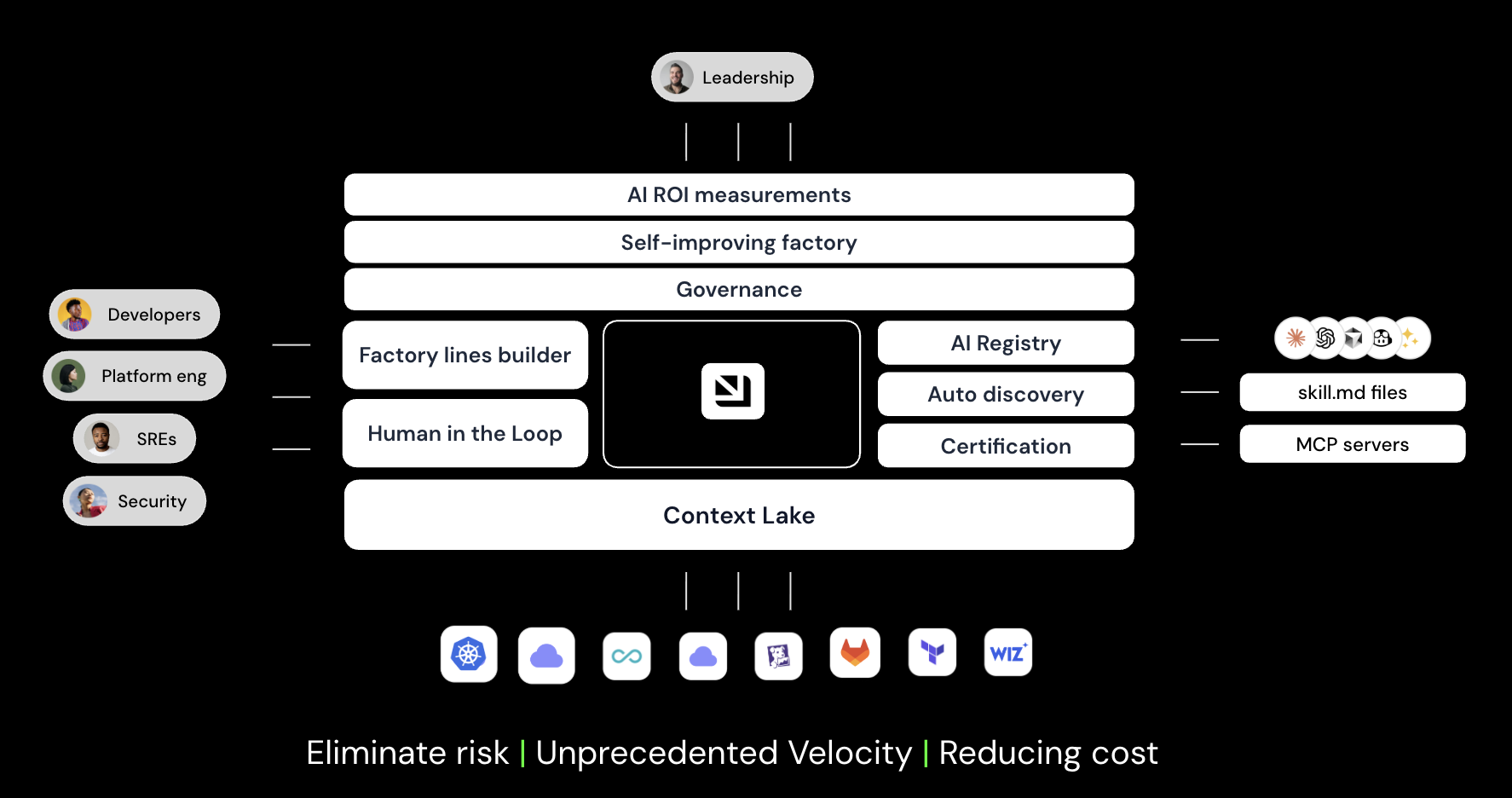
AI Software Factory
Image
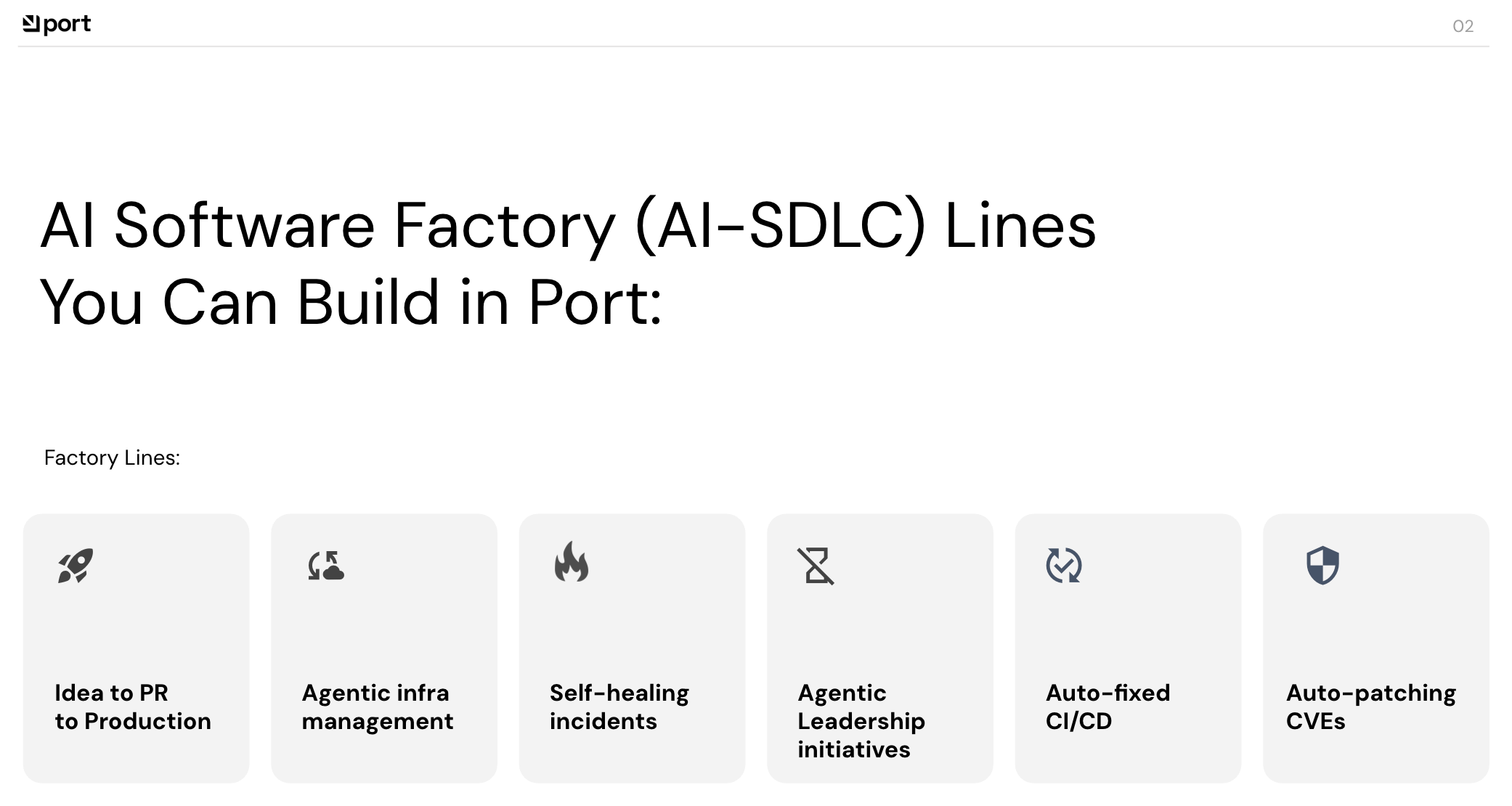
AI Software Factory Lines You Can Build In Port

Video
The SPS Commerce AI Software Factory on Port
Port is an open AI software Factory platform designed for engineering organizations to build, govern, and operate the AI-SDLC at scale. The company's platform maps services, tools, and standards into a context layer, connects any coding agent through an auto-discovered registry of agents, skills, and MCP servers, and assembles end-to-end factory lines such as idea-to-production, self-healing incidents, and auto-patching CVEs. Risk-based human-in-the-loop review, granular permissions, audit logs, and per-team costs keeps agents governed across every line, while ROI and quality measures self-improve the factory and give leadership factory-wide visibility. This lets teams ship higher-quality software faster and at lower cost without losing control.
Highlights
- Build end-to-end AI-SDLC factory lines.
- Govern agents with risk-based control.
- Track AI performance, ROI, and quality metrics.
Details
Sold by
Delivery method
Deployed on AWS
New
Introducing multi-product solutions
You can now purchase comprehensive solutions tailored to use cases and industries.

Features and programs
Financing for AWS Marketplace purchases
AWS Marketplace now accepts line of credit payments through the PNC Vendor Finance program. This program is available to select AWS customers in the US, excluding NV, NC, ND, TN, & VT.

Pricing
Pricing is based on the duration and terms of your contract with the vendor. This entitles you to a specified quantity of use for the contract duration. If you choose not to renew or replace your contract before it ends, access to these entitlements will expire.
Additional AWS infrastructure costs may apply. Use the AWS Pricing Calculator to estimate your infrastructure costs.
Dimension | Description | Cost/12 months |
|---|---|---|
Free forever | Create a professional internal developer portal, no time limit | $0.00 |
Basic | Basic Package | $360.00 |
Standard | Standard Package | $480.00 |
Enterprise Essentials | Essentials | $45,000.00 |
Enterprise Seats | Enterprise Seats Plan | $540.00 |
Dimensions summary
This listing bills by users through five contract options. Free forever lets you build an internal developer portal with no time limit and no cost. Basic and Standard are packaged tiers that add more capability as you move up. Enterprise Essentials covers core enterprise needs, while Enterprise Seats bills per allocated seat. All options scale by the number of users you add, so your cost tracks how many people use the platform.
Top-of-mind questions for buyers
Billing tracks each person who accesses the platform. Each individual account is one user. The one piece of personal data required is an email address, used to authenticate and sign each user in. Your cost rises as you add more people who use the platform.
Enterprise Seats bills per allocated seat, so cost tracks the number of seats you assign. Basic and Standard are packaged tiers that bundle capability at a set user level. Enterprise Essentials covers core enterprise needs. All contract options meter by users, not by data volume.
The Free forever plan has no time limit and no cost. It lets you build an internal developer portal with no expiration. Moving to Basic, Standard, Enterprise Essentials, or Enterprise Seats is a separate choice you make, not an automatic conversion.
www.port.io
Helpful?
Vendor refund policy
Contact Port for more information

Legal
Vendor terms and conditions
Upon subscribing to this product, you must acknowledge and agree to the terms and conditions outlined in the vendor's End User License Agreement (EULA) .
Content disclaimer
Vendors are responsible for their product descriptions and other product content. AWS does not warrant that vendors' product descriptions or other product content are accurate, complete, reliable, current, or error-free.
Delivery details
Software as a Service (SaaS)
SaaS delivers cloud-based software applications directly to customers over the internet. You can access these applications through a subscription model. You will pay recurring monthly usage fees through your AWS bill, while AWS handles deployment and infrastructure management, ensuring scalability, reliability, and seamless integration with other AWS services.
Resources
Vendor resources
Support
Vendor support
AWS infrastructure support
AWS Support is a one-on-one, fast-response support channel that is staffed 24x7x365 with experienced and technical support engineers. The service helps customers of all sizes and technical abilities to successfully utilize the products and features provided by Amazon Web Services.
Updated weekly
By Port


By Humanitec
Sentiment is AI generated from actual customer reviews on AWS and G2
Functionality
Ease of use
Customer service
Cost effectiveness
Positive reviews
Mixed reviews
Negative reviews
AI generated from product descriptions
Software Catalog Management
Comprehensive software catalog covering microservices, resources, and custom assets with support for any data model
Workflow Automation
Automation capabilities for developer workflows and self-service actions
Maturity Scorecards
In-context maturity scorecards for evaluating and tracking software components
No-Code Portal Builder
No-code platform for constructing internal developer portals without requiring custom code
Developer Self-Service Actions
Support for developer-initiated self-service actions and operations through the portal interface
Centralized Service Catalog
Consolidates software, APIs, and team resources in a single centralized repository with instant visibility and ownership clarity across all development assets.
Customizable Deployment Templates
Provides customizable service templates that enforce security and compliance best practices to enable consistent and secure deployments.
Documentation Management
Implements a centralized docs-as-code approach to maintain up-to-date and accessible documentation across the organization.
Plugin Ecosystem Integration
Supports integration with over 100 plugins built on the Backstage framework to extend functionality and enable seamless scaling.
Code Standards Compliance Monitoring
Identifies code that does not meet organizational standards and enables rapid remediation of non-compliant code.
Graph-Based Platform Architecture
Graph-based backend infrastructure that enables standardization by design for Internal Developer Platforms.
Deployment Automation
Automated deployment capabilities for workloads and infrastructure that eliminate manual configuration writing and maintenance.
Developer Self-Service Capabilities
Self-service portal and tooling that enable developers to provision and manage resources independently.
Infrastructure Standardization
Resource Packs and orchestration mechanisms that drive automation and standardization across infrastructure deployments.
Deployment Frequency Optimization
Platform capabilities designed to increase deployment frequency and reduce deployment wait times.
Standard contract
No
Customer reviews
Information Technology and Services
A clear interface and useful integrations that make deployment and everyday platform work easier
Reviewed on Oct 20, 2026
Review provided by G2
What do you like best about the product?
Port has helped us make namespace deployment more consistent. Our onboarding workflow collects the details, generates the configuration, and routes changes through our existing review process. There are now fewer manual steps, but more actions to add to get it as close to fully automated as we'd like. It’s also helping with repository setup. Our automation creates the application configuration repository and prepares the changes needed for deployment, saving us from repeating the same setup work for each team. Having GitLab repositories, infrastructure, and deployment information in one catalog has been useful too. It gives us one place to start when looking for information. We’ve appreciated being able to build around our existing tools and processes while making them easier for teams to use.
What do you dislike about the product?
I like how the interface brings information from our different tools into one place. The integrations with GitLab and Argo CD make it easier to find repositories and check deployment status without switching between systems.
What problems is the product solving and how is that benefiting you?
One of the main problems right now that it's solving is saving time. The namespace deployment used to be all manual and now Port has allowed us to cut that down to a fraction of the time required.
FilipGrasheski
Unified portal has standardized cloud landing zones and streamlined day two operations
Reviewed on Jun 03, 2026
Review from a verified AWS customer
What is our primary use case?
My main use case for Port is using it as a client where we have access to this internal development platform to build our landing zones and all the products that come with it.
A specific example of how I use Port for building landing zones or products is that we can build easily any cloud landing zone in Azure, AWS, or GCP. We can do day two operations such as building networks, setting up permissions, and so on. We have full visibility in the portal as a software catalog.
What is most valuable?
The best features Port offers include having a single source of truth where you can see how your infrastructure looks. It pulls real-time data from all these tools, and it is great for setting up these golden paths and how developers can work with the infrastructure. You can put guardrails and constraints in place.
Port sets up the golden path and guardrails for developers by allowing you to define a standardized way of doing common engineering tasks. You can ingest some security checks, implement standard workflows with approved cloud resources, and set up policies to constrain what can be used in which environment. Port also offers integrations with other systems such as GitHub and allows you to approve specific Terraform modules, for example. Approvals are also available.
Port has impacted my organization positively by helping establish a standard way of doing things without having to cater for each development team separately. As a team that develops infrastructure, it is positive because I do not have to follow many different processes for clouds, deployments, or other tasks. Instead, I have this single stop of a software catalog that tells me what is available. I can click through it, get my infrastructure provisioned, and deploy the products.
While I do not have any measurements, I can safely say that the time saved is enormous because you do not have to look at different parts in the organization and spend time finding who does what or where to get something provisioned. Instead, it is a single portal where you can do pretty much everything.
What needs improvement?
It is hard for me to say how Port can be improved because so far I have not found many things that I would have an issue with.
I would find it interesting to see some kind of migration plans for Port, including support for migrations that it could automate, such as moving from other systems or directly migrating cloud resources to Port.
For how long have I used the solution?
I have been using Port for about two years.
What do I think about the stability of the solution?
Port is stable.
What do I think about the scalability of the solution?
Port's scalability is great; it scales very well. So far we have not reached the limits, and I hope we do not.
How are customer service and support?
I believe the customer support for Port is great.
Which solution did I use previously and why did I switch?
I have not used any different commercial solution before Port; I have only worked with in-house developed IDPs.
What was our ROI?
I do not have any relevant metrics such as time saved or money saved to share regarding return on investment from using Port.
What's my experience with pricing, setup cost, and licensing?
I do not have any experience with Port's pricing, setup cost, and licensing because it is not handled by my team.
Which other solutions did I evaluate?
I did not evaluate other options before choosing Port.
What other advice do I have?
I do not want to rate the governance and security in Port's AI capabilities.
I have not used Port's AI capabilities, so I cannot provide any thoughts on the accuracy and reliability of its output.
My advice to others looking into using Port is that you should go for it; it is a great product. I would rate this review a 9.
Martin L.
Great IDP
Reviewed on Sep 11, 2025
Review provided by G2
What do you like best about the product?
The simplicity and easy to plug new integrations.
What do you dislike about the product?
Probably not that complete in-app help menus.
What problems is the product solving and how is that benefiting you?
Service catalog, easy to share knowledge and usage of all the apps in the ecosystem.
Kolten F.
I like the tool, we're just scratching the surface.
Reviewed on Mar 04, 2025
Review provided by G2
What do you like best about the product?
Port has been helpful in giving us a catalogue for our cloud resources, we're working through the integrations to go from our code source, cloud resources, CI/CD pipelines.
What do you dislike about the product?
I think the documentation could be improved overall. The documentation for building new templates/blueprints/mappings, improved examples, potentially leverage genAI for code generation on the mappings and the JQ involved.
What problems is the product solving and how is that benefiting you?
A catalogue for all of our SaaS products and cloud resources
Information Technology and Services
Elegant self-service portal offering various features to make life easier
Reviewed on Feb 28, 2025
Review provided by G2
What do you like best about the product?
Workflow Automation – Helps streamline processes and reduce manual work. Scalability – Works well with adapting to business growth. Performance – Stable and responsive, with minimal downtime. Integration - supports various integrations + possibility to use not existing via webhooks, etc
What do you dislike about the product?
User Interface – Easy to navigate but sometimes I am confused where I can find our self services. Learning curve - During initial phase harder to get concept and learn terms with their usage
What problems is the product solving and how is that benefiting you?
Offering central place for developers and users to manage their needs without giving them direct access to platform. Eg. Triggering jobs, request DB access, Release management of deployments. All complex action reduced to few clicks for users even without deeper technical knowledge