
Sold by: cloudimg
Deployed on AWS
Free Trial
AWS Free Tier
This product has charges associated with it for seller support. Pre-hardened Password Pusher AMI for sharing passwords, text, files and URLs over one-time links that self-destruct. Anonymous by design with per-instance encryption keys and 24/7 cloudimg support.
Overview
Image
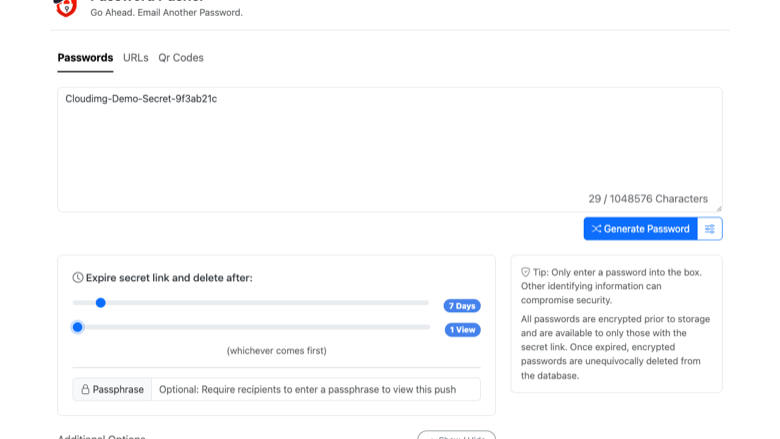
Push a one-time secret
Image
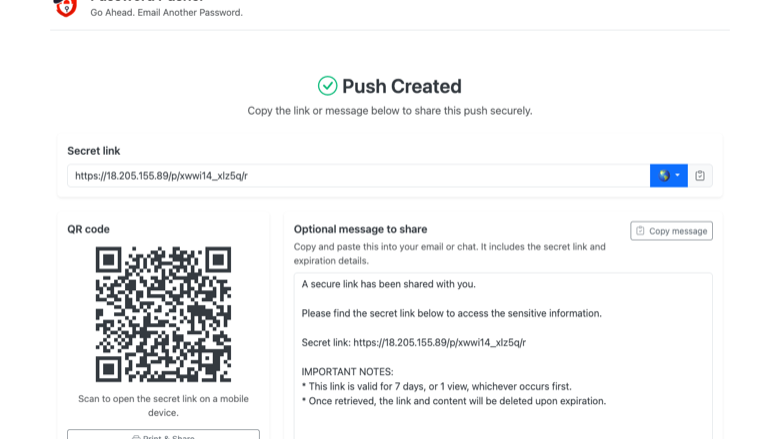
Share the generated link
Image
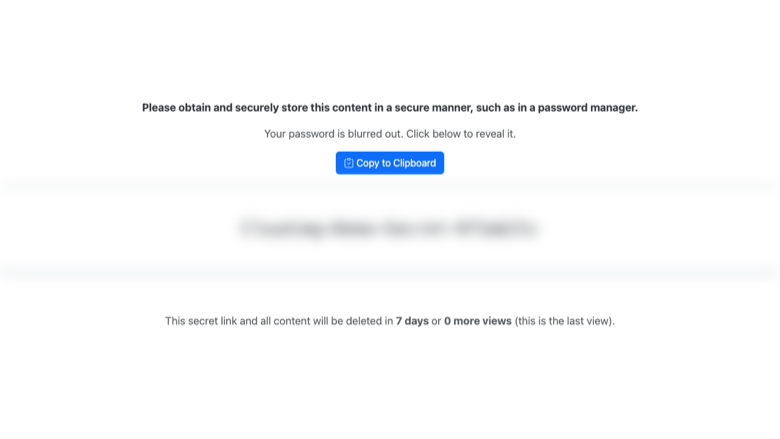
Retrieve on last view
Image
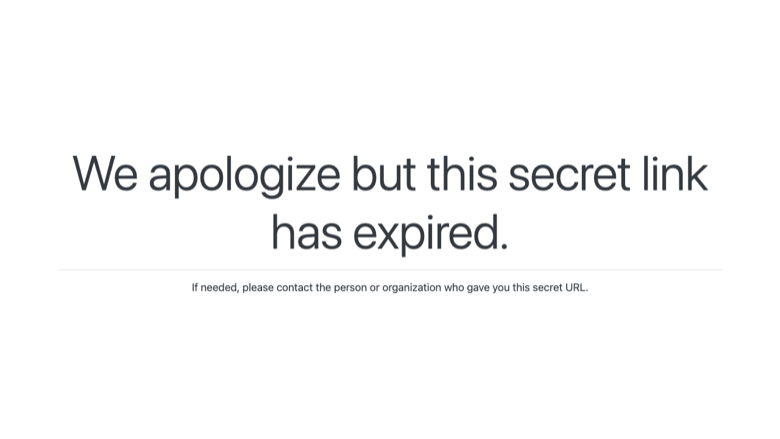
Link self-destructs
This is a repackaged open source software product wherein additional charges apply for cloudimg support services.
Overview
Password Pusher is a popular open-source, self-hosted web application for securely sharing sensitive information. A sender pushes a password, a block of text, a file or a URL and receives a one-time link that stops working automatically once it has been viewed a set number of times (default 5) or a set number of days have passed (default 7), whichever comes first, with a full audit trail. It is a private, self-hosted alternative to emailing credentials or using a public paste service, and this AMI delivers it fully installed and hardened so a working instance is operational within minutes of launch.
Why This Image vs a Manual Install
Password Pusher ships no prebuilt binary, so a manual install means compiling a matching Ruby, bundling gems, building front-end assets, preparing the database, authoring systemd units and configuring a TLS reverse proxy. This image completes every one of those steps at build time. It also closes the two security gaps a default deployment leaves open: the Rails session key and the database payload-encryption key both default to shared, insecure values upstream, and this image generates a unique random value for each on every instance's first boot.
Application Stack
The Rails application runs under puma as an unprivileged system user, bound to the loopback interface only, and is fronted by an nginx reverse proxy that terminates TLS on port 443 (with a plain-HTTP port 80 that redirects to HTTPS). Payloads are stored in a local SQLite database, encrypted at rest with the per-instance key. systemd starts the application and the web server on boot and restarts them on failure.
Security Hardening
This image follows a defence-in-depth approach:
- Anonymous by design: the login and registration system is disabled, so there is no admin account, no API key and no shared credential baked into the image
- Per-instance encryption keys: both the Rails session-signing key and the Lockbox database-encryption key are generated uniquely and at random on each instance's first boot, so no two deployments share key material
- Network isolation: the application binds exclusively to the loopback interface; only the nginx reverse proxy is network-facing, and it serves over TLS
- TLS by default: a self-signed certificate is regenerated on first boot with the instance address in its subject alternative names; because secrets are encrypted server-side, transport encryption is enforced end to end
- Least privilege: the application runs as an unprivileged system user with NoNewPrivileges, PrivateTmp and ProtectSystem set
- Fully patched base: the operating system is brought to a fully patched baseline at build time
Buyers requiring formal compliance documentation should contact cloudimg to discuss specific requirements.
Concrete Use Cases
- Secure credential handoff: An IT team sharing a database password or API key with a contractor via a link that self-destructs after a single view, leaving no copy in email or chat
- Onboarding and offboarding: HR or IT sending initial account credentials to new hires over links that expire automatically, with an audit trail of what was retrieved and when
- Support and incident response: An on-call engineer passing a one-time recovery token or certificate to a colleague without it persisting in a ticketing system
AWS Integration
Deploy on any EC2 instance type. Use the unauthenticated health endpoint with an Application Load Balancer for availability monitoring. Put your own domain and an ACM or CA-signed certificate on the reverse proxy or an ALB in front. Back up the SQLite database with EBS snapshots or AWS Backup if you need push history to survive an instance replacement.
Getting Started
Open the web interface in your browser, push a password, text, file or URL, and share the returned one-time link. The recipient views the secret once (or within the window you set) and the link then self-destructs. No login is required to push or retrieve a secret.
cloudimg Support
24/7 technical support by email and chat. Help with deployment, putting your own domain and TLS certificate in front, expiration and retrieval-step configuration, and backup planning for your push database.
Highlights
- Prebuilt and hardened in minutes: Password Pusher ships no binary, so a manual install means compiling Ruby, bundling gems, building assets, preparing the database, authoring systemd units and configuring a TLS reverse proxy. This image completes every step at build time. Launch an instance and share your first one-time secret link without editing a single configuration file.
- Secure by default with per-instance keys: the login and registration system is disabled so the appliance is anonymous by design with no admin account or shared credential, and both the Rails session key and the database payload-encryption key are generated uniquely and at random on every instance's first boot, so no two deployments share key material. The application binds to loopback and is reachable only through the nginx TLS reverse proxy.
- Self-destructing links with an audit trail and 24/7 support: share passwords, text, files or URLs over links that stop working after a set number of views or days, whichever comes first, with a full audit trail of retrievals. Payloads are encrypted at rest with the per-instance key. Backed by 24/7 cloudimg technical support via email and chat.
Details
Sold by
Categories
Delivery method
Delivery option
64-bit (x86) Amazon Machine Image (AMI)
Latest version
Operating system
Ubuntu 24.04
Deployed on AWS
New
Introducing multi-product solutions
You can now purchase comprehensive solutions tailored to use cases and industries.

Features and programs
Financing for AWS Marketplace purchases
AWS Marketplace now accepts line of credit payments through the PNC Vendor Finance program. This program is available to select AWS customers in the US, excluding NV, NC, ND, TN, & VT.

Pricing
Free trial
Try this product free for 7 days according to the free trial terms set by the vendor. Usage-based pricing is in effect for usage beyond the free trial terms. Your free trial gets automatically converted to a paid subscription when the trial ends, but may be canceled any time before that.
Pricing is based on actual usage, with charges varying according to how much you consume. Subscriptions have no end date and may be canceled any time. Alternatively, you can pay upfront for a contract, which typically covers your anticipated usage for the contract duration. Any usage beyond contract will incur additional usage-based costs.
Additional AWS infrastructure costs may apply. Use the AWS Pricing Calculator to estimate your infrastructure costs.
If you are an AWS Free Tier customer with a free plan, you are eligible to subscribe to this offer. You can use free credits to cover the cost of eligible AWS infrastructure. See AWS Free Tier for more details. If you created an AWS account before July 15th, 2025, and qualify for the Legacy AWS Free Tier, Amazon EC2 charges for Micro instances are free for up to 750 hours per month. See Legacy AWS Free Tier for more details.
Dimension | Description | Cost/hour |
|---|---|---|
m5.large Recommended | m5.large | $0.08 |
t3.micro | t3.micro instance type | $0.04 |
t2.micro | t2.micro instance type | $0.04 |
r8a.metal-24xl | r8a.metal-24xl instance type | $0.24 |
t3a.large | t3a.large instance type | $0.08 |
r8i-flex.12xlarge | r8i-flex.12xlarge instance type | $0.24 |
m8i-flex.2xlarge | m8i-flex.2xlarge instance type | $0.24 |
m6id.24xlarge | m6id.24xlarge instance type | $0.24 |
m8id.4xlarge | m8id.4xlarge instance type | $0.24 |
m5n.4xlarge | m5n.4xlarge instance type | $0.24 |
Vendor refund policy
Refunds available on request.

Legal
Vendor terms and conditions
Upon subscribing to this product, you must acknowledge and agree to the terms and conditions outlined in the vendor's End User License Agreement (EULA) .
Content disclaimer
Vendors are responsible for their product descriptions and other product content. AWS does not warrant that vendors' product descriptions or other product content are accurate, complete, reliable, current, or error-free.
Delivery details
64-bit (x86) Amazon Machine Image (AMI)
Amazon Machine Image (AMI)
An AMI is a virtual image that provides the information required to launch an instance. Amazon EC2 (Elastic Compute Cloud) instances are virtual servers on which you can run your applications and workloads, offering varying combinations of CPU, memory, storage, and networking resources. You can launch as many instances from as many different AMIs as you need.
Version release notes
Initial release of Password Pusher as a ready-to-use self-hosted one-time secret sharing appliance, built from source and served behind an nginx TLS reverse proxy, anonymous by design with the Rails session key and the database payload-encryption key both generated uniquely on each instance's first boot.
Additional details
Usage instructions
Connect via SSH on port 22 as the default login user for your operating system variant (for the Ubuntu 24.04 variant the user is ubuntu). Password Pusher is anonymous by design: there is no admin login, no API key and no database password to read. Open the web interface in a browser at https://<instance-public-ip>/ (the reverse proxy uses a self-signed certificate regenerated on first boot, so your browser will warn on the certificate; port 80 redirects to HTTPS). Push a password, block of text, file or URL to receive a one-time link that self-destructs after a set number of views or days. An unauthenticated health endpoint is available at https://<instance-public-ip>/healthz. Verify the one-time semantics at any time with: sudo /opt/passwordpusher/passwordpusher-selftest.sh. The instance security group opens ports 22, 80 and 443. The services run under systemd: systemctl status passwordpusher nginx.
Resources
Vendor resources
Support
Vendor support
cloudimg Support
cloudimg provides 24/7 technical support for this product by email and live chat.
Contact: support@cloudimg.co.uk
What we help with:
- Deployment and initial configuration
- Putting your own domain and TLS certificate in front (reverse proxy or ALB)
- Expiration, view-limit and retrieval-step configuration
- Backup planning for your push database using EBS snapshots or AWS Backup
- Performance tuning and troubleshooting
- Updates and security patching guidance
Refunds: For refund requests, contact support@cloudimg.co.uk with your AWS account ID and subscription details.
AWS infrastructure support
AWS Support is a one-on-one, fast-response support channel that is staffed 24x7x365 with experienced and technical support engineers. The service helps customers of all sizes and technical abilities to successfully utilize the products and features provided by Amazon Web Services.
Similar products

1Password takes the guesswork out of logins, shadow IT, and infrastructure secrets so you can keep your people safe and your business moving.

Keeper's password manager stores all of your organization's passwords in a zero trust, zero knowledge secure cloud vault that users can easily access from virtually any device, desktop or browser.

Protect from credential-based threats and securely store, manage and share business application passwords.

Hackers want access to your privileged accounts, which provide unlimited access to your systems and data. In nearly every recent high-profile breach, lapses in security and user practices were exploited by hackers to get their hands on privileged account credentials.

Self-hosted active directory password reset tool that lets users reset passwords and unlock accounts without helpdesk calls, keeping identity data in your own environment.
Customer reviews
No customer reviews yet
Be the first to review this product . We've partnered with PeerSpot to gather customer feedback. You can share your experience by writing or recording a review, or scheduling a call with a PeerSpot analyst.