
Sold by: cloudimg
Deployed on AWS
Free Trial
AWS Free Tier
This product has charges associated with it for seller support. Launch a production-ready Wiki.js knowledge base in minutes - no manual setup. Pre-configured with PostgreSQL and nginx, secured with unique credentials, and backed by 24/7 cloudimg support.
Overview

Image
Wiki.js sign-in
Image
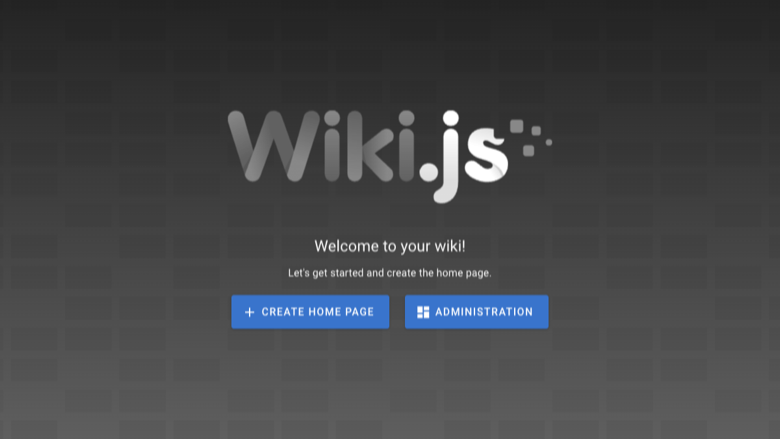
Wiki.js welcome
Image
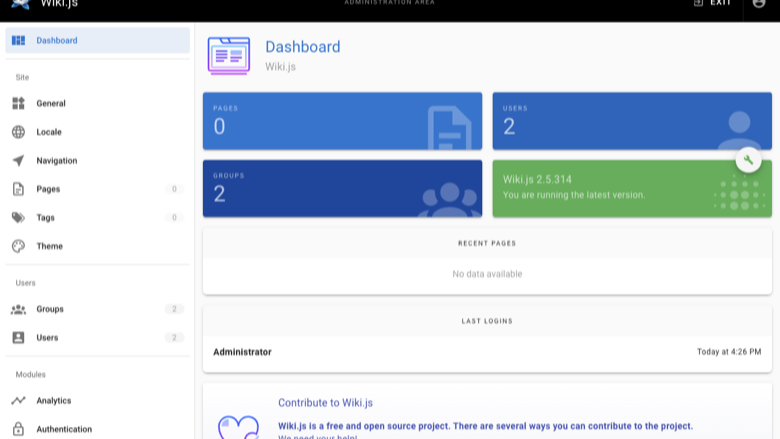
Administration dashboard
This is a repackaged open source software product wherein additional charges apply for cloudimg support services.
Launch a Private Knowledge Base in Minutes
Wiki.js is the popular open source wiki and knowledge-base platform trusted by thousands of teams worldwide. This AMI delivers Wiki.js 2.5 fully installed and configured on a bare-metal Node.js stack - no Docker overhead - so your team can create, search, and collaborate on documentation within minutes of launch.
Who This Is For
Engineering teams consolidating runbooks, architecture decisions, and onboarding guides in a single searchable platform with version history. Compliance and policy teams maintaining auditable documentation with granular access control and page-level permissions. IT administrators who need a self-hosted intranet wiki on AWS without dedicating ops cycles to installation, credential management, or reverse-proxy configuration.
Application Stack
- Wiki.js 2.5 Node.js server with Markdown and visual editors, full-text search, page history, and granular access control
- nginx reverse proxy handling TLS termination and static asset caching
- PostgreSQL datastore for pages, users, and asset metadata
- Server and database bind to the loopback interface for security
Secure By Default
Unlike AMIs that ship shared or default credentials, this image generates unique passwords on every first boot:
- A one-shot service completes Wiki.js setup automatically
- A single administrator account is created with a per-instance password written to a root-only file
- A fresh PostgreSQL password is generated and applied
- No shared credentials ever exist in the image
Getting Started
- Launch the AMI on a t3.small instance or larger (c5.large recommended for teams over 50 users)
- SSH into the instance and retrieve the admin password from the root-only file
- Open your browser to the instance IP or domain
- Sign in as administrator and create your first page in the Markdown or visual editor
- Organise content into namespaces, configure access control, and invite your team
- Connect external authentication (LDAP, SAML, OAuth) or storage backends from the admin area when ready
Recommended Instance Sizing
- Minimum: t3.small (2 vCPU, 2 GB RAM) - suitable for small teams up to 20 users
- Recommended: c5.large (2 vCPU, 4 GB RAM) - best performance for teams of 50+ concurrent users
- Storage: 20 GB gp3 EBS volume minimum; scale based on media uploads
- Networking: Open ports 80 and 443 in your security group for HTTP/HTTPS access
Use Case: Engineering Runbook Consolidation
An engineering team replaces scattered Google Docs and Confluence pages with a self-hosted Wiki.js instance. Developers author runbooks in Markdown directly from their workflow, search surfaces answers instantly during incidents, and version history provides an audit trail of every change. Granular permissions ensure only authorized team members edit production procedures while the broader org can read.
24/7 cloudimg Support
Every deployment is backed by cloudimg engineers available around the clock via email and live chat. Support covers:
- Initial deployment and instance sizing guidance
- Authentication configuration (LDAP, SAML, OAuth2)
- TLS termination with Let's Encrypt or custom certificates
- Storage backend integration (S3, local, Git)
- Wiki.js upgrades and PostgreSQL database administration
- Performance tuning and troubleshooting
Critical issues receive a one-hour average response time.
Evaluation
This AMI uses standard AWS pay-as-you-go infrastructure billing. Launch a t3.small instance to evaluate the platform with your team, and terminate at any time with no long-term commitment.
Wiki.js is a trademark of its respective owner. All product and company names are trademarks or registered trademarks of their respective holders. Use of them does not imply any affiliation with or endorsement by them.
Highlights
- Production-ready Wiki.js 2.5 running on bare-metal Node.js (no Docker overhead) with PostgreSQL and nginx reverse proxy. Launch on a t3.small or larger instance and have your first page editable within minutes - no manual installation, no dependency management, no configuration files to edit. Includes Markdown and visual editors, full-text search, page versioning, and granular access control out of the box.
- Secure by default with zero shared credentials: every instance generates unique administrator and PostgreSQL passwords on first boot, stored in a root-only file. Unlike AMIs shipping default passwords that teams forget to rotate, this image ensures no two deployments share authentication material. The automated one-shot setup eliminates manual credential configuration entirely.
- 24/7 technical support from cloudimg engineers via email and live chat with a one-hour average response for critical issues. Support scope covers deployment, authentication setup (LDAP, SAML, OAuth), TLS termination, storage backend integration, Wiki.js upgrades, and PostgreSQL administration - so your team focuses on content, not infrastructure maintenance.
Details
Sold by
Delivery method
Delivery option
64-bit (x86) Amazon Machine Image (AMI)
Latest version
Operating system
Ubuntu 24.04
Deployed on AWS
New
Introducing multi-product solutions
You can now purchase comprehensive solutions tailored to use cases and industries.

Features and programs
Financing for AWS Marketplace purchases
AWS Marketplace now accepts line of credit payments through the PNC Vendor Finance program. This program is available to select AWS customers in the US, excluding NV, NC, ND, TN, & VT.

Pricing
Free trial
Try this product free for 7 days according to the free trial terms set by the vendor. Usage-based pricing is in effect for usage beyond the free trial terms. Your free trial gets automatically converted to a paid subscription when the trial ends, but may be canceled any time before that.
Pricing is based on actual usage, with charges varying according to how much you consume. Subscriptions have no end date and may be canceled any time. Alternatively, you can pay upfront for a contract, which typically covers your anticipated usage for the contract duration. Any usage beyond contract will incur additional usage-based costs.
Additional AWS infrastructure costs may apply. Use the AWS Pricing Calculator to estimate your infrastructure costs.
If you are an AWS Free Tier customer with a free plan, you are eligible to subscribe to this offer. You can use free credits to cover the cost of eligible AWS infrastructure. See AWS Free Tier for more details. If you created an AWS account before July 15th, 2025, and qualify for the Legacy AWS Free Tier, Amazon EC2 charges for Micro instances are free for up to 750 hours per month. See Legacy AWS Free Tier for more details.
Dimension | Description | Cost/hour |
|---|---|---|
m5.large Recommended | m5.large | $0.08 |
t3.micro | t3.micro instance type | $0.04 |
t2.micro | t2.micro instance type | $0.04 |
g4ad.8xlarge | g4ad.8xlarge instance type | $0.24 |
c8i.4xlarge | c8i.4xlarge instance type | $0.24 |
c6i.2xlarge | c6i.2xlarge instance type | $0.24 |
m8a.24xlarge | m8a.24xlarge instance type | $0.24 |
c5ad.12xlarge | c5ad.12xlarge instance type | $0.24 |
p6-b300.48xlarge | p6-b300.48xlarge instance type | $0.24 |
m6id.metal | m6id.metal instance type | $0.24 |
Vendor refund policy
Refunds available on request.

Legal
Vendor terms and conditions
Upon subscribing to this product, you must acknowledge and agree to the terms and conditions outlined in the vendor's End User License Agreement (EULA) .
Content disclaimer
Vendors are responsible for their product descriptions and other product content. AWS does not warrant that vendors' product descriptions or other product content are accurate, complete, reliable, current, or error-free.
Delivery details
64-bit (x86) Amazon Machine Image (AMI)
Amazon Machine Image (AMI)
An AMI is a virtual image that provides the information required to launch an instance. Amazon EC2 (Elastic Compute Cloud) instances are virtual servers on which you can run your applications and workloads, offering varying combinations of CPU, memory, storage, and networking resources. You can launch as many instances from as many different AMIs as you need.
Version release notes
Initial release of Wiki.js 2.5 open source wiki and knowledge-base platform.
Additional details
Usage instructions
Connect via SSH on port 22 as the default login user for your operating system variant (the user guide lists it per variant; on Ubuntu it is 'ubuntu'). Wiki.js is served on port 80 through nginx (the server listens on 127.0.0.1:3000). Retrieve the generated administrator login with: sudo cat /root/wiki-js-credentials.txt. Browse to http://<instance-public-ip>/ and sign in with the email and password shown - the setup is already completed on first boot. The health endpoint http://<instance-public-ip>/healthz is open. Services are managed with systemctl (wiki-js, postgresql, nginx). To enable HTTPS, follow the Let's Encrypt section of the user guide.
Resources
Vendor resources
Support
Vendor support
cloudimg Support
cloudimg provides 24/7 technical support for this Wiki.js AMI via email and live chat.
Contact: support@cloudimg.co.uk
Response Times:
- Critical issues (service down, data loss risk): one-hour average response
- General inquiries: responded to within business hours
Support Scope:
Our engineers assist with the full lifecycle of your Wiki.js deployment:
- Initial deployment guidance and instance sizing recommendations
- Authentication configuration (LDAP, SAML, OAuth2, local accounts)
- TLS termination setup with Let's Encrypt or custom certificates
- Storage backend integration (AWS S3, Git, local filesystem)
- Wiki.js version upgrades and migration assistance
- PostgreSQL database administration, backup, and recovery
- nginx reverse proxy configuration and performance tuning
- Troubleshooting application errors and connectivity issues
Getting Help:
Email support@cloudimg.co.uk or use live chat with a description of your issue. For deployment questions before purchase, reach out to the same address. Include your instance ID and AWS region to expedite troubleshooting.
Refunds:
If you experience issues with the product, contact support@cloudimg.co.uk . Our team will work to resolve your concern or assist with the refund process through AWS Marketplace.
AWS infrastructure support
AWS Support is a one-on-one, fast-response support channel that is staffed 24x7x365 with experienced and technical support engineers. The service helps customers of all sizes and technical abilities to successfully utilize the products and features provided by Amazon Web Services.
Similar products

This product has charges associated with it for seller support. Simple, Secure and Supported deployment with the Hossted CLI, for easy self-maintenance.

This product has charges associated with it for deployment, configuration, and ongoing support. Self-hosted wiki with beautiful interface. Markdown and WYSIWYG editing, Git-backed storage, full-text search, diagrams, and 50+ authentication providers.

This product has charges associated with it for seller support. TikiWiki, often referred to simply as Tiki, is an open-source Content Management System (CMS) and Groupware platform. It is highly versatile and feature-rich, enabling users to build and maintain websites, intranets, and web applications.

This product has charges associated with it for AWS support & maintenance. Self-Hosted web-based DevOps lifecycle tool that includes Git repository management, issue tracking, CI/CD pipelines, code review, an IDE, activity streams, wikis, and more.
Customer reviews
No customer reviews yet
Be the first to review this product . We've partnered with PeerSpot to gather customer feedback. You can share your experience by writing or recording a review, or scheduling a call with a PeerSpot analyst.