
Sold by: Cortex
AI-powered Internal Developer Portal that helps engineering teams deliver reliable, secure, efficient software, faster.
4.3
Overview
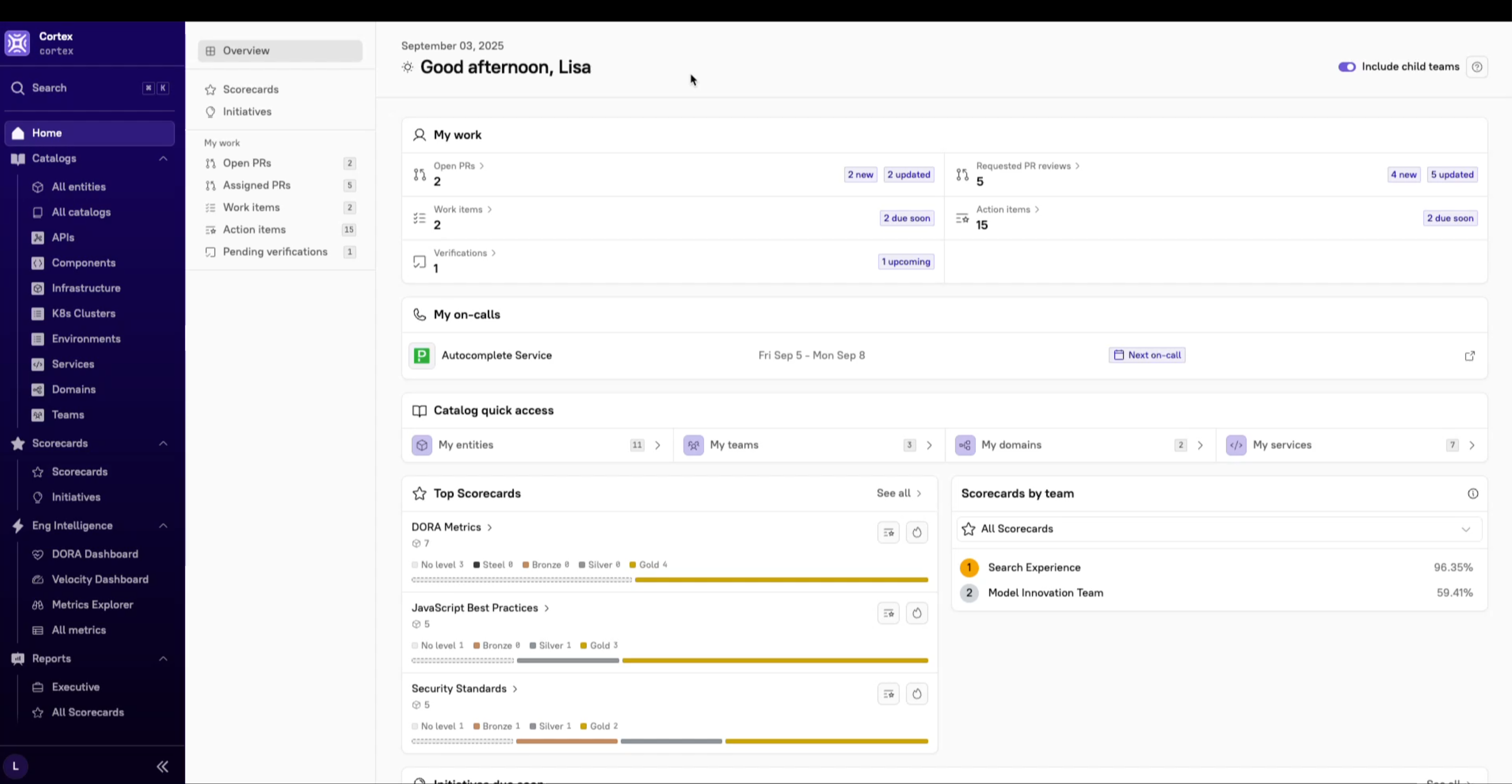
Video
Cortex Overview
Video
Eng Intel
Cortex is the AI-powered Internal Developer Portal that helps engineering leaders at companies like Canva, Skyscanner, and Grammarly build organizations that ship reliable, secure, and efficient software, faster. By connecting data across your engineering ecosystem, Cortex uses AI to make sense of complex systems, identify what's holding your teams back, and drive action automatically. From understanding ownership and production readiness to enforcing best practices and measuring AI maturity, Cortex transforms engineering data into meaningful insights and automated workflows. The result: teams that move faster with confidence, stronger reliability at scale, and an organization fully ready for the AI-powered future of software development.
Magellan: Onboarding with Cortex
Production Readiness
AI Chief of Staff for Eng Leaders
Cortex MCP Use Cases
Scorecards, Initiatives, & Reports
Workflows
Catalogs
Incident Management & Response
Book a demo: https://www.cortex.io/demo
Cortex provides custom packages for every phase towards engineering excellence. Please contact AWS-Marketplace@cortex.io for a demo of Cortex, Private Offer, or additional pricing options.
Highlights
- Cortex Overview: https://youtu.be/0ugYI8r1DwI
- Explore Cortex: https://www.cortex.io/explore
- Customer stories: https://www.cortex.io/case-studies
Details
Sold by
Delivery method
Deployed on AWS
New
Introducing multi-product solutions
You can now purchase comprehensive solutions tailored to use cases and industries.

Features and programs
Trust Center

Access real-time vendor security and compliance information through their Trust Center powered by Drata or Vanta. Review certifications and security standards before purchase.
Buyer guide
Gain valuable insights from real users who purchased this product, powered by PeerSpot.

Financing for AWS Marketplace purchases
AWS Marketplace now accepts line of credit payments through the PNC Vendor Finance program. This program is available to select AWS customers in the US, excluding NV, NC, ND, TN, & VT.

Pricing
Pricing is based on the duration and terms of your contract with the vendor, and additional usage. You pay upfront or in installments according to your contract terms with the vendor. This entitles you to a specified quantity of use for the contract duration. Usage-based pricing is in effect for overages or additional usage not covered in the contract. These charges are applied on top of the contract price. If you choose not to renew or replace your contract before the contract end date, access to your entitlements will expire.
Additional AWS infrastructure costs may apply. Use the AWS Pricing Calculator to estimate your infrastructure costs.
Dimension | Description | Cost/12 months |
|---|---|---|
Cortex IDP Users | 50 Users SaaS Hosted | $39,000.00 |
Depreciated SKU | Depreciated SKU | $100,000.00 |
Dimension | Description | Cost/user/hour |
|---|---|---|
Fees | Overage Fees | $1.00 |
Dimensions summary
This contract prices access to the Cortex Internal Developer Portal by user count. The Cortex IDP Users dimension covers 50 users on a SaaS-hosted basis, forming the core subscription you commit to for the term. The Overage Fees dimension applies when usage exceeds your committed amount, billed by user-hours. The Depreciated SKU dimension is a legacy user-based option retained for existing arrangements and is not the standard purchase path. Together, the base user allotment sets your committed capacity, while overage fees handle any usage beyond it.
Top-of-mind questions for buyers
A user is an individual person with access to the Cortex portal. The subscription covers 50 such users on Cortex's hosted, cloud-delivered environment. You do not manage the underlying infrastructure. Engineering leaders, platform teams, SREs, and developers each count as one user toward your allotment.
Overage Fees are billed by user-hours beyond your committed 50-user capacity. This meters extra usage rather than requiring you to buy a new block upfront. The base subscription sets your committed capacity, and overage charges apply on top only when actual usage crosses that amount.
The Depreciated SKU is a legacy user-based option retained for existing arrangements. It is not the standard purchase path for new buyers. If you are buying for the first time, the Cortex IDP Users subscription is the current user-based option. Contact the vendor if unsure which applies to you.
www.cortex.io
Helpful?
Vendor refund policy
N/A

Legal
Vendor terms and conditions
Upon subscribing to this product, you must acknowledge and agree to the terms and conditions outlined in the vendor's End User License Agreement (EULA) .
Content disclaimer
Vendors are responsible for their product descriptions and other product content. AWS does not warrant that vendors' product descriptions or other product content are accurate, complete, reliable, current, or error-free.
Delivery details
Software as a Service (SaaS)
SaaS delivers cloud-based software applications directly to customers over the internet. You can access these applications through a subscription model. You will pay recurring monthly usage fees through your AWS bill, while AWS handles deployment and infrastructure management, ensuring scalability, reliability, and seamless integration with other AWS services.
Resources
Vendor resources
Support
Vendor support
Please refer to Cortex Documentation, your company Slack channel with our team, or your Sales & Customer Success points of contacts for additional support. For any additional troubleshooting please contact help@cortex.io .
AWS infrastructure support
AWS Support is a one-on-one, fast-response support channel that is staffed 24x7x365 with experienced and technical support engineers. The service helps customers of all sizes and technical abilities to successfully utilize the products and features provided by Amazon Web Services.
Updated weekly
By Cortex


By Spotify for Backstage (Spotify AB)
Sentiment is AI generated from actual customer reviews on AWS and G2
Functionality
Ease of use
Customer service
Cost effectiveness
Positive reviews
Mixed reviews
Negative reviews
AI generated from product descriptions
AI-Powered Data Integration and Analysis
Connects data across engineering ecosystem and uses AI to analyze complex systems and identify bottlenecks across teams and infrastructure
Production Readiness Assessment
Evaluates and tracks production readiness status of services and systems to ensure reliability at scale
Ownership and Best Practices Tracking
Identifies service ownership, enforces best practices, and maintains compliance across engineering organizations
Automated Workflow Execution
Drives automated actions and workflows based on AI-generated insights to streamline engineering processes
AI Maturity Measurement
Measures and tracks AI maturity levels across the organization to assess readiness for AI-powered software development
AI Impact Measurement
Tracks adoption and utilization of AI coding tools, measures AI-assisted pull requests, and connects productivity changes to engineering outcomes including cycle time, deployment frequency, defect rates, and delivery predictability.
Multi-Source Data Integration
Passively ingests signals from source control, issue trackers, CI/CD pipelines, cloud infrastructure, and AI coding assistants to create a unified intelligence layer for engineering leadership.
Performance Metrics Framework
Implements DORA and SPACE metrics to establish consistent measurement strategy for benchmarking trends, tracking delivery health, and reporting engineering performance outcomes.
Intelligent Work Classification
Utilizes Amazon SageMaker for automated classification of engineering work and Amazon Bedrock for chat and agentic experiences to provide context-rich intelligence.
Cross-Functional Team Analytics
Provides unified visibility across software engineering, DevOps, SRE, and infrastructure teams with investment allocation tracking, developer experience metrics, and team-level performance benchmarking.
Software Quality Assurance
Codified checks and guidance to ensure quality, reliability, and alignment of software development practices
Access Control Management
Role-based access control mechanism to manage and control access to actions and data within the portal
Usage Analytics and Monitoring
Identification, benchmarking, and analysis of usage trends and adoption metrics
Knowledge Management Platform
Internal marketplace for learning and growth opportunities enabling knowledge sharing and skill development
Ownership and Permission Mapping
Clear association of owners to permissions and roles for simplified ownership management
Standard contract
No
No
No
Customer reviews
ManthanBorkar
Unified automation has reduced tribal knowledge and has streamlined microservice cataloging
Reviewed on Oct 06, 2026
Review from a verified AWS customer
What is our primary use case?
I use Cortex.io for cataloging and architecturing the catalog. I have used Cortex.io for eliminating tribal knowledge by creating a single automated system. Cortex.io maps all microprocesses, mono records, and machine learning models. It also has a Kafka topic integrated into it. Once we get a topic, we use that living context graph and then we can have a proper systematic deployment. The teams can instantly look into whatever specific component or dependencies it has. They can activate a deployment status, which can have a Slack channel integrated into it. Cortex.io has helped all the teams to integrate and work with a single skill.
How has it helped my organization?
If I want to have massive redundancy in the meantime, which is MTTR, then I can use Cortex.io. If I connect Cortex.io for data across 50 plus integrations, like PagerDuty or Jira, I can give it on a context graph for it, which reduces almost 75% of MTTR. For accelerating velocity, I can use Cortex.io. We have one-click self-service in Cortex.io. There are different services while shifting left security audits, and I can use Cortex.io there as well.
What is most valuable?
It is simpler if we use pretty simple language. For example, if I have microservices inventory into a dynamic or automatic execution engine, and I just tell it that I want to have a deeply interconnected automatic edge for every microprocess, it will create a backstage or confluence for it first. It requires access, and once we give them manual upkeep, it pulls all the metadata directly from the tool, from GitHub or AWS or Kubernetes. It maps on a real-time basis depending on the ownership. We can automate the service which can break at, for instance, 2:00 a.m. So at any time, anyone on call instantly sees who owns it, who is upstreaming the dependencies, and who is using an active Slack. Cortex.io has pretty good features.
For visualization, I have used it, but I cannot remember the specific details for now. We have used it for engineering intelligence. We have used DORA metrics.
I have not utilized Cortex.io's custom algorithm development feature.
I do not have a lot of knowledge about Cortex engineering.
I have done real-time analysis in Cortex.io.
What needs improvement?
For now, I do not have any recommendations regarding improvements.
Maybe once I have used it more widely, then I can have a suggestion. But for now, it has only been two to three months.
Regarding pros and cons, I do not still remember a lot of it from Cortex.io. One issue is that if we are taking, for example, if I want to automate any mapping or context mapping, then sometimes it gives a little problem. But cons are that for a predefined data structure, the internal engine basically does not give a proper data model. That can be a con.
What do I think about the stability of the solution?
I have not faced any issues with stability or scalability.
What do I think about the scalability of the solution?
For now I do not have anything regarding limitations or performance issues with Cortex.io.
How are customer service and support?
I have previously escalated questions to the technical support team regarding other matters, but not regarding Cortex.io.
Which solution did I use previously and why did I switch?
I have used ITSM, but I cannot remember it properly now.
How was the initial setup?
The setup process of Cortex.io is straightforward with no challenges or complexities. It was easy and straightforward.
What was our ROI?
Cortex.io is pretty much good and cost-effective.
What's my experience with pricing, setup cost, and licensing?
I had a pretty good idea about the setup cost, but I cannot recall it precisely. I think it is around two to three dollars per credit if I use AI credit.
I did not purchase Cortex.io through the AWS Marketplace. I got it directly from the official website itself.
Which other solutions did I evaluate?
I have not used other solutions, but I think Cortex.io is better with Snowflake. It integrates well with Snowflake.
What other advice do I have?
I have used the SaaS version of Cortex.io as well as AWS with Cortex.io.
Cortex.io is pretty much good, and I can rate it as an eight out of ten.
I have not explored all the features of Cortex.io. I have not used Cortex.io for investigating a large or huge amount of data. I have not gotten the development footprint from Cortex.io, so I cannot directly say it is a perfect ten out of ten. But for automation and all, I can give ten out of ten for automation and software cataloging. Cortex.io is pretty good.
Those data models with the internal engine that I mentioned are the reason that I give it an eight out of ten.
I can recommend Cortex.io in many other terms. Basically, if I compare it with Databricks LLM's model, then Cortex.io is pretty much faster. My overall rating for Cortex.io is eight out of ten.
Which deployment model are you using for this solution?
Public Cloud
If public cloud, private cloud, or hybrid cloud, which cloud provider do you use?
Amazon Web Services (AWS)
Uchechi-Sylvanus
Automation has streamlined workshop and billing processes but still invites future refinements
Reviewed on Oct 06, 2026
Review provided by PeerSpot
What is our primary use case?
Cortex.io is used at Cedric Masters to automate our after-sales operations, specifically when customers bring in vehicles for service. From the moment a customer walks in with their vehicle through invoicing and departure, to the purchasing of parts, Cortex.io supports the entire process.
When a customer walks in with their vehicle, customer service personnel enter the issue the customer came in with, whether they need a part change, car part replacement, or servicing. The issue then goes directly to the workshop if a part change is needed, and workshop personnel receive a notification. Upon receiving the notification, workshop personnel automatically check if that part is available, how many units are in stock, the costing, and all relevant details. After obtaining this information, they inform the technician, who verifies part availability and receives approval to begin the job. Once the technician completes the work, they log into Cortex.io and access the portal, after which customer service receives an invoice detailing the total cost of all services provided. The customer then pays based on this invoice.
Cortex.io also helps us manage inventory within the workshop.
How has it helped my organization?
Cortex.io has positively impacted our organization by making our processes faster. The main achievement is in processing speed, where delays in obtaining quotes and prices for particular services offered to customers have been eliminated and are now visible immediately. Previously, confirmation of prices required calling the workshop chairman by phone, but now every detail is on the system. There is no need to reach out to any staff to confirm prices because they are already available and seamless on the platform.
What is most valuable?
Cortex.io's best features for me include the pre-cloud deployment that we used. The pre-deployment feature was seamless for my team and was not difficult because Cortex.io has inbuilt databases, all of which are within the same environment. It was not difficult navigating through different deployment folders to deploy our applications, and it was easy for us to generate links to access our application.
Cortex.io's governance and security capabilities are fine. Regarding Cortex.io's reliability and accuracy, I can give a 100% rating for both capabilities.
What needs improvement?
Since we are using Cortex.io for the first time, I am impressed with what is already in place. As we continue using it for other applications, we might observe one or two aspects that could be improved, but for now, it has addressed everything we needed.
For how long have I used the solution?
This is the first time we are implementing Cortex.io, as we used it to build one of our internal process automation systems here at Cedric Masters.
What do I think about the stability of the solution?
Cortex.io is stable.
What do I think about the scalability of the solution?
Cortex.io's scalability is something I would give a range for.
How are customer service and support?
I have not had any need to contact customer support at this time, so we are satisfied.
Which solution did I use previously and why did I switch?
Before Cortex.io, we managed these operations manually. We did not previously use a different solution, as we have never used any previous solution.
What was our ROI?
I cannot share any relevant metrics such as money or time saved or fewer employees needed, so I do not have a return on investment to report at this time.
What's my experience with pricing, setup cost, and licensing?
Regarding my experience with pricing, setup cost, and licensing, my developers used the free licensing for now, and we do not have access to the paid environment yet. This is something we will need to explore.
Which other solutions did I evaluate?
I did not evaluate other options before choosing Cortex.io because my developers were comfortable with it and had worked with it before in their previous applications.
What other advice do I have?
We took advantage of Cortex.io's cloud environment for now, and we are trying to determine how we can incorporate an Azure cloud environment while also speaking to other cloud providers. Currently, we do not have any infrastructure in place, so we took advantage of Cortex.io's cloud environment.
My advice for others looking into using Cortex.io is to take advantage of the environment because it is seamless, scalable, and reliable. I rate Cortex.io a seven out of ten.
Isaac Gyekye
User-friendly data visualization has supported non-technical teams and improved customer insights
Reviewed on Jul 29, 2026
Review provided by PeerSpot
What is our primary use case?
We are partners, and I stand more like an end user. We usually give Cortex.io's data visualization tool to customers, and that's how we use it.
What is most valuable?
Cortex.io is user-friendly, and its intuitive user interface is beneficial for non-technical team members. Our customers benefit from using Cortex.io and find this product beneficial for them.
What needs improvement?
Deployment for Cortex.io is not a simple process and is somewhat complex.
For how long have I used the solution?
I have been working with Cortex.io for three years now.
How are customer service and support?
Cortex.io's technical support is helpful and responsive. I would rate this aspect a nine out of ten.
What about the implementation team?
Depending on the kind of project, two or three people usually take part in implementation.
What other advice do I have?
I am familiar with Cortex.io. From my point, we are the support team, and we do not do the deployment. The engineers do the deployment, so I cannot give you the timeframe they use in doing those deployments. I have not used it myself, so I cannot tell you what I appreciate in this solution. My team is using it, and they usually give it to customers. In case they have any issue, they call us. From my department, I cannot give answers about why customers want this because I am more on the support side. I have no idea whether customers utilize Cortex.io's custom algorithms development feature because I am not aware of that. I am not sure how Cortex.io's automated data clearing impacts data accuracy, so I cannot give you that information either. My overall review rating for this product is ten out of ten.
reviewer2807607
Centralized service catalog has improved visibility and now drives faster incident resolution
Reviewed on Mar 06, 2026
Review from a verified AWS customer
What is our primary use case?
My main use case for Cortex.io is that it provides the centralization of data from all the tools like CI/CD, monitoring, or incident management, making it a single source of truth and giving us a centralized command center for managing the health and reliability of the software services and the teams.
I use Cortex.io as a centralized command center to manage many microservices and engineering squads in a centralized way, which provides a centralized service catalog that centralizes data from all the microservices, allowing us to know who owns each service, its current health, and any documentation gaps.
What is most valuable?
The best feature Cortex.io offers is visibility, which is most relevant to the teams or services struggling with consistency and operational toil. This visibility gives us complete insight across our entire services and organization, which stands out the most for me.
The visibility feature has helped our teams by resulting in a 75% reduction in mean time to restore, allowing us to get alerts and incident history instead of relying on scattered spreadsheets and unreliable tools, thus saving around 15 to 20 hours per newly created service.
Cortex.io positively impacts our organization not only with visibility but also through its scorecards that grade each service against engineering standards, helping us check for on-call owners, passing tests, and production readiness.
The scorecards feature has changed how our teams work by providing me, as a manager, with a bird's eye view of operational maturity across teams and insight into pending incidents and responsible personnel.
What needs improvement?
I wish Cortex.io could cater to smaller teams struggling with visibility and operational toil, as a lighter version would be really great.
I believe AI adoption tracking can be enhanced and made more useful, as it currently lags behind market trends, especially in the area of security tracking for AI adoption. I think the interface and support could improve in that field.
For how long have I used the solution?
I have been using Cortex.io for the last six months.
What do I think about the stability of the solution?
Cortex.io is very stable.
What do I think about the scalability of the solution?
The scalability of Cortex.io is high.
How are customer service and support?
Customer support is very professional, and I receive complete answers within a fraction of time.
Which solution did I use previously and why did I switch?
I haven't used any other solution previously.
How was the initial setup?
I deploy Cortex.io using both public cloud and on-premise solutions.
For my public cloud deployment, I use AWS, and for my self-hosted deployment, I utilize Kubernetes plus Helm.
What about the implementation team?
I don't have complete visibility on how Cortex.io was purchased, but I believe it is through AWS Marketplace.
What was our ROI?
I have been seeing a 70 to 75% reduction in MTTR after using Cortex.io, which is the only metric I can share.
What's my experience with pricing, setup cost, and licensing?
Regarding pricing, it is fair, and the setup cost for the self-hosted version is really simple. I am on a starter deal with five product tiers that include engineering intelligence and DORA matrices. Although I have faced budget restrictions regarding engineering intelligence for renewal, initial setup costs are justified and licensing fees are broadly acceptable in the industry.
Which other solutions did I evaluate?
Before choosing Cortex.io, I evaluated Spotify Backstage, which I believe is open source, and also looked at Port.io, as these are the two options I discussed or analyzed.
What other advice do I have?
My advice to others looking into using Cortex.io is to start with a service catalog first, as scorecards are the real power feature, and it is beneficial to invest in Cortex Academy early for teams to learn how to use it effectively.
If Cortex.io gets better AI adoption tracking improvements and they provide solutions for smaller setups, that would also enhance its value.
I would rate this product an 8 out of 10 overall. I feel completely satisfied, as I do not have any other improvements needed, and have no additional thoughts about Cortex.io.
Armani Bond
Centralized metrics have improved risk visibility and now guide daily security decisions
Reviewed on Feb 24, 2026
Review from a verified AWS customer
What is our primary use case?
I have experiences in Cortex.io to centralize overall security and engineering insights and to track the overall health and risk metrics. I use it for monitoring scoreboards, metrics to measure systems' reliability, and the security posture overall. I also track the vulnerabilities and do remediation progress, provide visibility into the team performances and compliance data, and use dashboards to prioritize security and improve overall operations with my team. I drive data-based decisions to reduce risk and improve engineering efficiency.
I use Cortex.io daily to track my security and the operational health metrics for services. For example, I use it to monitor service scoreboards that measure things such as vulnerability backlogs, deployment risk, incident trends, and compliance metrics. When I saw a service with a growing vulnerability backlog, I worked with the engineering team to prioritize remediation tasks and track the progress in Cortex.io. I updated dashboards and metrics so that leadership could see improvements over time, which helped teams make data-driven decisions. It helped them reduce risk by ensuring vulnerabilities were addressed in a timely manner, and everything was fixed promptly.
Another example of how I used Cortex.io is that I used it to monitor security and compliance health across our services. I review service scoreboards and metrics that track open security findings, configuration compliance, incident response performance, and deployment risk indicators. When a service showed non-compliant configurations or any open findings, I notified the engineering teams, helped prioritize remediation, and tracked progress in Cortex.io dashboards. I provided updates so leadership could measure improvements. Overall, this ensured security issues were addressed proactively and in a timely manner, giving teams clear visibility into the risk. I check dashboards and metrics regularly as part of my daily workflow and use the data to guide security and operational improvements.
What is most valuable?
In my opinion, one of the best features of Cortex.io is the unified service catalog because Cortex.io automatically builds a centralized catalog for all your services and teams, detailing the ownerships, so you always know what exists and who owns that feature. I also love the scorecards and readiness checks; Cortex.io provides custom scoreboards that measure things such as security controls and best compliance practices, allowing teams to track health and improvements over time. I also love the progress tracking and how you can initiate and tie the scorecard goals so that work isn't just visible but actionable, allowing you to complete owners, deadlines, and also track progress that way. I appreciate the visibility and overall better reliability, as Cortex.io helps speed up onboarding, improves reliability, and frees engineers to focus on high-impact work throughout the team.
The scorecards control the readiness, security controls, and best practices, and they have helped my team make better tracking of health improvements and save a lot of time.
Cortex.io has positively impacted team collaboration because it provides clear visibility into service health, security posture, and operational metrics. Before Cortex.io, insights were scattered across tools and spreadsheets, making it harder to prioritize work and measure progress. With Cortex.io, my teams could see scoreboards and metrics all in one place, which allowed us to identify vulnerabilities and risks faster. We track remediation progress over time, make data-driven decisions more quickly, and improve collaboration through shared visibility. This enhances my team's efficiency, accountability, and helps reduce risk by addressing issues proactively and in a timely manner.
I experienced timely remediation because Cortex.io improved my team's efficiency and security visibility by centralizing service measures and risk data. Before using it, we tracked vulnerabilities and operational metrics in separate tools and spreadsheets, which made prioritization difficult. We reduced time spent searching for risk data because everything was on one dashboard, and my teams could quickly see scoreboards. We did remediation efforts to track it better and prioritize high-risk issues faster, and overall, it improved collaboration and decision-making within my security team. The operational health measures also made it more transparent.
What needs improvement?
One feature I would love to see in Cortex.io is more advanced real-time threat detection and automated alerting. I feel that this is very important, especially tailored for vulnerability severity and risk prioritization. Currently, Cortex.io provides excellent scoreboards and insights, but having real-time security alerts tied directly to risk levels, with automatic escalation and suggested remediation actions, will make the platform even more powerful in my opinion. This matters because it bridges the gap between observability and active security response, helping prioritize high-severity risks automatically, which can cut down the time spent manually correlating metrics and alerts.
One area for Cortex.io's improvement could be deeper automation and actionable recommendations. For example, the automation prioritization for vulnerabilities by risk could have more remediation actions based on historical issues, and also more security tools for real-time alerts.
For how long have I used the solution?
I have been using Cortex.io for about five years.
What other advice do I have?
Something I wish I knew before starting that could serve as good advice for others looking into using Cortex.io is to integrate it into your daily workflow. If possible, use it more than just part of your daily routine. I feel that it should be used actively as a decision-making tool and not just for visibility. The scorecards and metrics are powerful, and they are most valuable when teams actively use the insights to prioritize security and operational improvements. I advise others to regularly review scorecards and health metrics and to treat the dashboards as decision-making tools. Collaborate on remediation based on insights, track progress over time, focus on metric improvements, and maintain clear ownership and accountability, as Cortex.io works best when integrated into team processes, leading to better overall improvement. I would rate my overall experience with Cortex.io as an 8 out of 10.
Which deployment model are you using for this solution?
Hybrid Cloud
If public cloud, private cloud, or hybrid cloud, which cloud provider do you use?
Amazon Web Services (AWS)