Sold by: cloudimg
Deployed on AWS
Free Trial
AWS Free Tier
This product has charges associated with it for the installation, configuration and packaging of Oracle Database 11g. Oracle Database 11g Standard Edition 11.2.0.4 on Oracle Linux or AlmaLinux 8.10: a non-CDB ORCL database, per-instance SYS/SYSTEM passwords and a loopback listener. For legacy and migration use. Bring your own Oracle licence.
These options are for Oracle Database 11g Standard Edition | cloudimg.
View 1 other optionOverview
Image
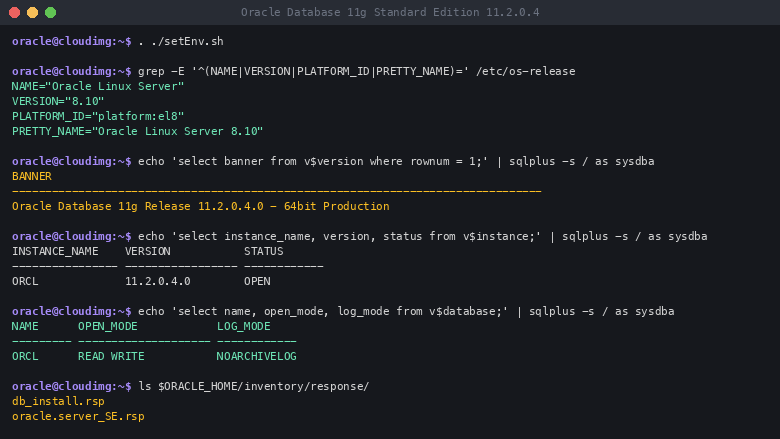
Oracle Database 11g Standard Edition 11.2.0.4
Image
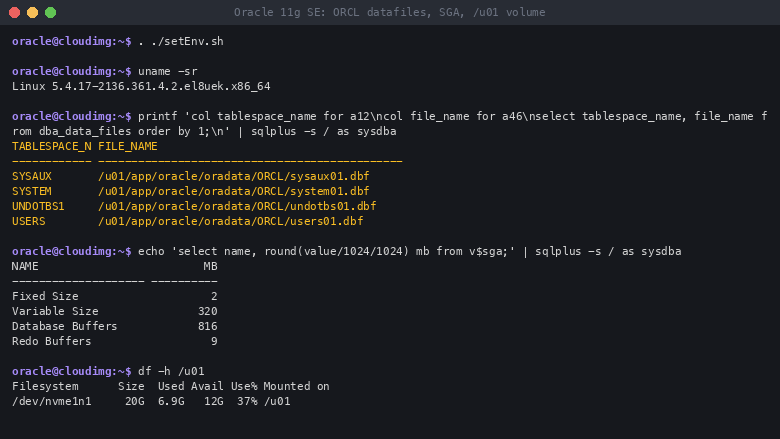
Oracle 11g SE: ORCL datafiles, SGA, /u01 volume
Image
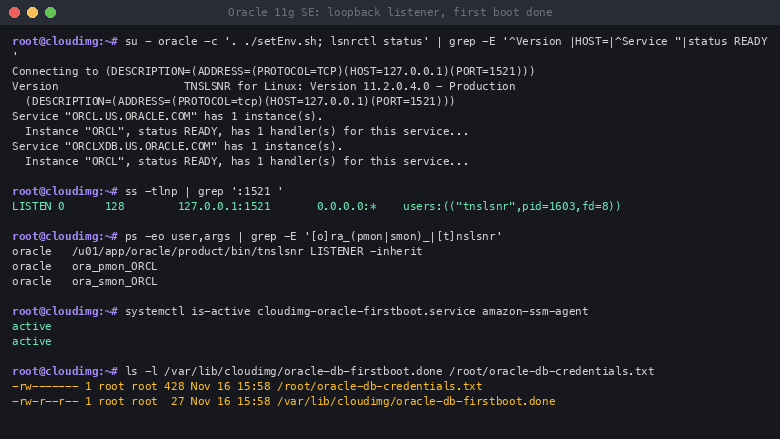
Oracle 11g SE: loopback listener, first boot done
This is a repackaged software product wherein additional charges apply for the installation, configuration and packaging of the software in this image by cloudimg.
What cloudimg adds to Oracle Database 11g Standard Edition
This image installs Oracle Database 11g Release 2 Standard Edition (release 11.2.0.4.0) on Amazon EC2 with its database already created. Choose the operating system when you subscribe; both versions were built on 16 November 2026 and fully updated from the distribution's own repositories:
- Oracle Linux 8.10, updated from Oracle's repositories
- AlmaLinux 8.10, updated from AlmaLinux's own repositories (the Oracle Linux repositories are disabled)
On both versions you get:
- Each instance's own passwords: at first boot, SYS and SYSTEM get two different 24-character random passwords made on that instance, written to /root/oracle-db-credentials.txt (root only); every other database account is re-keyed with a random value and locked, so no Oracle default password remains
- Listener on 127.0.0.1:1521 only: connect SQL*Plus, SQL Developer or JDBC through an SSH tunnel; the user guide shows how to allow other hosts from your own address range
- An OS you can update: sudo dnf update works on both versions, and a boot script applies security updates at every boot
- Oracle software on its own EBS volume: a dedicated 20 GB /u01 volume, separate from the 50 GB root disk
- A database created at build time: non-CDB database ORCL (SID ORCL), service ORCL.US.ORACLE.COM, AL32UTF8 character set, SCOTT sample schema (locked)
- One-command operation: an oracle OS user with setEnv.sh, start_all.sh and stop_all.sh
- AWS tooling: AWS CLI v2, the SSM Agent and the CloudWatch agent (installed, not configured)
- A step-by-step user guide for every step below, updates and troubleshooting
If you subscribed before 16 November 2026, your instances share a build-time SYS/SYSTEM password: change SYS and SYSTEM and delete /stage/scripts/oracle-database-credentials.log; the user guide shows how.
Licensing: bring your own Oracle licence
This listing does not include an Oracle Database licence. The hourly charge on this listing is cloudimg's, for the installation, configuration and packaging of Oracle Database 11g Standard Edition in these images. You must hold a valid Oracle Database licence that covers Standard Edition 11g and use it under your agreement with Oracle. Oracle's cloud licensing policy allows Amazon EC2 instances of up to 16 vCPUs under a Standard Edition licence and up to 8 vCPUs under a Standard Edition 2 licence; check the current policy for how vCPUs are counted.
Oracle Database 11g Release 2 is past the end of Oracle's support: Premier Support ended in January 2015 and Extended Support in December 2020, so Oracle publishes no new patches for it. This image ships the 11.2.0.4.0 release with no Patch Set Update. Oracle Database 11.2.0.4 is not certified on Oracle Linux 8 or AlmaLinux 8. Use it for legacy applications, testing and migration to a current release, not for new production systems.
Oracle and Java are registered trademarks of Oracle and/or its affiliates. AlmaLinux is a trademark of the AlmaLinux OS Foundation. cloudimg is not affiliated with or endorsed by Oracle.
Who it is for
- Teams that must keep an Oracle 11g Standard Edition application running while they plan an upgrade
- DBAs rehearsing an 11g to 19c migration with Data Pump
- Software vendors testing support for customers still on Oracle 11g
- Test and training environments that must match an existing 11g estate
What Standard Edition includes
Oracle Database 11g Release 2 Standard Edition provides the core Oracle engine: SQL and PL/SQL, ACID transactions with multi-version read consistency, XML DB, Oracle Text, Data Pump, SQL*Loader, RMAN backup and recovery and Oracle Net connectivity. Enterprise Edition options such as Partitioning, OLAP, Data Mining and Data Guard are not part of Standard Edition, and Automatic Storage Management (Grid Infrastructure) is not installed on this image.
Getting started
- Subscribe and choose the Oracle Linux 8 or AlmaLinux 8 version (m5.large or larger; up to 16 vCPUs under a Standard Edition licence, 8 vCPUs under a Standard Edition 2 licence).
- The suggested security group allows SSH (TCP 22) from anywhere: change the source to your own IP. No other port is needed.
- SSH in as ec2-user, read this instance's passwords with sudo cat /root/oracle-db-credentials.txt, then run sudo su - oracle and . ./start_all.sh (the database does not start at boot).
- From your machine, open an SSH tunnel (ssh -i your-key.pem -L 1521:127.0.0.1:1521 ec2-user@<public-ip>) and connect SQL Developer to localhost:1521, service ORCL.US.ORACLE.COM.
Highlights
- Oracle Database 11g Standard Edition (11.2.0.4.0) on Oracle Linux 8.10 or AlmaLinux 8.10, fully updated from each distribution's own repositories, with a non-CDB ORCL database started with one script.
- Each instance gets its own SYS and SYSTEM passwords at first boot, in a root-only file; every other database account is locked with a random password. The listener answers on 127.0.0.1 only: connect through an SSH tunnel.
- Bring your own Oracle Database licence covering Standard Edition. Oracle software on a dedicated 20 GB /u01 volume; service ORCL.US.ORACLE.COM, AL32UTF8; step-by-step user guide. For legacy and migration use.
Features and programs
Financing for AWS Marketplace purchases
AWS Marketplace now accepts line of credit payments through the PNC Vendor Finance program. This program is available to select AWS customers in the US, excluding NV, NC, ND, TN, & VT.

Pricing
Free trial
Try this product free for 7 days according to the free trial terms set by the vendor. Usage-based pricing is in effect for usage beyond the free trial terms. Your free trial gets automatically converted to a paid subscription when the trial ends, but may be canceled any time before that.
Pricing is based on actual usage, with charges varying according to how much you consume. Subscriptions have no end date and may be canceled any time. Alternatively, you can pay upfront for a contract, which typically covers your anticipated usage for the contract duration. Any usage beyond contract will incur additional usage-based costs.
Additional AWS infrastructure costs may apply. Use the AWS Pricing Calculator to estimate your infrastructure costs.
If you are an AWS Free Tier customer with a free plan, you are eligible to subscribe to this offer. You can use free credits to cover the cost of eligible AWS infrastructure. See AWS Free Tier for more details. If you created an AWS account before July 15th, 2025, and qualify for the Legacy AWS Free Tier, Amazon EC2 charges for Micro instances are free for up to 750 hours per month. See Legacy AWS Free Tier for more details.
- ...
Dimension | Description | Cost/hour |
|---|---|---|
m5.large Recommended | m5.large | $0.10 |
t2.micro | t2.micro instance type | $0.06 |
t3.micro | t3.micro instance type | $0.06 |
m7a.large | m7a.large instance type | $0.10 |
m7i-flex.xlarge | m7i-flex.xlarge instance type | $0.15 |
m7i.large | m7i.large instance type | $0.10 |
t3.small | t3.small instance type | $0.06 |
x1e.32xlarge | x1e.32xlarge instance type | $0.28 |
r5b.24xlarge | r5b.24xlarge instance type | $0.28 |
p3.2xlarge | p3.2xlarge instance type | $0.28 |
Dimensions summary
You pay by the hour for the instance type you run. Pricing follows your chosen Amazon EC2 instance size, so cost scales with the compute you select. Smaller instances like t3.small or m5.large carry lower hourly rates, while larger compute, memory, storage, and accelerated instances cost more per hour. The hourly charge covers the cloudimg machine image and 24/7 support; it does not include an Oracle Database license, which you must hold separately. There are no tiers or commitments. You start and stop instances as needed, and billing stops when the instance stops.
Top-of-mind questions for buyers
The hourly charge covers the cloudimg machine image and 24/7 support with a 24-hour response SLA. It does not include an Oracle Database license. You must hold a valid Oracle license for Standard Edition 11g and use it under your agreement with Oracle.
The hourly software charge meters running time, so billing stops when the instance stops. You pay per hour for the instance type while it runs. Stopped instances may still incur underlying AWS storage fees for the attached volumes, but the software charge applies only while the instance is active.
The hourly rate rises with the instance size you select. Oracle's cloud licensing policy allows EC2 instances up to 16 vCPUs under a Standard Edition license and up to 8 vCPUs under Standard Edition 2. Check the current policy for how vCPUs are counted before choosing a larger type.
www.cloudimg.co.uk
Helpful?
Vendor refund policy
Refunds available on request.

Legal
Vendor terms and conditions
Upon subscribing to this product, you must acknowledge and agree to the terms and conditions outlined in the vendor's End User License Agreement (EULA) .
Content disclaimer
Vendors are responsible for their product descriptions and other product content. AWS does not warrant that vendors' product descriptions or other product content are accurate, complete, reliable, current, or error-free.
Delivery details
64-bit (x86) Amazon Machine Image (AMI)
Amazon Machine Image (AMI)
An AMI is a virtual image that provides the information required to launch an instance. Amazon EC2 (Elastic Compute Cloud) instances are virtual servers on which you can run your applications and workloads, offering varying combinations of CPU, memory, storage, and networking resources. You can launch as many instances from as many different AMIs as you need.
Version release notes
Rebuilt 16 November 2026. The operating system is fully updated to 8.10 from the distribution's own repositories (on AlmaLinux the Oracle Linux repositories are disabled), so sudo dnf update works. At first boot each instance sets its own SYS and SYSTEM passwords (two different 24-character random values, in /root/oracle-db-credentials.txt, root only), and every other database account is re-keyed with a random value and locked. The build-time password file /stage/scripts/oracle-database-credentials.log is no longer on the image. The listener answers on 127.0.0.1:1521 only: connect through an SSH tunnel. Oracle software unchanged: Oracle Database 11g Standard Edition 11.2.0.4.0 with no Patch Set Update.
Additional details
Usage instructions
Oracle Database 11g Standard Edition 11.2.0.4.0 (bring your own Oracle licence).
- Connect over SSH as ec2-user: ssh -i your-key.pem ec2-user@<public-ip>
- Read this instance's own SYS and SYSTEM passwords, made at its first boot (about a minute after launch): sudo cat /root/oracle-db-credentials.txt
- Start the database and listener (they do not start at boot): sudo su - oracle then . ./start_all.sh and connect locally with sqlplus / as sysdba
- The listener answers on 127.0.0.1:1521 only. From your machine open an SSH tunnel: ssh -i your-key.pem -L 1521:127.0.0.1:1521 ec2-user@<public-ip> then connect SQL Developer or sqlplus to localhost:1521, service name ORCL.US.ORACLE.COM (SID ORCL), user SYSTEM.
- To update the OS, stop the database (. ./stop_all.sh as oracle), run sudo dnf update, reboot if a kernel was installed, then run start_all.sh again. The suggested security group allows SSH from anywhere: change the source to your own IP. Never open TCP 1521 to 0.0.0.0/0. Guide: https://www.cloudimg.co.uk/guides/oracle-database-11g-standard/
Resources
Vendor resources
Support
Vendor support
cloudimg Support
cloudimg's support team is on hand 24 hours a day by email for this image, with a guaranteed response within 24 hours: launch and first login, SSH and SQL*Plus connections, reading this instance's SYS and SYSTEM passwords, the SSH tunnel to the listener and allowing other hosts safely, starting and stopping the database and listener, operating system updates, planning a migration from 11g to a current Oracle release, configuration and backup, and troubleshooting.
Contact: support@cloudimg.co.uk or https://www.cloudimg.co.uk/support
Contact support@cloudimg.co.uk for product usage questions, technical troubleshooting or to request a refund. Oracle software support, patches and licences come from Oracle under your own agreement.
Feedback: we welcome your reviews. You can leave a review at the bottom of this listing page or via the AMI Catalog in the AWS Console.
AWS infrastructure support
AWS Support is a one-on-one, fast-response support channel that is staffed 24x7x365 with experienced and technical support engineers. The service helps customers of all sizes and technical abilities to successfully utilize the products and features provided by Amazon Web Services.
Similar products
This product has charges associated with it for the installation, configuration and packaging of Oracle Database 11g. Oracle Database 11g Standard Edition 11.2.0.4 on AlmaLinux 8.10: a non-CDB ORCL database, per-instance SYS/SYSTEM passwords and a loopback listener. For legacy and migration use. Bring your own Oracle licence.
This product has charges associated with it for the installation, configuration and packaging of Oracle Database 11g. Oracle Database 11g Enterprise Edition 11.2.0.4 on Oracle Linux, Rocky Linux or AlmaLinux 8.10: ORCL database, per-instance SYS/SYSTEM passwords, loopback listener. For legacy and migration use. Bring your own Oracle licence.
This product has charges associated with it for the installation, configuration and packaging of Oracle Database 11g. Oracle Database 11g Enterprise Edition 11.2.0.4 on Oracle Linux, Rocky Linux or AlmaLinux 8.10: ORCL database, per-instance SYS/SYSTEM passwords, loopback listener. For legacy and migration use. Bring your own Oracle licence.
This product has charges associated with it for the installation, configuration and packaging of Oracle Database 19c in these images. Standard Edition 2 (19.3) on Oracle Linux 9 or AlmaLinux 8: first boot creates the ORCL database with unique SYS and SYSTEM passwords per instance; listener on 127.0.0.1 only. Bring your own Oracle licence.
Customer reviews
No customer reviews yet
Be the first to review this product . We've partnered with PeerSpot to gather customer feedback. You can share your experience by writing or recording a review, or scheduling a call with a PeerSpot analyst.