
Sold by: Techlatest.net
Deployed on AWS
AWS Free Tier
This is a repackaged open source software product wherein additional charges apply for support by TechLatest.net. This VM provides you full bitcoin node . It has out of box setup for bitcoin which includes the bitcoind and bitcoin QT GUI, Ordinal , Hiro wallet and synched ledger (updated on monthly basis). Ledger with this VM is synced till the vm publishing date, making it easier and faster for you to fully sync the remaining ledger.
4.8
Overview
Image
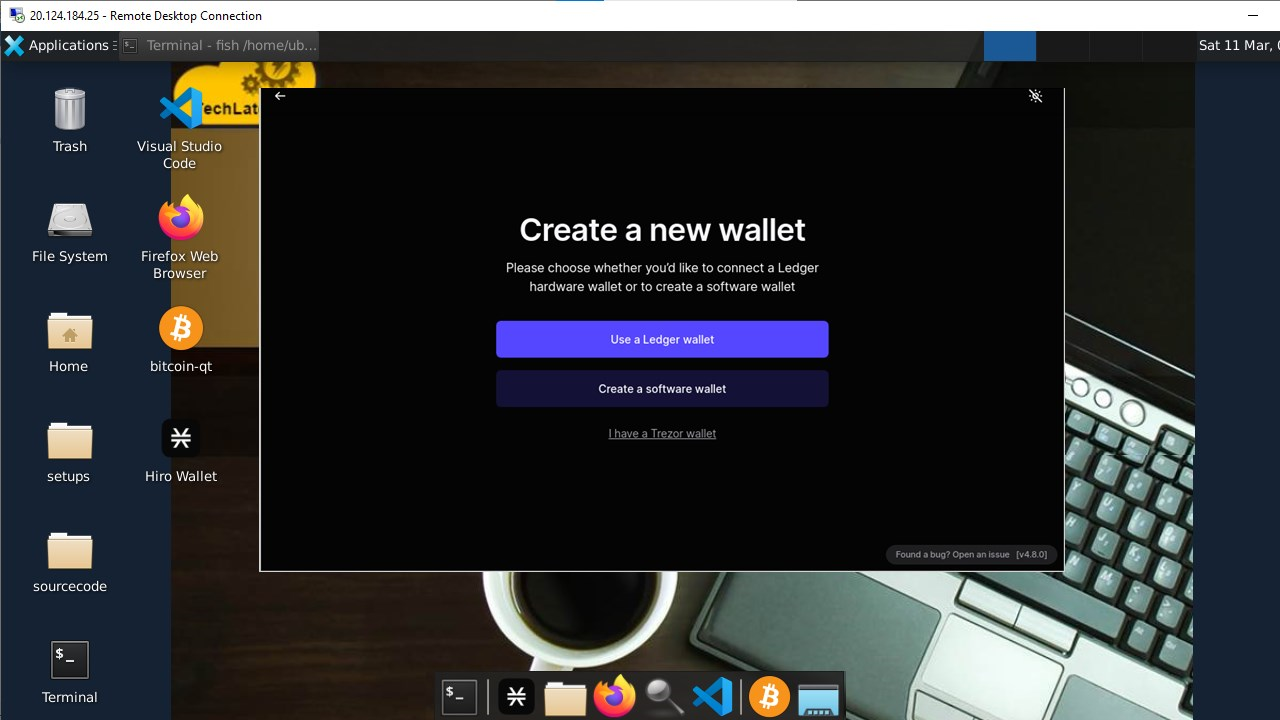
Create or import a wallet
Image
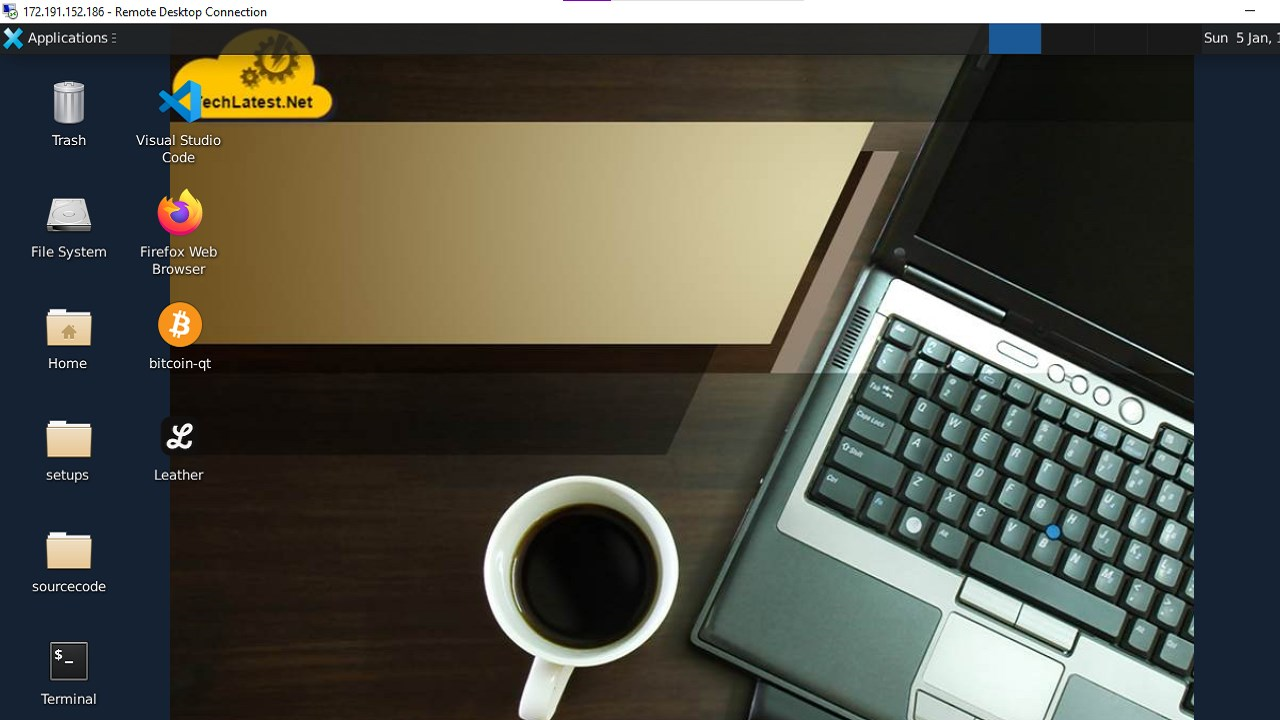
Bitcoin Full Node GUI desktop environment
Image
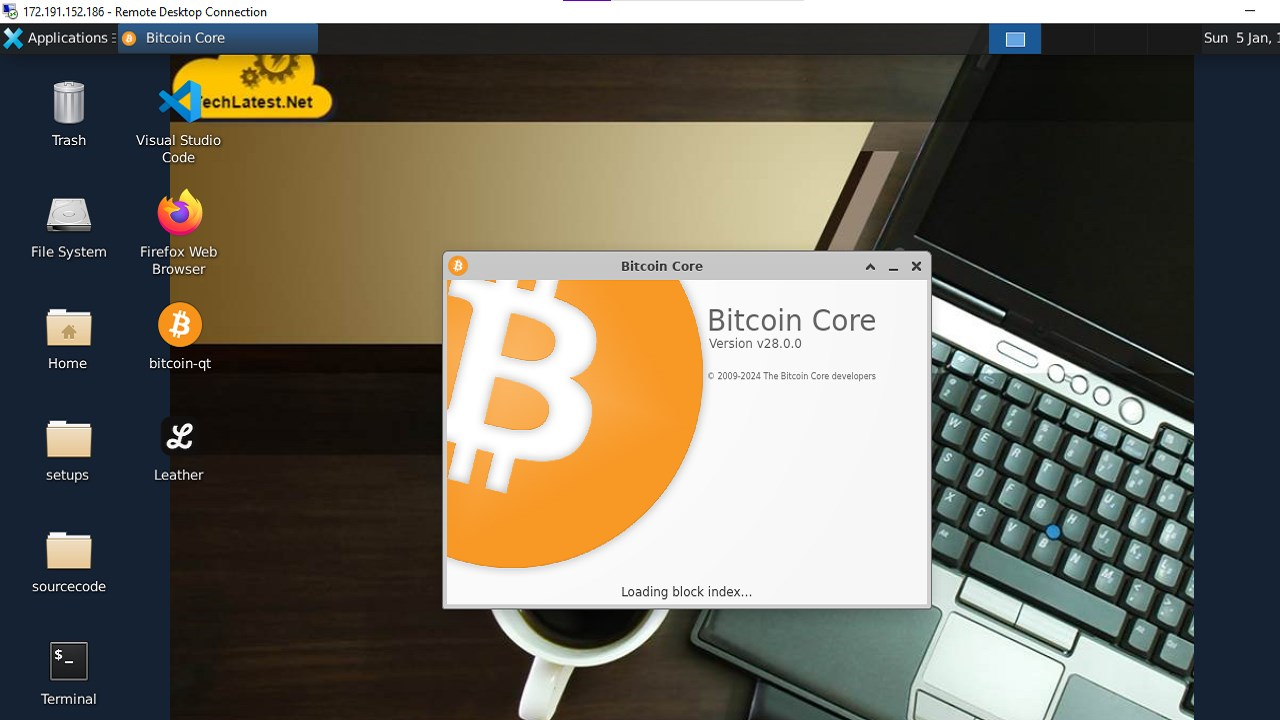
Bitcoin-qt with Bitcoin-Core v0.28.0
Image
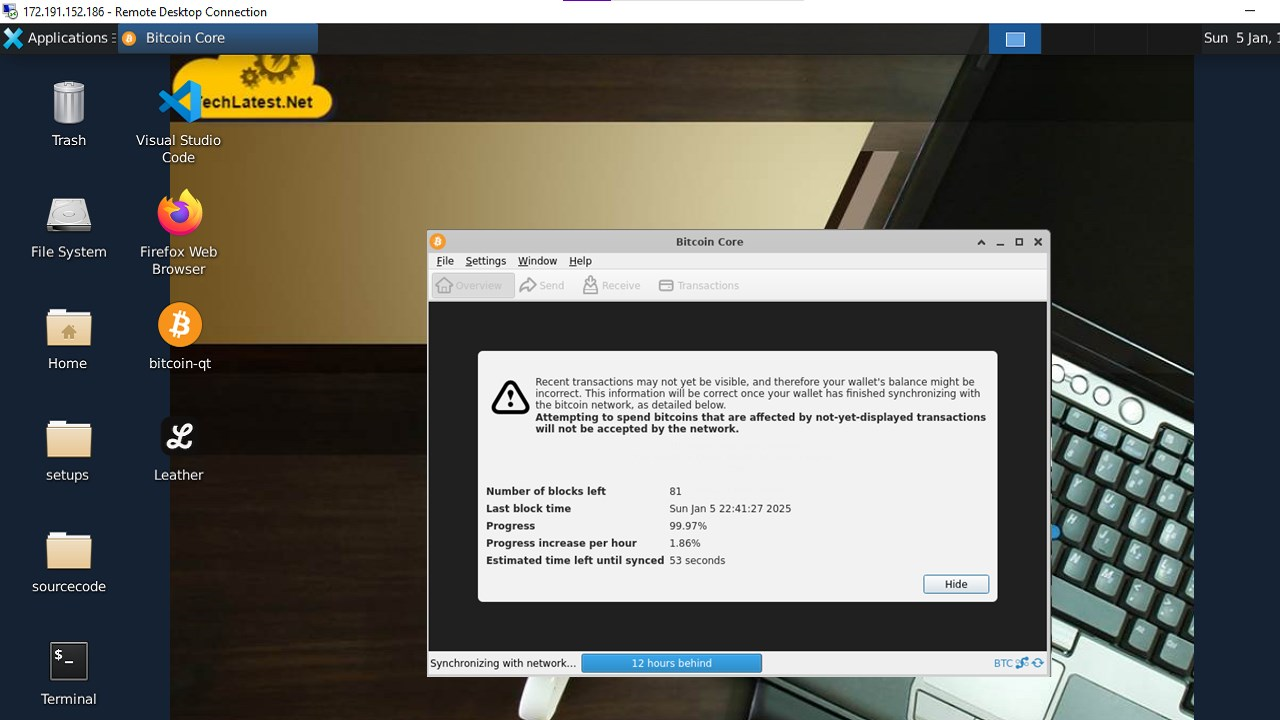
bitcoin-qt syncing status
Image
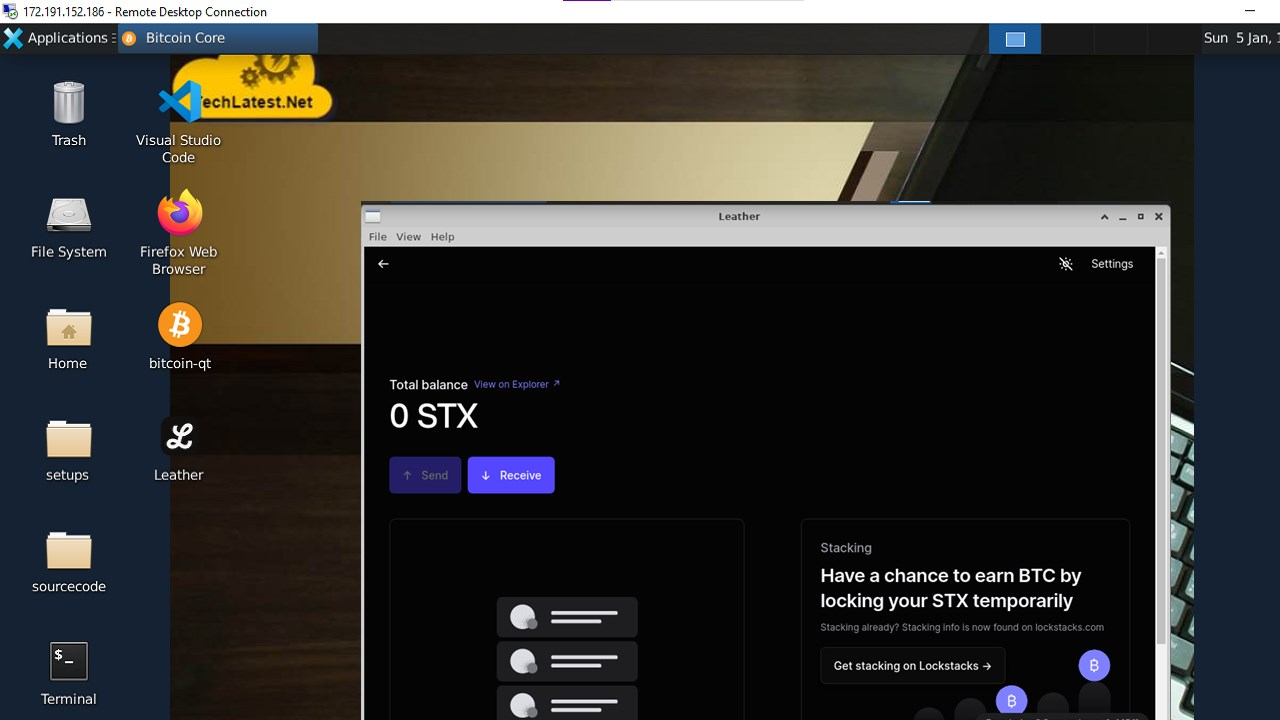
leather desktop app

Video
Product video
This is a repackaged open source software product wherein additional charges apply for support by TechLatest.net.
Important: For step by step guide on how to setup this vm , please refer to our Getting Started guide
This VM comes with the bitcoin core V30.2.0 along with updated bitcoin-qt, bitcoin-cli and bitcoin-wallet on Ubuntu 24.04. It also provide you the latest ordinal installed which is a numbering scheme for satoshis that allows tracking and transferring individual sats. For more details please visit- https://docs.ordinals.com/introduction.html
It also include Hiro Wallet Desktop App installed out of the box so you can quickly start with the Ordinal inscriptions.
This VM provides you full bitcoin node . It has out of box setup for bitcoin which includes bitcoind & bitcoin QT GUI, ordinal, Hiro Wallet & synced ledger (till the vm publishing date ) making it easier & faster for you to fully sync the ledger.
Why you need a fullnode:
-
Enable Ordinal Inscription : Ordinals (Bitcoin NFT) inscription on Bitcoin ledger requires a fully synced ledger. This VM comes with a fully synced ledger along with Ordinal wallet as Firefox Extension & standalone Desktop app so you can use it for Ordinals inscription.
-
Increased Privacy: When you use a third-party service or wallet to interact with the Bitcoin network, your transactions and private information may be exposed to the service provider. By running your own full node, you can interact with the network directly and maintain complete control over your private keys and transactions.
-
Improved Security: When you run a full node, you have access to the entire Bitcoin blockchain, which allows you to verify all transactions and blocks yourself. This reduces the risk of fraud or double-spending attacks, as you can be sure that the transactions you receive are valid and confirmed.
-
Support for the Network: By running a full node, you contribute to the decentralization and security of the Bitcoin network. Full nodes help to ensure that the network remains distributed and resilient, as each node provides redundancy and validation checks for other nodes.
-
Personal Education: Running a full node provides a great opportunity to learn more about how the Bitcoin network works and how transactions are verified and confirmed. It can be a valuable learning experience for anyone interested in cryptocurrencies and blockchain technology.
Preinstalled setups include:
Note: This VM provides Bitcoin full-ledger for development and non commercial purposes and it is not recommended to use it as hot wallet.
Highlights
- Out of Box Bitcoin, Bitcoind & Wallet setup on AWS EC2
- Includes preinstalled Ordinal wallet & (ord) setup
- Fully synced ledger to support Ordinal (Bitcoin NFT) Protocol
Details
Sold by
Categories
Delivery method
Delivery option
64-bit (x86) Amazon Machine Image (AMI)
Latest version
Operating system
Ubuntu 24.04 LTS
Deployed on AWS
New
Introducing multi-product solutions
You can now purchase comprehensive solutions tailored to use cases and industries.

Features and programs
Financing for AWS Marketplace purchases
AWS Marketplace now accepts line of credit payments through the PNC Vendor Finance program. This program is available to select AWS customers in the US, excluding NV, NC, ND, TN, & VT.

Pricing
Pricing is based on actual usage, with charges varying according to how much you consume. Subscriptions have no end date and may be canceled any time.
Additional AWS infrastructure costs may apply. Use the AWS Pricing Calculator to estimate your infrastructure costs.
If you are an AWS Free Tier customer with a free plan, you are eligible to subscribe to this offer. You can use free credits to cover the cost of eligible AWS infrastructure. See AWS Free Tier for more details. If you created an AWS account before July 15th, 2025, and qualify for the Legacy AWS Free Tier, Amazon EC2 charges for Micro instances are free for up to 750 hours per month. See Legacy AWS Free Tier for more details.
Dimension | Cost/hour |
|---|---|
t2.large Recommended | $0.13 |
t3.micro | $0.13 |
t2.micro | $0.13 |
x1.16xlarge | $0.13 |
c3.8xlarge | $0.13 |
g4ad.8xlarge | $0.13 |
m3.medium | $0.13 |
c3.large | $0.13 |
m5a.16xlarge | $0.13 |
c5n.18xlarge | $0.13 |
Dimensions summary
You pay by the hour for the software running on your chosen Amazon EC2 instance type. The many dimensions are not feature tiers. Each one maps to a specific EC2 instance size, from small burstable types like t2.nano and t3.micro up to large compute-, memory-, storage-, and GPU-optimized types such as x1e.32xlarge and p3dn.24xlarge. The software runs the same across all of them. Your rate scales with the size and capability of the instance you select. You are billed only for the hours the instance runs.
Top-of-mind questions for buyers
Each hourly unit covers the software running on one instance of the type you select. You are charged for every hour that instance runs. Stopping the instance halts the software hourly charge, though underlying AWS storage fees for the volume may still apply.
The software hourly charge accrues only while the instance runs. A stopped instance does not accrue software hours. Note that AWS may still bill separately for attached storage while the instance is stopped, but the software licence meters running time only.
No. The Bitcoin full node software, including Bitcoin Core, Ordinal support, the GUI wallet, and the pre-synced ledger, is identical across all instance types. Only the compute, memory, storage, and GPU capacity change with the instance size you pick, which sets your hourly rate.
www.techlatest.net
Helpful?
Vendor refund policy
Will be charged for usage, can be canceled anytime and usage fee is non refundable.

Legal
Vendor terms and conditions
Upon subscribing to this product, you must acknowledge and agree to the terms and conditions outlined in the vendor's End User License Agreement (EULA) .
Content disclaimer
Vendors are responsible for their product descriptions and other product content. AWS does not warrant that vendors' product descriptions or other product content are accurate, complete, reliable, current, or error-free.
Delivery details
64-bit (x86) Amazon Machine Image (AMI)
Amazon Machine Image (AMI)
An AMI is a virtual image that provides the information required to launch an instance. Amazon EC2 (Elastic Compute Cloud) instances are virtual servers on which you can run your applications and workloads, offering varying combinations of CPU, memory, storage, and networking resources. You can launch as many instances from as many different AMIs as you need.
Version release notes
This version comes with Bitcoin Core v30.2.0, Ordinal v0.27.1 and Leather Wallet Desktop App on Ubuntu 24.04. Bitcoin Fullnode ledger is synced till 29Aug, 2026.
Additional details
Usage instructions
Please visit http://www.techlatest.net/support/bitcoin_fullnode_support/aws_gettingstartedguide/ for step by step guide to provision bitcoin fullnode vm.
Resources
Vendor resources
Support
Vendor support
email info@techlatest.net
AWS infrastructure support
AWS Support is a one-on-one, fast-response support channel that is staffed 24x7x365 with experienced and technical support engineers. The service helps customers of all sizes and technical abilities to successfully utilize the products and features provided by Amazon Web Services.
Updated weekly

By Syntactic Engineering

By Kaleido
Top
10
In Blockchain, Financial Services
Top
10
In Blockchain, Financial Services
Top
10
In Blockchain
Sentiment is AI generated from actual customer reviews on AWS and G2
Functionality
Ease of use
Customer service
Cost effectiveness
Positive reviews
Mixed reviews
Negative reviews
AI generated from product descriptions
Bitcoin Core Version
Bitcoin Core V30.2.0 with updated bitcoin-qt, bitcoin-cli, and bitcoin-wallet components
Ordinal Protocol Support
Ordinal numbering scheme for satoshis installed with support for tracking and transferring individual sats and Bitcoin NFT inscriptions
Pre-synced Blockchain Ledger
Fully synced Bitcoin ledger updated on monthly basis to the VM publishing date, reducing initial synchronization time
Integrated Wallet Applications
Multiple wallet applications preinstalled including Hiro Wallet Desktop App, Leather Desktop App, and ordinal wallet functionality
Operating System and Development Tools
Ubuntu 24.04 operating system with preinstalled Visual Studio Code, Fish shell with auto-completion, and remote desktop access
Blockchain Synchronization
Fully synchronized with the Bitcoin blockchain, released monthly with up-to-date blockchain data
Bitcoin Core Implementation
Runs Bitcoin Core 29.2 in full node mode with indexes enabled, utilizing cryptographically verifiable binaries from bitcoincore.org
Operating System and Runtime
Runs on Ubuntu 24.04 with bitcoind service configured as a native Ubuntu service that starts automatically at boot
Hardware Optimization
Optimized to run on ARM-based Graviton CPU instances for efficient performance
Automated Build and Testing
Built, tested, and released using comprehensive automation and testing procedures following Bitcoin Core best practices
Multi-Protocol Blockchain Support
Support for multiple blockchain protocols including Ethereum, Hyperledger Besu, Polygon, Avalanche, Hyperledger Fabric, Quorum, and Corda with integrated Hyperledger FireFly stack for Web3 development
Multi-Region and Multi-Cloud Deployment
Capability to deploy and operate blockchain networks across multiple regions and cloud providers with hybrid deployment options including on-premise infrastructure
Enterprise Security and Compliance
ISO 27001 and SOC 2 Type 2 certifications with built-in high availability, disaster recovery, network isolation, and dedicated storage achieving 99.99% uptime
Integrated Web3 Development Stack
Hyperledger FireFly integration providing complete Web3 development stack with APIs for digital assets, data flows, and blockchain transactions
Distributed Governance and Member Management
Built-in governance tools, automated workflows, simplified member onboarding, and flexible shared IT policies for managing network participation across multiple parties
Standard contract
No
Customer reviews
reviewer2865519
Running a full network node has empowered my bitcoin research and hands‑on student assignments
Reviewed on Jun 26, 2026
Review provided by PeerSpot
What is our primary use case?
My main use case for Bitcoin Full Node is research. I run experiments and fetch network state and also create assignments for Bitcoin class using Bitcoin Full Node and create some exercises for the students to work on Bitcoin Full Node and get the experience of verifying transactions and other things. I create automated Python scripts to analyze data using Bitcoin Full Node.
What is most valuable?
Bitcoin Full Node offers very good features for transaction verification, which is the idea of having a full node. It provides decentralization and allows me to have full control over the wallet. If I want to do some research and play around with blockchain data, Bitcoin Full Node is what I need.
As a Bitcoin and lightning network researcher, the transaction verification feature helps my research and teaching significantly, and decentralization impacts my work because I can run my own node and get the data for my research.
What needs improvement?
I think for beginners, at least, some instructions would be really helpful to assist them in setting up their own Bitcoin Full Node. I think it is already there, but it can be made easier to use.
I gave Bitcoin Full Node a nine out of ten because maybe a guide to help beginners set up their node, along with a guide that can actually tell how you can integrate your full node with your IDE or the codes that you want to use along with a full node could be really helpful, especially for beginners.
I think it would be nice to integrate some AI capabilities with Bitcoin Full Node, such as telling the users to search the commands easily in an easy way. That would be really helpful, and I think that is going to be very helpful.
For how long have I used the solution?
I have been using Bitcoin Full Node for three years.
What do I think about the stability of the solution?
In my experience, Bitcoin Full Node is reliable, and there are no issues with reliability as far as I have a good hard drive and internet.
What was our ROI?
Since it was very relevant for my research and for the class that we have in our university, it is worth investing in the hard drives, which is good for my knowledge and also to experience blockchain decentralization.
What's my experience with pricing, setup cost, and licensing?
Since Bitcoin is decentralized, things are free of cost. It is just that I have to invest in my hardware drive because I need terabytes of a good amount of storage in my hard drive. That investment is necessary, and I do not have any additional cost for licensing and downloading; all I need is just Bitcoin Core app, then connect my hard drive and download my blocks, and of course, I need to have good internet.
Which other solutions did I evaluate?
Bitcoin Full Node is Bitcoin Full Node; there is no alternative.
What other advice do I have?
Bitcoin Full Node helps students learn Bitcoin and understand various concepts within Bitcoin positively.
Students get real experience by using Bitcoin Full Node and they get to know exactly what Bitcoin is and how they can use a full node for a variety of activities they want to run or maintain their own wallets or anything of that nature.
If I want to fetch details, I can just use some APIs from mempool.space and other platforms such as Blockstream. I did use mempool.space for some of the data fetching, and that was good.
My advice for others looking into using Bitcoin Full Node is to set up your full node and have a sense of what Bitcoin actually is.
I felt a few questions were not relevant for Bitcoin Full Node, and it is not a commercial product that you have in the market and get a review for. So that could be changed if you are focusing heavily on just Bitcoin Full Node. In fact, Bitcoin Full Node is something that you download from software called Bitcoin Core, so the review for Bitcoin Core could have been more relevant than interviewing for Bitcoin Full Node.
I rate this review a nine out of ten.
Omarh Omarh
Running a full node has enabled trustless payments, deep privacy, and rich on-chain analysis
Reviewed on Jun 16, 2026
Review provided by PeerSpot
What is our primary use case?
I have used Bitcoin Full Node for building several infrastructure tools for developers building within the Bitcoin ecosystem.
I have used Bitcoin Full Node for trustless verification. For example, when you receive a payment, your node personally confirms its validity on the blockchain. The way it could be described is that you are not trusting a bank or third-party service. This trustless model is the foundation of Bitcoin's peer-to-peer system. Another example was maximum privacy. Downloading the entire blockchain is the most private way to operate a wallet. All other lightweight solutions leak information about which addresses are yours because they must query third-party servers. ATM servers, for example, can link your addresses together. Another example I have used is for business and payment processing with BTCPay Server. Running a full node powers self-hosted payment infrastructure. The merchants I work with via BTCPay Server accept Bitcoin without relying on a payment processor, avoiding fees, Know Your Customer requirements, and middlemen.
One of the examples I have used Bitcoin Full Node for was on-chain analysis. I query the blockchain directly without rate limits or API keys. This was useful for developers, researchers, and power users who needed raw transaction data for our API tools.
How has it helped my organization?
Bitcoin Full Node certainly improved security through complete independence and privacy, which have benefited my organization. A full node is the backbone of opening payment channels. I was also building a stablecoin payment system, so a full node is the backbone for opening payment channels, routing payments, and earning routing fees on Lightning, which enables instant, zero-cost Bitcoin transactions. I have also used it for self-hosted payments with BTCPay Server. Businesses can accept Bitcoin payments with zero process fees, no chargebacks, and full custody directly tied to their own nodes.
What is most valuable?
Bitcoin Full Node offers several features that I find valuable. The first is its complete independence. When I verify every transaction myself, no trust in exchanges, wallets, or block explorers is needed. If someone sends me Bitcoin, I confirm it is real, not relying on Coinbase or a third party. Another feature I appreciate is true privacy. My wallet queries my own node, not someone else's server. No one learns my addresses, balances, or transaction history. This is the biggest privacy upgrade available in Bitcoin.
What needs improvement?
There were several challenges that I faced with Bitcoin Full Node, and I have suggested to a couple of developers and organizations what should be improved. The first is Initial Block Download speed, or IBD. Syncing from Genesis still takes days on average hardware. Improvements such as better parallelization of block validation, faster peer discovery, and improved connection logic within the initial block download could address IBD speed. Another concern is storage efficiency. Bitcoin Full Node's blockchain is over 500 GB and grows 50 GB a year. Solutions being explored are better pruning modes that do not sacrifice security and more aggressive compression of historical block data.
Several improvements are needed in other areas as well. The first is privacy improvements. Encrypted peer-to-peer connections as default, as proposed in BIP 324, could be improved. Another is Dandelion, which has been proposed. It hides which nodes originally broadcast a transaction, making it harder to link IP addresses to transactions.
For how long have I used the solution?
I have been using Bitcoin Full Node for the past two and a half years, approximately thirty months.
Which solution did I use previously and why did I switch?
I did not use a different solution before Bitcoin Full Node. As a developer myself, I knew what I needed and designed the entire architecture of how I would implement my entire infrastructure.
What other advice do I have?
For my organization, I would say the protocol governance vote helped and benefited us greatly. Generally in Bitcoin, running a node is how you vote on protocol rules. When contentious upgrades happen, such as the 2017 SegWit wars, node operators, not miners, ultimately decided what Bitcoin rules are. The protocol governance vote benefited us significantly.
The impact that I had participating in protocol governance can be explained this way. The core idea is that nodes enforce rules and miners produce blocks. Bitcoin miners decide which transactions to include and in what order, but full nodes decide what counts as a valid block. If miners produce a block that violates the rules my node enforces, my node simply rejects it, regardless of how much hash power is behind it.
There are several key tools I look for in Bitcoin Full Node regarding its governance and security capabilities. I would say protocol analysis could help. Artificial intelligence can parse Bitcoin Improvement Proposals, or BIPs, to simulate economic impacts and surface unintended consequences faster than human review. Sentiment mapping tracks developer mailing lists, GitHub debates, and community forums to give a clearer picture of where consensus actually stands. Conflict detection identifies when proposed changes contradict existing rules or create edge cases humans miss. Simulation models how a rule change would behave under adversarial conditions at network scale.
The way Bitcoin Full Node's AI capabilities relate to accuracy and reliability of output goes hand in hand. This is where the core tension lies. Artificial intelligence systems are probabilistic by nature. Bitcoin's security model demands deterministic, exact rule enforcement. There are two things that are fundamentally in conflict at the protocol level regarding reliable AI output. The first is pattern recognition, such as detection of known stack signatures, spam patterns, and anomalous peer behavior. The second is log parsing and summarization of structured data with clear patterns and low risk of meaningful errors. Code review assistance can flag known vulnerability classes in Bitcoin Core. Why this works is because these outputs can be independently verified against ground truth. If AI misclassifies a peer as malicious, a human can check. The cost of error is low and recoverable.
I would rate this review as a 9.5 out of 10.