
Sold by: cloudimg
Deployed on AWS
Free Trial
AWS Free Tier
This product has charges associated with it for the installation, configuration and packaging of the ELK Stack 8.19 on AlmaLinux 8. Elasticsearch, Logstash and Kibana 8.19.14 installed on AlmaLinux 8.10, with security on, Kibana on port 5601 and data on its own EBS volume. Elastic License 2.0 (source-available, Basic tier).
Overview
Image
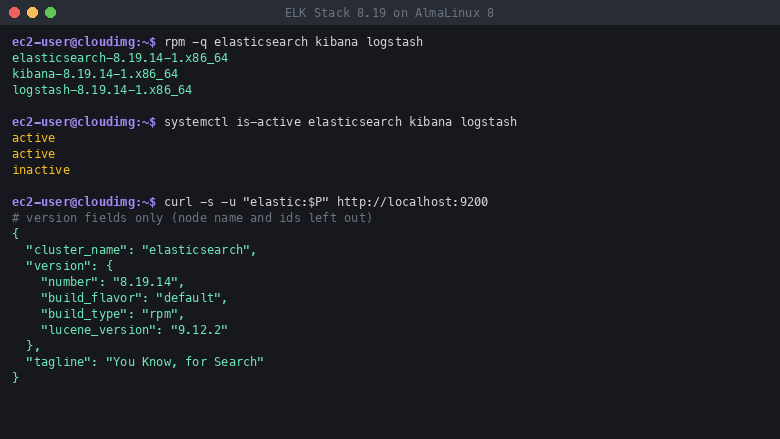
ELK Stack 8.19.14 packages and services
Image
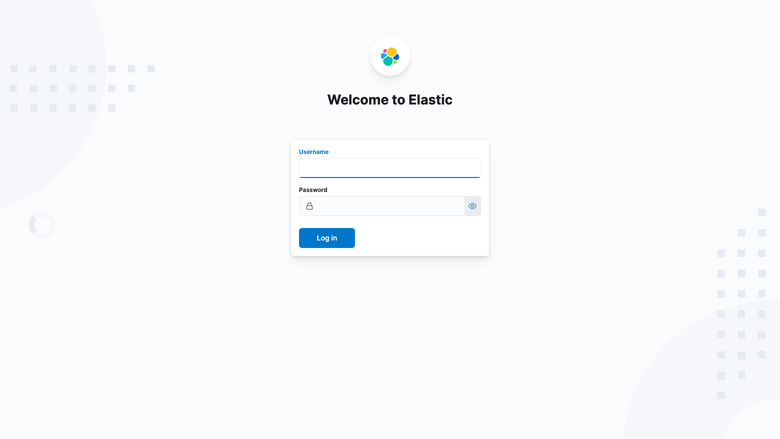
Kibana 8.19 sign-in page
Image
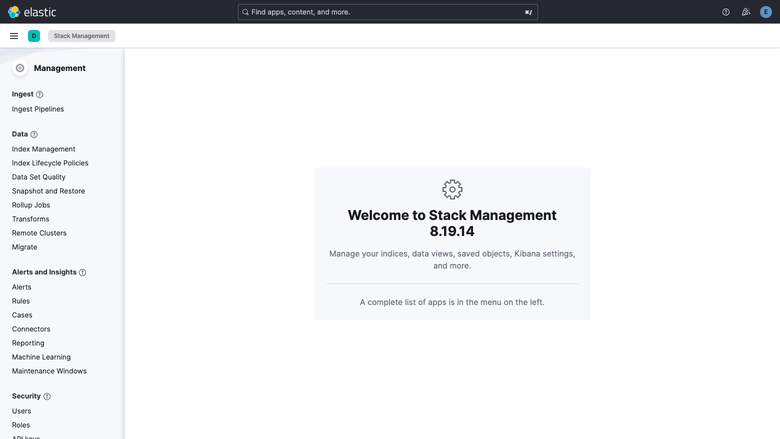
Kibana Stack Management 8.19.14
This is a repackaged software product wherein additional charges apply for the installation, configuration and packaging of the software in this image by cloudimg.
What cloudimg adds to the ELK Stack
This image installs Elasticsearch, Logstash and Kibana 8.19.14 from Elastic's official packages on AlmaLinux 8.10 and wires them together, so you start with a running, secured Elasticsearch node and a Kibana sign-in page instead of three installs and their security set-up.
- Elasticsearch 8.19.14 with security on: every request needs a user name and password; HTTP on localhost:9200 only, so the API is not reachable from the network until you choose to expose it
- Kibana 8.19.14 already connected: it signs in to Elasticsearch as kibana_system and serves on port 5601, started at boot with Elasticsearch
- Logstash 8.19.14 installed with its systemd service ready; it stays stopped until you add a pipeline under /etc/logstash/conf.d
- Data on its own volume: Elasticsearch indices on a dedicated 10 GB EBS volume at /var/lib/elasticsearch, separate from the root disk
- AWS tooling: AWS CLI v2, the SSM Agent (running at boot) and the Amazon CloudWatch agent (installed, not configured)
- Security updates at boot: AlmaLinux security errata are applied at every boot (the kernel is excluded)
- A step-by-step user guide for setting the elastic password, signing in to Kibana, adding a Logstash pipeline and troubleshooting
Licensing
Elastic distributes the Elasticsearch and Kibana packages under the Elastic License 2.0 and the Logstash package under Elastic's licence agreement for its default distribution. These are source-available licences, not OSI open source licences. The cluster runs Elastic's Basic licence tier, which needs no Elastic subscription; paid Elastic features need a subscription from Elastic. The hourly charge on this listing is cloudimg's, for the installation, configuration and packaging of the ELK Stack 8.19 on AlmaLinux 8.
Elasticsearch, Logstash and Kibana are trademarks of Elasticsearch B.V., registered in the U.S. and in other countries. AlmaLinux is a trademark of the AlmaLinux OS Foundation. cloudimg is not affiliated with or endorsed by Elastic.
Who it is for
- DevOps engineers and SREs who want a single-node ELK server for log search and dashboards on AWS
- Teams evaluating Elasticsearch and Kibana 8.19 before planning a cluster
- Developers who need a search and analytics back end for test and proof-of-concept work
- Training and lab environments for Kibana, Logstash pipelines and the Elasticsearch REST API
What the stack does
Elasticsearch stores and searches JSON documents with full-text search and aggregations through a REST API. Logstash reads data from files, syslog, Beats and other inputs, transforms it with filters such as grok and date, and writes it to Elasticsearch. Kibana provides Discover for ad-hoc search, dashboards and Lens visualisations, the Dev Tools console and user and role management. This image is a single node; it does not include TLS, Beats shippers, preset dashboards or a multi-node cluster.
Getting started
- Subscribe and launch on an instance with at least 8 GB of RAM (m5.large or t3.large); allow TCP 22 from your address.
- SSH in as ec2-user and set the elastic password: sudo /usr/share/elasticsearch/bin/elasticsearch-reset-password -u elastic -i.
- Check Elasticsearch with curl -u elastic localhost:9200.
- Allow TCP 5601 from your own address only (Kibana is plain HTTP) or use an SSH tunnel, then sign in to Kibana at port 5601 as elastic.
Support
cloudimg's support team is on hand 24 hours a day by email, with a guaranteed response within 24 hours, for launch, password, Kibana sign-in, Logstash pipeline and configuration questions about this image. Contact support@cloudimg.co.uk or https://www.cloudimg.co.uk/support
Highlights
- Elasticsearch, Logstash and Kibana 8.19.14 on AlmaLinux 8.10: Elasticsearch with security on (localhost:9200), Kibana connected and serving on port 5601, both started at boot.
- Elasticsearch data on a dedicated 10 GB EBS volume; Logstash installed ready for your pipelines; AWS CLI v2 and SSM Agent; step-by-step guide to set the elastic password and sign in.
- Elastic packages under the Elastic License 2.0 (source-available, Basic tier). AlmaLinux security errata are applied at every boot, with the kernel excluded.
Details
Sold by
Categories
Delivery method
Delivery option
64-bit (x86) Amazon Machine Image (AMI)
Latest version
Operating system
OtherLinux 8
Deployed on AWS
Features and programs
Financing for AWS Marketplace purchases
AWS Marketplace now accepts line of credit payments through the PNC Vendor Finance program. This program is available to select AWS customers in the US, excluding NV, NC, ND, TN, & VT.

Pricing
Free trial
Try this product free for 7 days according to the free trial terms set by the vendor. Usage-based pricing is in effect for usage beyond the free trial terms. Your free trial gets automatically converted to a paid subscription when the trial ends, but may be canceled any time before that.
Pricing is based on actual usage, with charges varying according to how much you consume. Subscriptions have no end date and may be canceled any time. Alternatively, you can pay upfront for a contract, which typically covers your anticipated usage for the contract duration. Any usage beyond contract will incur additional usage-based costs.
Additional AWS infrastructure costs may apply. Use the AWS Pricing Calculator to estimate your infrastructure costs.
If you are an AWS Free Tier customer with a free plan, you are eligible to subscribe to this offer. You can use free credits to cover the cost of eligible AWS infrastructure. See AWS Free Tier for more details. If you created an AWS account before July 15th, 2025, and qualify for the Legacy AWS Free Tier, Amazon EC2 charges for Micro instances are free for up to 750 hours per month. See Legacy AWS Free Tier for more details.
- ...
Dimension | Description | Cost/hour |
|---|---|---|
m5.large Recommended | - | $0.10 |
t2.micro | - | $0.06 |
t3.micro | - | $0.06 |
c3.2xlarge | - | $0.28 |
c3.4xlarge | - | $0.28 |
c3.8xlarge | - | $0.28 |
c3.large | - | $0.10 |
c3.xlarge | - | $0.15 |
c4.2xlarge | - | $0.28 |
c4.4xlarge | - | $0.28 |
Dimensions summary
You pay by the hour for the running software image, with no upfront commitment. The hourly charge is cloudimg's fee for the image and support; AWS bills your EC2 compute separately. Price varies only by the EC2 instance type you pick, so the dimensions are not feature tiers. Each option maps to one instance size and family, such as general purpose, compute, memory, storage, or accelerated types. Larger instances carry higher hourly rates. All options deliver the same software stack. cloudimg recommends an instance with at least 8 GB of RAM.
Top-of-mind questions for buyers
Each dimension maps to one EC2 instance type running a prebuilt image. The image includes Elasticsearch, Logstash, and Kibana 8.19.14 on AlmaLinux 8.10, with security enabled and data on a separate 10 GB volume. The hourly charge covers the image and 24/7 email support.
The hourly charge applies while the instance runs. A stopped instance does not accrue the software fee, since billing meters running time. You may still pay AWS for attached storage while stopped. Note the data volume is deleted when you terminate the instance.
The rate covers cloudimg's image and support only. The cluster runs Elastic's free Basic licence tier. Paid Elastic features need a separate subscription from Elastic, which is not part of this listing's charge. TLS and Beats shippers are also not preconfigured on the image.
www.cloudimg.co.uk
Helpful?
Vendor refund policy
Refunds available on request.

Legal
Vendor terms and conditions
Upon subscribing to this product, you must acknowledge and agree to the terms and conditions outlined in the vendor's End User License Agreement (EULA) .
Content disclaimer
Vendors are responsible for their product descriptions and other product content. AWS does not warrant that vendors' product descriptions or other product content are accurate, complete, reliable, current, or error-free.
Delivery details
64-bit (x86) Amazon Machine Image (AMI)
Amazon Machine Image (AMI)
An AMI is a virtual image that provides the information required to launch an instance. Amazon EC2 (Elastic Compute Cloud) instances are virtual servers on which you can run your applications and workloads, offering varying combinations of CPU, memory, storage, and networking resources. You can launch as many instances from as many different AMIs as you need.
Version release notes
Rebuilt 18 November 2026: Elasticsearch, Logstash and Kibana 8.19.25 (from 8.19.14: Elastic's security fixes since). Each instance makes its own internal secrets at its first boot: the elastic superuser's starting password (nobody knows it; set your own as before), the kibana_system password Kibana connects with, Elasticsearch's keystore and Fleet's signing keys; earlier builds shared them, and the guide shows how to change Kibana's on an older instance. AlmaLinux 8.10 fully updated (kernel 4.18.0-553.186.1). The original build's stale password log files are gone.
Additional details
Usage instructions
SSH to port 22 as ec2-user with your key pair; change the suggested security group's SSH source to your own IP. At the first boot SSH answers a few minutes after launch, once the instance has set its own internal passwords. Set the elastic password first with Elastic's elasticsearch-reset-password tool (guide Step 3). Kibana is on port 5601 over plain HTTP: open it to your own IP only, or use an SSH tunnel. Guide: https://www.cloudimg.co.uk/guides/elk-stack/
Resources
Vendor resources
Support
Vendor support
cloudimg Support
cloudimg's support team is on hand 24 hours a day by email for this image, with a guaranteed response within 24 hours: launch and first login, setting the elastic password and signing in to Kibana, starting Logstash and adding a pipeline, opening Kibana safely, storage and configuration, updates and troubleshooting.
Contact: support@cloudimg.co.uk or https://www.cloudimg.co.uk/support
Contact support@cloudimg.co.uk for product usage questions, technical troubleshooting or to request a refund.
Feedback: we welcome your reviews. You can leave a review at the bottom of this listing page or via the AMI Catalog in the AWS Console.
AWS infrastructure support
AWS Support is a one-on-one, fast-response support channel that is staffed 24x7x365 with experienced and technical support engineers. The service helps customers of all sizes and technical abilities to successfully utilize the products and features provided by Amazon Web Services.
Similar products

This is a repackaged open source software product wherein additional charges apply for Code Creator integration of Elasticsearch, Kibana, Logstash and Filebeat, preconfigured logging and analytics stack deployment, Ubuntu integration, and AWS Marketplace AMI engineering. This server offers a comprehensive logging and analytics solution powered by the Elasticsearch, Kibana, Logstash, and Filebeat often referred to as the ELK Stack with Filebeat.

A Harbor-based container registry as a service offered and operated by the project's maintainer and contributors.

This product has charges associated with it for cloudimg's configuration and packaging of Windows Server 2019 Datacenter with the AWS tools and drivers. Microsoft Windows Server 2019 Datacenter with Desktop Experience (English), patched on 13 November 2026 to build 17763.9487 with AWS's EC2 tools. Windows Server licence included in the EC2 price.

Oracle Database 19c Enterprise Edition with ASM installed from Oracle's base media and ready at first boot: a database, listener and service configured, a password unique to each instance, and an OS updated at build. Bring your own Oracle Database licence. Oracle and Java are trademarks of Oracle; cloudimg is not affiliated with Oracle.
Customer reviews
No customer reviews yet
Be the first to review this product . We've partnered with PeerSpot to gather customer feedback. You can share your experience by writing or recording a review, or scheduling a call with a PeerSpot analyst.