AWS for M&E Blog
Building audio provenance for AI-generated content at the source with AWS
AI-generated audio is increasingly integrated into media supply chains worldwide. If you’re generating this content for European markets, you face a December 2, 2026, compliance deadline under EU AI Act Article 50. In this post, we show how to build SENTINEL, an Amazon Web Services (AWS) pipeline that embeds a cryptographic provenance watermark into AI-generated audio at the point of synthesis and carries a verifiable chain of custody through a live-streaming media pipeline. This post covers the architecture, AWS service implementation, deployment approach, and engineering trade-offs we encountered while building SENTINEL.
Why did this become urgent in 2026?
- EU AI Act Article 50 requires machine-readable provenance marking for AI-generated content served in the European Union (EU). Systems launched after August 2, 2026, must comply immediately. Existing systems have until December 2, 2026. Noncompliance carries penalties up to €15 million or 3% of global turnover, whichever is higher.
- Industry copyright settlements from Universal Music Group and Warner Music Group show the necessity of attribution metadata on AI-generated music.
- The industry recognizes the ATSC A/334 standard specifying the VP1 watermark format for NextGen TV broadcast.
On July 9, 2026, the European Commission endorsed the Code of Practice on Transparency of AI-Generated Content as adequate for demonstrating Article 50 compliance. The finalized code establishes minimum obligations for providers including: (1) a publicly accessible detection solution, (2) digitally signed metadata with imperceptible watermarking, (3) zero-retention handling of content submitted for detection, and (4) an interoperability deadline of February 2, 2027. These obligations sharpen the technical requirements facing audio providers beyond what the December 2025 first draft envisioned.
Audio provenance doesn’t require new technology. The industry already has the essential elements, and SENTINEL assembles them into a live AWS pipeline. AudioSeal provides an open source, MIT-licensed watermarking technique that is robust and imperceptible. SENTINEL uses it to generate the watermark and moves the embedding to the point of synthesis, binding the payload to the generating model and its Amazon Bedrock Guardrails safety-policy evaluation. C2PA 2.0 provides the open, cryptographically signed content-credential manifest. SENTINEL composes and signs these manifests and carries them through the delivery chain. And C2PA’s Durable Content Credentials with soft binding define exactly the recovery mechanism SENTINEL implements—an invisible watermark that recovers the manifest from a repository if intervening steps strip the embedded metadata. SynthID demonstrates the same at-generation-plus-C2PA direction at scale within one vendor’s products. SENTINEL brings that model to any third-party AWS pipeline.
Put together, these building blocks describe a Durable Content Credential: a signed manifest plus a soft binding that survives processing. When AI-generated audio flows through a live production pipeline then two provenance assets travel with it: the C2PA manifest (signed metadata attached to the media container) and the AudioSeal watermark (a 16-bit payload embedded directly in the audio waveform). The manifest is often dropped by transcoders that don’t implement metadata pass-through. The watermark, because it lives inside the audio signal itself, survives codec transcoding, re-quantization, ±6 dB gain, and cropping to 10%. It does not survive time-stretching or moderate additive noise. SENTINEL uses the surviving watermark as the soft binding that recovers the dropped manifest from a provenance registry, making it an AWS implementation of durable C2PA content credentials for live audio.
In this implementation, the AI content is synthesized by Amazon Polly (neural engine), transcoded by AWS Elemental MediaLive, repackaged into HTTP Live Streaming (HLS) segments by AWS Elemental MediaPackage, modified by server-side ad insertion (SSAI) in AWS Elemental MediaTailor, and delivered through Amazon CloudFront. In addition, Amazon Bedrock Guardrails does the policy evaluation.
Solution overview
SENTINEL operates across four functional planes:
- Generation (Plane 1) – Watermark fused into raw pulse code modulation (PCM) audio during AI synthesis
- Transform (Plane 2) – Signed chain-of-custody assertions attached at each media processing stage
- Registry (Plane 3) – Tamper-evident provenance storage with cross-organization anchoring
- Recovery (Plane 4) – Edge API that reconstructs the full provenance chain from at least 1 second of captured audio
The following diagram shows how audio flows through the four SENTINEL planes, from generation through recovery.
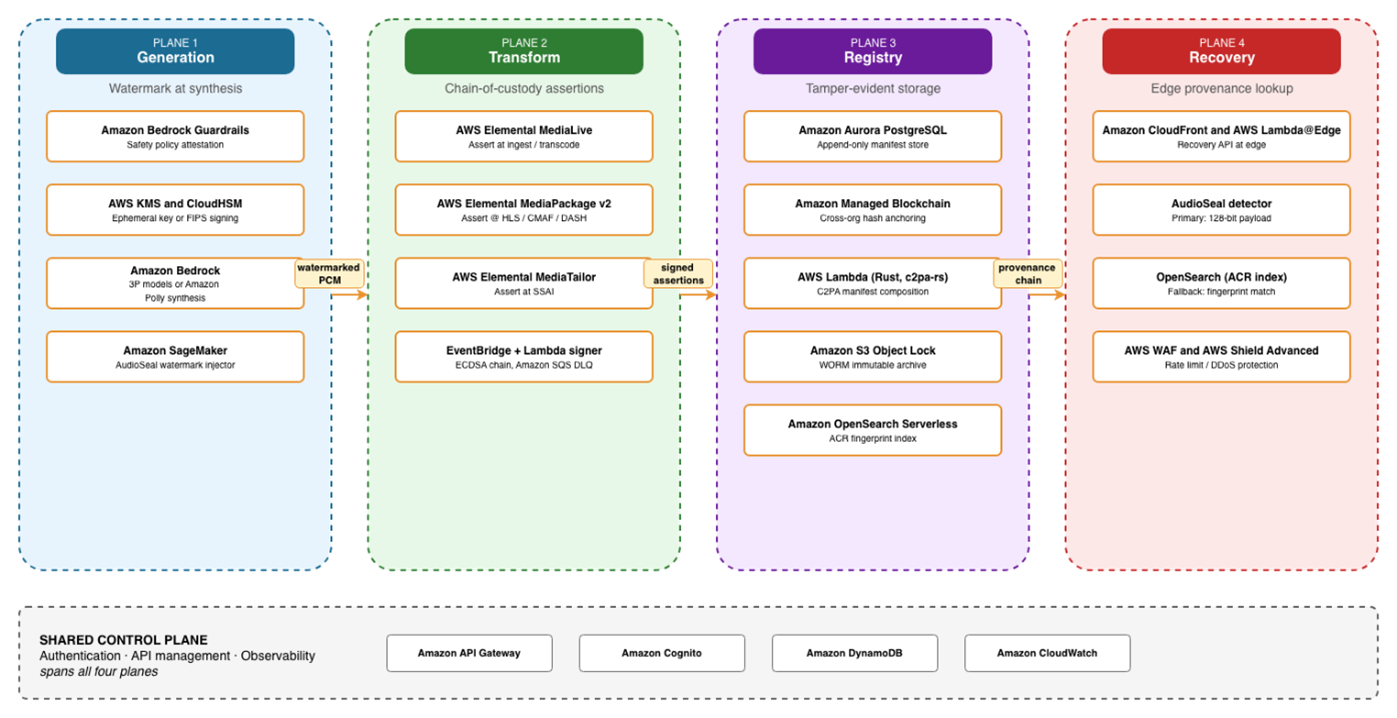
Figure 1: SENTINEL four-plane architecture
Audio is watermarked at synthesis (Plane 1), assertions are attached at each media processing stage (Plane 2), provenance is stored in a tamper-evident registry (Plane 3), and the full chain is recoverable at the edge (Plane 4).
A shared control plane (Amazon API Gateway, Amazon Cognito, Amazon DynamoDB, Amazon CloudWatch) provides authentication, API management, and observability across all planes.
Plane 1: Watermark at the point of synthesis
SENTINEL performs four operations on each synthesis request before the audio leaves Plane 1:
- Safety policy attestation – Amazon Bedrock Guardrails evaluates the synthesis request against configured content policy categories using the
ApplyGuardrailAPI. Guardrails returns an assessment result (anactionfield and anassessmentsarray). This is a plain API response, not a signed artifact. SENTINEL then establishes the cryptographic chain of trust itself: it computes a guardrail policy hash (SHA-256 of the serializedApplyGuardrailresponse, including the guardrail ID, version, and assessments), then signs that hash with AWS Key Management Service (AWS KMS) (ECDSA_SHA_256). The KMS keys are protected by FIPS 140-3 Security Level 3 validated HSMs. The signed hash becomes part of the watermark payload, creating a permanent, verifiable record that the audio was generated under a specific safety policy configuration, with the signature, not Guardrails, providing the tamper-evidence. - Cryptographic key derivation – AWS KMS derives an ephemeral per-tenant data key using GenerateDataKey with FIPS 140-3 Level 3 signing for chain-of-custody timestamps, maintaining multi-tenant cryptographic isolation.
- Audio synthesis – Amazon Polly (neural engine) generates the raw PCM waveform at 16 kHz.
- Vocoder-layer watermark injection – The watermark injector runs on Amazon SageMaker and uses AudioSeal generator. It embeds a 16-bit payload into the raw PCM waveform before encoding or packaging. The imperceptibility comes from AudioSeal’s learned perceptual loss plus SENTINEL’s adaptive α search with a quality gate. A BS.1387-derived masking-threshold check runs as a guard. Measured worst-case margin is: +22.3 dB, 0 of 467 frames audible – a validated result.
The watermark embedded in the waveform carries 16 bits – the first two bytes of the asset’s SHA-256 content hash as a registry lookup key. The full 128-bit provenance payload, binding the content hash, model identity, guardrail policy hash, tenant key ID, timestamp, and nonce, is carried in the signed C2PA manifest, with the full-width values held in the registry. The watermark points; the manifest proves.
Injecting at this pre-encoding stage bakes the watermark into the audio at its highest-fidelity point. Every subsequent processing step, from Advanced Audio Coding (AAC) compression to HLS packetization and ad insertion, operates on audio that already carries the provenance payload.
The following table outlines the engineering targets for the watermark injector.
| Metric | Target | Basis |
|---|---|---|
| Perceptual Evaluation of Speech Quality (PESQ) degradation | 0.23 MOS or less | ITU-T P.862 (imperceptible to listeners) |
| Scale-invariant signal-to-noise ratio (SI-SNR) | 25 dB or greater | Signal integrity |
| Injection latency | Less than 50 ms per second of audio | Real-time streaming requirement |
| Minimum recoverable audio | 1.0 second or more | Practical for monitoring services |
| Payload capacity | 16 bits | Manifest lookup key |
| Watermark bit error rate (BER) after MP3 128k or AAC 96k | 4% or less | AudioSeal published robustness (ICML 2024) |
Note: These are engineering targets based on AudioSeal’s published ICML 2024 results and architectural constraints. Production validation across diverse content types requires rigorous A/B testing with Multiple Stimuli with Hidden Reference and Anchor (MUSHRA) listening panels.
Plane 2: Chain-of-custody through live streams
At each stage of the media broadcast pipeline, Amazon EventBridge events from AWS Elemental services trigger a transformer-signer AWS Lambda function that appends a cryptographically signed assertion to the provenance chain:
- AWS Elemental MediaLive – Assertion at ingest and transcoding
- AWS Elemental MediaPackage v2 – Assertion at HLS, Common Media Application Format (CMAF), and Dynamic Adaptive Streaming over HTTP (DASH) repackaging
- AWS Elemental MediaTailor – Assertion at SSAI
Each assertion references its predecessor using prev_assertion_id and is signed with an AWS KMS asymmetric key (ECDSA_SHA_256), creating a linked chain like:
{
  "assertion_id": "ast-7f3a9b2c",
  "transform_type": "transcode",
  "created_at": "2026-05-20T14:23:07.442Z",
  "digest": "a8f2e1...",
  "signature": "MGQCMBn...",
  "prev_assertion_id": "ast-2d8e4a1f",
  "sequence_number": 3
}
Tampering, whether by inserting, removing, or reordering assertions, breaks the chain’s cryptographic integrity. Amazon Simple Queue Service (Amazon SQS) dead-letter queues (DLQs) catch any assertion failures for retry.
Plane 3: Tamper-evident registry
SENTINEL persists the provenance chain in a multi-layer registry, as outlined in the following table.
| Layer | Service | Purpose |
|---|---|---|
| Primary manifest store | Amazon Aurora PostgreSQL-Compatible Edition serverless v2 | Low-latency queries; append-only journal implemented at the application layer (hash-chained rows), enforced with insert-only grants and triggers |
| Cross-organization anchoring | First-party or third-party blockchain integration (Hyperledger Fabric) | Hash anchoring across organizational trust boundaries |
| C2PA manifest composition | AWS Lambda (Rust, c2pa-rs) | Standards-compliant C2PA content credential manifests |
| Immutable archive | Amazon Simple Storage Service (Amazon S3) with Object Lock (COMPLIANCE mode) | Write once read many (WORM) storage for long-term legal retention |
| Fingerprint index | Amazon OpenSearch Serverless | Automatic content recognition (ACR) fingerprint matching when watermarks are stripped |
Plane 4: Recovery API at the edge
Any downstream platform submits at least 1 second of captured audio to the recovery API, deployed on Amazon CloudFront with Lambda@Edge, and receives the full provenance chain. This can take one of the following two paths mentioned:
- Primary path (watermark intact) – Lambda@Edge extracts the 16-bit payload using the AudioSeal detector, looks up the manifest in Aurora, and returns the full chain (model identity plus guardrail attestation plus all transform assertions) as a C2PA-compatible manifest with a confidence score.
- Fallback path (watermark degraded or stripped) – The system matches an audio fingerprint against the OpenSearch Serverless ACR index, returning a probabilistic match with a reduced confidence score. This secondary path handles cases where aggressive content delivery network (CDN) transcoding or adversarial processing degrades the embedded watermark.
The target latency is less than 1 second at the 99th percentile (p99) through the CloudFront global edge network. AWS WAF provides rate limiting and bot mitigation; AWS Shield Advanced provides DDoS protection. The following diagram is a high-level functional flow for the SENTINEL implementation.
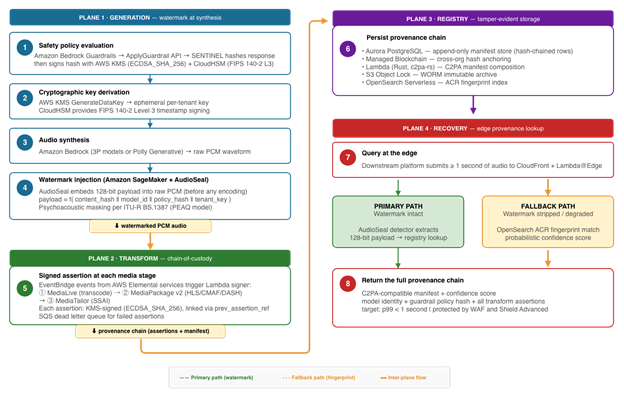
Figure 2: SENTINEL functional data flow
The key lessons learnt during SENTINEL implementation are:
- AudioSeal’s 16-bit message limit requires multi-frame encoding – AudioSeal’s pretrained model carries 16 bits per frame. Folding a 128-bit payload across eight consecutive frames requires roughly 8 seconds of audio for a full read and produces a fragile, order-dependent decode. However, SENTINEL uses the 16 bits as a clean registry lookup key and keeps the full payload in the signed manifest. This holds recovery at 1 second of audio. Widening the key via AudioSeal’s multi-bit extension modes or custom training is on the roadmap.
- Post-vocoder injection is the pragmatic starting point – Injecting the watermark inside a modified HiFi-GAN vocoder produces the strongest differentiation from prior art but requires custom vocoder training on an Amazon SageMaker
ml.p4d.24xlargeinstance (8 NVIDIA A100 GPUs) for 2 – 4 weeks. SENTINEL’s current implementation injects immediately after vocoder output but before any lossy encoding, using AudioSeal as-is, and the roadmap migrates to in-vocoder injection in a future phase. - Lambda@Edge cold starts require architectural mitigation – Lambda@Edge functions have higher cold-start latency than Regional Lambda and don’t support provisioned concurrency. SENTINEL mitigates this with a CloudFront cache-first architecture (caching manifest lookups by watermark hash) and lightweight function design (minimal dependencies, no heavy frameworks) to hold p99 recovery latency under the 1-second target. For compute-heavy detection (AudioSeal inference), requests are forwarded to a Regional Lambda function where provisioned concurrency is available.
Conclusion
SENTINEL embeds the watermark during generation – not as a post-processing step and tracks provenance through every transformation with signed assertions. This creates a chain of custody inseparable from the audio. The solution is built on AWS managed services including Amazon Bedrock, AWS KMS, AWS Elemental Media Services, Amazon Aurora, and Amazon CloudFront, so you can deploy the pipeline using infrastructure you already operate.
Audio provenance is a compliance requirement, not a differentiator. The EU AI Act’s December 2026 deadline was further sharpened by the July 2026 finalized Code of Practice mandating public detection solutions and zero-retention handling. The music industry attribution mandates and broadcast standards all converge on the same message that if you generate AI audio, provenance must be built in at the source. SENTINEL provides a blueprint for meeting these obligations without waiting for post-processing workflows to catch up.
The SENTINEL reference implementation will be published to GitHub in October 2026. Follow the AWS for Media and Entertainment Blog for updates to build verifiable provenance into your AI-generated audio before the December 2, 2026, deadline.
Further reading
- Get started with Amazon Bedrock on the AWS Management Console.
- Explore the C2PA 2.0 specification for content credential manifests.