Real-time intelligence running AI at the edge
Deploy and manage fleets of IoT devices using Avnet /IOTCONNECT and AWS IoT Core
Introduction
Modern warehouses are no longer static rows of storage racks — they’ve become dynamic environments of sensors, smart cameras, and AI-driven analytics. There are strong tailwinds pushing these trends forward:
- First, automation is accelerating across supply chains, reducing pick-and-pack cycle times and minimizing shrinkage through real-time visibility.
- Second, edge AI has matured—today’s smart cameras can run powerful models like YOLO or EfficientDet locally, sending only the most relevant metadata instead of raw video streams.
- And third, cloud-native IoT platforms have also matured, with services like AWS IoT Core and accelerators like Avnet /IOTCONNECT offering enterprise-grade scalability without the operational burden of building from scratch.
As these trends drive transformation, organizations are making significant investments to scale their IoT implementations. Enterprise Architects now face exponentially growing challenges in managing large fleets of IoT devices running AI workloads, as the complexity of device provisioning, security, and management increases dramatically with scale.
In this article, we’ll explore how Avnet’s /IOTCONNECT, deployed via AWS Marketplace, can serve as the secure, scalable control plane for managing fleets of edge devices—and how AWS IoT Core, AWS IoT Greengrass, Amazon S3, and AWS Lambda fit into the bigger picture.
What it takes to manage a fleet of IoT Devices
Ensuring all desired outcomes are met requires that multiple angles be carefully considered when building an enterprise ready IoT fleet management solution. Visibility into the status and availability, device and data security and workload lifecycle is only a small sample of the expectations different technical stakeholders will have on the solution.
To address these challenges some foundational requirements must be satisfied:
- At-scale provisioning capabilities – Assigning unique identifiers securely, managing device certificates and having access to device configuration templates are key capabilities that enable provisioning from dozens to thousands of devices.
- Model lifecycle management – Over-the-air (OTA) deployment of versioned models with predictable ways to test and roll back. Rapid deployment capabilities enable teams to keep up with the pace of AI model development.
- Data integrity – IoT devices can produce voluminous data streams that may include sensitive information.
- Scalability – There is a clear trend of a rapid increase in the count and diversity of IoT devices, the system must be able to quickly scale to meet these requirements.
Building a system that satisfies all the requirements that branch out from the high-level foundations outlined above can take plenty of time and effort. Finding a managed solution that collapses implementation time from months to days is of course ideal.
Solution: /IOTCONNECT as the warehouse-IoT control plane
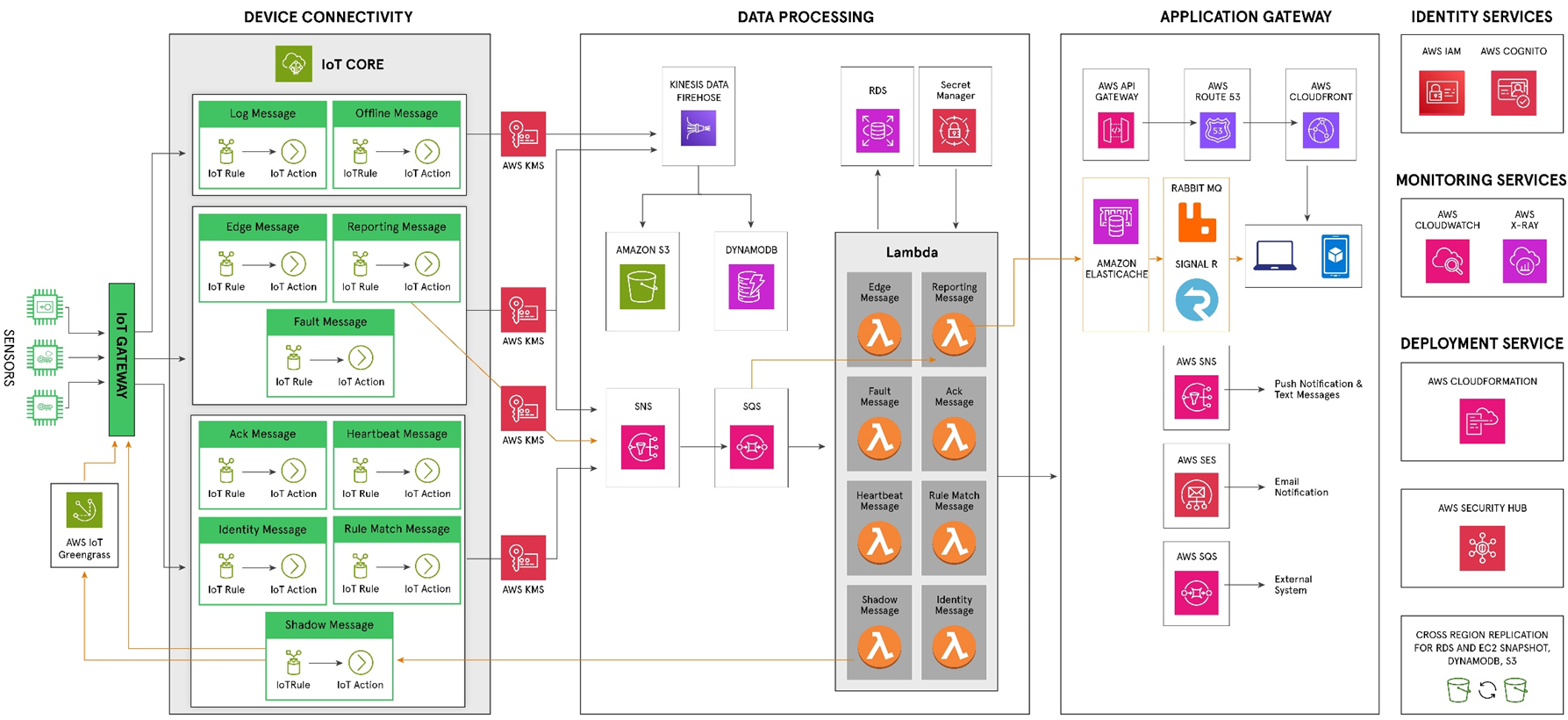
A product that sits at the core of the architecture required to fulfill all our requirements is Avnet’s /IOTCONNECT, a cloud-native platform purpose-built for secure, scalable device management and analytics. While /IOTCONNECT presents a streamlined interface for users, it is fundamentally powered by AWS tools, with AWS IoT Core serving as its backbone for device connectivity and messaging.
This integration offers several key advantages:
- /IOTCONNECT leverages AWS IoT Core's MQTT-based messaging features to facilitate real-time, bi-directional communication between devices and the cloud. This setup supports various communication protocols and ensures reliable message delivery, crucial for time-sensitive applications like warehouse monitoring and safety systems.
- Through /IOTCONNECT, devices are provisioned with X.509 certificates, utilizing AWS IoT Core's secure authentication mechanisms. This process ensures that only authorized devices can connect to the network, maintaining the integrity and security of the IoT ecosystem.
- Once connected, devices send telemetry data through AWS IoT Core, which /IOTCONNECT then processes and stores using services like Amazon S3 and Amazon DynamoDB. This integration allows for scalable data storage and real-time analytics, enabling enterprises to gain insights into their operations and make informed decisions.
- /IOTCONNECT utilizes AWS IoT Core's device management capabilities to perform over-the-air (OTA) updates, ensuring that devices run the latest firmware and security patches. OTA functionality is critical to comply with the Cyber Resilience Act (CRA) in the EU and the Cyber Trust Mark in the US. This feature is also key for maintaining device performance and security across large fleets.
- By building on secure AWS infrastructure, /IOTCONNECT inherits robust security features, including data encryption, identity and access management (IAM), and compliance with industry standards. This foundation provides enterprises with the confidence that their IoT deployments meet stringent security and compliance requirements.
In essence, /IOTCONNECT abstracts the complexities of AWS IoT Core, allowing users to focus on their core business logic and application development. This synergy between /IOTCONNECT and AWS services enables rapid deployment, scalability, and robust security, making it an ideal solution for managing modern, edge-enabled warehouse environments.
Edge AI deployment with /IOTCONNECT
One of the compelling features of /IOTCONNECT is its capability to manage and deploy AI/ML models directly to edge devices. This functionality is crucial for applications requiring real-time decision-making, such as object recognition in warehouse environments.
/IOTCONNECT provides a centralized platform for handling the complete lifecycle of AI models: from development to edge deployment. /IOTCONNECT offers version control and model validation against real-world datasets before deployment. Through its intelligent model distribution system, /IOTCONNECT ensures that the right model is deployed to the appropriate device, considering hardware specifications and use cases.
The platform's over-the-air (OTA) capabilities streamline the deployment and updates of AI models on edge devices. It supports automated push deployment, incremental updates to minimize downtime and bandwidth usage, and real-time rollback in case of deployment issues.
Furthermore, /IOTCONNECT supports continuous monitoring and feedback for deployed models to ensure optimal performance. It tracks model performance metrics on the edge in real-time and collects data from edge devices to retrain and improve models. This feedback loop is essential for maintaining the accuracy and efficiency of AI models in dynamic environments.
By integrating these capabilities, /IOTCONNECT simplifies the complexities associated with deploying and managing AI models at the edge, enabling enterprises to harness the power of edge AI effectively.
Implementation
Preparing your environment
Before getting started, ensure you have the necessary resources and environment in place. This includes:
- An active Avnet /IOTCONNECT account to access the online portal. You can create this account by launching the /IOTCONNECT free trial in AWS Marketplace.
- An edge-AI development board, kit, or configurable camera or sensor. This will be used to communicate with /IOTCONNECT through a variety of protocols. For some example kits already enabled with /IOTCONNECT see the following resources:
Once you have the above things ready, visit the /IOTCONNECT online portal and login using your credentials.
Getting started
The first thing we want to define when connecting a device is a template. A template is a schema that captures the device’s identity, message version, capabilities, and every telemetry or command attribute the platform should expect from it. Navigate to Devices → Templates and create a new template. Give your template a Code and Name.
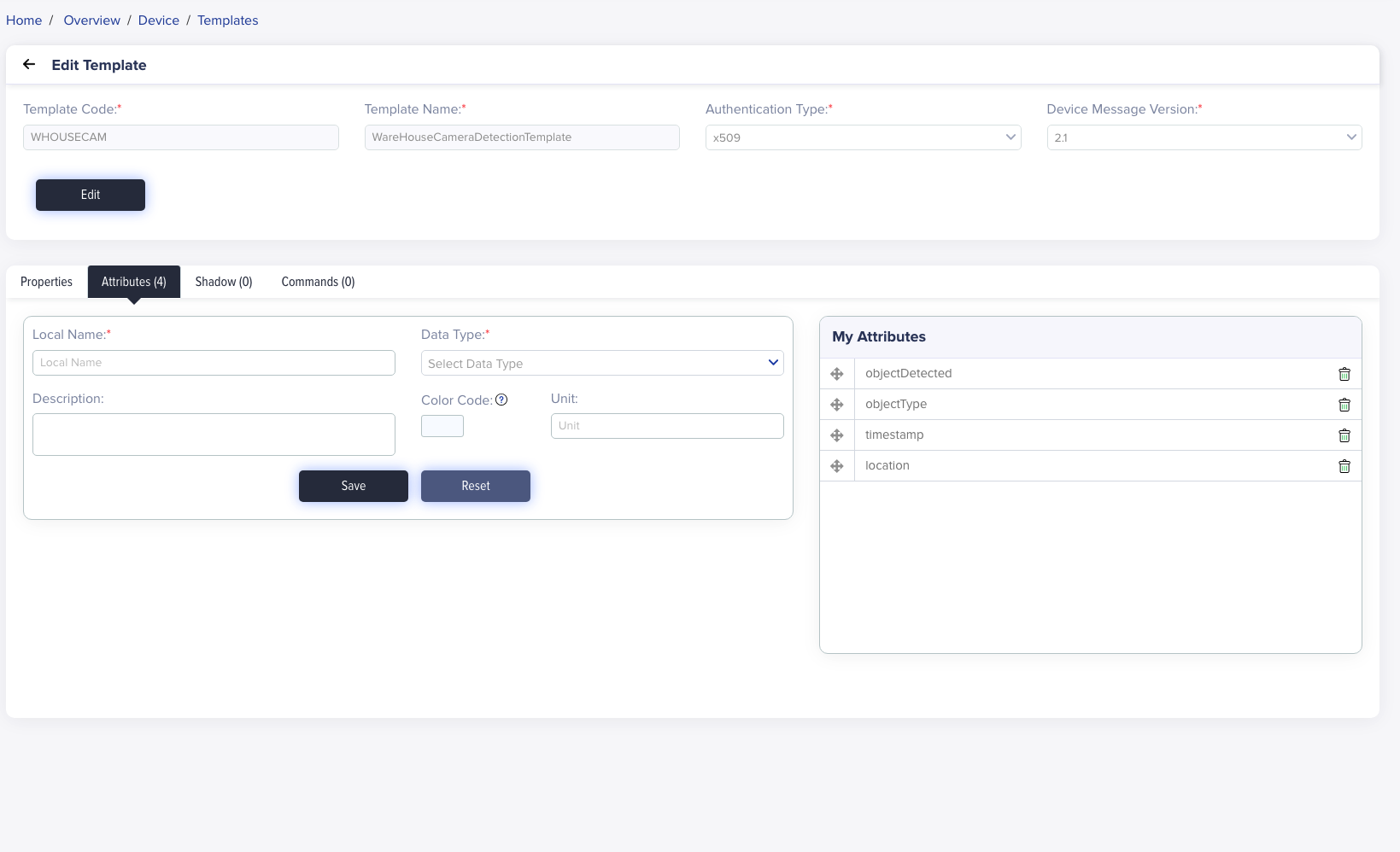
As shown in the example, the authentication type is set to X.509, meaning every device will authenticate using a unique certificate/key pair issued by /IOTCONNECT. X.509 authentication not only satisfies enterprise security requirements (mutual TLS, individual revocation, hardware secure-element compatibility) but also integrates seamlessly with AWS IoT Core’s TLS policy, eliminating the need for a separate token service.
The message version is set to 2.1, which tells /IOTCONNECT (and the std21-patch SDK) how to route, validate, and store payloads.
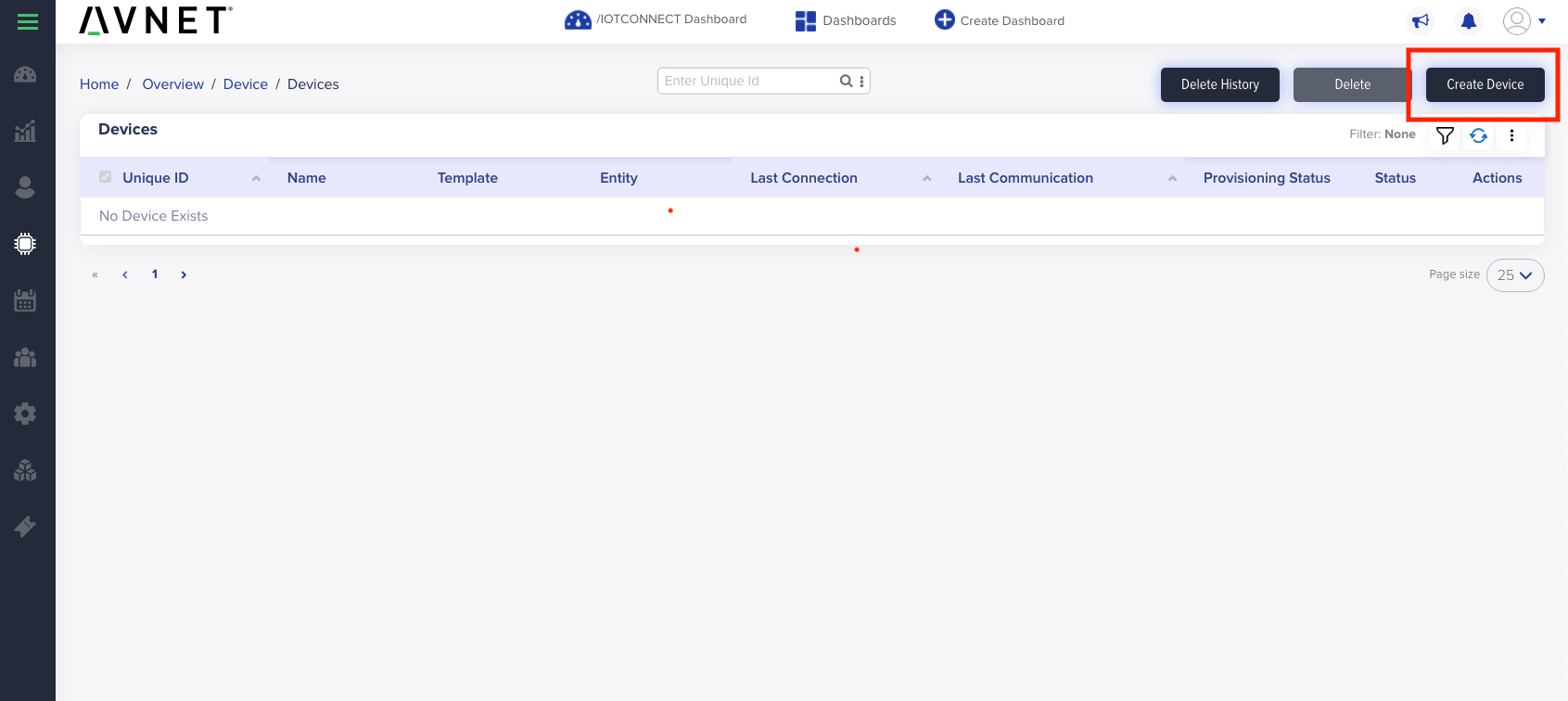
Once your template is published, it’s time to add a device. Navigate to Devices → Create Device.
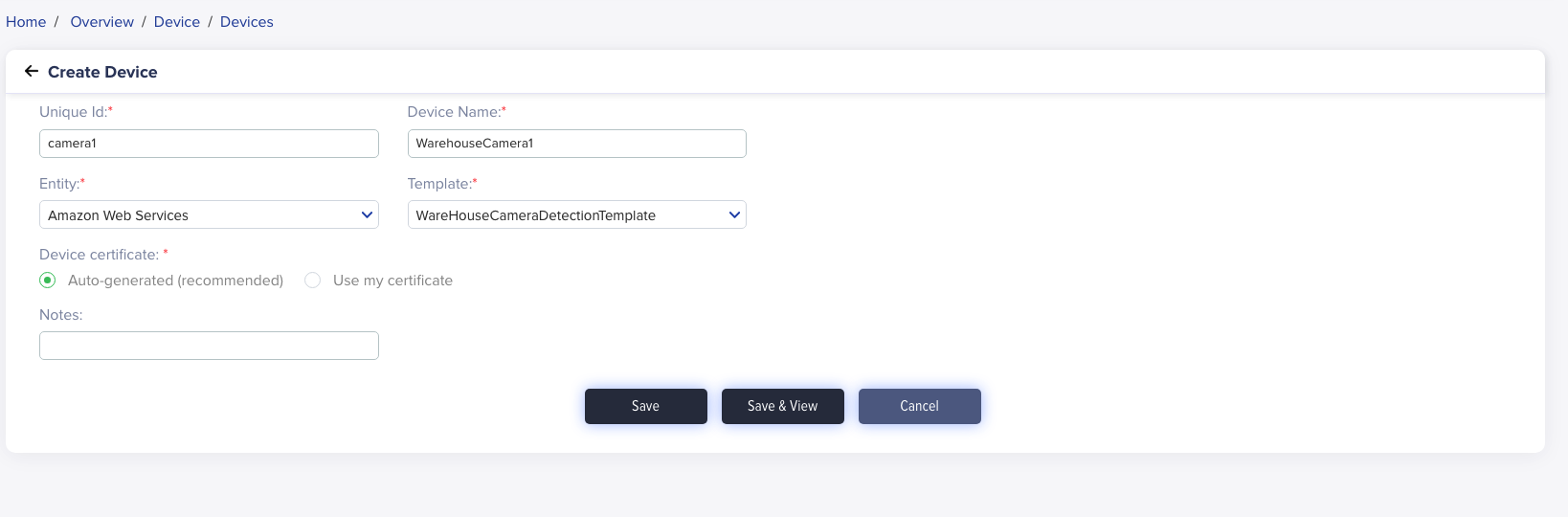
Give your device a Unique ID and Name and select the template you just created. Your entity should be pre-populated based on your initial account setup. If not, navigate to Entity in the left sidebar and create one.
You should now see your new device in the list of devices. You can now click on the device’s Unique ID and you will be re-directed to the page showing the device info and other information related to the device.
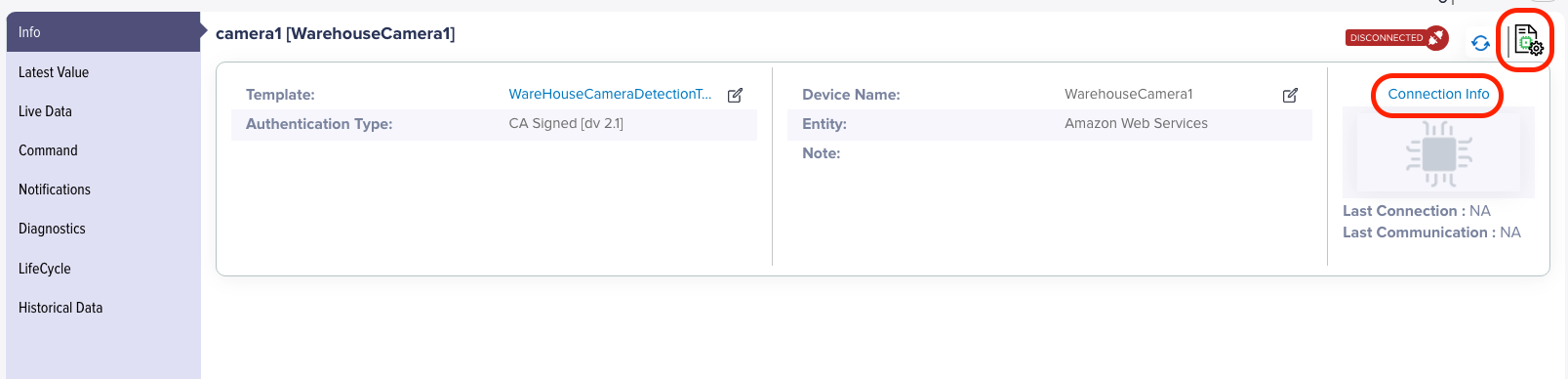
The highlighted icon button shown above downloads a json configuration file with useful connection metadata. The Connection Info button has all the necessary details (broker details, topic paths, etc.) regarding setting up the device to connect to /IOTCONNECT.
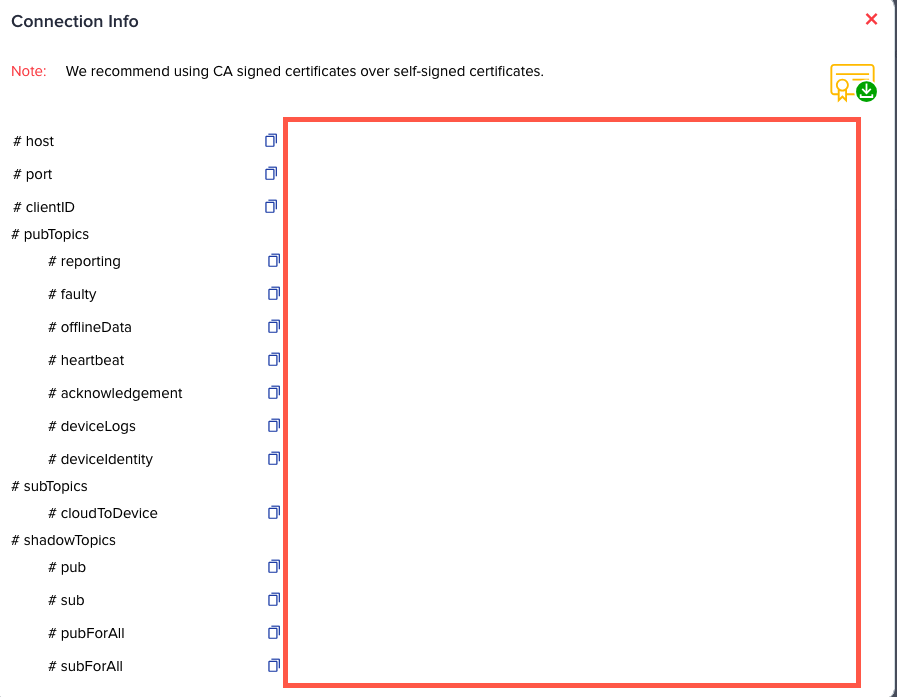
Use the certificate icon (top right) to download the device’s required .crt and .pem files. Save these for configuring your device connection later.
Connecting your device
Next, configure your device to send data to /IOTCONNECT. This step varies based on the hardware you're using:
- If you’re using a pre-enabled device from one of Avnet’s supplier partners (e.g., Infineon, Microchip, NXP, Renesas, ST, Raspberry Pi, AMD), refer to the appropriate Quick Start available in the documentation library.
- For all other devices, use the general configuration guide provided here to install certificates and set up MQTT/TLS.
Once configured properly, your device’s Provisioning Status in /IOTCONNECT should change to Connected.

You can repeat this process to connect an entire fleet of devices. (Note: You can also bulk import device definitions in JSON format via the Device Import option.)
Viewing device data
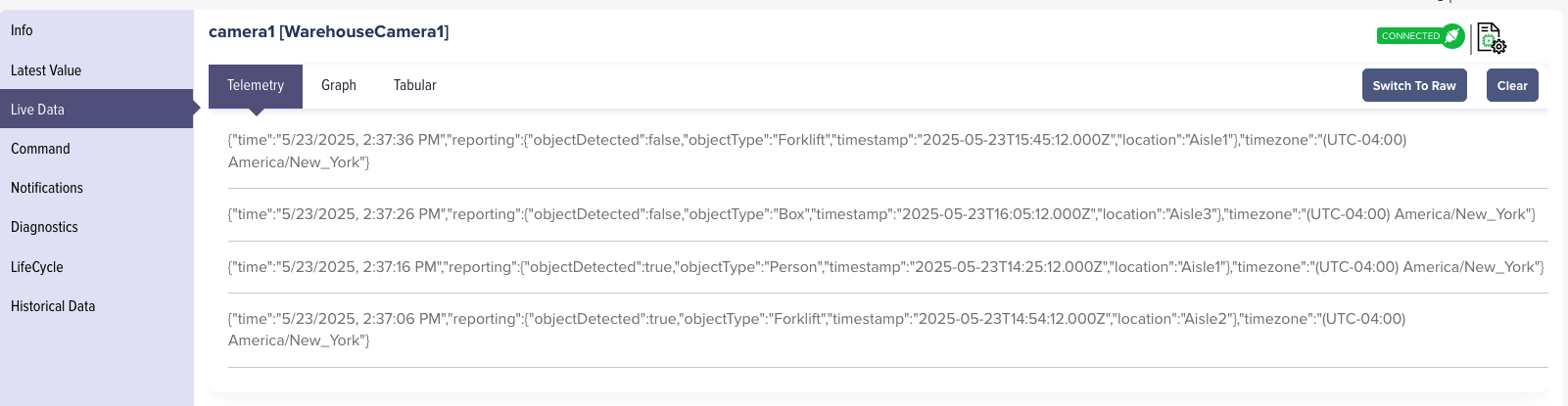
Once your device is connected, navigate to the Live Data tab to monitor its telemetry. You can view the data in multiple formats, including Tabular and Graph. To see historical trends, scroll to the Historical Data section, where you can also export the data if needed. At this point, your devices are connected and streaming real-time data into /IOTCONNECT. Let’s explore some key features that make the platform particularly valuable.
Exploring key /IOTCONNECT features
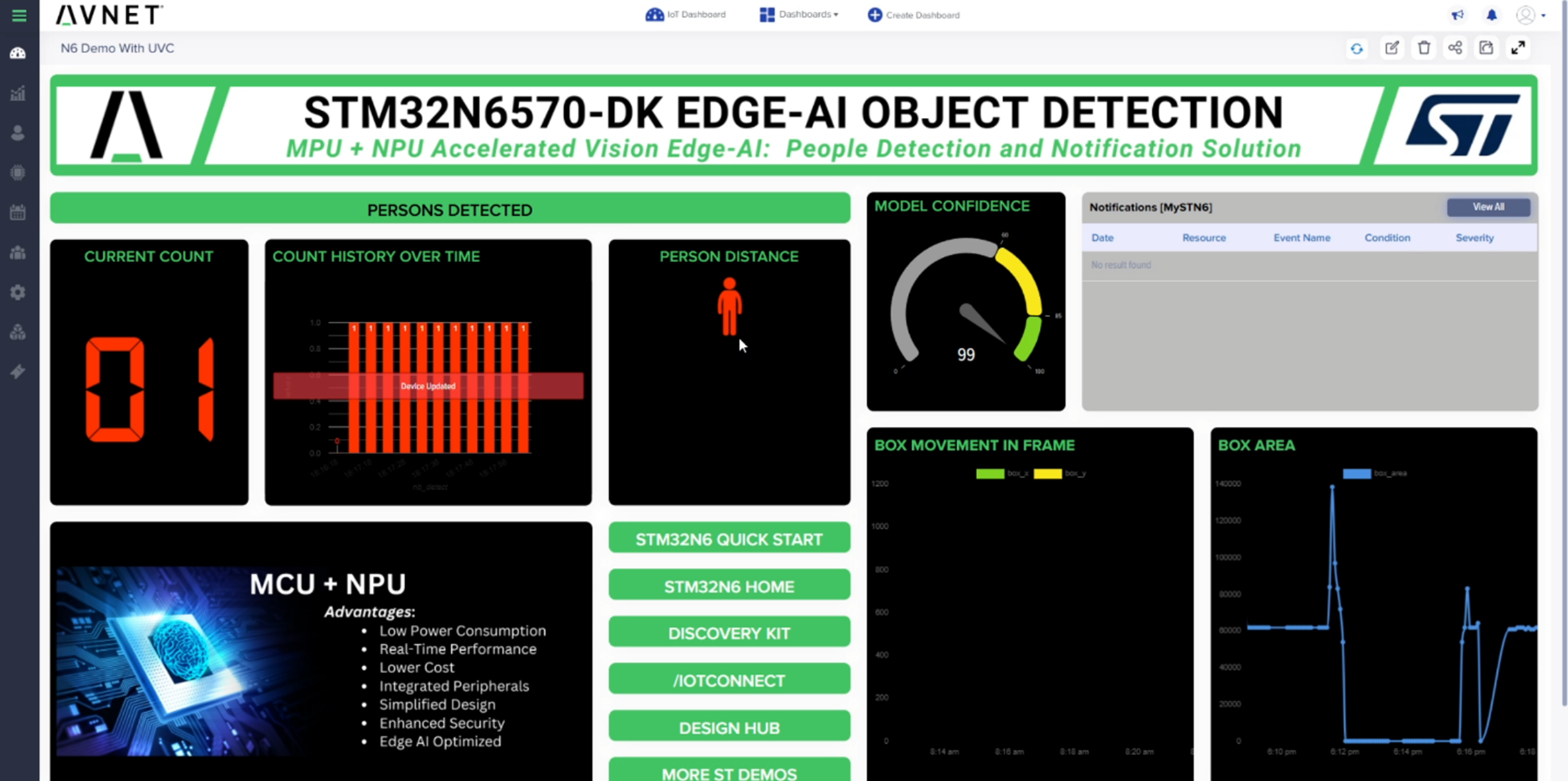
Let’s first look at creating a dashboard on /IOTCONNECT. Navigate to the Dashboard tab and click Create Dashboard on the top.
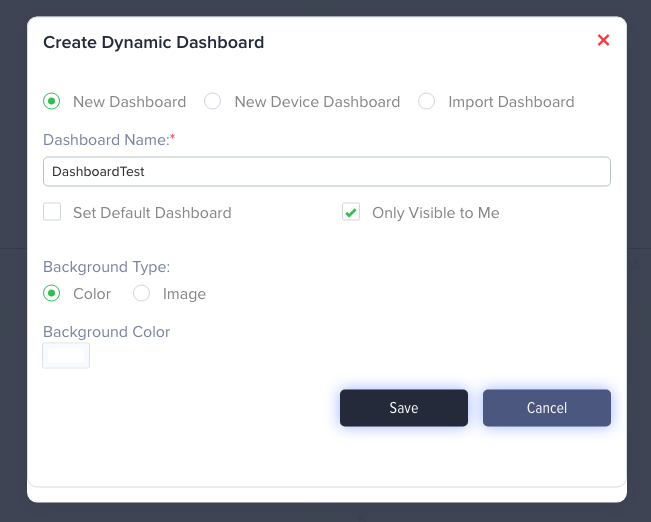
You’ll be able to add various widgets—such as location, device activity, and bar graphs—to visualize device activity and status. Widgets are drag-and-drop and fully customizable. Here’s an example of a full dashboard for object detection.
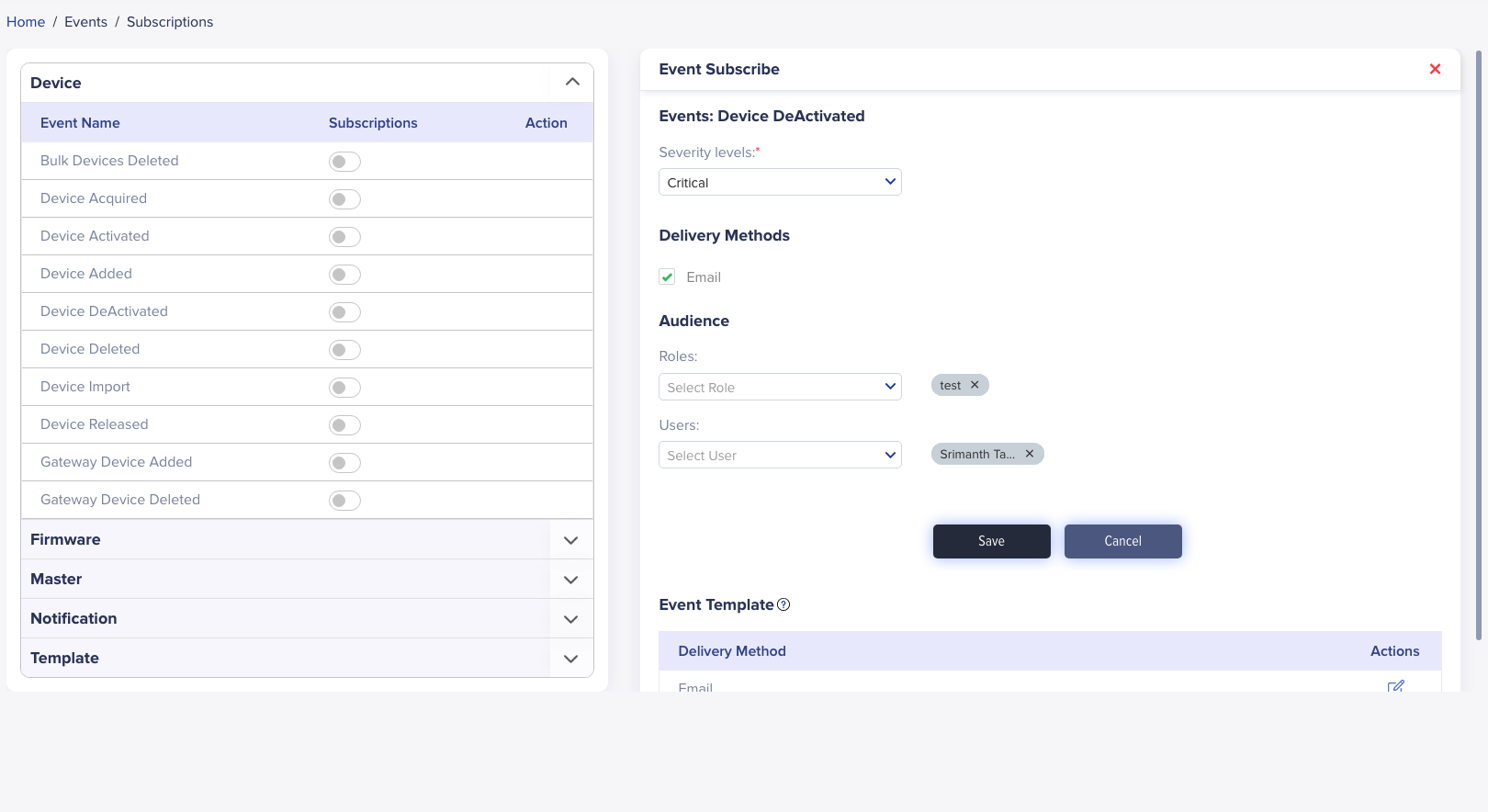
Another important feature is Subscription located under Events→ Subscriptions. These are real-time alerts you can create regarding your devices. For example, you might set an alert to send an email when a device becomes deactivated. You can configure the severity level, event type, and recipients directly from the UI.
In /IOTCONNECT, a command is a named and cloud-triggered instruction that devices listen for. Commands are defined at the template level and are part of the same JSON block that defines attributes and OTA metadata.
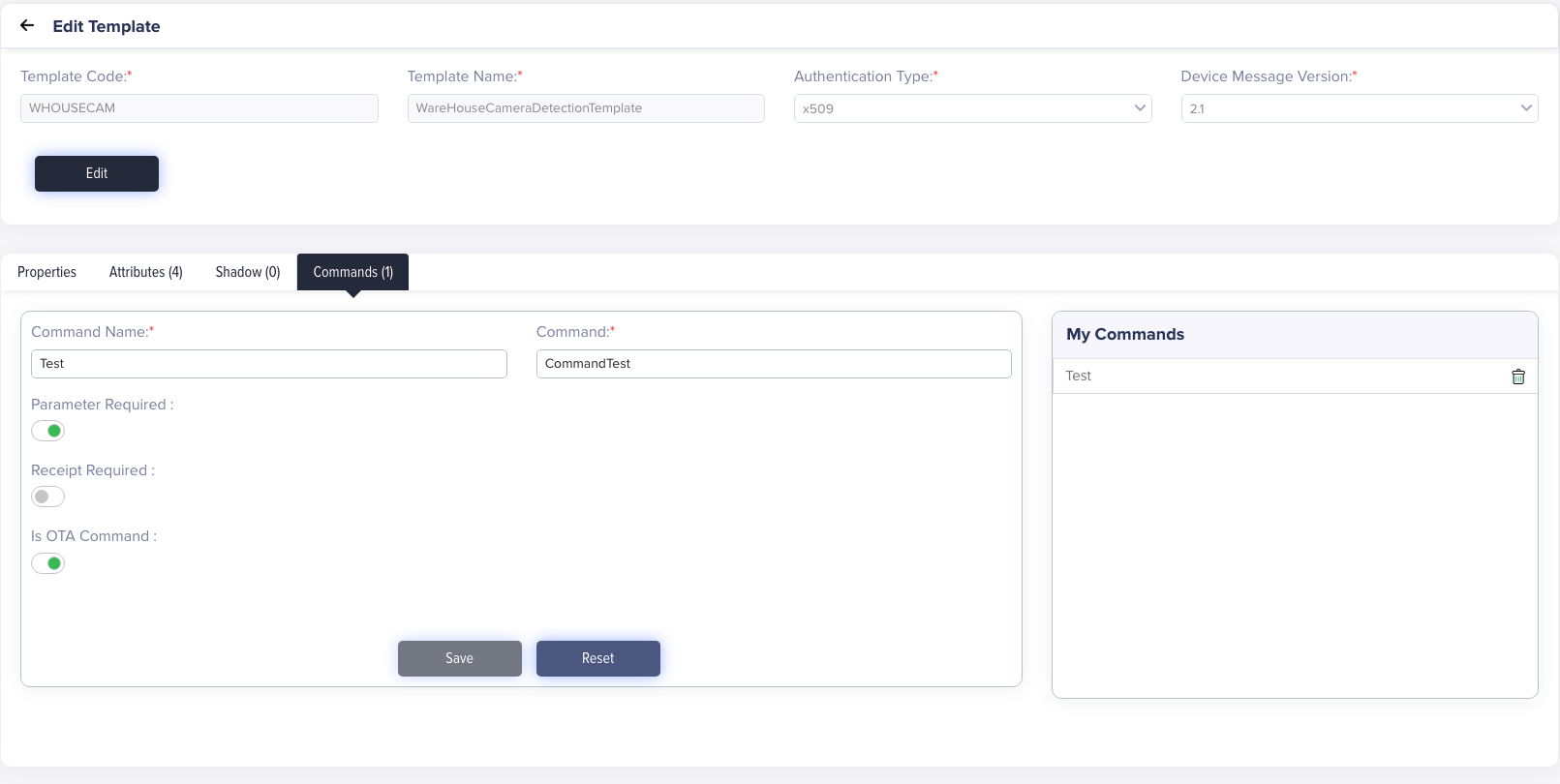
Commands let the cloud instruct devices to perform actions. Command configuration options include:
- Parameter Required - If true, the cloud must supply a JSON payload of parameters when sending the command.
- Receipt Required - If true, the device must return an ACK (usually a JSON response) so IoT Connect can mark the command “completed.”
- Is OTA Command – If true, the command will trigger FOTA/firmware logic; handled separately by the agent.
These commands allow you to remotely reboot a device, adjust detection thresholds, or deploy updated models—all without physical access.
As shown, real-time dashboards, smart rules, remote commands, and OTA updates all ship out-of-the-box—no additional infrastructure or coding needed. Together, they make Avnet’s /IOTCONNECT a powerful and accessible platform for managing modern, edge-enabled warehouse environments.
Key takeaways
Operating fleets of IoT devices is increasingly becoming a challenge enterprise engineering teams must solve, however dealing with the complexities of data streams at scale, device security, workload management and overall system visibility require meaningful time and effort to build.
Solutions such as Avnet /IOTCONNECT abstract the complexity of meeting these requirements by taking advantage of the comprehensive capabilities provided by AWS IoT Core and providing a key set of features that are critical to successful deployment:
- Sign up for Avnet /IOTCONNECT for free with your AWS account.
- Automate the generation and assignment of certificates and device identifiers.
- Use versioned templates to manage device configuration.
- Take advantage of dashboards for system visibility and to enable diverse stakeholders to extract meaningful value from the solution.
Why AWS Marketplace for on-demand cloud tools
Free to try. Deploy in minutes. Pay only for what you use.
Launch directly into your AWS environment
Featured tools are designed to plug in to your AWS workflows and integrate with your favorite AWS services.
No sales cycles—start building right away
Subscribe through your AWS account with no upfront commitments, contracts, or approvals.
Free trials help you evaluate fast
Try before you commit. Most tools include free trials or developer-tier pricing to support fast prototyping.
Usage-based pricing, billed through AWS
Only pay for what you use. Costs are consolidated with AWS billing for simplified payments, cost monitoring, and governance.
Curated tools built for cloud engineers
A broad selection of tools across observability, security, AI, data, and more can enhance how you build with AWS.