
Sold by: Elastic
Deployed on AWS
Free Trial
Vendor Insights
Address your search, observability, and security challenges with Elastic's leading vector database, built for generative AI, semantic search, and hundreds of open, pre-built integrations. Start a 7-day free trial and harness the power of your data, securely and at scale.
4.3
Overview
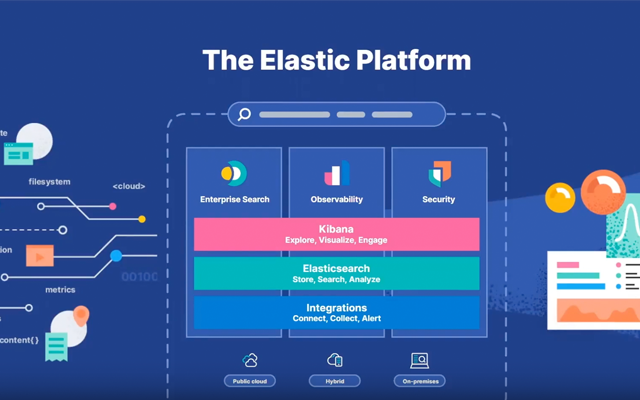
Video
Video 1

Video
Product video
Elastic's Search AI Platform combines world-class search with generative AI to address your search, observability, and security challenges.
Elasticsearch - the industry's most used vector database with an extensive catalog of GenAI integrations - gives you unified access to ML models, connectors, and frameworks through a simple API call. Manage data across sources with enterprise-grade security and build scalable, high-performance apps that keep pace with evolving business needs. Elasticsearch gives you a decade-long head start with a flexible Search AI toolkit and total provisioning flexibility-fully managed on serverless, in the cloud, or on your own infrastructure.
Elastic Observability resolves problems faster with open-source, AI-powered observability without limits, that is accurate, proactive and efficient. Get comprehensive visibility into your AWS and hybrid environment through 400+ integrations including Bedrock, CloudWatch, CloudTrail, EC2, Firehose, S3, and more. Achieve interoperability with an open and extensible, OpenTelemetry (OTel) native solution, with enterprise-grade support.
Elastic Security modernizes SecOps with AI-driven security analytics, the future of SIEM. Powered by Elastic's Search AI Platform, its unprecedented speed and scalability equips practitioners to analyze and act across the attack surface, raising team productivity and reducing risk. Elastic's groundbreaking AI and automation features solve real-world challenges. SOC leaders choose Elastic Security when they need an open and scalable solution ready to run on AWS.
Take advantage of Elastic Cloud Serverless - the fastest way to start and scale security, observability, and search solutions without managing infrastructure. Built on the industry-first Search AI Lake architecture, it combines vast storage, compute, low-latency querying, and advanced AI capabilities to deliver uncompromising speed and scale. Users can choose from Elastic Cloud Hosted and Elastic Cloud Serverless during deployment. Try the new Serverless calculator for price estimates: https://cloud.elastic.co/pricing/serverless .
Ready to see for yourself? Sign into your AWS account, click on the "View Purchase Options" button at the top of this page, and start using a single deployment and three projects of Elastic Cloud for the first 7 days, free!
Highlights
- Search: Build innovative GenAI, RAG, and semantic search experiences with Elasticsearch, the leading vector database.
- Security: Modernize SecOps (SIEM, endpoint security, cyber security) with AI-driven security analytics powered by Elastic's Search AI Platform.
- Observability: Use open, extensible, full-stack observability with natively integrated OpenTelemetry for Application Performance Monitoring (APM) of logs, traces, and other metrics.
Details
Sold by
Delivery method
Deployed on AWS
New
Introducing multi-product solutions
You can now purchase comprehensive solutions tailored to use cases and industries.

Features and programs
Skip the manual risk assessment. Get verified and regularly updated security info on this product with Vendor Insights.
Security credentials achieved
(2)

ISO27001

AWS Security Specialization
Buyer guide
Gain valuable insights from real users who purchased this product, powered by PeerSpot.

Financing for AWS Marketplace purchases
AWS Marketplace now accepts line of credit payments through the PNC Vendor Finance program. This program is available to select AWS customers in the US, excluding NV, NC, ND, TN, & VT.

AWS PrivateLink
Get next level security. Connect VPCs and AWS services without exposing data to the internet.
Pricing
Free trial
Try this product free according to the free trial terms set by the vendor.
Pricing is based on actual usage, with charges varying according to how much you consume. Subscriptions have no end date and may be canceled any time.
Additional AWS infrastructure costs may apply. Use the AWS Pricing Calculator to estimate your infrastructure costs.
Dimension | Cost/unit |
|---|---|
Elastic Consumption Unit | $0.001 |
Dimensions summary
Elastic Consumption Units (ECUs) represent Elastic's unified pricing metric across both their Cloud Hosted and Serverless offerings on AWS Marketplace. For Cloud Hosted solutions, ECUs measure infrastructure resource consumption, while for Serverless offerings, ECUs quantify usage based on service-specific dimensions such as data ingestion, search operations, and security events. This flexible pricing model ensures customers pay only for their actual usage, whether they're using Elasticsearch, Observability, Security, or other Elastic services.
Top-of-mind questions for buyers like you
What is an Elastic Consumption Unit (ECU) and how is it calculated?
An ECU is Elastic's standardized billing metric that measures usage across their services. For Cloud Hosted deployments, ECUs are calculated based on infrastructure resources consumed, while for Serverless offerings, ECUs are determined by service-specific usage metrics like data ingestion volume, search operations, or security events processed.
How can I estimate my monthly costs for Elastic Cloud on AWS Marketplace?
Elastic provides a pricing calculator on their website where you can estimate costs based on your expected usage patterns. You can also monitor your actual ECU consumption through Elastic Cloud console's usage monitoring features, and the billing interface shows detailed breakdowns of usage by service and deployment.
Does Elastic Cloud on AWS Marketplace require any upfront commitment?
Elastic Cloud on AWS Marketplace follows a pay-as-you-go model with no upfront commitments required. However, customers can opt for annual commitments to receive volume discounts, and usage is billed monthly through your AWS account based on actual consumption of ECUs.
Vendor refund policy
See EULA above.
Custom pricing options
Request a private offer to receive a custom quote.

Legal
Vendor terms and conditions
Upon subscribing to this product, you must acknowledge and agree to the terms and conditions outlined in the vendor's End User License Agreement (EULA) .
Content disclaimer
Vendors are responsible for their product descriptions and other product content. AWS does not warrant that vendors' product descriptions or other product content are accurate, complete, reliable, current, or error-free.
Delivery details
Software as a Service (SaaS)
SaaS delivers cloud-based software applications directly to customers over the internet. You can access these applications through a subscription model. You will pay recurring monthly usage fees through your AWS bill, while AWS handles deployment and infrastructure management, ensuring scalability, reliability, and seamless integration with other AWS services.
Resources
Vendor resources
Support
Vendor support
Visit Elastic Support (https://www.elastic.co/support ) for more information. If you are a customer, go to the Elastic Support Hub (http://support.elastic.co ) to raise a case.
AWS infrastructure support
AWS Support is a one-on-one, fast-response support channel that is staffed 24x7x365 with experienced and technical support engineers. The service helps customers of all sizes and technical abilities to successfully utilize the products and features provided by Amazon Web Services.
Updated weekly
By Elastic

By ChaosSearch, Inc.
Top
10
In Databases & Analytics Platforms
Top
10
In Generative AI, Log Analysis
Top
100
In Log Analysis, Analytic Platforms
Sentiment is AI generated from actual customer reviews on AWS and G2
Functionality
Ease of use
Customer service
Cost effectiveness
Positive reviews
Mixed reviews
Negative reviews
AI generated from product descriptions
Vector Database Capabilities
Elasticsearch functions as a vector database with extensive GenAI integrations, providing unified access to ML models, connectors, and frameworks through API calls for semantic search and RAG applications.
Observability and Monitoring
Full-stack observability solution with OpenTelemetry native integration supporting 400+ integrations including AWS services like Bedrock, CloudWatch, CloudTrail, EC2, Firehose, and S3 for comprehensive visibility across environments.
AI-Driven Security Analytics
Security operations platform powered by Search AI Platform delivering AI-driven security analytics for SIEM, endpoint security, and cyber security with advanced automation features for attack surface analysis.
Serverless Architecture
Serverless deployment option built on Search AI Lake architecture combining vast storage, compute, low-latency querying, and advanced AI capabilities without infrastructure management requirements.
Enterprise-Grade Data Management
Unified data management across multiple sources with enterprise-grade security, flexible provisioning options across serverless, cloud, and on-premises infrastructure deployments.
AI-Powered Root Cause Analysis
Automatically investigates alerts and pinpoints root causes with 5x faster analysis capabilities.
Natural Language Query Interface
Enables querying of observability data using conversational natural language to identify issues and receive actionable insights.
Real-Time Anomaly Detection
Detects system anomalies in real-time to prevent incidents before they impact users.
OpenTelemetry Integration
Supports standardized OpenTelemetry integration for unified data collection across logs, metrics, and traces in cloud-native environments including Kubernetes, serverless, and microservices.
Multi-Tiered Storage Architecture
Implements multi-tiered storage and data management capabilities to optimize telemetry costs and achieve 30% to 50% cost savings.
Direct S3 Data Indexing
Indexes Amazon S3 data without transformation or schema changes, enabling immediate access to all data as-is
SQL and Search Query Support
Enables SQL queries and search workloads on indexed S3 data through open APIs compatible with analytics tools
Machine Learning Workload Capability
Supports machine learning workloads on indexed data stored in Amazon S3 with infinite scalability
Unlimited Data Retention
Provides unlimited retention of indexed data, enabling historical analysis across any time horizon without data purging or archival requirements
Fully Managed Service Architecture
Operates as a fully managed service eliminating administrative overhead including re-indexing, sharding, load balancing, and compute/storage management
Validated by AWS Marketplace
FedRAMP
GDPR
HIPAA
ISO/IEC 27001
PCI DSS
SOC 2 Type 2
-
-
-
-
-
-
-
No security profile
Standard contract
No
No
No
Customer reviews
Tom Everson
Search through massive message archives in milliseconds and have supported large compliance data
Reviewed on Mar 24, 2026
Review from a verified AWS customer
What is our primary use case?
I can describe a few use cases for Elastic Search because in my previous company, we had a message database and needed to implement a search system. We first used Postgres full text search, but it did not work well, so we had to migrate everything into Elastic Search . Elastic Search could better index the data and we could search every document in instant time.
The key differences between Elastic Search and Postgres search, including both pros and cons, are primarily related to indexing speed. In Postgres, the full text search speed is quite noticeable if you have a message document. In Elastic Search, I am not quite certain about when comparing to normal data, but for our use case of searching through message documents, the speed difference is noticeable in Postgres because our documents are very large. Since Elastic Search is primarily built for search, I think it can better search through the document. Our documents were sometimes really large, ranging from 100 megabytes to 200 megabytes per document, so I think Elastic Search handles this much better than Postgres.
What is most valuable?
What I appreciate about Elastic Search is that the best features include the ability to search through very big documents and index and search through them really fast. This is the one thing I value most about Elastic Search.
Regarding stability, I have not had any crashes, downtimes, or performance issues with it. We did have one incident, but it was not from Elastic Search. I think it was an AWS service outage. The downtime was an AWS error, not from Elastic Search.
Concerning scalability, I find it scalable because it is quite scalable right now. We currently have a terabyte of compliance data, and the client can search through that very effectively. We have not experienced any scalability errors so far. I think our compliance data amounts to approximately five or six terabytes of data, which is very large. We can search through that document quite easily, sometimes in 7 milliseconds, sometimes one or two milliseconds. It was quite fast.
What needs improvement?
Apart from the good things, what I would like to see improved or enhanced in Elastic Search is the storage cost. I think the main problem with Elastic Search is that sometimes the storage was quite expensive. We also have a file system in addition to compliance. We have an FDS on our server, and we sometimes want to attach something on top of the FDS and search through every file without having to create a search index dedicatedly.
The missing features or functionalities in Elastic Search that I would like to see included in the future or some functionality that requires enhancement would be the ability to attach to our file system, such as network file system or NFS, or maybe our on-premise NAS server, and then search through everything, whether it is a document, text, or some information from those documents. That may be our primary use case right now, but we do not have that capability. Additionally, I would like to see a better search system so we can locally embed and find through everything.
For how long have I used the solution?
I have been working with Elastic Search for approximately one or two years.
What do I think about the stability of the solution?
Regarding stability, I have not had any crashes, downtimes, or performance issues with it. We did have one incident, but it was not from Elastic Search. I think it was an AWS service outage, not from Elastic Search. The error was an AWS error.
What do I think about the scalability of the solution?
Concerning scalability, I find it scalable because it is quite scalable right now. We currently have a terabyte of compliance data, and the client can search through that very effectively. We do not have any scalability errors so far. I think our compliance data amounts to approximately five or six terabytes of data, which is very large. We can search through that document quite easily, sometimes in 7 milliseconds, sometimes one or two milliseconds. It was quite fast.
How are customer service and support?
I do not know anything about the tech support because I have not escalated any questions to the technical support or customer service teams. We have not talked to anyone.
Which solution did I use previously and why did I switch?
I previously used a different solution for search. The solution I used for the search previously was Postgres full text search.
How was the initial setup?
The initial setup process of Elastic Search was straightforward. I did not face many challenges or complexities except for the fact that we had to extract every document and build a search index. Aside from that, we did not experience much complexity during that time.
What's my experience with pricing, setup cost, and licensing?
When it comes to pricing, I think we had to pay AWS approximately 1,000 to 1,200 per month for the overall stack. I am not quite certain about how much Elastic Search costs specifically because I was not in charge of pricing. The overall system cost was approximately 1,200 to 1,500 per month.
I do not find it cost-effective. I am not quite certain. Maybe the client might complain, but I am not certain. We just built out the system.
Which other solutions did I evaluate?
Before choosing Elastic Search, I evaluated other options. At first, we tried to go with Redis search because we really needed fast retrieval, but Redis search was closed source at that time, so we could not go with Redis search. We had to try Elastic Search and it performed quite surprisingly well.
What other advice do I have?
Given my experience with Elastic Search, a piece of advice or recommendation I may share with other organizations considering it is that if you are looking for a simple search, I am not certain whether I would recommend Elastic Search. However, if you are handling message data with a massive amount of data and you need sub-millisecond search time, I think in that scenario Elastic Search outperforms everything. I would give this product a rating of eight out of ten. Especially if you are using SQL to search through the data, Elastic Search really outperforms SQL when you have to search through massive data.
Which deployment model are you using for this solution?
Public Cloud
If public cloud, private cloud, or hybrid cloud, which cloud provider do you use?
Amazon Web Services (AWS)
Tahir-Khan
Indexing millions of daily records has been streamlined and search performance meets our needs
Reviewed on Feb 27, 2026
Review provided by PeerSpot
What is our primary use case?
Elastic Search use cases for us involve maintaining a huge amount of data per day, around millions of transactions for each record. We are maintaining all this data with Elastic, and Elastic is doing a fantastic job by doing the indexing. The algorithm is very good, enabling us to process the data very fast.
We are conducting searches with Elastic Search because the data volume is too high. With a couple of indexing configurations, we are able to achieve our goal.
What is most valuable?
A good feature of Elastic Search is that they have something called policies, which we can make hot and cold, all related to data retention, and that is what I appreciate the most.
What needs improvement?
From the UI point of view, we are using most probably Kibana, and I think they can do much better than that. That is something they can fine-tune a little bit, and then it will definitely be a good product.
Maintenance in terms of Elastic is that they can improve the UI and UX, and if they fine-tune it a little bit, then it will be much better.
For how long have I used the solution?
I have used Elastic Search for the last two years in my career.
What do I think about the stability of the solution?
So far I haven't noticed any lagging, crashing, or downtime with Elastic Search.
What do I think about the scalability of the solution?
The scalability of Elastic Search is good, and I am satisfied with that as of now, and the performance is good.
How are customer service and support?
I don't think I have ever had to contact technical support.
How was the initial setup?
I find the initial deployment of Elastic Search easy; it is quite straightforward.
Approximately, I am able to deploy Elastic Search within two to three hours for the first time.
What about the implementation team?
To deploy, one or two people will be enough because you need Logstash to be configured to bring the data to Elastic Search for indexing.
Which other solutions did I evaluate?
We tried to implement big data pipelines and all, and we tried to use Spark as well for analytics and data cleaning, but I think Elastic is better in that field. I didn't find anything better than that.
Rajeev G.
Fast, Scalable Elasticsearch for Quick Log Analysis
Reviewed on Feb 19, 2026
Review provided by G2
What do you like best about the product?
From our use, Elasticsearch is fast, scalable and provides quick results for querying which makes it very useful for any log analysis
What do you dislike about the product?
Operational cost is increasing
Shard allocation and indexing can be made easier to configure
Shard allocation and indexing can be made easier to configure
What problems is the product solving and how is that benefiting you?
We use ELK for log parsing, and with it its ability to respond quickly to queries helps us identify issues and get clues about what’s going wrong much faster.
Mustafa U.
Powerful and Scalable Search Solution
Reviewed on Feb 18, 2026
Review provided by G2
What do you like best about the product?
What I like most about Elasticsearch is its speed and flexibility. It handles large amounts of data efficiently and makes searching very fast. It is also versatile enough to be used for both search and analytics use cases.
What do you dislike about the product?
One thing I dislike about Elasticsearch is that it can become complex to manage as it grows. It requires careful planning and monitoring to avoid performance and stability issues. Licensing and pricing changes over time have also created some uncertainty for users.
What problems is the product solving and how is that benefiting you?
Elasticsearch helps us quickly search and analyze large amounts of data in one place. It makes it easier to find relevant information, monitor systems, and generate insights from logs or application data. This improves visibility and allows us to respond to issues faster and make better decisions.
Computer Hardware
Powerful Log Database with Helpful Integrations for Easy Parsing
Reviewed on Feb 12, 2026
Review provided by G2
What do you like best about the product?
You can use it as a database and classify all type of logs. The integrations they have helps you to parse them
What do you dislike about the product?
Sometimes correlations can be difficult between different technologies
What problems is the product solving and how is that benefiting you?
Handling logs