Listing Thumbnail

    Elastic Cloud (Elasticsearch Service)

     Info
    Sold by: Elastic 
    Deployed on AWS
    Free Trial
    Vendor Insights
    Address your search, observability, and security challenges with Elastic's leading vector database, built for generative AI, semantic search, and hundreds of open, pre-built integrations. Start a 7-day free trial and harness the power of your data, securely and at scale.
    4.3

    Overview

    Play video

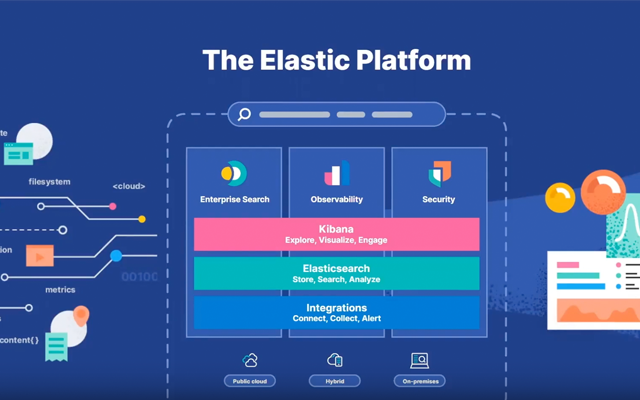
    Elastic's Search AI Platform combines world-class search with generative AI to address your search, observability, and security challenges.

    Elasticsearch - the industry's most used vector database with an extensive catalog of GenAI integrations - gives you unified access to ML models, connectors, and frameworks through a simple API call. Manage data across sources with enterprise-grade security and build scalable, high-performance apps that keep pace with evolving business needs. Elasticsearch gives you a decade-long head start with a flexible Search AI toolkit and total provisioning flexibility-fully managed on serverless, in the cloud, or on your own infrastructure.

    Elastic Observability resolves problems faster with open-source, AI-powered observability without limits, that is accurate, proactive and efficient. Get comprehensive visibility into your AWS and hybrid environment through 400+ integrations including Bedrock, CloudWatch, CloudTrail, EC2, Firehose, S3, and more. Achieve interoperability with an open and extensible, OpenTelemetry (OTel) native solution, with enterprise-grade support.

    Elastic Security modernizes SecOps with AI-driven security analytics, the future of SIEM. Powered by Elastic's Search AI Platform, its unprecedented speed and scalability equips practitioners to analyze and act across the attack surface, raising team productivity and reducing risk. Elastic's groundbreaking AI and automation features solve real-world challenges. SOC leaders choose Elastic Security when they need an open and scalable solution ready to run on AWS.

    Take advantage of Elastic Cloud Serverless - the fastest way to start and scale security, observability, and search solutions without managing infrastructure. Built on the industry-first Search AI Lake architecture, it combines vast storage, compute, low-latency querying, and advanced AI capabilities to deliver uncompromising speed and scale. Users can choose from Elastic Cloud Hosted and Elastic Cloud Serverless during deployment. Try the new Serverless calculator for price estimates: https://console.qa.cld.elstc.co/pricing/serverless .

    Ready to see for yourself? Sign into your AWS account, click on the "View Purchase Options" button at the top of this page, and start using a single deployment and three projects of Elastic Cloud for the first 7 days, free!

    Highlights

    • Search: Build innovative GenAI, RAG, and semantic search experiences with Elasticsearch, the leading vector database.
    • Security: Modernize SecOps (SIEM, endpoint security, cyber security) with AI-driven security analytics powered by Elastic's Search AI Platform.
    • Observability: Use open, extensible, full-stack observability with natively integrated OpenTelemetry for Application Performance Monitoring (APM) of logs, traces, and other metrics.

    Details

    Delivery method

    Deployed on AWS
    New

    Introducing multi-product solutions

    You can now purchase comprehensive solutions tailored to use cases and industries.

    Multi-product solutions

    Features and programs

    Vendor Insights

     Info
    Skip the manual risk assessment. Get verified and regularly updated security info on this product with Vendor Insights.
    Security credentials achieved
    (2)

    Buyer guide

    Gain valuable insights from real users who purchased this product, powered by PeerSpot.

    Buyer guide

    Financing for AWS Marketplace purchases

    AWS Marketplace now accepts line of credit payments through the PNC Vendor Finance program. This program is available to select AWS customers in the US, excluding NV, NC, ND, TN, & VT.

    Financing for AWS Marketplace purchases

    AWS PrivateLink

    Get next level security. Connect VPCs and AWS services without exposing data to the internet.

    Pricing

    Free trial

    Try this product free according to the free trial terms set by the vendor.

    Elastic Cloud (Elasticsearch Service)

     Info
    Pricing is based on actual usage, with charges varying according to how much you consume. Subscriptions have no end date and may be canceled any time.
    Additional AWS infrastructure costs may apply. Use the AWS Pricing Calculator  to estimate your infrastructure costs.

    Usage costs (1)

     Info
    Dimension
    Cost/unit
    Elastic Consumption Unit
    $0.001

    AI Insights

     Info

    Dimensions summary

    Elastic Consumption Units (ECUs) represent Elastic's unified pricing metric across both their Cloud Hosted and Serverless offerings on AWS Marketplace. For Cloud Hosted solutions, ECUs measure infrastructure resource consumption, while for Serverless offerings, ECUs quantify usage based on service-specific dimensions such as data ingestion, search operations, and security events. This flexible pricing model ensures customers pay only for their actual usage, whether they're using Elasticsearch, Observability, Security, or other Elastic services.

    Top-of-mind questions for buyers like you

    What is an Elastic Consumption Unit (ECU) and how is it calculated?
    An ECU is Elastic's standardized billing metric that measures usage across their services. For Cloud Hosted deployments, ECUs are calculated based on infrastructure resources consumed, while for Serverless offerings, ECUs are determined by service-specific usage metrics like data ingestion volume, search operations, or security events processed.
    How can I estimate my monthly costs for Elastic Cloud on AWS Marketplace?
    Elastic provides a pricing calculator on their website where you can estimate costs based on your expected usage patterns. You can also monitor your actual ECU consumption through Elastic Cloud console's usage monitoring features, and the billing interface shows detailed breakdowns of usage by service and deployment.
    Does Elastic Cloud on AWS Marketplace require any upfront commitment?
    Elastic Cloud on AWS Marketplace follows a pay-as-you-go model with no upfront commitments required. However, customers can opt for annual commitments to receive volume discounts, and usage is billed monthly through your AWS account based on actual consumption of ECUs.

    Vendor refund policy

    See EULA above.

    Custom pricing options

    Request a private offer to receive a custom quote.

    How can we make this page better?

    We'd like to hear your feedback and ideas on how to improve this page.
    We'd like to hear your feedback and ideas on how to improve this page.

    Legal

    Vendor terms and conditions

    Upon subscribing to this product, you must acknowledge and agree to the terms and conditions outlined in the vendor's End User License Agreement (EULA) .

    Content disclaimer

    Vendors are responsible for their product descriptions and other product content. AWS does not warrant that vendors' product descriptions or other product content are accurate, complete, reliable, current, or error-free.

    Usage information

     Info

    Delivery details

    Software as a Service (SaaS)

    SaaS delivers cloud-based software applications directly to customers over the internet. You can access these applications through a subscription model. You will pay recurring monthly usage fees through your AWS bill, while AWS handles deployment and infrastructure management, ensuring scalability, reliability, and seamless integration with other AWS services.

    Support

    Vendor support

    Visit Elastic Support (https://www.elastic.co/support ) for more information. If you are a customer, go to the Elastic Support Hub (http://support.elastic.co ) to raise a case.

    AWS infrastructure support

    AWS Support is a one-on-one, fast-response support channel that is staffed 24x7x365 with experienced and technical support engineers. The service helps customers of all sizes and technical abilities to successfully utilize the products and features provided by Amazon Web Services.

    Product comparison

     Info
    Updated weekly

    Accolades

     Info
    Top
    10
    In Databases & Analytics Platforms
    Top
    10
    In Generative AI, Log Analysis
    Top
    100
    In Log Analysis, Analytic Platforms

    Customer reviews

     Info
    Sentiment is AI generated from actual customer reviews on AWS and G2
    Reviews
    Functionality
    Ease of use
    Customer service
    Cost effectiveness
    2 reviews
    Insufficient data
    Insufficient data
    Insufficient data
    Insufficient data
    Positive reviews
    Mixed reviews
    Negative reviews

    Overview

     Info
    AI generated from product descriptions
    Vector Database Capabilities
    Advanced vector database supporting generative AI, semantic search, and machine learning model integration through a unified API
    Observability Integration
    Comprehensive visibility across AWS and hybrid environments with over 400 integrations including CloudWatch, CloudTrail, EC2, and S3
    Security Analytics
    AI-driven security analytics platform with advanced threat detection and cross-attack surface analysis capabilities
    Open Telemetry Support
    Native OpenTelemetry (OTel) compatibility for extensible and interoperable performance monitoring
    Multi-Infrastructure Deployment
    Flexible deployment options across serverless, cloud, and on-premises infrastructure with enterprise-grade security
    Artificial Intelligence Analysis
    Advanced AI agent that automates data analysis and accelerates root cause investigations
    Telemetry Data Integration
    Supports unified visibility across logs, metrics, and traces for cloud-native environments
    Anomaly Detection
    Real-time system anomaly detection to proactively prevent potential incidents
    OpenTelemetry Compatibility
    Flexible integration with OpenTelemetry standards for standardized observability pipelines
    Multi-Architecture Support
    Native compatibility with modern architectures including Kubernetes, serverless, and microservices environments
    Data Indexing
    Indexes Amazon S3 data without transformation, optimizing for data size and performance
    Analytics Integration
    Supports search, SQL, and machine learning workloads through open APIs with tools like Kibana, Elastic, Looker, and Tableau
    Cloud Storage Transformation
    Converts Amazon S3 into a hot analytical data lake with native indexing capabilities
    Data Access Architecture
    Enables direct data access without complex data pipelines, parsing, or schema changes
    Scalability Mechanism
    Provides infinite scale data analysis with no administrative overhead for re-indexing, sharding, or load balancing

    Security credentials

     Info
    Validated by AWS Marketplace
    FedRAMP
    GDPR
    HIPAA
    ISO/IEC 27001
    PCI DSS
    SOC 2 Type 2
    -
    -
    -
    -
    -
    -
    -
    No security profile

    Contract

     Info
    Standard contract
    No
    No
    No

    Customer reviews

    Ratings and reviews

     Info
    4.3
    323 ratings
    5 star
    4 star
    3 star
    2 star
    1 star
    36%
    50%
    11%
    2%
    2%
    43 AWS reviews
    |
    280 external reviews
    External reviews are from G2  and PeerSpot .
    Emil K.

    Exceptional Documentation, Intuitive UI, and Outstanding Support

    Reviewed on Dec 08, 2025
    Review provided by G2
    What do you like best about the product?
    I appreciate the wealth of documentation available which makes it easier to implement solutions on my own. Their AI support option is also excellent and often times I do not need to lodge an actual support ticket as the AI recommendations resolved my issue.

    The Elastic UI is clean, intuitive and easy to use.

    I find the Dev Tools feature within Elastic to be really useful as most of my updates are managed via Elastic ESQL queries which enables me to keep my changes within a repo.

    Setting up SSO via Entra ID was fairly straightforward. Ability to do the role mappings for entra ID groups to Elastic roles was easy to do via the UI and also via the Dev Tools.

    Customer Support is excellent, they work with you until your issue is fully resolved.

    Elastic can be purchased via AWS Marketplace which makes billing seamless if you already work with AWS.

    The Elastic infrastructure is scalable and also very resilient. If there are load issues or similar it will scale up as required.

    The web crawler is also easy to configure and update directly in the UI.

    Search queries are very performant (milliseconds usually).
    What do you dislike about the product?
    From version 9, you will have to self-manage your Elastic web crawlers which shifts the responsibility on the customer to provide the infrastructure that supports the web crawler. There is also the ongoing support that comes with this too.

    It seems to be focusing more and more on its core feature i.e. search, and not so much on user-focused features tailored for non-tech business users.

    It would be great if it provided repos with examples to easily setup frontend search experiences.
    What problems is the product solving and how is that benefiting you?
    Provides a highly performant search solution (used by our frontend search experiences) and enables our customers to find exactly what they need.

    Our search is now returning more relevant results and an enhanced user experience. Ultimately leads to more business from clients.
    Higher Education

    High-Performance, Flexible Search with Powerful Cloud Features

    Reviewed on Dec 08, 2025
    Review provided by G2
    What do you like best about the product?
    Elasticsearch is a mature product with high levels of performance and is very flexible. Able to be tuned for accurate lexical search but also supports semantic search. The Cloud Hosted option helps to abstract away much of the infrastructure management and also has an AutoOps feature to help identify issues with indexing or searching. Working closely with their knowledgeable product team helped to ease the implementation of our solution.
    What do you dislike about the product?
    It is very API-centric and although the Kibana interface continues to improve and add management features, if the end-users are not very technical, they will need support with some of the management activities. Also, if you need to use the Elasticsearch web crawlers for indexing web pages, version 9 moves away from the Elastic-hosted crawlers so you will need to run the Open Crawler on your own infrastructure.
    What problems is the product solving and how is that benefiting you?
    Elasticsearch is helping to improve our Enterprise search both in relevancy and performance when compared to our previous solution. It also moves us into a direction of semantic and AI experiences.
    Computer Software

    Unmatched Speed and Real-Time Analytics with Elasticsearch

    Reviewed on Dec 04, 2025
    Review provided by G2
    What do you like best about the product?
    The "best strength" of Elasticsearch is its ability to perform lightning-fast, near real-time search and analytics across massive, diverse datasets
    What do you dislike about the product?
    A bit harder to manage self hosted installation.
    What problems is the product solving and how is that benefiting you?
    Helping us store events data at scale.
    Muhammad Mustafa Amin Shah

    Full-text search has transformed log analysis and real-time views for faster issue resolution

    Reviewed on Dec 04, 2025
    Review from a verified AWS customer

    What is our primary use case?

    Elastic Search  is normally used for full-text search where users are fully depending on it for searching by name, address, and similar fields, and we need to gather the data with good latency, so we normally prefer to save it into Elastic Search .

    Elastic Search helps for full-text search because we normally use it for keywords and other related terms. If there are keywords and searching requires numerical data and other elements, we prefer RDS  over Elastic Search. However, if it is regarding complete full-text search in which we cannot do any kind of indexing and it is very difficult, we prefer Elastic Search.

    What is most valuable?

    Elastic Search's best feature is that it is very convenient to save, plus it is schema-less, and it has very good latency and also provides us with different kinds of mapping strategies which allow us to optimize many things according to the data structure. It is a kind of non-structured and structured mix.

    The benefits of using Elastic Search are mostly for two to three purposes. For logging, it is very easy to insert the logs into Elastic Search and start searching it using Kibana, and it is very easy to make visualizations over there. The second purpose is that we normally use it for views. If we have searches from the front end with a specific structure, it is very difficult to go to a different table and create the query in the database, so what we do is sync our database with Elastic Search and create a view on Elastic Search which will give us the result in milliseconds. This is how we are currently utilizing it.

    What needs improvement?

    Elastic Search has an annoying limitation regarding page size. It has a specific limit for queries on Elastic Search, and the default is ten thousand, and we can increase it. However, after increasing, it can slow down. Pagination in Elastic Search is very slow. If I need to parse one million records saved into Elastic Search, it becomes a nightmare because I need to do the pagination, and it is very problematic in that regard. I need to do ten thousand records and then go to the other page, and when going to the other page, it currently takes much more time than RDS . For specific cases, if we need to do full-text search and searching for one specific word returns less than ten thousand records, it works very well. However, if we go for more than ten thousand, then it creates an issue for us.

    For how long have I used the solution?

    It has been almost ten years since using Elastic Search.

    What do I think about the stability of the solution?

    Elastic Search receives a stability rating of nine point five; we rely on it.

    What do I think about the scalability of the solution?

    In terms of scalability, for the managed service, it is very easy, but the scalability aspect is a bit tricky. Scaling up Elastic Search cluster requires a bit of time because of sharding and replications. It takes more time since it needs to copy the data. For example, if we are working on three nodes and adding a fourth node, the synchronization process will occur in the middle, and the higher the data volume, the more time it will take. Scalability is rated around five to six.

    How are customer service and support?

    Elastic Search's technical support receives a rating of eight.

    How would you rate customer service and support?

    Positive

    Which solution did I use previously and why did I switch?

    Previously, we were using the AWS  managed cluster on the cloud, but now we have created our own. On the same cloud, we have deployed Elastic Search on our EC2  machines, so it is self-managed, not on-premises. On-premises would be if we give the solution to somebody else, then we would deploy Elastic Search on their specific cloud, but we only deployed it in our system.

    How was the initial setup?

    I did not go into the deployment part of Elastic Search because it is a DevOps matter. I was in a senior role, so I sent the request and we received it. Normally, it does not take a lot of time if the person deploying is capable; it does not take more than two to three days.

    What about the implementation team?

    We have about twelve specialists.

    What was our ROI?

    I cannot say much about the return on investment part because we normally work on a use case basis. If we find some kind of issue in our database which is currently taking time, then we need to shift to Elastic Search, and it will start giving us very good results. On the cost-saving side, rather than increasing our RDS from a less cluster to a big cluster, we can create a specific separate Elastic Search cluster, and it saves our money on our basic structure while giving us much more performance. I cannot tell you the exact part on how much was saved with the calculation, and I cannot provide the numbers, but it saves our time on the debugging side. Using it on the logs and creating visualization is very convenient for us to search the log and identify the issue as soon as possible. This saves our time, saves the customer's time, and decreases the time to respond and resolve.

    What's my experience with pricing, setup cost, and licensing?

    Elastic Search's pricing totally depends on the server. Managed services from AWS  are used, and we have worked on a self-managed Elastic Search cluster. On the AWS side, it is very expensive because they charge based on query basis or how much data is transferred in and out, making it very expensive. That is why we moved to the self-managed option. In self-managed, it is very easy to handle. We do not think any kind of proprietary Elastic Search solution is required.

    Which other solutions did I evaluate?

    Elastic Cloud Serverless  is not being used. The GenAI experience with features like agentic AI, RAG, or semantic search is not currently being used. Kafka Streams is being used for log instigation.

    What other advice do I have?

    Elastic Search has many pros, but the cons of it are that it is not structured, and we need to put all the things which are connected into a single index. Therefore, we cannot use it for our base structure database, but we always use it for supporting purposes.

    While part of Careem, there were hundreds of thousands of customers using the solution, and now that in a startup, the clients are no more than one hundred.

    Elastic Search requires maintenance. We need to keep it updated because Elastic Search normally launches new features and versions on both Kibana and Elastic Search sides. We need to keep updated ourselves, and also, we need to do maintenance on the storage side. Normally, we use Elastic Search for timelines, saving all the data from beginning to end, so normally the storage maintenance is an issue, and we have to increase the storage time to time, but it is not related to Elastic Search; it is actually related to our use case.

    There is lots of support for Elastic Search in different tools like Logstash  which we normally use for integration, and there are other tools as well, but it is very easy and not a big issue for that.

    The Attack Discovery feature is not being used. Big businesses cannot survive without Elastic Search because it gives us very good visibility and handles our use cases very well. If we need something reliable and trustworthy as a solution, then Elastic Search is the way to go, as it is an integral part of big solutions. The overall review rating for Elastic Search is eight point five.

    Igor Khokhriakov

    Centralized analytics and monitoring have supported reliable insights for scientific web services

    Reviewed on Dec 03, 2025
    Review provided by PeerSpot

    What is our primary use case?

    Elastic Search  is being used for two main streams. The first use case is an internal analytics engine for the usage of our services, which is based on logs that are put into Elastic Search  indices to build different dashboards for key executives and developers, providing different levels of information. This is essential to provide statistics as a nonprofit organization funded by the Department of Energy and other infrastructures. The main focus is on web access to the Protein Data Bank for scientists and bioinformaticians with a publicly facing service supporting roughly 15 million users and an average load of about 700 requests per second. There are two data centers, one on the East Coast  and another on the West Coast , serving the same publicly available interface. Logs from these services are monitored and collected, then put into Elastic Search database, from which different perspectives are provided for various stakeholders.

    The second use case is Application Performance Monitoring , where Elastic Search APM  stack is used to collect application performance metrics, primarily using Java, with a bit of Python and Node.js. Those three agents are used along with a standard infrastructure with the APM server that injects everything into Elastic Search indices for incident recovery and finding performance bottlenecks. As a nonprofit organization using an open-source license, there have been no problems with Elastic Search trying to change the license. Since no commercialized services are provided, the organization remains out of the scope of those issues and continues using open-source licenses. Recently, integration with an internal Keycloak instance was completed to provide role-based access to the Kibana application, which was a bit non-trivial but was managed successfully.

    What is most valuable?

    The experience regarding the relevancy of search results with Elastic Search is positive since it is used for providing search features for end-users of the Protein Data Bank. During ETL processes, information is collected from different data sources regarding proteins, including protein annotations and structures, which are transformed and loaded into the internal database. One part of that database includes Elastic Search indices. For search capabilities, full-text search is performed for end-users while keyword search is used primarily for internal needs, and no complaints have been heard about either of them.

    The main focus is on web access to the Protein Data Bank for scientists and bioinformaticians with a publicly facing service supporting roughly 15 million users and an average load of about 700 requests per second. There are two data centers, one on the East Coast and another on the West Coast, serving the same publicly available interface. Logs from these services are monitored and collected, then put into Elastic Search database, from which different perspectives are provided for various stakeholders.

    What needs improvement?

    There are a couple of improvements that would definitely save a lot of headache with Elastic Search. One would be if the open-source license had multi-user access to Kibana, which exists in the paid tier license. There were also some difficult times with parallel and point-in-time interfaces, so better documentation could help, particularly more example-driven content. The provided documentation tends to have some common words but lacks real applicable examples. More specific examples, such as step-by-step guides, would be ideal. From a technical point of view, there are no significant issues recalled as Elastic Search has been absolutely awesome for this use case and covers 100% of the needs.

    For how long have I used the solution?

    Elastic Search has been used for roughly five years.

    What do I think about the stability of the solution?

    Regarding stability, there are no major incidents recalled with Elastic Search. While not part of the DevOps team, nothing significant has ever exploded to affect the whole organization. If there were issues, the DevOps team was able to fix them quickly. Problems have been experienced with other services, but not with Elastic Search.

    What do I think about the scalability of the solution?

    In terms of scalability, Elastic Search is good for this organization. A standard three-node setup with multiple clusters is being used for internal and public needs, resulting in six nodes per database across the data centers.

    How are customer service and support?

    There has been no need to contact customer tech support for Elastic Search. It has been sufficient to visit conferences such as SCALE in Southern California Linux Expo, where Elastic Search has a booth to talk to their staff. The organization often relies on publicly available resources such as forums, issue trackers, and an internal knowledge base. Once, a ticket was created on GitHub  concerning a Kibana issue with Application Performance Monitoring, but that was essentially the extent of it. The main sources of support are conferences and documentation.

    How would you rate customer service and support?

    Which other solutions did I evaluate?

    No alternatives similar to Elastic Search have been tried. When the discussion about the open-source license started, OpenSearch  was briefly looked into but the decision was made not to move forward because the organization felt secure in the current usage without commercialization.

    What other advice do I have?

    Elastic Search AI, RAG, and semantic search have not been explored yet, as those opportunities for integration are just beginning. Nothing has been moved into production, so further comment cannot be provided. Standard agents from APM are being used to collect telemetry metrics and send them to the Application Performance Monitoring server, which are different from AI agents.

    It is difficult to assess the current pricing of Elastic Search because the organization is in a specific niche as a nonprofit organization. On-premises instances are managed internally and a managed option had been considered, but that did not pass the board's approval. Open-source licensing has worked well, and there have been no ceilings where payment options for additional services needed to be considered. Users are quite satisfied with what is provided, and the organization is happy with what is received from Elastic Search.

    The learning curve with Elastic Search was very easy. With a strong background in Java and software engineering, and having a great tutor in the organization who showed how to perform ingestion pipelines with Grok  and how to use the development environment within the stack, the process was manageable. While it might be difficult for middle-level and junior developers, having someone experienced in the organization makes it manageable to share knowledge.

    Elastic Search mostly requires maintenance during upgrades. While it is running in standard mode, there have been no major incidents from memory, so it has quite low maintenance requirements.

    There are no official partnerships with Elastic Search; the organization is just a user utilizing the open-source license. Overall, this review has been given a rating of 9.

    View all reviews