
Sold by: Elastic
Deployed on AWS
Free Trial
Address your search, observability, and security challenges with Elastic's leading vector database, built for generative AI, semantic search, and hundreds of open, pre-built integrations. Start a 7-day free trial and harness the power of your data, securely and at scale.
4.4
Overview
Video
Video 1

Video
Product video
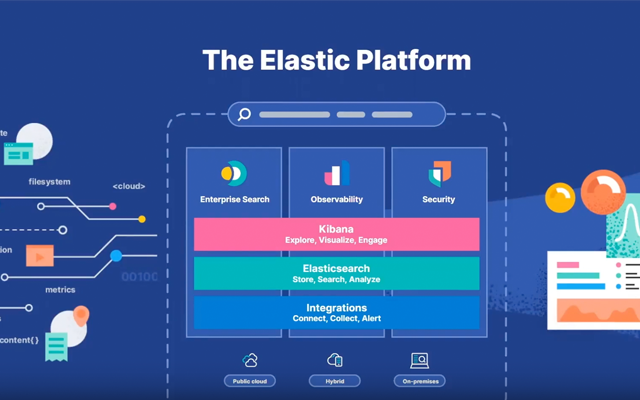
The Elasticsearch Platform combines world-class search with agentic AI to address your search, observability, and security challenges.
Elasticsearch's vector database enables developers to deliver high precision semantic search and scalable AI experiences faster at lower costs. Elastic ensures peak performance even as customers scale across thousands of customers and petabytes of data, while consumption-based pricing and resource optimization tools help keep overall costs low.
Elasticsearch is the most complete data platform for context engineering and AI - the most deeply integrated open stack combining a scalable distributed data store, vector database, hybrid search, Jina AI models, and an agent builder. It simplifies building best-in-class search, AI, and agentic applications that deliver trusted answers at scale, regardless of where data resides. Built for production, Elasticsearch scales predictably with near real-time performance and cost efficiency on-prem or in the cloud, powering even the most demanding workloads.
Elastic Observability - SRE teams shouldn't have to choose between metrics coverage and cost control. Elasticsearch, the best-in-class for logs, is now best-in-class for metrics, too - with a single backend and a single query language. Native Prometheus and PromQL support means existing queries, dashboards, and alert rules work without modification. Elastic delivers more metrics, longer retention, lower cost - no retraining budget, no surprise bill at the end of the month.
Elastic is the agentic security operations platform built to secure, not to tax. A platform where autonomous agents handle the full lifecycle from ingestion through response, and your analysts handle judgment, verification and approval. When your adversary moves at machine speed, every vendor-imposed barrier is a gap the adversary exploits. Elastic removes them all. No taxes on your time, wallet, trust, or attention.
Take advantage of Elastic Cloud Serverless - the fastest way to start and scale security, observability, and search solutions without managing infrastructure. Built on the industry-first Search AI Lake architecture, it combines vast storage, compute, low-latency querying, and advanced AI capabilities to deliver uncompromising speed and scale. Users can choose from Elastic Cloud Hosted and Elastic Cloud Serverless during deployment. Try the new Serverless calculator for price estimates.
Ready to see for yourself? Sign into your AWS account, click on the "View Purchase Options" button at the top of this page, and start using a single deployment and three projects of Elastic Cloud for the first 7 days, free!
Highlights
- Search: Build innovative agentic AI, GenAI, and semantic search experiences with Elasticsearch, the leading vector database.
- Security: Modernize SecOps (SIEM, endpoint security, cyber security) with AI-driven security analytics powered by the Elasticsearch Platform.
- Observability: Use open, extensible, full-stack observability with natively integrated OpenTelemetry for Application Performance Monitoring (APM) of logs, traces, and metrics.
Details
Sold by
Delivery method
Deployed on AWS
New
Introducing multi-product solutions
You can now purchase comprehensive solutions tailored to use cases and industries.

Features and programs
Buyer guide
Gain valuable insights from real users who purchased this product, powered by PeerSpot.

Financing for AWS Marketplace purchases
AWS Marketplace now accepts line of credit payments through the PNC Vendor Finance program. This program is available to select AWS customers in the US, excluding NV, NC, ND, TN, & VT.

AWS PrivateLink
Get next level security. Connect VPCs and AWS services without exposing data to the internet.
Pricing
Free trial
Try this product free according to the free trial terms set by the vendor.
Pricing is based on actual usage, with charges varying according to how much you consume. Subscriptions have no end date and may be canceled any time.
Additional AWS infrastructure costs may apply. Use the AWS Pricing Calculator to estimate your infrastructure costs.
Dimension | Cost/unit |
|---|---|
Elastic Consumption Unit | $0.001 |
Dimensions summary
This listing uses one pricing dimension: the Elastic Consumption Unit (ECU). You pay based on usage rather than a fixed subscription or seat count. The service tracks the resources and features you actually consume and converts them into ECUs. As your search, observability, and security workloads grow, your ECU usage rises, so your cost scales with demand. You can start and scale in minutes, then draw the charges against your existing AWS spend through one consolidated bill. There are no long-term commitments; you pay only for what you use.
Top-of-mind questions for buyers
An Elastic Consumption Unit measures the resources and features you actually use. It converts compute, storage, and platform capabilities into a single billing metric. You are not charged per user or per seat. Instead, your usage across search, observability, and security workloads is tracked and metered as consumption units.
The service scales resources up and down based on your search and indexing load. When your workload grows, your consumption unit usage rises and your bill increases. When load drops, usage falls and cost decreases. You pay only for what you consume, with no fixed minimum tied to a set capacity.
Search, observability, and security workloads all consume units. Data volume and query activity are the main drivers. Storing more data and running heavier search or indexing loads increases consumption. Data tiers and searchable snapshots let cold data stay affordable, which can lower the units used for infrequently accessed data.
www.elastic.co+3
Helpful?
Vendor refund policy
See EULA above.
Custom pricing options
Request a private offer to receive a custom quote.

Legal
Vendor terms and conditions
Upon subscribing to this product, you must acknowledge and agree to the terms and conditions outlined in the vendor's End User License Agreement (EULA) .
Content disclaimer
Vendors are responsible for their product descriptions and other product content. AWS does not warrant that vendors' product descriptions or other product content are accurate, complete, reliable, current, or error-free.
Delivery details
Software as a Service (SaaS)
SaaS delivers cloud-based software applications directly to customers over the internet. You can access these applications through a subscription model. You will pay recurring monthly usage fees through your AWS bill, while AWS handles deployment and infrastructure management, ensuring scalability, reliability, and seamless integration with other AWS services.
Resources
Vendor resources
Support
Vendor support
Visit Elastic Support (https://www.elastic.co/support ) for more information. If you are a customer, go to the Elastic Support Hub (http://support.elastic.co ) to raise a case.
AWS infrastructure support
AWS Support is a one-on-one, fast-response support channel that is staffed 24x7x365 with experienced and technical support engineers. The service helps customers of all sizes and technical abilities to successfully utilize the products and features provided by Amazon Web Services.
Updated weekly
By Elastic

By ChaosSearch, Inc.
Top
10
In Databases & Analytics Platforms
Top
10
In Generative AI, Log Analysis
Top
100
In Log Analysis, Analytic Platforms
Sentiment is AI generated from actual customer reviews on AWS and G2
Functionality
Ease of use
Customer service
Cost effectiveness
Positive reviews
Mixed reviews
Negative reviews
AI generated from product descriptions
Vector Database Capabilities
Enables semantic search and AI experiences with vector database functionality optimized for generative AI applications and high-precision retrieval at scale.
Hybrid Search Architecture
Combines vector search with traditional search capabilities and integrates Jina AI models for comprehensive search and AI application development.
Observability Platform
Provides unified backend for logs, metrics, and traces with native Prometheus and PromQL support, allowing existing queries and dashboards to function without modification.
Distributed Data Store
Scalable distributed architecture supporting petabyte-scale data processing with near real-time performance and predictable scaling across thousands of deployments.
OpenTelemetry Integration
Natively integrated OpenTelemetry support for full-stack observability including Application Performance Monitoring (APM) across logs, traces, and metrics collection.
AI-Powered Root Cause Analysis
Automatically investigates alerts and pinpoints root causes with 5x faster analysis capabilities.
Natural Language Query Interface
Enables querying of observability data using conversational natural language to identify issues and receive actionable insights.
Real-Time Anomaly Detection
Detects system anomalies in real-time to prevent incidents before they impact users.
OpenTelemetry Integration
Supports standardized OpenTelemetry integration for unified data collection across logs, metrics, and traces in cloud-native environments including Kubernetes, serverless, and microservices.
Multi-Tiered Storage Architecture
Implements multi-tiered storage and data management capabilities to optimize telemetry data retention and reduce storage costs.
Data Indexing Without Transformation
Indexes Amazon S3 data as-is without requiring parsing, schema changes, or data transformation while optimizing for both data size and performance.
SQL and Search Query Support
Enables search, SQL, and machine learning workloads on indexed S3 data with support for open APIs and native integrations with analytics tools such as Kibana, Elastic, Looker, and Tableau.
Unlimited Data Retention
Provides unlimited data retention capability enabling analysis across any time horizon without data retention limits or need for managing trade-offs between cluster resources and retained data volume.
Fully Managed Service Architecture
Operates as a fully managed service eliminating administrative overhead including re-indexing, sharding, load balancing, and management of compute and storage resources.
Direct Amazon S3 Integration
Directly indexes data stored in Amazon S3 without requiring data movement, complex data pipelines, or intermediate storage systems.
Standard contract
No
No
No
Customer reviews
Sandeep B.
Powerful Search, Observability, and Security Analytics at Scale
Reviewed on Oct 01, 2026
Review provided by G2
What do you like best about the product?
Elasticsearch offers a strong combination of intuitive UI/UX, powerful integrations, and reliable performance at scale. Its real-time search, observability, security capabilities, and AI-driven features provide significant value for enterprise use cases. The platform integrates well with existing technology stacks, while onboarding and documentation make adoption relatively straightforward. Pricing can be a consideration for large-scale deployments, but the overall ROI is strong when consolidating search, observability, and security analytics on one platform.
What do you dislike about the product?
Elasticsearch is powerful, but the platform can have a learning curve, especially around advanced configuration, query optimization, and managing large deployments. The UI can feel complex for new users, and pricing may become a concern as data volume and retention requirements increase. Some integrations require additional configuration, while AI capabilities are promising but may need further refinement and tuning for specific enterprise use cases. More streamlined onboarding and simpler cost management would further improve the overall experience.
What problems is the product solving and how is that benefiting you?
Elasticsearch helps solve challenges around real-time search, centralized log analysis, observability, and security monitoring across large volumes of data. It provides fast data search and analytics, integrates with multiple data sources, and supports AI-driven insights, helping teams troubleshoot issues faster and improve operational visibility. A concrete benefit is reducing incident investigation time—for example, teams can search and correlate application logs, metrics, and events in one place instead of manually checking multiple systems, helping resolve production issues more quickly. Its scalability also supports growing data and enterprise workloads.
Nikhil D.
Review
Reviewed on Sep 30, 2026
Review provided by G2
What do you like best about the product?
It uses Apache Lucene under the hood to build inverted indexes, which lets it run full-text searches across massive datasets almost instantly. Queries are matched in milliseconds.
What do you dislike about the product?
Complex Cluster Management: Although scaling out is theoretically straightforward, operating and maintaining a large, highly available cluster in production is notoriously complex. Handling problems such as network partitions, split-brain scenarios, shard rebalancing, and persistent “red” cluster statuses often demands dedicated DevOps or Site Reliability Engineering (SRE) expertise to diagnose and resolve effectively.
What problems is the product solving and how is that benefiting you?
Elasticsearch addresses the challenge of searching and analyzing massive amounts of unstructured data quickly. With fast, relevant text and vector search, it helps systems—and AIs—retrieve accurate information in milliseconds.
Aakash D.
Powerful and Scalable Search Platform
Reviewed on Sep 30, 2026
Review provided by G2
What do you like best about the product?
Fast and accurate search capabilities, making it easy to index and retrieve large volume.
What do you dislike about the product?
The initial setup and configuration can be complex
What problems is the product solving and how is that benefiting you?
Elasticsearch helps us centralize logs and more
Sourav S.
Review of ElasticSearch
Reviewed on Sep 30, 2026
Review provided by G2
What do you like best about the product?
Helps me leverage my data for search applications and handle the data for various agents deployed across the platforms for various usecases
What do you dislike about the product?
Currently I don't see any downsides with this
Phani S.
Elasticsearch is fast and scalable
Reviewed on Sep 30, 2026
Review provided by G2
What do you like best about the product?
Setting up an Elasticsearch cluster isn’t too hectic.
What do you dislike about the product?
Configuration in elastic.yml varies depending on the version type.
What problems is the product solving and how is that benefiting you?
I’m using it for both caching and logging services.