Sold by: IBM Software
Deployed on AWS
IBM Maximo Application Suite is an integrated asset lifecycle management solution that enables you to remotely maintain and manage all your assets throughout their entire lifecycle, from acquisition to disposal, all within a single unified platform. It uses AI, IoT and analytics to optimize equipment performance, extend asset lifecycles and reduce operational downtime and costs.
4.4
Overview
Video
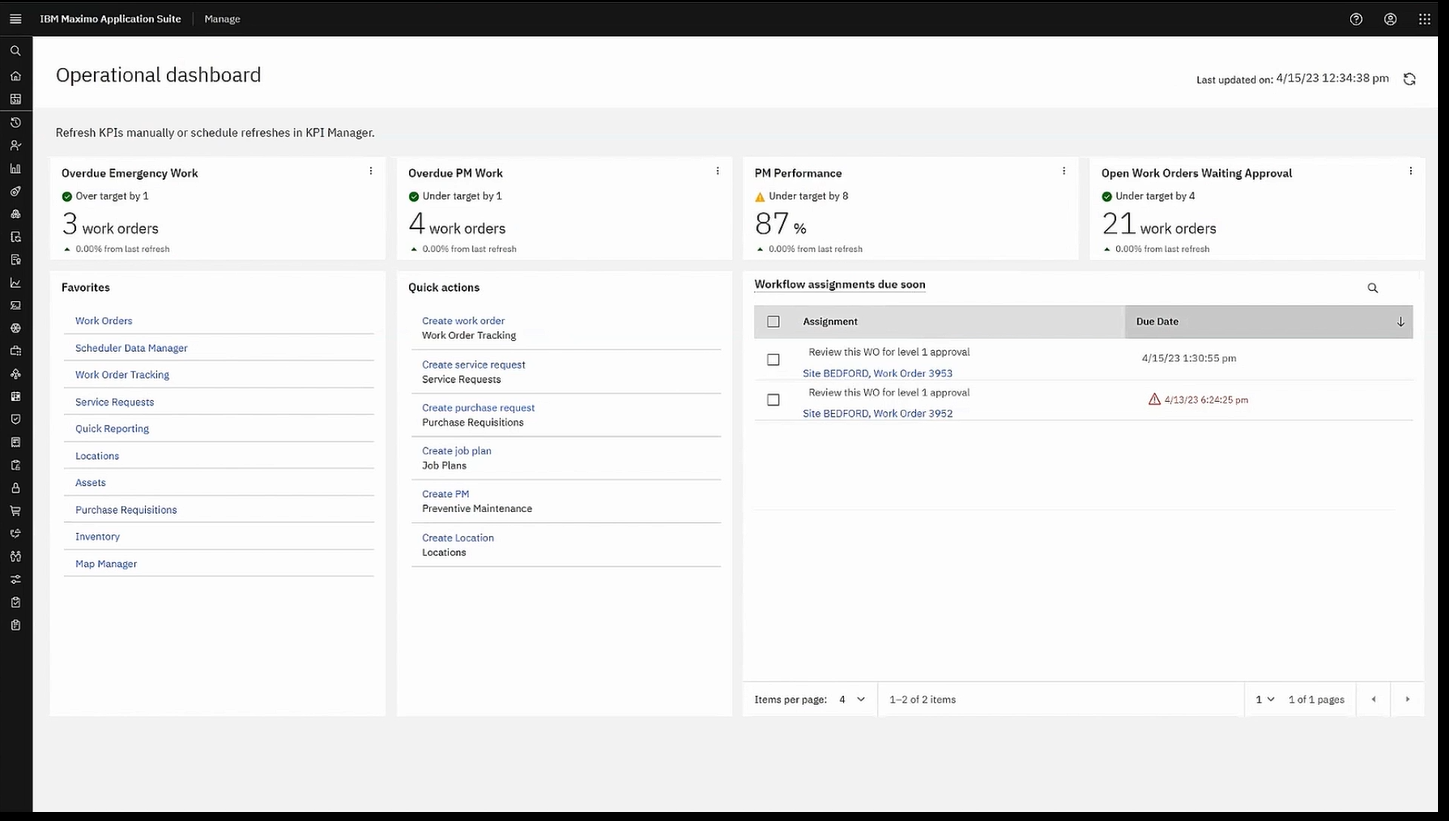
IBM Maximo Maintenance Management
Video
IBM Maximo Health of Your Assets

Video
IBM Maximo Mobile
Video
IBM Maximo Reliability Strategies
IBM Maximo Application Suite is an integrated asset lifecycle management solution that brings together best-in-class capabilities for asset and facilities management. Built on a remarkable 40-year legacy, IBM Maximo helps organizations reduce unplanned downtime, optimize performance and health of the assets, extending average lifespan of the assets and enhance technician productivity with a fully mobile EAM and AI powered applications.
With IBM Maximo Maintenance Essentials, you gain an easy-to-adopt solution with key Enterprise Asset Management (EAM), Reliability-Centered Maintenance (RCM), and mobility capabilities in an entry-level configuration. Backed by reliable enterprise-grade security and quality, it enables rapid deployment to drive immediate value.
You can also purchase Maximo IT to help your organization break down silos between IT and OT, visualize service relationships and asset lifecycles in one place, and combine ITSM and ITAM with intelligent automation to reduce downtime, optimize asset utilization and accelerate issue resolution.
Subscriptions for IBM Maximo, bundled with AWS infrastructure, are purchased as a single unit, simplifying procurement and management. These subscriptions include comprehensive services such as installation, configuration, platform upgrades, application operations, database management, infrastructure and network management, and Red Hat OpenShift application installation, ensuring a seamless and fully managed experience.
Want to explore Maximo Application Suite before making a purchase? Try it for free https://www.ibm.com/account/reg/us-en/signup?formid=urx-52271
Try the interactive Maximo IT demo at https://www.ibm.com/resources/digital-innovation/demos/IBM-Maximo-IT-demo .
To explore the full scope of MAS SaaS Essentials, Standard, and Premium Edition configurations, offering additional capacity, applications, and operational options, use the "Request private offer" button, or alternatively, contact your IBM Sales Representative, email AssetManagement@ibm.com , or visit https://www.ibm.com/products/maximo/pricing .
Highlights
- IBM Maximo Application Suite is an integrated asset lifecycle management solution that enables you to remotely maintain and manage all your assets throughout their entire lifecycle, from acquisition to disposal, all within a single unified platform.
- Leverage Maximo Maintenance Essentials to reduce unplanned downtime, optimize asset performance, extend asset lifespan, and enhance technician productivity.
- Combine IBM Maximo software and AWS infrastructure into a single subscription, simplifying procurement and management. This easy-to-adopt solution features key EAM, RCM, and mobility capabilities, backed by enterprise-grade security. Enjoy fully managed services, including installation, upgrades, database management, and Red Hat OpenShift support, for fast deployment and immediate value.
Details
New
Introducing multi-product solutions
You can now purchase comprehensive solutions tailored to use cases and industries.

Features and programs
Buyer guide
Gain valuable insights from real users who purchased this product, powered by PeerSpot.

Financing for AWS Marketplace purchases
AWS Marketplace now accepts line of credit payments through the PNC Vendor Finance program. This program is available to select AWS customers in the US, excluding NV, NC, ND, TN, & VT.

Pricing
Pricing is based on the duration and terms of your contract with the vendor, and additional usage. You pay upfront or in installments according to your contract terms with the vendor. This entitles you to a specified quantity of use for the contract duration. Usage-based pricing is in effect for overages or additional usage not covered in the contract. These charges are applied on top of the contract price. If you choose not to renew or replace your contract before the contract end date, access to your entitlements will expire.
Additional AWS infrastructure costs may apply. Use the AWS Pricing Calculator to estimate your infrastructure costs.
Dimension | Description | Cost/12 months | Overage cost |
|---|---|---|---|
Maintenance Essentials | Manage, Health, Mobile & Reliability Stgys: 1 Prod Env, Up To 25 Users | $39,782.00 | |
Maint Esstls w/NPrd | Manage, Health, Mobile & Rblty Stgys: 1 Prod, 1 Non-Prod, Up To 25 Usr | $52,512.00 | |
Maint Esstls w/Usrs | Manage, Health, Mobile & Rblty Stgys: 1 Prod Env, Up To 50 Users | $53,042.00 | |
Maint Esstls w/NPrd+Usrs | Manage, Health, Mobile & Rblty Stgys: 1 Prod, 1 Non-Prod, Up To 50 Usr | $65,773.00 | |
Maximo IT | Maximo IT, 1 Prod Env, Up To 25 Users | $92,156.00 |
Dimension | Cost/unit |
|---|---|
Maximo IT, 1 Prod Env, Up To 25 Users - Overage | $39.75 |
Dimensions summary
This listing offers two product families as separate contract options. The Maintenance Essentials dimensions bundle Manage, Health, Mobile and Reliability Strategies for one production environment. You scale these along two axes: user capacity (up to 25 or up to 50 users) and whether a non-production environment is included. This creates four Maintenance Essentials variants covering those combinations. The Maximo IT dimension is a distinct option covering one production environment for up to 25 users. A matching Maximo IT overage dimension bills usage that exceeds that included capacity. Choose the variant that fits your environment count and user count.
Top-of-mind questions for buyers
Each unit entitles you to one production environment for the named applications. User limits set the number of people who can access that environment. Maintenance Essentials variants cap access at up to 25 or up to 50 users. Maximo IT caps access at up to 25 users. Non-production variants add a separate testing environment.
A separate Maximo IT overage dimension bills the usage that goes beyond your included one production environment and up to 25 users. The base dimension covers the committed capacity. The overage dimension charges for consumption above that level, so cost rises with additional usage rather than requiring a new contract.
Maintenance Essentials variants bundle Manage, Health, Mobile and Reliability Strategies applications. Maximo IT is a distinct option focused on IT asset and service management. They bill as separate contract dimensions, so you choose based on whether you manage physical assets or IT assets and services.
www.ibm.com
Helpful?
Vendor refund policy
All orders are non-cancellable and all fees and other amounts paid are non-refundable.
Custom pricing options
Request a private offer to receive a custom quote.

Legal
Vendor terms and conditions
Upon subscribing to this product, you must acknowledge and agree to the terms and conditions outlined in the vendor's End User License Agreement (EULA) .
Content disclaimer
Vendors are responsible for their product descriptions and other product content. AWS does not warrant that vendors' product descriptions or other product content are accurate, complete, reliable, current, or error-free.
Delivery details
Software as a Service (SaaS)
SaaS delivers cloud-based software applications directly to customers over the internet. You can access these applications through a subscription model. You will pay recurring monthly usage fees through your AWS bill, while AWS handles deployment and infrastructure management, ensuring scalability, reliability, and seamless integration with other AWS services.
Resources
Vendor resources
Support
Vendor support
IBM Maximo Application Suite clients receive Base Support, which provides strong business protection for production workloads. Alternately, clients who require higher tier, priority care to respond to critical support requests and drive faster case resolution subscribe to Advanced Support, which enables clients to tailor support to their business and environment.
Compare support options at https://www.ibm.com/support/pages/ibm-advanced-support-offering .
View the Maximo Application Suite as a Service Getting Started Guide at https://www.ibm.com/docs/mas-saas and view product documentation at https://www.ibm.com/docs/en/mas .
Click Get support to access product resources, open a case or chat with a support representative.
AWS infrastructure support
AWS Support is a one-on-one, fast-response support channel that is staffed 24x7x365 with experienced and technical support engineers. The service helps customers of all sizes and technical abilities to successfully utilize the products and features provided by Amazon Web Services.
Updated weekly


Top
100
In Industrial IoT
Top
25
In Automotive
Top
10
In Anomaly Detection-Structured, Data Analysis, Industrial IoT
Sentiment is AI generated from actual customer reviews on AWS and G2
Functionality
Ease of use
Customer service
Cost effectiveness
Positive reviews
Mixed reviews
Negative reviews
AI generated from product descriptions
Asset Lifecycle Management
Integrated platform enabling remote maintenance and management of assets throughout their entire lifecycle, from acquisition to disposal within a single unified system.
Enterprise Asset Management and Reliability-Centered Maintenance
Entry-level configuration incorporating key EAM and RCM capabilities for asset and facilities management with enterprise-grade security.
AI and IoT Integration
Utilizes artificial intelligence and Internet of Things technologies to optimize equipment performance, extend asset lifecycles, and reduce operational downtime.
Mobile Enterprise Asset Management
Fully mobile EAM application enabling technician productivity and remote asset management capabilities.
Managed Cloud Infrastructure
Bundled subscription combining IBM Maximo software with AWS infrastructure, including installation, configuration, platform upgrades, database management, and Red Hat OpenShift application installation as fully managed services.
Asset Lifecycle Management
Complete asset lifecycle management from cradle to grave with capabilities to track assets, build hierarchies, manage groups, and access detailed asset data with risk calculations.
Work Order Management
Automated work order capture, scheduling, and labor cost tracking with field data collection, compliance management through built-in calibration, and resource allocation optimization.
Inventory and Procurement Management
Requisition, quote, and purchase order management with streamlined procurement processes and stock level optimization to minimize working capital.
Mobile Access and Field Operations
Mobile device access for asset data updates, work request submission, real-time notifications, and on-site inspection capabilities.
Enterprise Integration and AI Assistance
Native enterprise integrations including Workday ERP and SAP Certified S/4HANA integration, combined with embedded AI assistant for prescriptive actions, data classification, and workflow automation.
Predictive Maintenance Analytics
AI/ML self-supervised deep-learning algorithms that eliminate the need for historical data to predict asset failures and maintenance requirements
Emission Detection and Localization
Methane and VOCs leak detection with pinpoint leak location identification and duration/timing analysis for industrial equipment including slop tanks, reciprocating compressors, and pressure relief valves
Automated Data Acquisition and Processing
Fully automated end-to-end platform that remotely monitors and manages asset performance 24/7 with integrated sensor data collection and analytics without requiring domain experts or new IT infrastructure
Plug-and-Play Deployment
Self-managed, zero-friction deployment approach designed for non-experts that includes sensors and end-to-end APM software in a single SaaS subscription with zero capital expenditure requirements
Scalable Multi-Asset Monitoring
Infinitely scalable solution capable of monitoring unconnected and connected industrial assets across multiple sites and manufacturing equipment from a centralized platform
Standard contract
No
No
Customer reviews
Sayed S.
All-in-One Platform for Managing the Entire Asset Lifecycle
Reviewed on Oct 01, 2026
Review provided by G2
What do you like best about the product?
One platform that I use to manage the entire asset lifecycle and track performance through it.
What do you dislike about the product?
Cost-wise, especially in the Middle East region and it works better for mega projects.
What problems is the product solving and how is that benefiting you?
Managing Asset life cycle through one platform.
Alaa B.
Robust Asset Management with a Steep Learning Curve
Reviewed on Sep 22, 2026
Review provided by G2
What do you like best about the product?
I like IBM Maximo Application Suite for its very rich functional coverage, including work orders, preventive maintenance, inventory, and the asset register all in one platform. The configurability without code using Application Designer, automation scripts, and workflows is another standout, as it makes it easy to adapt the software without needing Java customizations. The modern, containerized architecture on OpenShift is quite appealing, especially with the availability of the wider suite, like Monitor, Health, and Predict, for further expansion when needed. I particularly value the automation scripts because they allow me to update business rules quickly, which simplifies migrations and upgrades. Additionally, the Application Designer is a crucial tool for tailoring screens to fit customer needs, and the MAS operators on OpenShift make installation and updates more standardized and repeatable.
What do you dislike about the product?
Installation and upgrades with IBM Maximo Application Suite require solid OpenShift expertise, which many Maximo teams do not have yet, so there's a real learning curve. The AppPoints licensing model also takes time to understand and size correctly. Additionally, the documentation can be scattered across versions, making troubleshooting slower. The initial setup is demanding, as it involves having a properly sized OpenShift cluster, storage, certificates, and the MAS operators before you can even configure Manage. For a team without container experience, the first installation requires real effort and planning.
What problems is the product solving and how is that benefiting you?
IBM Maximo Application Suite centralizes maintenance activities like work orders and inventory, solving the end of support for Maximo 7.6. It offers a modern, containerized architecture and a clear upgrade path, easing migrations and upgrades, especially with automation scripts and Application Designer.
Banking
Flexible, Integrated Platform That Delivers
Reviewed on Sep 07, 2026
Review provided by G2
What do you like best about the product?
A single integrated platform that provides flexibility
What do you dislike about the product?
Maximo is a robust platform, but improvements in usability, configuration simplicity, and self-service reporting would make it easier to adopt and use efficiently.
What problems is the product solving and how is that benefiting you?
Before using IBM Maximo Application Suite, we struggled with fragmented maintenance information, manual tracking, and limited visibility into equipment history and outstanding work. This made it harder to prioritize maintenance activities and increased the risk of reactive repairs.
With Maximo, we can manage work orders, preventive maintenance schedules, asset history, and maintenance planning in one centralized system. This has made it much easier to track equipment performance, assign and prioritize work, and ensure preventive maintenance activities are completed on time.
The biggest benefit has been improved visibility and control over our maintenance operations. We have reduced reliance on spreadsheets and manual processes, improved communication between maintenance teams, and can make better decisions using consistent asset and maintenance data. It has also helped us shift from a more reactive approach toward proactive maintenance, which supports better equipment reliability and reduces avoidable downtime.
With Maximo, we can manage work orders, preventive maintenance schedules, asset history, and maintenance planning in one centralized system. This has made it much easier to track equipment performance, assign and prioritize work, and ensure preventive maintenance activities are completed on time.
The biggest benefit has been improved visibility and control over our maintenance operations. We have reduced reliance on spreadsheets and manual processes, improved communication between maintenance teams, and can make better decisions using consistent asset and maintenance data. It has also helped us shift from a more reactive approach toward proactive maintenance, which supports better equipment reliability and reduces avoidable downtime.
ghribi h.
A Unified Platform for Smarter Asset Lifecycle Management
Reviewed on Jul 13, 2026
Review provided by G2
What do you like best about the product?
modular structure: you can activate only the applications you need, which helps both with flexibility and cost Powerful asset and work management: it's very detailed and customizable, which is great for managing complex maintenance processes. Integration with AI and IoT: the predict and monitor modules bring a lot of added value by helping anticipate issues before they happens
What do you dislike about the product?
Initial setup and configuration can be complex, especially for new users or organizations without strong Maximo expertise. Licensing and entitlements aren't always intuitive. It takes time to fully understand how to manage access across the different applications Performance can vary depending on the deployment model. Cloud versions occasionally experience lags, especially when dealing with large data volumes.
What problems is the product solving and how is that benefiting you?
IBM Maximo Application Suite is helping us address fragmented asset information, reactive maintenance, unplanned downtime, and inefficient planning and field-service processes. It gives us a more integrated view of assets, work orders, maintenance history, condition, risk, and resources. This helps us move toward preventive and condition-based maintenance, prioritise the right work, assign resources more effectively, and make better-informed asset investment decisions
reviewer2871036
Custom asset workflows have automated reporting and archival and now improve maintenance decisions
Reviewed on Jul 13, 2026
Review from a verified AWS customer
What is our primary use case?
I generally develop IBM Maximo reports and then some automation scripts, and the major thing which I have customized is an application called Archival solution that we created from scratch.
For the Archival solution, databases are becoming increasingly huge. Whenever you want to search any record, it takes more time because of the huge transaction loads stored in the databases. I created an application which archives older records that have not been used for an extended period, and you can retrieve them back whenever an audit occurs in your company. This reduces the load on your query and databases, then gives you faster results. I was using an action launch point script for that.
Coming back to reports, I created some custom reports for a client based on his requirements, mostly list-based reports and graphical reports that come from the database by taking data from the database.
I have worked on automation scripts, including several automation scripts on object launch point, attribute launch point, and action launch point, and I have created some IBM Maximo reports.
For me, the entire IBM Maximo application itself is a standalone thing which helps business maintain their asset records, and then determine which assets need to be repaired and create PM work orders based on frequencies, meter readings, or time-based factors. These are very useful for the customer. IBM Maximo is doing a great job.
IBM Maximo is a vast tool. I still need to learn a lot, and we have many things that MIF thing and MAS 9.0, the latest version, which we need to look upon. It has great insights upon it. I am still learning the things, which I love. I believe it is very useful for the users and then it makes our daily life easy.
What is most valuable?
We got a great revenue by using IBM Maximo. We have increased our revenue by 30%. We have automated some things and made the client save around 60% of his work. We have automated several things which have increased the client revenue as well because there is no need to spend on manual tasks.
What needs improvement?
There are a couple of places, but I cannot name one at this moment because I still need to go through more of the things because there is a lot which I need to learn.
Something related to the customizations. Whenever we are trying to create an application from scratch, there are some things we cannot do, or when we are trying to reuse XML things. We need to duplicate the same logic and then keep it with a new ID and then use it. Instead, if it makes us to use it in a reusable manner, it would be useful for us from the XML lookup or from menu.xml. In that way, if it helps us to use reusable things, it is very helpful.
For how long have I used the solution?
In IT industry it is around four years, but in Cognizant, it is around three months.
Which solution did I use previously and why did I switch?
When I compare it with Hexagon, IBM Maximo has more number of customizations and more number of things which we cannot do in Hexagon, but we can achieve it in IBM Maximo. I feel IBM Maximo has vast features and then customization options. That is the reason I have given it a rating of eight.
What other advice do I have?
AI Watson, I have not used it so far. I was trying to use it, but there are some challenges for me to use it. I will definitely try to give a review once I use it.
I have not used it so far. I will be using it in a couple of days.
A partner can convince the client by saying it makes your daily life easy by updating your asset values or oil and gas things. It will be very easy for them to use IBM Maximo. They make their lives easier by not needing to see the asset daily based on the meter reader frequency. Work orders will be auto-generated and then assigned to the technician so that it will be easy for them to do audits or do the maintenance work. It makes their life easy and then increases their business.
I would rate this product an eight out of ten.