
Sold by: Accenture
Drive delivery of impactful digital assistant experiences with Accenture experts and a leading AI platform.
3.9
Overview
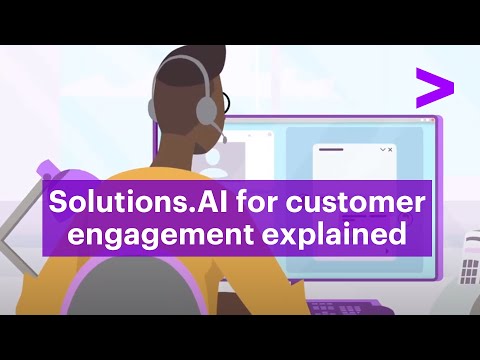
Conversational AI Platform is a middleware solution for building and operating robust and comprehensive conversational AI solutions including virtual agents, chatbots, voice assistants and more. It allows organizations to fully manage their conversational AI solution, with modules for RPA design, execution, analytics, and agent escalation.
CAIP also provides more than 80 industry cartridges out of the box that can be easily tailored to organizational requirements. There is also a growing ecosystem of available integrations with customer relationship management software and other enterprise programs and platforms.
CAIP eases call volume surges, reduces wait times, improves customer satisfaction, and facilitates continuous improvements through AI and machine learning. In the middle of the response to the COVID 19 pandemic, customers have proven that frequent changes to existing and new conversations can be rapidly deployed to address an organic landscape of interactions and needs.
CAIP is purpose built to handle complex ecosystems, bringing together legacy, hybrid and cloud elements to create one cohesive solution that not only improves the user experience, but delivers real business value.
Accenture uses AWS Private Offers to extend custom pricing, scope, EULA, and contract terms. Please contact us at AWS-Marketplace@accenture.com for more information about Private Offers.
Highlights
- Accelerate pace to deliver: Pre-built technical integrations and reusable components speed up implementation.
- Operate and scale a living system: Centralizing creation, publishing and maintenance of experiences helps organizations to break traditional silos and enables scaling across the enterprise.
- Leverage pre-built conversational experiences: Access an ever-evolving library of use cases created by designers and subject matter experts that are ready to be rolled out for a range of industries.
Details
Sold by
Delivery method
Deployed on AWS
New
Introducing multi-product solutions
You can now purchase comprehensive solutions tailored to use cases and industries.

Features and programs
Buyer guide
Gain valuable insights from real users who purchased this product, powered by PeerSpot.

Financing for AWS Marketplace purchases
AWS Marketplace now accepts line of credit payments through the PNC Vendor Finance program. This program is available to select AWS customers in the US, excluding NV, NC, ND, TN, & VT.

Pricing
Pricing is based on the duration and terms of your contract with the vendor. This entitles you to a specified quantity of use for the contract duration. If you choose not to renew or replace your contract before it ends, access to these entitlements will expire.
Additional AWS infrastructure costs may apply. Use the AWS Pricing Calculator to estimate your infrastructure costs.
Dimension | Description | Cost/12 months |
|---|---|---|
Premium Tier | Premium CAIP offering with Voice and Text Channels | $180,000.00 |
Vendor refund policy
Contact seller for refund policy

Legal
Vendor terms and conditions
Upon subscribing to this product, you must acknowledge and agree to the terms and conditions outlined in the vendor's End User License Agreement (EULA) .
Content disclaimer
Vendors are responsible for their product descriptions and other product content. AWS does not warrant that vendors' product descriptions or other product content are accurate, complete, reliable, current, or error-free.
Delivery details
Software as a Service (SaaS)
SaaS delivers cloud-based software applications directly to customers over the internet. You can access these applications through a subscription model. You will pay recurring monthly usage fees through your AWS bill, while AWS handles deployment and infrastructure management, ensuring scalability, reliability, and seamless integration with other AWS services.
Support
Vendor support
AWS infrastructure support
AWS Support is a one-on-one, fast-response support channel that is staffed 24x7x365 with experienced and technical support engineers. The service helps customers of all sizes and technical abilities to successfully utilize the products and features provided by Amazon Web Services.
Updated weekly

Top
25
In Speech Recognition
Top
10
In Contact Center, CRM, IT Business Management
Top
10
In Contact Center
Sentiment is AI generated from actual customer reviews on AWS and G2
Functionality
Ease of use
Customer service
Cost effectiveness
Positive reviews
Mixed reviews
Negative reviews
AI generated from product descriptions
Robotic Process Automation Integration
RPA design and execution modules integrated within the platform for automating business processes
Pre-built Industry Templates
Over 80 industry cartridges available out of the box that can be customized for organizational requirements
Multi-channel Conversational Interfaces
Support for building virtual agents, chatbots, voice assistants and other conversational AI solutions
Analytics and Performance Monitoring
Analytics modules for tracking and monitoring conversational AI solution performance and interactions
Enterprise System Integration
Ecosystem of integrations with customer relationship management software and other enterprise platforms to connect legacy, hybrid and cloud elements
Omnichannel Communication
Support across multiple channels including web, social, mobile, voice, messaging, live chat, and email with seamless conversational experiences
Knowledge Management
Comprehensive knowledge graph and knowledge management system integrated with AI agents for enhanced resolution capabilities
Pre-built and Custom Integrations
Over 1,200+ pre-built integrations available on the Zendesk App Marketplace with tools to create and configure custom experiences
Real-time Reporting and Analytics
Real-time reporting and analytics capabilities with measurement and insights for monitoring service performance and outcomes
Omnichannel Engagement Platform
Native applications for omnichannel engagement with voice engagement, studio and routing capabilities across multiple communication channels
AI-Powered Automation
AI-powered virtual agents, agent assist, AI trainer, and generative AI solutions integrated into the platform for automating customer service processes
Unified Analytics and Reporting
Common data model with live and explore standard reporting, dashboards, and customer experience analytics accessible through a single pane of glass interface
Workforce and Knowledge Management
Workforce engagement management, employee collaboration tools, and knowledge management capabilities with over 70 out-of-the-box integrations
Enterprise Integration Architecture
Open platform architecture with shared services, API access, studio functions, and pre-built connectors enabling rapid deployment and reduced time-to-value
Standard contract
No
No
No
Customer reviews
Areeb Memon
Customer support has become faster and more efficient with automated query handling
Reviewed on Sep 18, 2026
Review provided by PeerSpot
What is our primary use case?
My main use case for Accenture Conversational AI is for quickly finding helpful information, answering queries, and improving customer interaction.
A specific example of how I use Accenture Conversational AI to answer queries or improve customer interaction is utilizing it for AI-powered customer support, answering FAQs, automating queries, and handling routine conversations.
Regarding my main use case, I also use Accenture Conversational AI for assisting customers.
What is most valuable?
The best features Accenture Conversational AI offers include a smooth and user-friendly conversation experience, which is helpful for quickly finding information and answering queries.
The smooth and user-friendly conversation experience of Accenture Conversational AI is attributed to it being an AI-powered chat that answers customer questions conversationally, utilizing natural language understanding, automated customer support, omnichannel support, and personalized responses.
Accenture Conversational AI has positively impacted my organization by reducing operational costs through automating repetitive customer queries, improving customer experience with faster 24/7 responses, providing faster resolution through instant access to information, and increasing employee productivity along with many other improvements.
I experienced a cost reduction of between 10% to 40% in overall expenses after using Accenture Conversational AI, and one Accenture customer transformation example reported a 30% decrease in OPEX. Since it is related to management, I cannot provide this explanation in greater percentage detail.
What needs improvement?
Accenture Conversational AI can be improved by enhancing response accuracy, better understanding of complex questions, addressing issues we face sometimes, and improving context retention with more seamless human handoff to transfer complex cases to an agent with the full conversational context. Additionally, improvements are needed for domain knowledge, faster response, reduced latency for real-time customer interaction, and better integration for CRM, ERP, knowledge bases, and internal applications.
For how long have I used the solution?
I have been using Accenture Conversational AI for my client for the last one year.
What do I think about the stability of the solution?
Accenture Conversational AI is stable, and I find it to be better.
What do I think about the scalability of the solution?
The scalability of Accenture Conversational AI is good.
How are customer service and support?
The customer support provided by Accenture Conversational AI is good.
I would rate the customer support of Accenture Conversational AI an eight on a scale of one to ten.
Which solution did I use previously and why did I switch?
I have not previously used a different solution before Accenture Conversational AI.
How was the initial setup?
Accenture Conversational AI is deployed in my organization as an enterprise AI solution that integrates with existing business applications and customer service channels.
What about the implementation team?
We use Microsoft Azure as the cloud provider for this deployment.
What was our ROI?
I have seen a return on investment through the solution demonstrating ROI via reduced manual effort, faster customer service, and quicker response times, which led to a reduction in human costs and positive outcomes based on what I saw from the team and management.
What's my experience with pricing, setup cost, and licensing?
Regarding pricing, setup cost, and licensing of Accenture Conversational AI, I am not involved in that aspect as a developer because the BA and the entire team manage those details.
Which other solutions did I evaluate?
I did not evaluate other options before choosing Accenture Conversational AI.
What other advice do I have?
My advice for others considering using Accenture Conversational AI is to evaluate everything properly before starting development or finalizing this AI tool, as my scenario did not allow for a thorough check due to a managerial decision. If your organization and product are small, it is crucial to manage costs and other factors properly before finalizing and starting the development. I have provided an overall review rating of eight for this product.
Chandler Elmore, MBA
Virtual assistants have transformed employee self-service but still need better intent handling
Reviewed on Sep 10, 2026
Review from a verified AWS customer
What is our primary use case?
My main use case for Accenture Conversational AI is as an enterprise tool that I use to build virtual assistants and chatbots that handle client and employee interactions.
A specific example of how I use it for client or employee interactions involves it having a bank of information that we use for employees to reference and chat with, allowing them to pull up information at any time on each of their personal machines.
I decided to implement a virtual assistant for employee support rather than sticking with traditional methods like email or phone support because it was more efficient, allowing employees to self-serve and get the information they needed quickly and efficiently.
What is most valuable?
The best features Accenture Conversational AI offers include consistently delivering great, steady, reliable data and predictable responses for automated tasks, as well as having instant support that provides 24/7 immediate answers to repetitive queries, which frees up our human employees.
The reliability and instant support of Accenture Conversational AI have made a difference in my day-to-day work by freeing up our human agents, enabling them to focus on more interactive tasks that are more complex instead of repeating the same things over the course of the day, adding more engagement to their day and making their work more inviting.
One feature that stands out and I appreciate is that this platform is versatile, definitely streamlining diverse workflows ranging from what we have on our client end for engagement all the way to data troubleshooting.
What needs improvement?
I think Accenture Conversational AI can be improved by addressing query misclassification, as there are unclear user phrasings that can sometimes cause the system to misclassify intents unless you spend a lot of time extensively optimizing it.
For how long have I used the solution?
I have been using Accenture Conversational AI for three years.
What do I think about the stability of the solution?
Accenture Conversational AI is stable and very reliable.
What do I think about the scalability of the solution?
Accenture Conversational AI's scalability is very good.
How are customer service and support?
The customer support is exceptional.
Which solution did I use previously and why did I switch?
I did not previously use a different solution before Accenture Conversational AI.
How was the initial setup?
I did not purchase Accenture Conversational AI through the AWS marketplace.
What about the implementation team?
My company does not have a business relationship with this vendor other than being a customer.
What was our ROI?
From automating those HR processes, we were able to save 200 man-hours over the course of a year, which translated into about $10,000 worth of savings.
We have seen a return on investment, as we were able to save 200 employee hours over the course of our time using this platform.
What's my experience with pricing, setup cost, and licensing?
I have no issues with pricing, setup cost, and licensing.
Which other solutions did I evaluate?
Before choosing Accenture Conversational AI, we did not evaluate other options.
What other advice do I have?
My advice to others looking into using Accenture Conversational AI is to look at different products that might be more suitable and smaller for your needs, as you need to be an enterprise-level company to make the most out of this platform. I would rate this product a 6.
Which deployment model are you using for this solution?
Hybrid Cloud
If public cloud, private cloud, or hybrid cloud, which cloud provider do you use?
Amazon Web Services (AWS)
Esse Wognin
Automation has transformed support workflows and delivers faster, accurate customer resolutions
Reviewed on Aug 26, 2026
Review provided by PeerSpot
What is our primary use case?
I used Accenture Conversational AI to resolve customer inquiries. I started working as a customer support analyst focused on ticketing, and the tool was used to resolve customer inquiries, automatic tier one support triage, and streamlining conversational routing to human agents. It was used to filter the queries we were getting on a daily basis so that queries were filtered and sent to the direct competent agent.
We received different types of queries, and Accenture Conversational AI helped with customer inquiries and ticket triage. There were queries regarding onboarding, transaction status checks, and transactions paused for admin action. The AI was configured to answer most of these queries that did not need human intervention. For queries requiring us to react, such as onboarding requests, the AI was escalating to the direct support agent. Most of our queries regarding transaction status checks, to understand if a transaction was completed or failed, were resolved quickly by this conversational AI tool.
What is most valuable?
Accenture Conversational AI helped my team reduce the volume of tickets we were getting on a daily basis in a significant way. It sped up our resolution time because most of the issues that a human being could take five minutes to handle were tackled in seconds by the AI tool. After resolving issues, there was a data analysis component where the AI could tell us the number of requests we were getting on a daily basis and what we could do to prevent those requests from coming. In addition to supporting with real-time answers, the AI was providing us with real-time data.
The best features Accenture Conversational AI offers in my experience include support with responding to agents and pre-built industry configuration. Based on our industry, the AI was configured to use the language we use on a daily basis. Someone working in FinTech cannot have the same language as someone working in the hotel industry.
Accenture Conversational AI provided conversation analytics and insights on a weekly or daily basis. The tool could provide us with a detailed dashboard tracking containment rates, drop-off points, and intent accuracy. It clarified customer sentiment so that we could build on different features we were already offering to our partners. We were also able to create features based on different needs picked up by the AI from the conversations it was receiving. Robotic Process Automation was very important when it came to native connectors that let conversational flow trigger back-end transactional workflows like balance lookup, account update, ticket generation, and transaction status checks. Those were very impactful features for my team.
Accenture Conversational AI impacted my organization positively by revealing that the volume of queries a human agent was treating had reduced considerably and customer satisfaction rate had increased because the AI was able to provide direct responses to our partners. The majority of our requests were about transaction posts for admin action and transaction status checks. When the AI started answering these tickets, it was a great period for us because the AI was working toward providing timely responses and our partners were happy. We have also seen an increase in client acquisition because of word-of-mouth marketing. When people are satisfied with your product and support team, they tell others that the company is doing well because responses are always available. The good thing about Accenture Conversational AI is that it works even at night and on weekends, every day and any time. This has impacted our organization by revealing that we are closer to our partners.
What needs improvement?
Nothing is perfect in the world, and I can say Accenture Conversational AI can be improved in several areas. The initial setup, training dataset integration, and edge case prompt tuning have a steep learning curve. Custom integration with proprietary back-end database APIs often requires significant technical support. The tool is better suited for medium to enterprise support teams dealing with high volume inquiries. I would like them to increase the customization capabilities so that the tool can grow as our company grows.
For how long have I used the solution?
I have used it for three years.
What do I think about the stability of the solution?
I have not experienced any downtime with Accenture Conversational AI. Maintenance was planned ahead, and we were informed before it occurred. Every software undergoes maintenance, and this was frequent, but we were informed of the specific period when maintenance would happen. We informed our partners in advance. I did not experience any downtime where the software went down without being informed. The tool is very stable.
What do I think about the scalability of the solution?
Accenture Conversational AI is very scalable. We have grown with it, and we noticed a huge number of partner acquisitions. I give scalability a rating of eight out of ten.
How are customer service and support?
Accenture Conversational AI's customer service team has been helpful at some points, but I give them a rating of seven out of ten because there were times we contacted them and did not get a response, even though we were in need of quick support.
Which solution did I use previously and why did I switch?
I have used Sprout Social and Zendesk AI before Accenture Conversational AI. I am not the one who makes decisions regarding tool selection. Even though I am a senior partner support analyst, I work under a partner support manager and head of support. The decisions are taken at a higher level. Even though we provided essential feedback on the necessity of having such an application, those making the decision ultimately chose to switch to Zendesk. After using Accenture Conversational AI for three years, I believe the organization has enjoyed the benefits. We have switched to Zendesk, so perhaps Zendesk has more to offer, but I cannot confirm this because I was not part of the decision-making process.
How was the initial setup?
The major challenges we faced were when we started using the application. There was significant miscommunication regarding training and user onboarding for my team, as we were the ones handling integration. We did not receive very strong support when it came to integration. The learning material was not complete. It took considerable time for us to fully integrate and use the application at its full capacity. I recommend that they work well on the onboarding process, as this will make the application shine and encourage people to subscribe to the tool.
What was our ROI?
For the thousands of customers we were handling on a daily basis, Accenture Conversational AI was great because my team was not large. When it comes to money saved, I can mention customer retention at the high percentage I provided. Regarding efficiency, we were able to handle all customer queries without neglecting or ignoring any partners. Premium and default partners were all served well. The return on investment is great and very positive.
What's my experience with pricing, setup cost, and licensing?
I was not involved in the acquisition process. The acquisition occurred before I joined the company, but they acquired it for my customer support team. Regarding pricing, I believe it is very good because the company supported the pricing throughout the three years we used it. The setup was complicated when it came to human configuration, but the licensing was good and the pricing was correct. Given our budget, it was good, which is why I think we used it for three years.
What other advice do I have?
I did track specific metrics and numbers regarding reduction in ticket volume, faster response times, and improvements in customer satisfaction. Accenture Conversational AI has improved our customer satisfaction rate by ninety-five percent because we are always resolving queries. What pushes partners to give complete satisfaction is when their request is resolved in less than five minutes, in less than ten minutes, or is resolved within the SLA resolution time. It also sped up our full-time resolution time. Even new employees who were not well-trained were supported by this tool. We noticed a ninety-five percent improvement in customer satisfaction rate. We achieved one hundred percent full-time resolution for the different queries the AI was able to resolve, such as transaction status checks and many other issues we trained the AI to tackle. We also noticed a very significant improvement in customer retention because all our customers remained with us because they were happy. I can say we achieved one hundred percent retention rate. Regarding acquisition, I cannot quantify this because I do not work in the commercial department, but I have seen many partners joining because of word-of-mouth marketing.
I give Accenture Conversational AI a rating of eight out of ten because the application is very good and is working for the services we are paying for. I removed two points because there is room for improvement regarding onboarding and personalization of the application according to the company. They have much to do in these areas. Additionally, we are not getting timely support from them, which is something they should consider.
Accenture Conversational AI's AI capabilities demonstrate strong governance and security, and we felt safe using the application. We did not notice any data breach or privacy issues. I could give a rating of nine out of ten for security because the application is very good, only authorized people can access it, and we did not experience any security concerns. During these three years, we felt confident about privacy and compliance, ensuring that everything was secure.
I will give Accenture Conversational AI a rating of ten out of ten for accuracy because the responses are very accurate. All responses given to customers are correct and are based on our FAQ. I have never seen Accenture Conversational AI providing a wrong response. Accuracy is one hundred percent.
For a company that does not have a large budget for designing support based on AI, Accenture Conversational AI is an excellent choice because it is very affordable and very reliable. I do not see any downtime, and even though the support team is not fast when we need them, they are there and eventually solve the issues raised. It is very good and integrates well. For a company with five hundred members and one thousand customers, this tool would be a very good fit. What I can tell them is that Accenture Conversational AI is trainable and easy to train so that it can adapt to your industry terms and language and react as needed. My overall rating for Accenture Conversational AI is eight out of ten.
Bethanywalstad Wallister
AI agents have transformed team collaboration and have supported multilingual project delivery
Reviewed on Aug 25, 2026
Review provided by PeerSpot
What is our primary use case?
Accenture Conversational AI has helped us to build AI-enabled microservices that help us to frame Spring Boot and write backend microservices that we could direct into Accenture Conversational AI model endpoints. I usually use it for coding the REST and GraphQL APIs that conversational agents dynamically invoke to retrieve customer data or execute backend actions.
What is most valuable?
The distiller framework is an advanced agent layer allowing my team to build autonomous agents capable of multi-agent collaboration, complex reasoning, and structured multi-turn goal execution. The distiller framework has allowed my team to build a reliable agent communication system that enhances efficient collaboration between our team and in our enterprise. When we are brainstorming on a project, we usually use this platform to collaborate efficiently and reason as a team.
There is also the hybrid intent approach that blends the trained intent path for strict business compliance with generative AI to provide natural language flexibility such that this hybrid intent approach provides clear and efficient natural language flexibility that can convert any language to a user-based language. It is very efficient when it comes to language orchestration.
Our communication infrastructure has developed in such a way that when we have data, it can be easily analyzed using the AI system to get the most useful information that helps us to implement most projects in our enterprise. The system has been reliable and most of the services it has provided have performed quite well. I do not think there are any downtimes or any bottleneck that prevents us from working efficiently while we use this platform.
What needs improvement?
I could pick the integration side and documentation.
For how long have I used the solution?
I have been using Accenture Conversational AI for the last one year.
What do I think about the stability of the solution?
I can give it a rating of nine out of ten because the performance has been efficient and most of the projects that we have implemented using Accenture Conversational AI have come out successfully.
What do I think about the scalability of the solution?
Accenture Conversational AI is highly scalable because it has been evaluating inbound queries and outbound responses for potential policy violations and harmful content. It ensures that the content that is converged through the system does not violate conversational policy and adheres to set enterprise policies.
How are customer service and support?
The customer support was reliable. They have been very responsive. When we call them, they are active twenty-four seven. They respond very fast and they do not keep us queuing. They are very friendly and professional.
Which solution did I use previously and why did I switch?
We settled on Accenture Conversational AI for the first time because it was the one that aligned with our enterprise use cases and we could not engage other platforms because this one was accurate and it was the one that suited our enterprise.
How was the initial setup?
My experience with pricing has been efficient and the setup cost is affordable, which was within our budget. The license is very flexible because they usually give you the option of subscribing up to the period when you are capable. The timelines of payment are reasonable, as they may give you some grace period for initiating the full payment process. They are very friendly, the team is professional, and they provide clear primary training when they give you the system package after deployment.
What about the implementation team?
The system has been reliable and most of the services it has provided have performed quite well. I do not think there are any downtimes or any bottleneck that prevents us from working efficiently while we use this platform.
What's my experience with pricing, setup cost, and licensing?
My experience with pricing has been efficient and the setup cost is affordable, as it was within our budget. The license is very flexible because they usually give you the option of subscribing up to the period when you are capable.
What other advice do I have?
Accenture Conversational AI is deployed on-premises. It has saved us a lot of time and cost. When it comes to cost of conversation between our teams, it enhances clear, reliable conversation that meets our needs. That saves time because conversation between teams has been streamlined via the API agent that makes everything clear. I can totally recommend this platform because it has an advanced document analysis and translation that helps companies to save on token costs and it supports multilingual support. It can support most languages including English, Spanish, and any language from any country, and it is highly flexible when it comes to communication within an enterprise and outside the borders. I rate this product nine out of ten.
Mufaddal Mufaddal
Intelligent reporting has transformed our POS branches and now drives faster sales decisions
Reviewed on Jul 26, 2026
Review from a verified AWS customer
What is our primary use case?
Our organization deals with online retail POS solutions here in East Africa, and Accenture Conversational AI is now integrated with our invoicing system and reporting to ensure that our customers get the best value out of the POS system itself.
Our POS is used in multiple branches and with multiple users, so whenever the manager or the admin wants to see the reports of the particular branch performance or with respect to particular employees or with respect to the overall sales in a given month, Accenture Conversational AI helps not just as a chatbot, but as much more than a chatbot, to get the results and proper, valid results on the fly.
What is most valuable?
Accenture Conversational AI helps not just on the current POS data or the customer data, but it also does forecasting for helping us in competitive analysis and giving responses as if we are chatting with an AI bot, so it helps us to grow our business with respect to competitive analysis and add more value to it.
The best feature and the most important feature of Accenture Conversational AI is ease of usage, as it is hosted on the cloud and tightly integrated with our systems, summarizing all the conversations, even forecasting, and getting our reporting or any results we want about our company, suppliers, sales or invoices on the fly.
What needs improvement?
Since Accenture is a big organization, they can improve the cost metrics by charging per user integration and also the most optimal use of tokens.
Support is an important aspect here, especially in the African market, as Accenture is not directly present in Kenya, so sometimes online support does not work out because people need the physical presence, requiring a kind of physical touch. Thus, support is a bit lacking and needs improvement.
For how long have I used the solution?
I have been using Accenture Conversational AI for the past one year.
How are customer service and support?
Accenture Conversational AI has responded positively in terms of our customers' feedback, as they can easily migrate to get the reports on the fly and even get assistance in any kind of complex reporting or complex sales processes, helping to reduce the overall time to market and improve some of the KPI indicators, such as the sales conversion cycle or spending more time with the customers.
How was the initial setup?
Setting up those integrations with our existing systems was a one-time integration with a simple REST API we used to integrate Accenture Conversational AI, so it was pretty straightforward.
What was our ROI?
The CSAT score improved from 40% to almost 90%, and the average call handling time has been reduced so that customers save their time on more productive activities instead of just fetching reports from the old systems.
What other advice do I have?
I would advise anyone with a startup or if it is an SME to definitely prefer using Accenture Conversational AI, as the integration is very easy to do, and there are obviously a lot of other features which I have mentioned.
Which deployment model are you using for this solution?
Public Cloud
If public cloud, private cloud, or hybrid cloud, which cloud provider do you use?
Amazon Web Services (AWS)