AWS News Blog
Category: AWS Lambda

New for AWS Lambda – Container Image Support
February 9, 2021: Post updated with the current regional availability of container image support for AWS Lambda. With AWS Lambda, you upload your code and run it without thinking about servers. Many customers enjoy the way this works, but if you’ve invested in container tooling for your development workflows, it’s not easy to use the […]

Preview: AWS Proton – Automated Management for Container and Serverless Deployments
Today, we are excited to announce the public preview of AWS Proton, a new service that helps you automate and manage infrastructure provisioning and code deployments for serverless and container-based applications. Maintaining hundreds – or sometimes thousands – of microservices with constantly changing infrastructure resources and configurations is a challenging task for even the most […]

New for AWS Lambda – Functions with Up to 10 GB of Memory and 6 vCPUs
AWS Lambda runs your code on an highly available and scalable compute infrastructure so that you can focus on what you want to build. Do you want to get the advantages of Lambda for workloads that are memory or computationally intensive? Wait no more! Starting today, you can allocate up to 10 GB of memory […]

New for AWS Lambda – 1ms Billing Granularity Adds Cost Savings
What I like about AWS Lambda is that it lets you run code without provisioning or managing servers, and you pay only for what you use. Since we launched Lambda in 2014, you have been charged for the number of times your code is triggered (requests) and for the time your code executes, rounded up […]

New – Code Signing, a Trust and Integrity Control for AWS Lambda
Code signing is an industry standard technique used to confirm that the code is unaltered and from a trusted publisher. Code running inside AWS Lambda functions is executed on highly hardened systems and runs in a secure manner. However, function code is susceptible to alteration as it moves through deployment pipelines that run outside AWS. […]

New – Use AWS PrivateLink to Access AWS Lambda Over Private AWS Network
AWS Lambda is a serverless computing service that lets you run code without provisioning or managing servers. You simply upload your code and Lambda does all the work to execute and scale your code for high availability. Many AWS customers today use this serverless computing platform to significantly improve their productivity while developing and operating […]
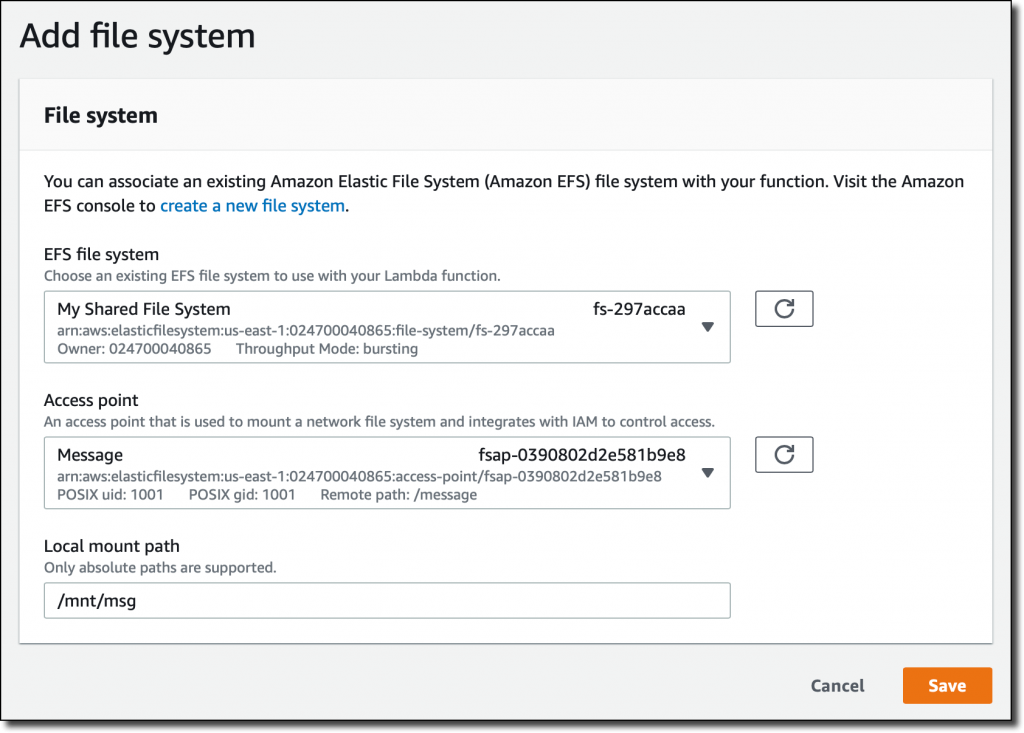
New – A Shared File System for Your Lambda Functions
July 1, 2020: Post updated to take care that Amazon EFS increased file system minimum throughput, when burst credits are exhausted, to 1 MiB/s. I am very happy to announce that AWS Lambda functions can now mount an Amazon Elastic File System (Amazon EFS), a scalable and elastic NFS file system storing data within and across multiple availability […]

Savings Plan Update: Save Up to 17% On Your Lambda Workloads
Late last year I wrote about Savings Plans, and showed you how you could use them to save money when you make a one or three year commitment to use a specified amount (measured in dollars per hour) of Amazon Elastic Compute Cloud (Amazon EC2) or AWS Fargate. Savings Plans give you the flexibility to […]