AWS Big Data Blog
Category: Expert (400)
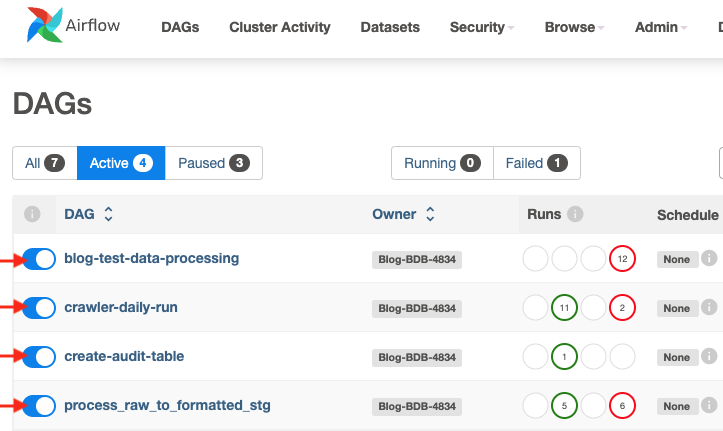
Building scalable AWS Lake Formation governed data lakes with dbt and Amazon Managed Workflows for Apache Airflow
Organizations often struggle with building scalable and maintainable data lakes—especially when handling complex data transformations, enforcing data quality, and monitoring compliance with established governance. Traditional approaches typically involve custom scripts and disparate tools, which can increase operational overhead and complicate access control. A scalable, integrated approach is needed to simplify these processes, improve data reliability, […]
Cross-account lakehouse governance with Amazon S3 Tables and SageMaker Catalog
In this post, we walk you through a practical solution for secure, efficient cross-account data sharing and analysis. You’ll learn how to set up cross-account access to S3 Tables using federated catalogs in Amazon SageMaker, perform unified queries across accounts with Amazon Athena in Amazon SageMaker Unified Studio, and implement fine-grained access controls at the column level using AWS Lake Formation.
Federate access to SageMaker Unified Studio with AWS IAM Identity Center and Okta
This post shows step-by-step guidance to setup workforce access to Amazon SageMaker Unified Studio using Okta as an external Identity provider with AWS IAM Identity Center.
Stream mainframe data to AWS in near real time with Precisely and Amazon MSK
In this post, we introduce an alternative architecture to synchronize mainframe data to the cloud using Amazon Managed Streaming for Apache Kafka (Amazon MSK) for greater flexibility and scalability. This event-driven approach provides additional possibilities for mainframe data integration and modernization strategies.
Visualize data lineage using Amazon SageMaker Catalog for Amazon EMR, AWS Glue, and Amazon Redshift
Amazon SageMaker offers a comprehensive hub that integrates data, analytics, and AI capabilities, providing a unified experience for users to access and work with their data. Through Amazon SageMaker Unified Studio, a single and unified environment, you can use a wide range of tools and features to support your data and AI development needs, including […]
How Laravel Nightwatch handles billions of observability events in real time with Amazon MSK and ClickHouse Cloud
Laravel, one of the world’s most popular web frameworks, launched its first-party observability platform, Laravel Nightwatch, to provide developers with real-time insights into application performance. Built entirely on AWS managed services and ClickHouse Cloud, the service already processes over one billion events per day while maintaining sub-second query latency, giving developers instant visibility into the health of their applications.
Deep dive into the Amazon Managed Service for Apache Flink application lifecycle – Part 2
In Part 1 of this series, we discussed fundamental operations to control the lifecycle of your Amazon Managed Service for Apache Flink application. In this post, we explore failure scenarios that can happen during normal operations or when you deploy a change or scale the application, and how to monitor operations to detect and recover when something goes wrong.
Deep dive into the Amazon Managed Service for Apache Flink application lifecycle – Part 1
In this two-part series, we explore what happens during an application’s lifecycle. This post covers core concepts and the application workflow during normal operations. In Part 2, we look at potential failures, how to detect them through monitoring, and ways to quickly resolve issues when they occur.
Implement fine-grained access control using Amazon OpenSearch Service and JSON Web Tokens
This post demonstrates how to build a secure search application using Amazon OpenSearch Service and JSON Web Tokens (JWTs). We discuss the basics of OpenSearch Service and JWTs and how to implement user authentication and authorization through an existing identity provider (IdP). The focus is on enforcing fine-grained access control based on user roles and permissions.
Amazon Redshift out-of-the-box performance innovations for data lake queries
In this post, we first briefly review how planner statistics are collected and what impact they have on queries. Then, we discuss Amazon Redshift features that deliver optimal plans on Iceberg tables and Parquet data even with the lack of statistics. Finally, we review some example queries that now execute faster because of these latest Amazon Redshift innovations.