AWS Architecture Blog
Category: Networking & Content Delivery

New Whitepaper: Selecting & Designing Your Hybrid Connectivity Model
Introduction Many organizations need to connect their on-premises data centers, remote sites, and the cloud. A hybrid network connects these different environments. A modern organization uses an extensive array of IT resources. In the past, it was common to host these resources in an on-premises data center or a colocation facility. With the increased adoption […]

Field Notes: Using Infrastructure as Code to Manage Your AWS Networking Environment
Infrastructure as Code (IaC) brings automation to the provisioning process, which was traditionally done manually. Rather than relying on manually performed steps, both administrators and developers can instantiate infrastructure using configuration files. IaC helps avoid configuration drift through automation, and increases the speed and agility of infrastructure deployments. It also helps reduce errors and enhances […]

Field Notes: Working with Route Tables in AWS Transit Gateway
An AWS Transit Gateway enables you to attach Amazon VPCs, AWS S2S VPN and AWS Direct Connect connections in the same Region, and route traffic between them. Transit Gateways are designed to be highly scalable and resilient. You can attach up to 5000 VPCs to each gateway and each attachment can handle up to 50 […]
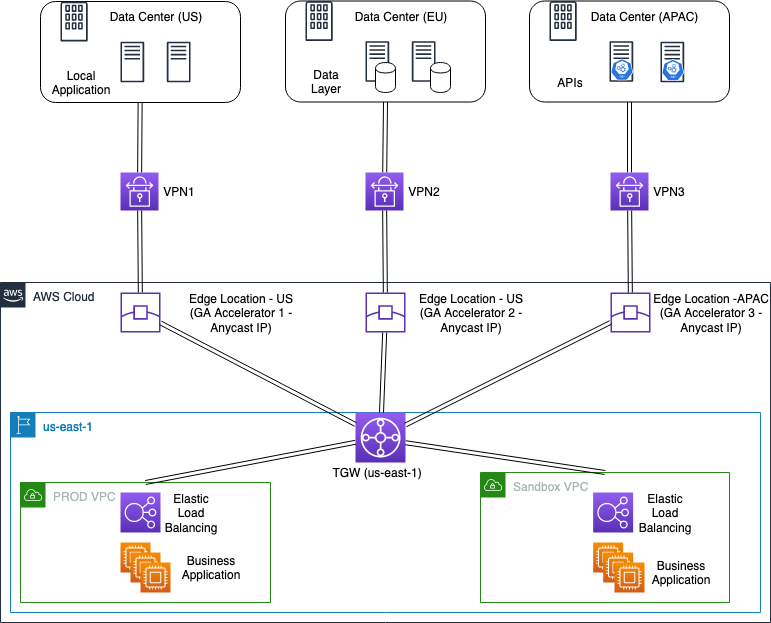
Improve VPN Network Performance of AWS Hybrid Cloud with Global Accelerator
Introduction Connecting on-premises data centers to AWS using AWS Site-to-Site VPN to support distributed applications is a common practice. With business expansion and acquisitions, your company’s on-premises IT footprint may grow into various geographies, with these multiple sites comprising of on-premises data centers and co-location facilities. AWS Site-to-Site VPN supports throughput up to 1.25 Gbps, […]

Field Notes: Integrating HTTP APIs with AWS Cloud Map and Amazon ECS Services
This post was cowritten with Preeti Pragya Jha, a senior software developer in Tata Consultancy Services (TCS). Companies are continually looking for ways to optimize cost. This is true of RS Components, a global trading brand of Electrocomponents plc, a global omni-channel provider of industrial and electronic products and solutions. RS Components set out to […]

What’s New in the Well-Architected Performance Efficiency Pillar?
We recently published a significant update to the AWS Well-Architected Framework, and as part of that update, the Performance Efficiency Pillar whitepaper has been streamlined and improved. The questions in the whitepaper are now better aligned with those in the AWS Well-Architected Tool, making it easy to cross-reference between them when reviewing workloads. With clearer […]

Leveraging AWS Global Backbone for Data Center Migration and Global Expansion
Update: January, 2025 AWS Direct Connect now supports directly communication between AWS Direct Connect locations using SiteLink feature. The architecture described in this post is no longer needed. Refer to Introducing AWS Direct Connect SiteLink and Advanced Routing scenarios with AWS Direct Connect SiteLink to learn more. Many companies run their applications in data centers, […]

BBVA: Helping Global Remote Working with Amazon AppStream 2.0
This post was co-written with Javier Jose Pecete, Cloud Security Architect at BBVA, and Javier Sanz Enjuto, Head of Platform Protection – Security Architecture at BBVA. Introduction Speed and elasticity are key when you are faced with unexpected scenarios such as a massive employee workforce working from home or running more workloads on the public […]

The Journey to Cloud Networking
IP networking is often seen as a means to an end, an abstract aspect of your business. You don’t say, “I really want a fast network…just to have a fast network.” Quite the contrary. As a business, you set out to accomplish your mission and goals, and then find you need applications to get there. […]
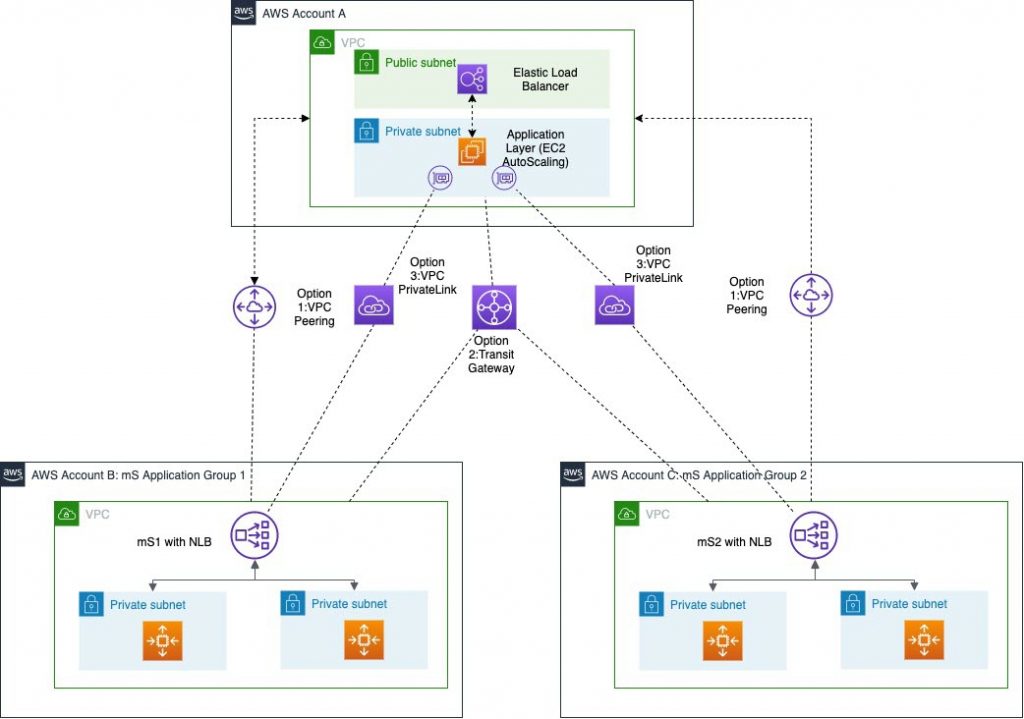
Using VPC Sharing for a Cost-Effective Multi-Account Microservice Architecture
Introduction Many cloud-native organizations building modern applications have adopted a microservice architecture because of its flexibility, performance, and scalability. Even customers with legacy and monolithic application stacks are embarking on an application modernization journey and opting for this type of architecture. A microservice architecture allows applications to be composed of several loosely coupled discreet services […]