AWS Big Data Blog
Category: Customer Solutions
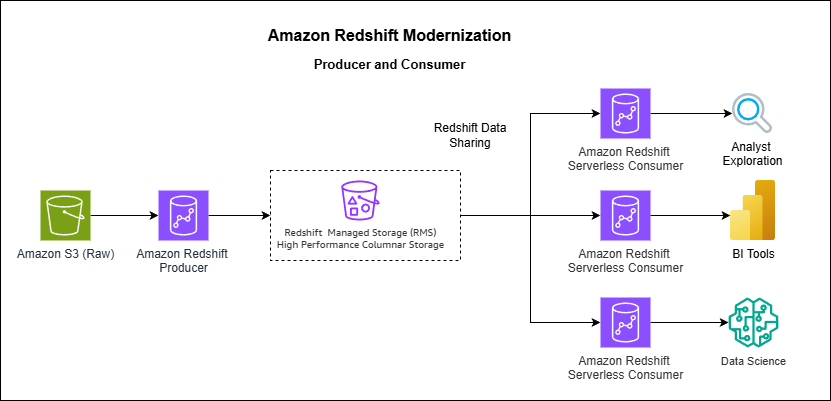
How Vanguard transformed analytics with Amazon Redshift multi-warehouse architecture
In this post, Vanguard’s Financial Advisor Services division describes how they evolved from a single Amazon Redshift cluster to a multi-warehouse architecture using data sharing and serverless endpoints to eliminate performance bottlenecks caused by exponential growth in ETL jobs, dashboards, and user queries.

Amazon Redshift DC2 migration approach with a customer case study
In this post, we share insights from one of our customers’ migration from DC2 to RA3 instances. The customer, a large enterprise in the retail industry, operated a 16-node dc2.8xlarge cluster for business intelligence (BI) and ETL workloads. Facing growing data volumes and disk capacity limitations, they successfully migrated to RA3 instances using a Blue-Green deployment approach, achieving improved ETL query performance and expanded storage capacity while maintaining cost efficiency.
How Razorpay achieved 11% performance improvement and 21% cost reduction with Amazon EMR
In this post, we explore how Razorpay, India’s leading FinTech company, transformed their data platform by migrating from a third-party solution to Amazon EMR, unlocking improved performance and significant cost savings. We’ll walk through the architectural decisions that guided this migration, the implementation strategy, and the measurable benefits Razorpay achieved.
How Amplitude implemented natural language-powered analytics using Amazon OpenSearch Service as a vector database
Amplitude is a product and customer journey analytics platform. Our customers wanted to ask deep questions about their product usage. Ask Amplitude is an AI assistant that uses large language models (LLMs). It combines schema search and content search to provide a customized, accurate, low latency, natural language-based visualization experience to end customers. Amplitude’s search architecture evolved to scale, simplify, and cost-optimize for our customers, by implementing semantic search and Retrieval Augmented Generation (RAG) powered by Amazon OpenSearch Service. In this post, we walk you through Amplitude’s iterative architectural journey and explore how we address several critical challenges in building a scalable semantic search and analytics platform.
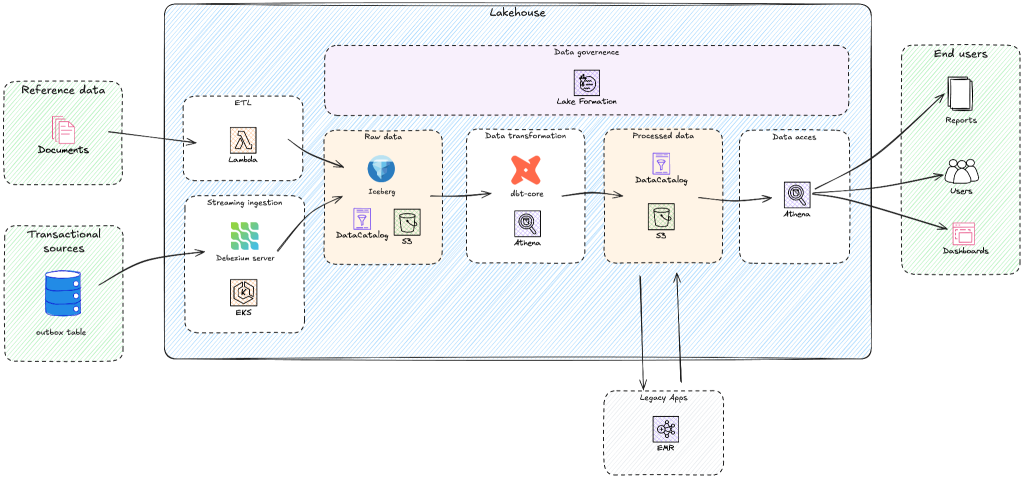
Building a modern lakehouse architecture: Yggdrasil Gaming’s journey from BigQuery to AWS
Yggdrasil Gaming develops and publishes casino games globally, processing massive amounts of real-time gaming data for game performance analytics, player behavior insights, and industry intelligence. Yggdrasil Gaming reduced multi-cloud complexity and built a scalable analytics foundation by migrating from Google BigQuery to AWS analytics services. In this post, you’ll discover how Yggdrasil Gaming transformed their data architecture to meet growing business demands. You will learn practical strategies for migrating from proprietary systems to open table formats such as Apache Iceberg while maintaining business continuity. Yggdrasil worked with GOStack, an AWS Partner, to migrate to an Apache Iceberg-based lakehouse architecture. The migration helped reduce operational complexity and enabled real-time gaming analytics and machine learning.
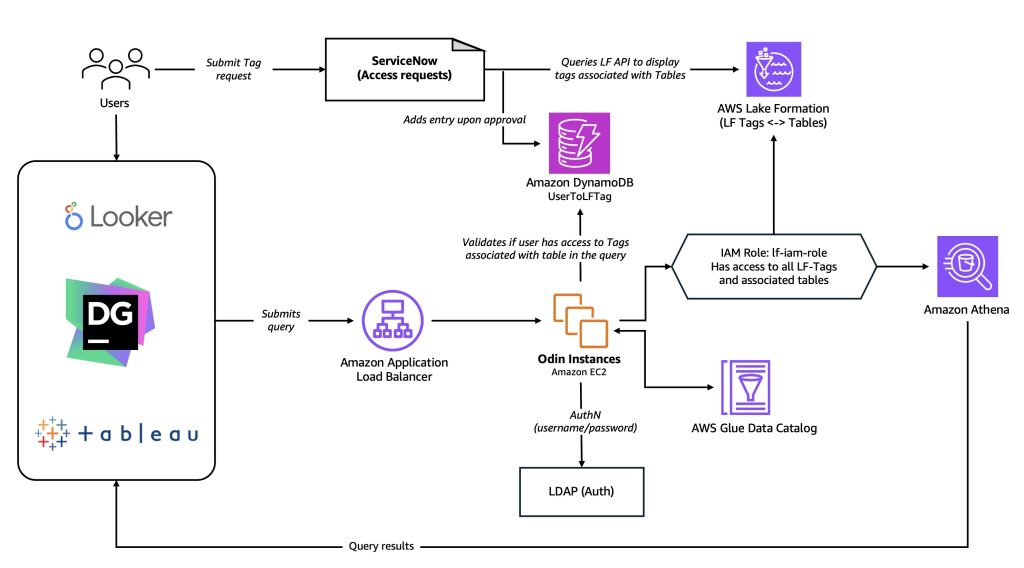
How Twilio secured their multi-engine query platform with AWS Lake Formation
Twilio is a cloud communications platform that provides programmable APIs and tools for developers to easily integrate voice, messaging, email, video, and other communication features into their applications and customer engagement workflows. In this blog series we discuss how we built a multi-engine query platform at Twilio. The first part introduces the use case that led us to build a new platform and why we selected Amazon Athena alongside our open-source Presto implementation. This second part discusses how Twilio’s query infrastructure platform integrates with AWS Lake Formation to provide fine-grained access control to all their data.
Improving order history search using semantic search with Amazon OpenSearch Service
If you’ve ever shopped on Amazon, you’ve used Your Orders. This feature maintains your complete order history dating back to 1995, so you can track and manage every purchase you’ve made. The order history search feature lets you find your past purchases by entering keywords in the search bar. Beyond just finding items, it provides a straightforward way to repurchase the same or similar items, saving you time and effort. In this post, we show you how the Your Orders team improved order history search by introducing semantic search capabilities on top of our existing lexical search system, using Amazon OpenSearch Service and Amazon SageMaker.
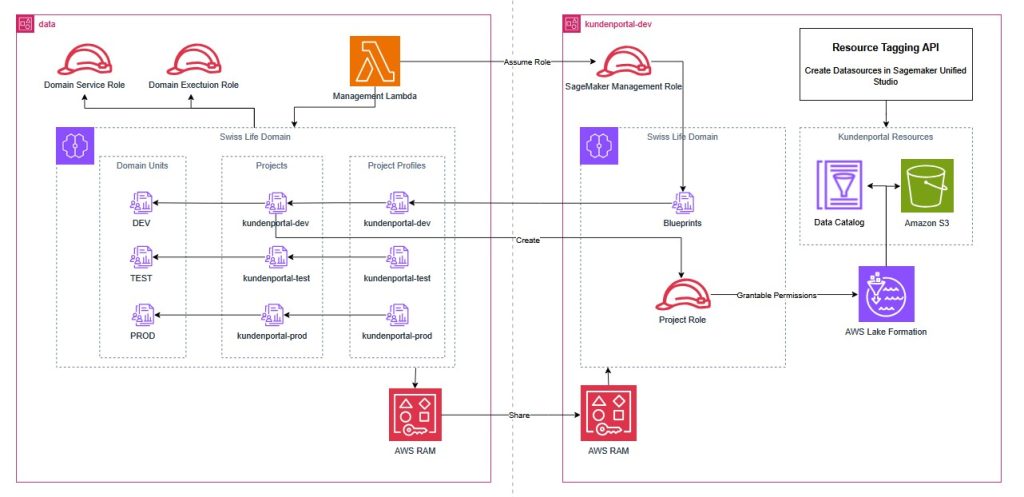
How Swiss Life Germany automated data governance and collaboration with Amazon SageMaker
Swiss Life Germany, a leading provider of customized pension products with over 100 years of experience, recently transitioned from legacy on-premises infrastructure to a modern cloud architecture. To enable secure data sharing and cross-departmental collaboration in this regulated environment, they implemented Amazon SageMaker with a custom Terraform pattern. This post demonstrates how Swiss Life Germany aligned SageMaker’s agility with their rigorous infrastructure as code standards, providing a blueprint for platform engineers and data architects in highly regulated enterprises.
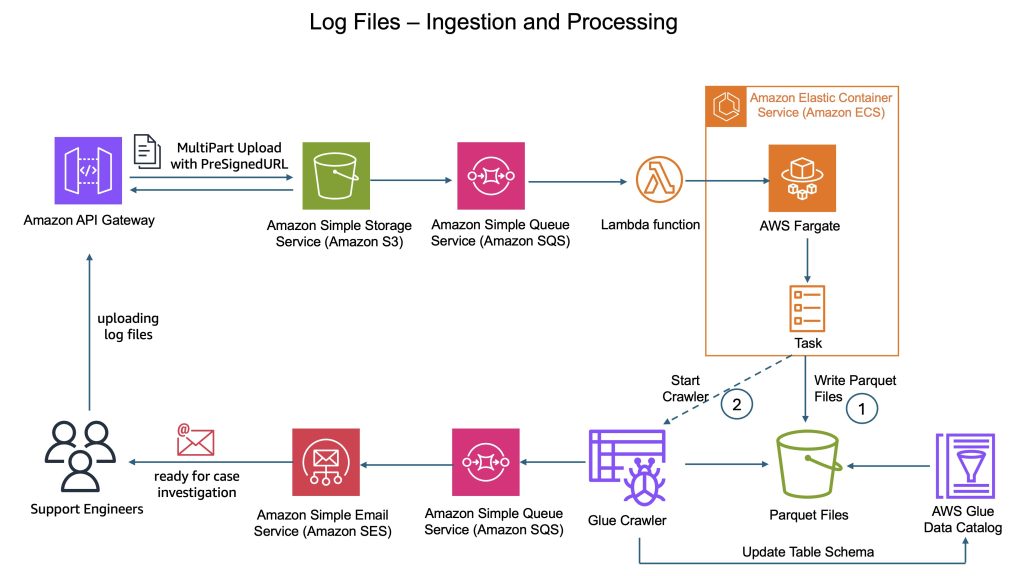
How CyberArk uses Apache Iceberg and Amazon Bedrock to deliver up to 4x support productivity
CyberArk is a global leader in identity security. Centered on intelligent privilege controls, it provides comprehensive security for human, machine, and AI identities across business applications, distributed workforces, and hybrid cloud environments. In this post, we show you how CyberArk redesigned their support operations by combining Iceberg’s intelligent metadata management with AI-powered automation from Amazon Bedrock. You’ll learn how to simplify data processing flows, automate log parsing for diverse formats, and build autonomous investigation workflows that scale automatically.
Verisk cuts processing time and storage costs with Amazon Redshift and lakehouse
Verisk, a catastrophe modeling SaaS provider serving insurance and reinsurance companies worldwide, cut processing time from hours to minutes-level aggregations while reducing storage costs by implementing a lakehouse architecture with Amazon Redshift and Apache Iceberg. If you’re managing billions of catastrophe modeling records across hurricanes, earthquakes, and wildfires, this approach eliminates the traditional compute-versus-cost trade-off by separating storage from processing power. In this post, we examine Verisk’s lakehouse implementation, focusing on four architectural decisions that delivered measurable improvements.