AWS Quantum Technologies Blog
Category: Thought Leadership

AWS open-sources OQpy to make it easier to write quantum programs in OpenQASM 3
In September 2021, we announced that AWS would be joining the OpenQASM 3 Technical Steering Committee in an effort to establish a consistent, industry-wide approach for describing quantum programs. In that blog post we also shared our plans to help extend the OpenQASM ecosystem to work with hardware being developed at the AWS Center for Quantum Computing. […]

Combinatorial Optimization with Physics-Inspired Graph Neural Networks
Combinatorial optimization problems, such as the traveling salesman problem where we are looking for an optimal path with a discrete number of variables, are pervasive across science and industry. Practical (and yet notoriously challenging) applications can be found in virtually every industry, such as transportation and logistics, telecommunications, and finance. For example, optimization algorithms help […]

Announcing the opening of the AWS Center for Quantum Computing
What if by harnessing the properties of quantum mechanics we could model and simulate the behavior of matter at its most fundamental level, down to how molecules interact? The machine that would make that possible would be transformative, changing what we know about science and how we probe nature for answers. Quantum computers have the […]

Exploring Simon’s Algorithm with Daniel Simon
Introduction Customers exploring quantum computing often rely on existing algorithms to learn the basics or evaluate new services. Amazon Braket includes many such algorithms in its SDK and managed notebooks. In this post, we will explore one of the first quantum algorithms invented, and a new addition to our Amazon Braket examples: Simon’s algorithm. We […]

AWS joins the OpenQASM 3.0 Technical Steering Committee
In the early 1990s, James Gosling introduced the Java programming language. One of the key advantages to Java was that programmers could write code once and have it run on many different backends, without needing to concern themselves with the underlying hardware. This was enabled by an intermediate representation called Java bytecode. Java programs were […]

Generating quantum randomness with Amazon Braket
Introduction – the need for randomness Random numbers are a crucial resource used throughout modern computer science. For example, in computation, randomized algorithms give efficient solutions for a variety of fundamental problems for which no deterministic algorithms are available. This includes Monte Carlo methods that have widespread applications in science for the simulation of physical, […]
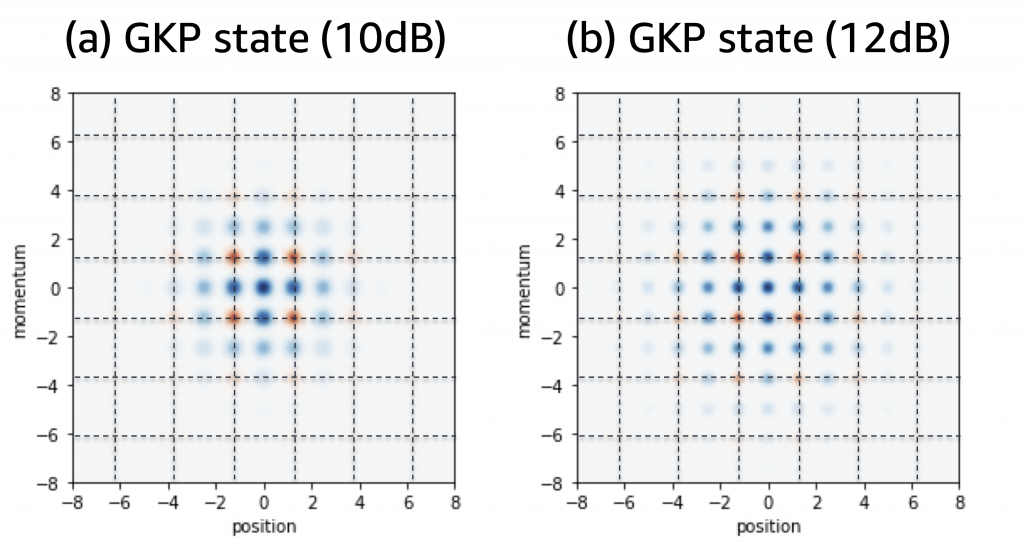
Low-overhead quantum computing with Gottesman-Kitaev-Preskill qubits
Introduction This post summarizes a research paper from the AWS Center for Quantum Computing that proposes a direction to implement fault-tolerant quantum computers with minimal hardware overhead. This research shows that by concatenating the surface code with Gottesman, Kitaev, and Preskill (GKP) qubits, it is theoretically possible to achieve a logical error rate of 10-8 […]

Designing a fault-tolerant quantum computer based on Schrödinger-cat qubits
At the AWS Center for Quantum Computing, we are doing scientific research and development on quantum computing algorithms and hardware. This post summarizes findings from our first architecture paper that describes a theoretical blueprint for a fault-tolerant quantum computer that features a novel approach to quantum error correction (QEC). Fair warning, this post dives somewhat […]

Working with PennyLane for variational quantum algorithms and quantum machine learning
The field of quantum computing today resembles the state of machine learning a few decades ago – in many ways. Near-term quantum algorithms for optimization, computational chemistry, and other applications are based on the very same principles that are used to train a neural network. In machine learning, there was no theoretical proof that a […]