AWS Database Blog
Category: Learning Levels

Build proactive database monitoring for Amazon RDS with Amazon CloudWatch Logs, AWS Lambda, and Amazon SNS
Customers running Amazon Relational Database Service (Amazon RDS) want to shorten the process of accessing database logs and to receive proactive notifications of database alerts. Generally, database administrators have host access to the database servers, which gives them access to the database logs on the host file system, which are used for monitoring and validating […]

Creating Amazon Timestream interpolated views using Amazon Kinesis Data Analytics for Apache Flink
August 30, 2023: Amazon Kinesis Data Analytics has been renamed to Amazon Managed Service for Apache Flink. Read the announcement in the AWS News Blog and learn more. Many organizations have accelerated their adoption of stream data processing technologies in an effort to more quickly derive actionable insights from their data. Frequently, it is required […]

Patterns for AWS IoT time series data ingestion with Amazon Timestream
August 30, 2023: Amazon Kinesis Data Analytics has been renamed to Amazon Managed Service for Apache Flink. Read the announcement in the AWS News Blog and learn more. Large-scale internet of things (IoT) applications generate data at fast rates, and many IoT implementations require data to be stored sequentially, based on date-time values generated either […]

Configuring an audit log to capture database activities for Amazon RDS for MySQL and Amazon Aurora with MySQL compatibility
September 2022: This post was reviewed for accuracy. Organizations improve security and tracing postures by going through database audits to check that they’re following and provisioning well-architected frameworks. Security teams and database administrators often perform in-depth analysis of access and modification patterns against data or meta-data in their databases. During auditing, you may raise the […]

Building a knowledge graph in Amazon Neptune using Amazon Comprehend Events
On 28-Oct-22, the AWS CloudFormation template and Jupyter notebook linked in this post were updated to 1/ add openCypher queries along with the existing Gremlin and SPARQL queries, 2/ updated to use Sagemaker newer Amazon Linux 2 instances, 3/ fixed a bug in the RDF generation code that improperly labeled a property as an RDF […]
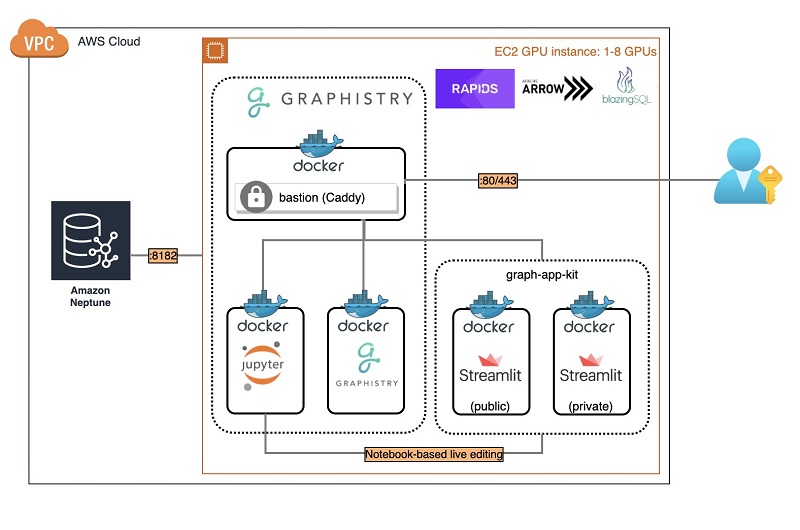
Enabling low code graph data apps with Amazon Neptune and Graphistry
One of the common challenges to unlocking the value of graph databases is building easy-to-use, customer-facing data tools that expose graph-powered insights in impactful and visual ways. Data engineers need to inspect data quality, data scientists need to perform discovery and inspect models, analysts need to investigate connections, and managers need insight into what’s going […]

Preparing on-premises and AWS environments for external Kerberos authentication for Amazon RDS
As database security becomes more and more essential to the success of a business, managing user access to databases effectively has always been a challenge to database administrators (DBAs) and security officers. Traditional database authentication is based on a username-password mechanism. This method unfortunately requires effort from both DBAs and users to maintain the credentials; […]

Cross-account replication with Amazon DynamoDB
July 2024, this post has been reviewed for accuracy. Hundreds of thousands of customers use Amazon DynamoDB for mission-critical workloads. In some situations, you may want to migrate your DynamoDB tables into a different AWS account, for example, in the eventuality of a company being acquired by another company. Another use case is adopting a […]

Performance impact of idle PostgreSQL connections
July 2023: This post was reviewed for accuracy. The first post of this series, Resources consumed by idle PostgreSQL connections, talked about how PostgreSQL manages connections and how even idle connections consume memory and CPU. In this post, I discuss how idle connections impact PostgreSQL performance. Transaction rate impact When PostgreSQL needs data, it first […]

Resources consumed by idle PostgreSQL connections
July 2023: This post was reviewed for accuracy. PostgreSQL is one of the most popular open-source relational database systems. With more than 30 years of development work, PostgreSQL has proven to be a highly reliable and robust database that can handle a large number of complex data workloads. AWS provides two managed PostgreSQL options: Amazon […]