AWS HPC Blog
Category: *Post Types
Simcenter STAR-CCM+ price-performance on AWS
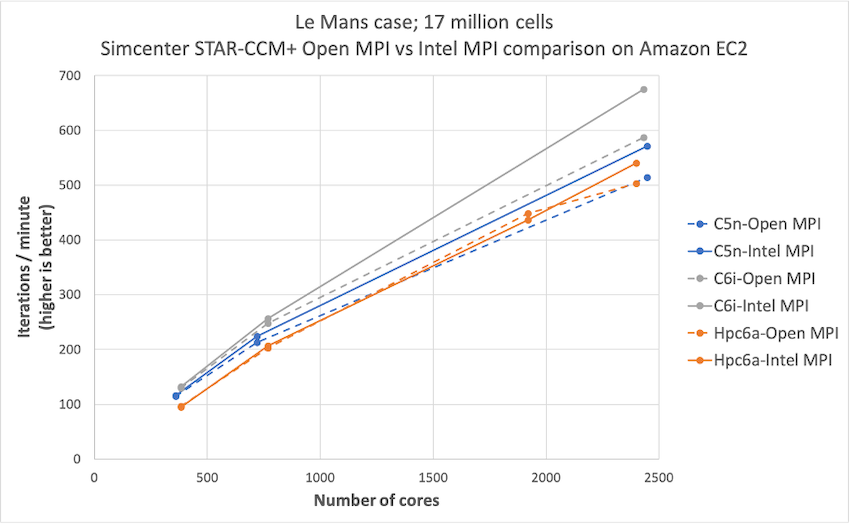
Organizations such as Amazon Prime Air and Joby Aviation use Simcenter STAR-CCM+ for running CFD simulations on AWS so they can reduce product manufacturing cycles and achieve faster times to market. In this post today, we describe the performance and price analysis of running Computational Fluid Dynamics (CFD) simulations using Siemens SimcenterTM STAR-CCM+TM software on AWS HPC clusters.
Data Science workflows at insitro: how redun uses the advanced service features from AWS Batch and AWS Glue
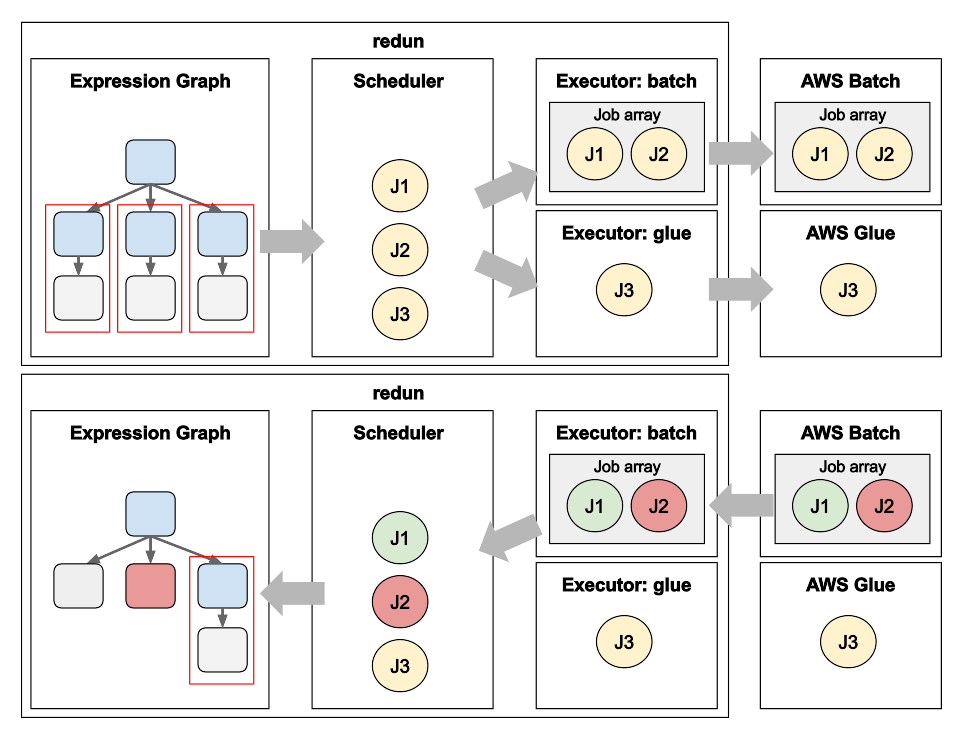
Matt Rasmussen, VP of Software Engineering at insitro, expands on his first post on redun, insitro’s data science tool for bioinformatics, to describe how redun makes use of advanced AWS features. Specifically, Matt describes how AWS Batch’s Array Jobs is used to support workflows with large fan-out, and how AWS Glue’s DynamicFrame is used to run computationally heterogenous workflows with different back-end needs such as Spark, all in the same workflow definition.

Data Science workflows at insitro: using redun on AWS Batch
Matt Rasmussen, VP of Software Engineering at insitro describes their recently released, open-source data science framework, redun, which allows data scientists to define complex scientific workflows that scale from their laptop to large-scale distributed runs on serverless platforms like AWS Batch and AWS Glue. I this post, Matt shows how redun lends itself to Bioinformatics workflows which typically involve wrapping Unix-based programs that require file staging to and from object storage. In the next blog post, Matt describes how redun scales to large and heterogenous workflows by leveraging AWS Batch features such as Array Jobs and AWS Glue features such as Glue DynamicFrame.

Creating a digital map of COVID-19 virus for discovery of new treatment compounds
Quantum physics and high-performance computing have slashed research times for a consortium of researchers led by Qubit Pharmaceuticals. This post describes the discovery of chemical substances that may lead to new COVID-19 treatments in only six months using cloud technology.

Choosing between AWS Batch or AWS ParallelCluster for your HPC Workloads
It’s an understatement that AWS has a lot of services (more than 200 at the time of this post!). We’re usually the first to point out that there’s more than one way to solve a problem. HPC is no different in this regard, because we offer a choice: customers can run their HPC workloads using AWS […]
Getting the best OpenFOAM Performance on AWS
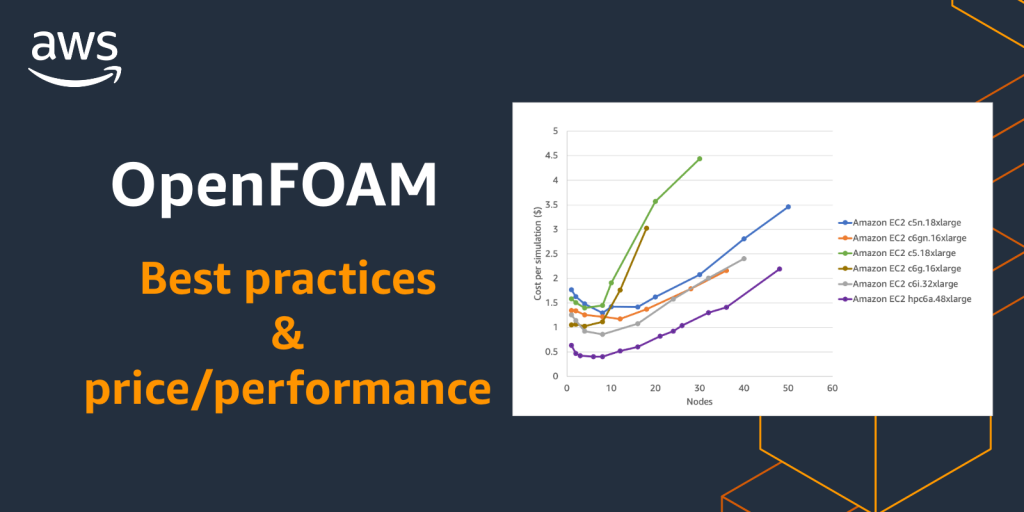
OpenFOAM is one the most widely used Computational Fluid Dynamics (CFD) packages and helps companies in a broad range of sectors (automotive, aerospace, energy, and life-sciences) to conduct research and design new products. In this post, we’ll discuss six practical things you can do as an OpenFOAM user to run your simulations faster and more cost effectively.

Cloud-native, high throughput grid computing using the AWS HTC-Grid solution
We worked with our financial services customers to develop an open-source, scalable, cloud-native, high throughput computing solution on AWS — AWS HTC-Grid. HTC-Grid allows you to submit large volumes of short and long running tasks and scale environments dynamically. In this first blog of a two-part series, we describe the structure of HTC-Grid and its objective to provide a configurable blueprint for HPC grid scheduling on the cloud.
Optimize your Monte Carlo simulations using AWS Batch
Introduction Monte Carlo methods are a class of methods based on the idea of sampling to study mathematical problems for which analytical solutions may be unavailable. The basic idea is to create samples through repeated simulations that can be used to derive approximations about a quantity we’re interested in, and its probability distribution. In this […]
Integrating OKTA identity service provider with NICE EnginFrame
This post by Roberto Meda and Salvo Maccarone covers how you can configure NICE EnginFrame to leverage OKTA as an identity service provider to support SAML 2.0 single sign on authentication and several other features like multi-factor verification, API access management and multi-device support.
How to Arm a world-leading forecast model with AWS Graviton and Lambda
The Met Office is the UK’s National Meteorological Service, providing 24×7 world-renowned scientific excellence in weather, climate and environmental forecasts and severe weather warnings for the protection of life and property. They provide forecasts and guidance for the public, to our government and defence colleagues as well as the private sector. As an example, if you’ve been on a plane over Europe, Middle East, or Africa; that plane took off because the Met Office (as one of two World Aviation Forecast Centres) provided a forecast. This article explains one of the ways they use AWS to collect these observations, which has freed them to focus more on top quality delivery for their customers.