AWS Security Blog
Category: Compute

How to Monitor and Visualize Failed SSH Access Attempts to Amazon EC2 Linux Instances
As part of the AWS Shared Responsibility Model, you are responsible for monitoring and managing your resources at the operating system and application level. When you monitor your application servers, for example, you can measure, visualize, react to, and improve the security of those servers. You probably already do this on premises or in other […]
Read More
How to Control TLS Ciphers in Your AWS Elastic Beanstalk Application by Using AWS CloudFormation
Securing data in transit is critical to the integrity of transactions on the Internet. Whether you log in to an account with your user name and password or give your credit card details to a retailer, you want your data protected as it travels across the Internet from place to place. One of the protocols […]
Read More
How to Visualize and Refine Your Network’s Security by Adding Security Group IDs to Your VPC Flow Logs
September 9, 2021: Amazon Elasticsearch Service has been renamed to Amazon OpenSearch Service. See details. August 31, 2020: The directions in this blog post for how to create an Amazon ES cluster have been updated. February 28, 2019: The features and services described in this post have changed since the post was published and the […]
Read More
Centrally Manage Tags and Search for Resources Across AWS Services by Using the New Resource Groups Tagging API
Today, we made available the new Resource Groups Tagging API that makes it easier for you to centrally manage tags and search for resources across AWS services and regions. This new API includes five operations that enable you to programmatically tag and untag resources, list resources with a specific tag, and list unique tag keys […]
Read More
Easily Tag Amazon EC2 Instances and Amazon EBS Volumes on Creation
In 2010, AWS launched resource tagging for Amazon EC2 instances and other EC2 resources. Since that launch, we have raised the allowable number of tags per resource from 10 to 50 and made tags more useful with the introduction of resource groups and Tag Editor. AWS customers use tags to track ownership, drive their cost accounting […]
Read More
How to Monitor Host-Based Intrusion Detection System Alerts on Amazon EC2 Instances
September 9, 2021: Amazon Elasticsearch Service has been renamed to Amazon OpenSearch Service. See details. To help you secure your AWS resources, we recommend that you adopt a layered approach that includes the use of preventative and detective controls. For example, incorporating host-based controls for your Amazon EC2 instances can restrict access and provide appropriate […]
Read More
Easily Replace or Attach an IAM Role to an Existing EC2 Instance by Using the EC2 Console
AWS Identity and Access Management (IAM) roles enable your applications running on Amazon EC2 to use temporary security credentials. IAM roles for EC2 make it easier for your applications to make API requests securely from an instance because they do not require you to manage AWS security credentials that the applications use. Recently, we enabled […]
Read More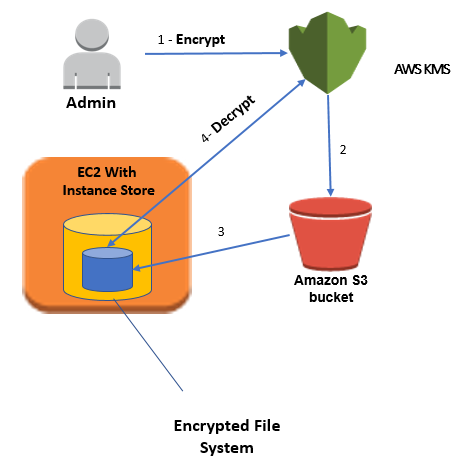
How to Protect Data at Rest with Amazon EC2 Instance Store Encryption
Note: By default, an instance type that includes an NVMe instance store encrypts data at rest using an XTS-AES-256 block cipher. See this FAQ about NVMe-supported instance types. If you’re using an NVMw instance type, then data at rest is encrypted by default, and this post doesn’t apply to your situation. Encrypting data at rest […]
Read More
How to Monitor AWS Account Configuration Changes and API Calls to Amazon EC2 Security Groups
You can use AWS security controls to detect and mitigate risks to your AWS resources. The purpose of each security control is defined by its control objective. For example, the control objective of an Amazon VPC security group is to permit only designated traffic to enter or leave a network interface. Let’s say you have […]
Read More
How to Manage Secrets for Amazon EC2 Container Service–Based Applications by Using Amazon S3 and Docker
Docker enables you to package, ship, and run applications as containers. This approach provides a comprehensive abstraction layer that allows developers to “containerize” or “package” any application and have it run on any infrastructure. Docker containers are analogous to shipping containers in that they provide a standard and consistent way of shipping almost anything. One […]
Read More