AWS Security Blog
Category: AWS Identity and Access Management (IAM)
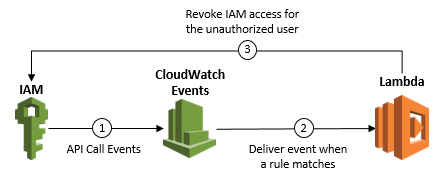
How to Detect and Automatically Revoke Unintended IAM Access with Amazon CloudWatch Events
Update on October 24, 2018: Note that if you do not author the Lambda function correctly, this setup can create an infinite loop (in this case, a rule that is fired repeatedly, which can impact your AWS resources and cause higher than expected charges to your account). The example Lambda function I provide in Step […]

How to Automate Restricting Access to a VPC by Using AWS IAM and AWS CloudFormation
Back in September, I wrote about How to Help Lock Down a User’s Amazon EC2 Capabilities to a Single VPC. In that blog post, I highlighted what I have found to be an effective approach to the virtual private cloud (VPC) lockdown scenario. Since that time, I have worked on making the related information easier […]

How to Record and Govern Your IAM Resource Configurations Using AWS Config
AWS Config recently added the ability to record changes to the configuration of your AWS Identity and Access Management (IAM) users, groups, and roles (collectively referred to as IAM entities) and the policies associated with them. Using this feature, you can record configuration details for these IAM entities, including details about which policies are associated […]

The IAM Console Now Helps Prevent You from Accidentally Deleting In-Use Resources
Deleting unused resources can help to improve the security of your AWS account and make your account easier to manage. However, if you have ever been unsure of whether an AWS Identity and Access Management (IAM) user or role was being used actively, you probably erred on the side of caution and kept it. Starting […]

Adhere to IAM Best Practices in 2016
As another new year begins, we encourage you to review our recommended AWS Identity and Access Management (IAM) best practices. Following these best practices can help you maintain the security of your AWS resources. You can learn more by watching the IAM Best Practices to Live By presentation that Anders Samuelsson gave at AWS re:Invent […]

Another Way to Remove Unnecessary Permissions in Your IAM Policies by Using Service Last Accessed Data
In my previous post, I introduced service last accessed data, a new feature of the AWS Identity and Access Management (IAM) console that helps you define policies that adhere better to the principle of least privilege. As part of that post, I walked through a sample use case demonstrating how you can use service last […]

Remove Unnecessary Permissions in Your IAM Policies by Using Service Last Accessed Data
As a security best practice, AWS recommends writing AWS Identity and Access Management (IAM) policies that adhere to the principle of least privilege, which means granting only the permissions required to perform a specific task. However, verifying which permissions an application or user actually needs can be a challenge. To help you determine which permissions […]

How to Use a Single IAM User to Easily Access All Your Accounts by Using the AWS CLI
Many AWS customers keep their environments separated from each other: development resources do not interact with production, and vice versa. One way to achieve this separation is by using multiple AWS accounts. Though this approach does help with resource isolation, it can increase your user management because each AWS account can have its own AWS […]

AWS Releases Preview of SMS MFA for IAM Users
Today, AWS introduced the preview of Short Message Service (SMS) support for multi-factor authentication (MFA), making it easier for you to implement a security best practice. Until now, you could enable MFA for AWS Identity and Access Management (IAM) users only with hardware or virtual MFA tokens, but this new feature enables you to use […]

Introducing IAM Console Search
We continually review your input submitted via the Feedback link on the AWS Identity and Access Management (IAM) console. Based on our recent review of that feedback, one of the features most frequently requested by you is the ability to search for an IAM user with their associated access key ID. To address this request […]