AWS Compute Blog
Category: Amazon EventBridge

Introducing Amazon EventBridge Scheduler
Today, we are announcing Amazon EventBridge Scheduler. This is a new capability from Amazon EventBridge that allows you to create, run, and manage scheduled tasks at scale. With EventBridge Scheduler, you can schedule one-time or recurrently tens of millions of tasks across many AWS services without provisioning or managing underlying infrastructure. Previously, many customers used […]

ICYMI: Serverless Q3 2022
Welcome to the 19th edition of the AWS Serverless ICYMI (in case you missed it) quarterly recap. Every quarter, we share all the most recent product launches, feature enhancements, blog posts, webinars, Twitch live streams, and other interesting things that you might have missed! In case you missed our last ICYMI, check out what happened […]

Introducing bidirectional event integrations with Salesforce and Amazon EventBridge
This blog shows how to act on changes to your Salesforce data in real-time using the new Salesforce partner event source integration with EventBridge. The example demonstrated how your Salesforce data can be processed and enriched with custom AWS applications and updates sent back to Salesforce using EventBridge API Destinations.

Securely retrieving secrets with AWS Lambda
AWS Lambda functions often need to access secrets, such as certificates, API keys, or database passwords. Storing secrets outside the function code in an external secrets manager helps to avoid exposing secrets in application source code. Using a secrets manager also allows you to audit and control access, and can help with secret rotation. Do […]
ICYMI: Serverless Q2 2022
Welcome to the 18th edition of the AWS Serverless ICYMI (in case you missed it) quarterly recap. Every quarter, we share all the most recent product launches, feature enhancements, blog posts, webinars, Twitch live streams, and other interesting things that you might have missed! In case you missed our last ICYMI, check out what happened […]

Building a low-code speech “you know” counter using AWS Step Functions
This post is written by Doug Toppin, Software Development Engineer, and Kishore Dhamodaran, Solutions Architect. In public speaking, filler phrases can distract the audience and reduce the value and impact of what you are telling them. Reviewing recordings of presentations can be helpful to determine whether presenters are using filler phrases. Instead of manually reviewing […]

Sending Amazon EventBridge events to private endpoints in a VPC
Event-driven architectures and EventBridge can help you accelerate feature velocity and build scalable, fault tolerant applications. This post demonstrates how to send EventBridge events to a private endpoint in a VPC using a Lambda function to relay events and emit response events.
Extending PowerShell on AWS Lambda with other services
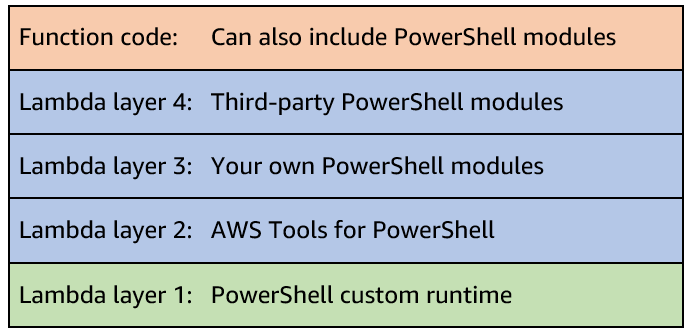
This post expands on the functionality introduced with the PowerShell custom runtime for AWS Lambda. The previous blog explains how the custom runtime approach makes it easier to run Lambda functions written in PowerShell. You can add additional functionality to your PowerShell serverless applications by importing PowerShell modules, which are shareable packages of code. Build your own […]

Testing Amazon EventBridge events using AWS Step Functions
This blog post outlines how to use Step Functions, Lambda, SQS, DynamoDB, and S3 to create a workflow that automates the testing of EventBridge events. With this example, you can send events to the EventBridge Event Tester endpoint to verify that event delivery is successful or identify the root cause for event delivery failures.
Benefits of migrating to event-driven architecture
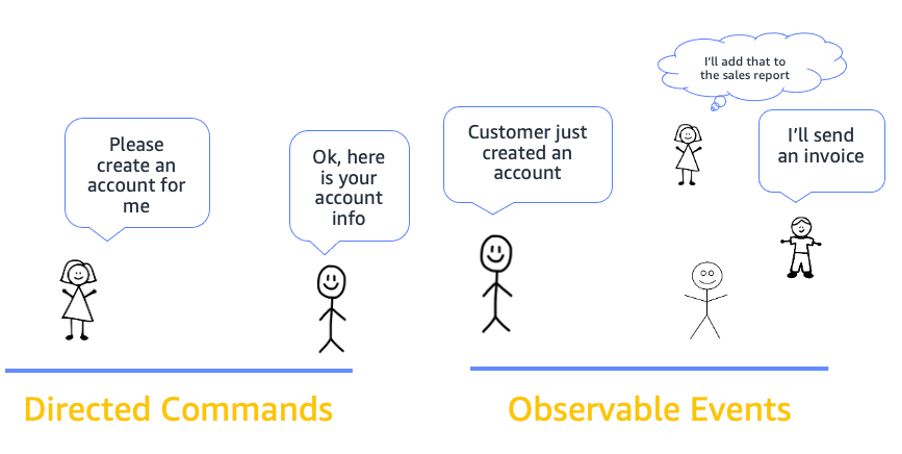
Two common options when building applications are request-response and event-driven architecture. In request-response architecture, an application’s components communicate via API calls. The client sends a request and expects a response before performing the next task. In event-driven architecture, the client generates an event and can immediately move on to its next task. Different parts of […]