Artificial Intelligence
Category: Amazon Lex
Intelligently connect to customers using machine learning in the COVID-19 pandemic
The pandemic has changed how people interact, how we receive information, and how we get help. It has shifted much of what used to happen in-person to online. Many of our customers are using machine learning (ML) technology to facilitate that transition, from new remote cloud contact centers, to chatbots, to more personalized engagements online. […]
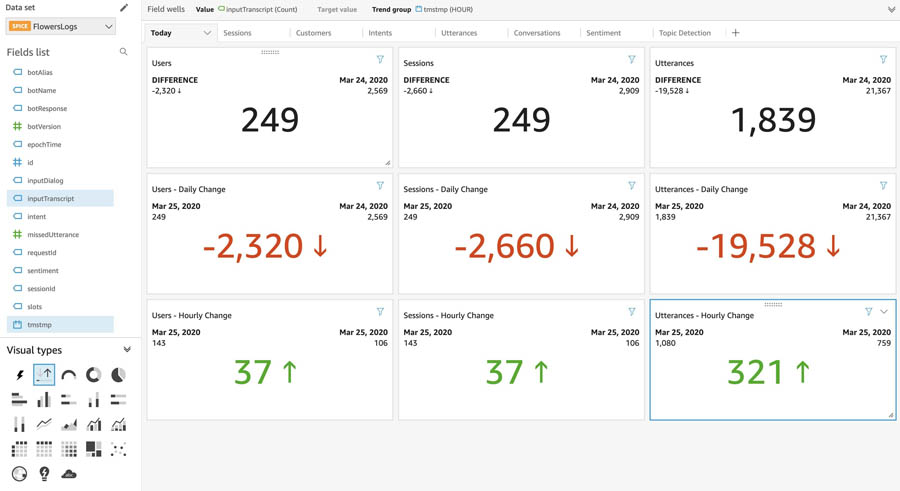
Building a real-time conversational analytics platform for Amazon Lex bots
Conversational interfaces like chatbots have become an important channel for brands to communicate with their customers, partners, and employees. They offer faster service, 24/7 availability, and lower service costs. By analyzing your bot’s customer conversations, you can discover challenges in user experience, trending topics, and missed utterances. These additional insights can help you identify how […]

Expanding Amazon Lex conversational experiences with US Spanish and British English
Amazon Lex provides the power of automatic speech recognition (ASR) for converting speech to text, along with natural language understanding (NLU) for recognizing user intents. This combination allows you to develop sophisticated conversational interfaces using both voice and text for chatbots, IVR bots, and voicebots. This week, we’re announcing Amazon Lex support for British English […]

Creating a sophisticated conversational experience using Amazon Lex in Australian English
Amazon Lex is a service for building conversational interfaces into any application using voice and text. To build truly engaging conversational experiences, you need high quality speech recognition and natural language understanding that understands the intent of the customer accurately. We are excited to announce that Amazon Lex now supports Australian English. With Australian English, […]
Announcing the express testing capability in Amazon Lex
Amazon Lex now provides the express testing capability on the AWS Management Console to expedite building your chatbot. You can start testing your bot soon after you initiate the build process without having to wait for the entire build to complete. You can use the new testing option to check the basic interaction elements such […]
How Citibot’s chatbot search engine uses AI to find more answers
Citibot is a technology company that builds AI-powered chat solutions for local governments such as Fort Worth, Texas; Charleston, South Carolina; and Arlington, Virginia. With Citibot, local residents can quickly get answers to city-related questions, report issues, and receive real-time alerts via text responses. To power these interactions, Citibot uses Amazon Lex, a service for building conversational interfaces for text and voice applications. Citibot built the chatbot to handle basic call queries, which allows government employees to allocate more time to higher-impact community actions.
Build more effective conversations on Amazon Lex with confidence scores and increased accuracy
In the rush of our daily lives, we often have conversations that contain ambiguous or incomplete sentences. For example, when talking to a banking associate, a customer might say, “What’s my balance?” This request is ambiguous and it is difficult to disambiguate if the intent of the customer is to check the balance on her […]

Create a multi-region Amazon Lex bot with Amazon Connect for high availability
AWS customers rely on Amazon Lex bots to power their Amazon Connect self service conversational experiences on telephone and other channels. With Amazon Lex, callers (or customers, in Amazon Connect terminology) can get their questions conveniently answered regardless of agent availability. What architecture patterns can you use to make a bot resilient to service availability issues? In this […]

Building a multilingual question and answer bot with Amazon Lex
Updated June 2021 – QnABot now supports voice interaction in multiple languages using Amazon LexV2. You can use Amazon Lex to build a question and answer chatbot. However, if you live in a non-English-speaking country or your business has global reach, you will want a multilingual bot to cater to all your users. This post […]

Enhancing your chatbot experience with web browsing
Chatbots are popping up everywhere. They are qualifying leads, assisting with sales, and automating customer service. However, conversational chatbot experiences have been limited to the space available within the chatbot window. What if these web-based chatbots could provide an interactive experience that expanded beyond the chat window to include relevant web content based on user […]