Artificial Intelligence
Category: Amazon SageMaker

Run your local machine learning code as Amazon SageMaker Training jobs with minimal code changes
We recently introduced a new capability in the Amazon SageMaker Python SDK that lets data scientists run their machine learning (ML) code authored in their preferred integrated developer environment (IDE) and notebooks along with the associated runtime dependencies as Amazon SageMaker training jobs with minimal code changes to the experimentation done locally. Data scientists typically […]

Amazon SageMaker Data Wrangler for dimensionality reduction
In the world of machine learning (ML), the quality of the dataset is of significant importance to model predictability. Although more data is usually better, large datasets with a high number of features can sometimes lead to non-optimal model performance due to the curse of dimensionality. Analysts can spend a significant amount of time transforming […]

Create SageMaker Pipelines for training, consuming and monitoring your batch use cases
Batch inference is a common pattern where prediction requests are batched together on input, a job runs to process those requests against a trained model, and the output includes batch prediction responses that can then be consumed by other applications or business functions. Running batch use cases in production environments requires a repeatable process for […]

Improved ML model deployment using Amazon SageMaker Inference Recommender
Each machine learning (ML) system has a unique service level agreement (SLA) requirement with respect to latency, throughput, and cost metrics. With advancements in hardware design, a wide range of CPU- and GPU-based infrastructures are available to help you speed up inference performance. Also, you can build these ML systems with a combination of ML […]
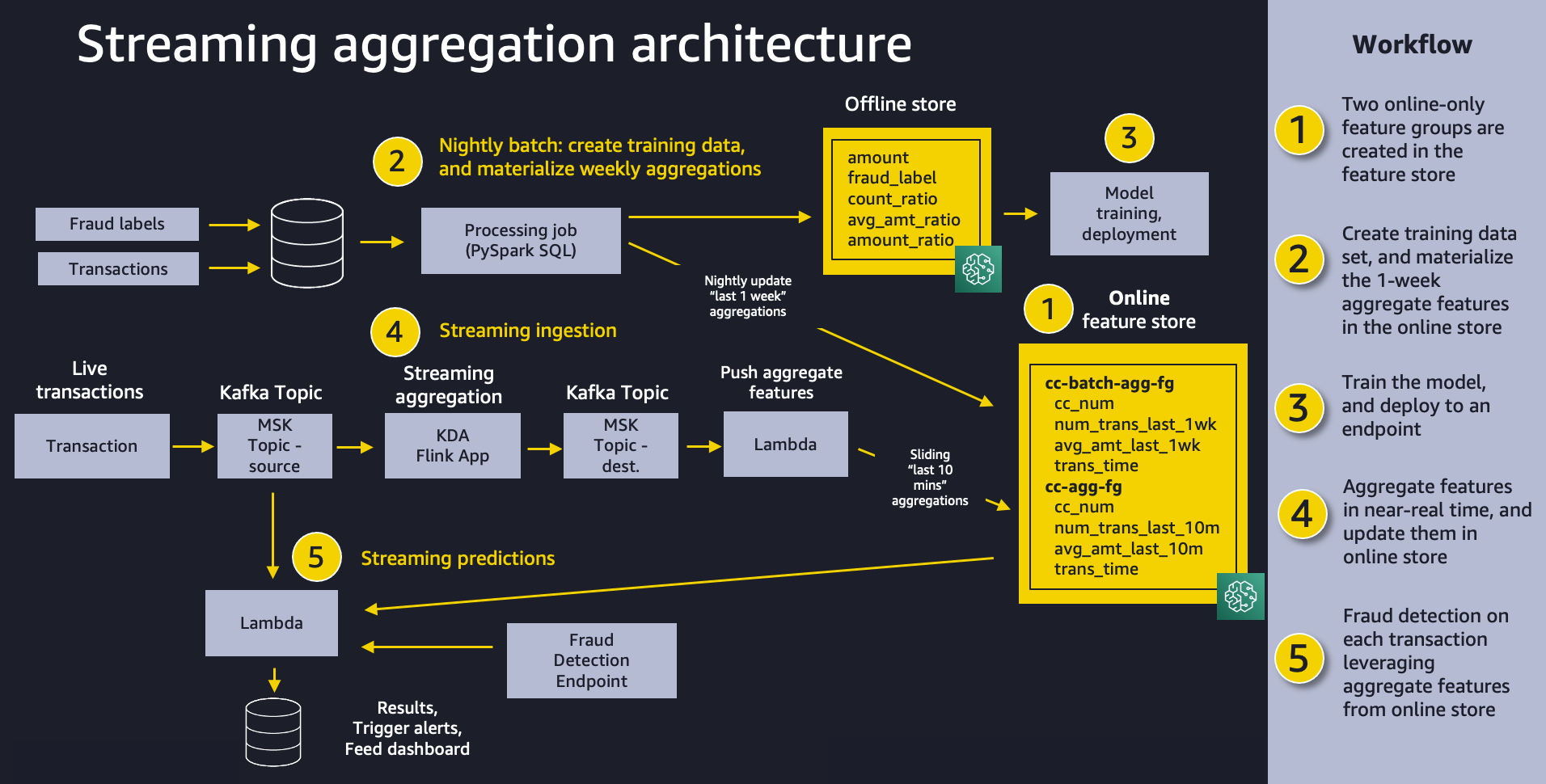
Use streaming ingestion with Amazon SageMaker Feature Store and Amazon MSK to make ML-backed decisions in near-real time
August 30, 2023: Amazon Kinesis Data Analytics has been renamed to Amazon Managed Service for Apache Flink. Read the announcement in the AWS News Blog and learn more. Businesses are increasingly using machine learning (ML) to make near-real-time decisions, such as placing an ad, assigning a driver, recommending a product, or even dynamically pricing products […]

Domain-adaptation Fine-tuning of Foundation Models in Amazon SageMaker JumpStart on Financial data
Large language models (LLMs) with billions of parameters are currently at the forefront of natural language processing (NLP). These models are shaking up the field with their incredible abilities to generate text, analyze sentiment, translate languages, and much more. With access to massive amounts of data, LLMs have the potential to revolutionize the way we […]

How RallyPoint and AWS are personalizing job recommendations to help military veterans and service providers transition back into civilian life using Amazon Personalize
This post was co-written with Dave Gowel, CEO of RallyPoint. In his own words, “RallyPoint is an online social and professional network for veterans, service members, family members, caregivers, and other civilian supporters of the US armed forces. With two million members on the platform, the company provides a comfortable place for this deserving population […]

Deploy large models at high performance using FasterTransformer on Amazon SageMaker
Sparked by the release of large AI models like AlexaTM, GPT, OpenChatKit, BLOOM, GPT-J, GPT-NeoX, FLAN-T5, OPT, Stable Diffusion, and ControlNet, the popularity of generative AI has seen a recent boom. Businesses are beginning to evaluate new cutting-edge applications of the technology in text, image, audio, and video generation that have the potential to revolutionize […]

Authoring custom transformations in Amazon SageMaker Data Wrangler using NLTK and SciPy
“Instead of focusing on the code, companies should focus on developing systematic engineering practices for improving data in ways that are reliable, efficient, and systematic. In other words, companies need to move from a model-centric approach to a data-centric approach.” – Andrew Ng A data-centric AI approach involves building AI systems with quality data involving […]

Connect Amazon EMR and RStudio on Amazon SageMaker
RStudio on Amazon SageMaker is the industry’s first fully managed RStudio Workbench integrated development environment (IDE) in the cloud. You can quickly launch the familiar RStudio IDE and dial up and down the underlying compute resources without interrupting your work, making it easy to build machine learning (ML) and analytics solutions in R at scale. […]