AWS Compute Blog
Category: Serverless

Introducing mutual TLS authentication for Amazon MSK as an event source
This post is written by Uma Ramadoss, Senior Specialist Solutions Architect, Integration. Today, AWS Lambda is introducing mutual TLS (mTLS) authentication for Amazon Managed Streaming for Apache Kafka (Amazon MSK) and self-managed Kafka as an event source. Many customers use Amazon MSK for streaming data from multiple producers. Multiple subscribers can then consume the streaming […]

Publishing messages in batch to Amazon SNS topics
This post is written by Heeki Park (Principal Solutions Architect, Serverless Specialist), Marc Pinaud (Senior Product Manager, Amazon SNS), Amir Eldesoky (Software Development Engineer, Amazon SNS), Jack Li (Software Development Engineer, Amazon SNS), and William Nguyen (Software Development Engineer, Amazon SNS). Today, we are announcing the ability for AWS customers to publish messages in batch […]
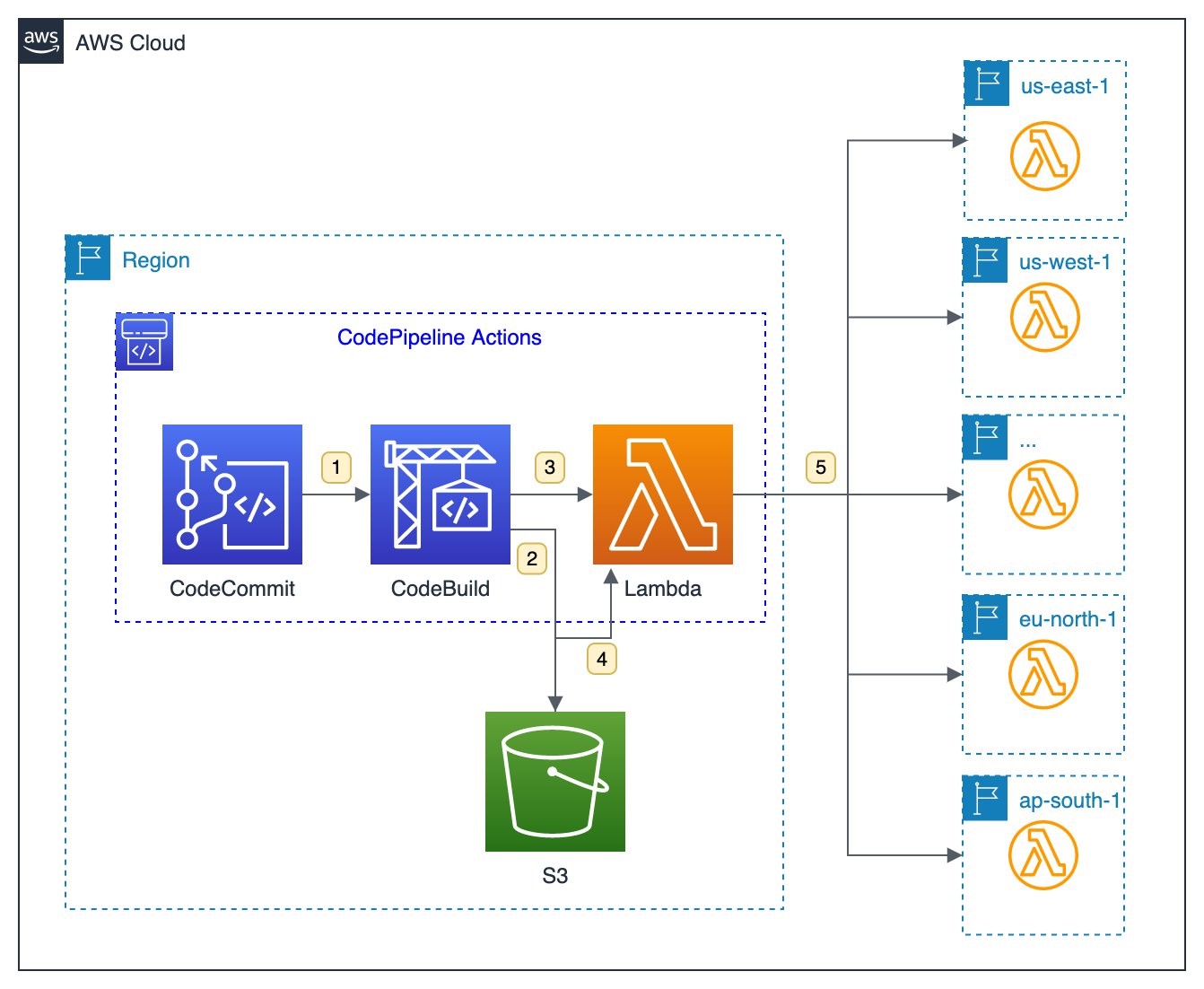
Deploying AWS Lambda layers automatically across multiple Regions
This blog post shows how to create a centralized pipeline to build and distribute Lambda layers consistently across multiple Regions. The pipeline is configurable and allows you to adapt the Regions and permissions according to your use-case.

Modernizing deployments with container images in AWS Lambda
This post is written by Joseph Keating, AWS Modernization Architect, and Virginia Chu, Sr. DevSecOps Architect. Container image support for AWS Lambda enables developers to package function code and dependencies using familiar patterns and tools. With this pattern, developers use standard tools like Docker to package their functions as container images and deploy them to […]

Understanding how AWS Lambda scales with Amazon SQS standard queues
This post explores Lambda’s scaling behavior when subscribed to SQS standard queues. It walks through several ways to scale faster and maximize Lambda throughput when needed. This includes increasing the memory allocation for the Lambda function, increasing batch size, catching errors, and making configuration changes.

Token-based authentication for iOS applications with Amazon SNS
This post is co-written by Karen Hong, Software Development Engineer, AWS Messaging. To use Amazon SNS to send mobile push notifications, you must provide a set of credentials for connecting to the supported push notification service (see prerequisites for push). For the Apple Push Notification service (APNs), SNS now supports using token-based authentication (.p8), in […]
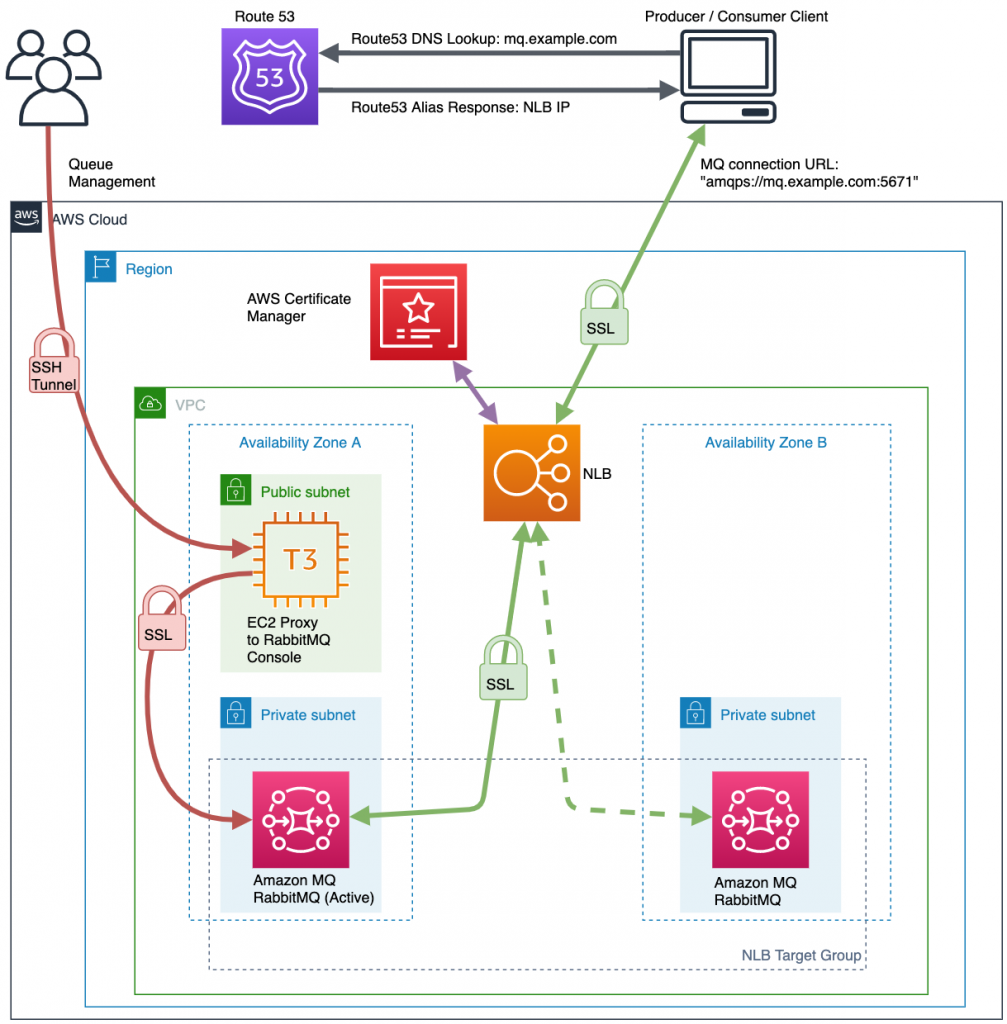
Creating static custom domain endpoints with Amazon MQ for RabbitMQ
In this post, you build a highly available Amazon MQ broker in a private subnet. You layer security by placing the brokers behind a highly scalable Network Load Balancer. You configure routing from a single custom subdomain URL to multiple brokers with a built-in health check.
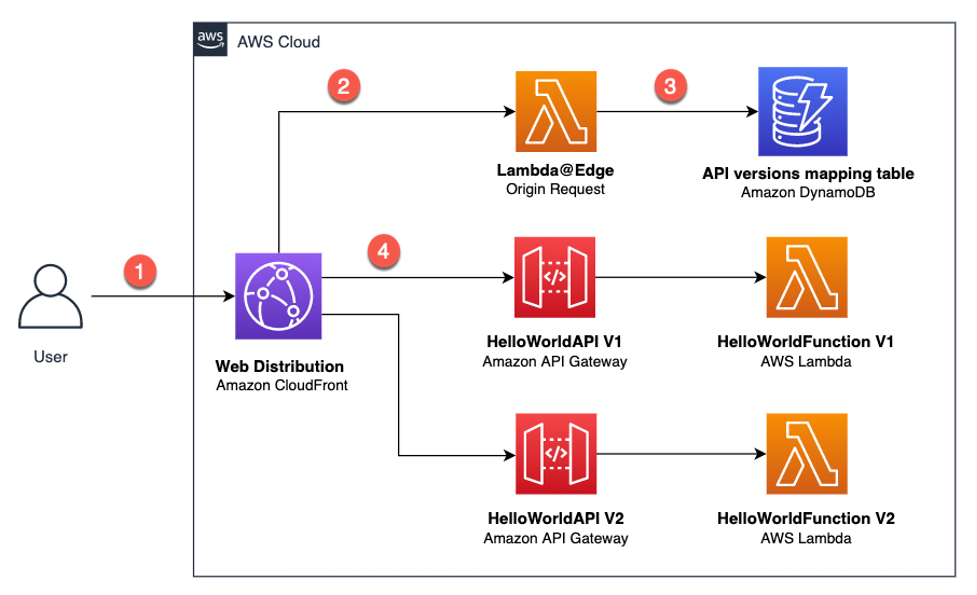
Implementing header-based API Gateway versioning with Amazon CloudFront
This post is written by Amir Khairalomoum, Sr. Solutions Architect. In this blog post, I show you how to use Lambda@Edge feature of Amazon CloudFront to implement a header-based API versioning solution for Amazon API Gateway. Amazon API Gateway is a fully managed service that makes it easier for developers to create, publish, maintain, monitor, […]

Introducing cross-account Amazon ECR access for AWS Lambda
This post is written by Brian Zambrano, Enterprise Solutions Architect and Indranil Banerjee, Senior Solution Architect. In December 2020, AWS announced support for packaging AWS Lambda functions using container images. Customers use the container image packaging format for workloads like machine learning inference made possible by the 10 GB container size increase and familiar container […]
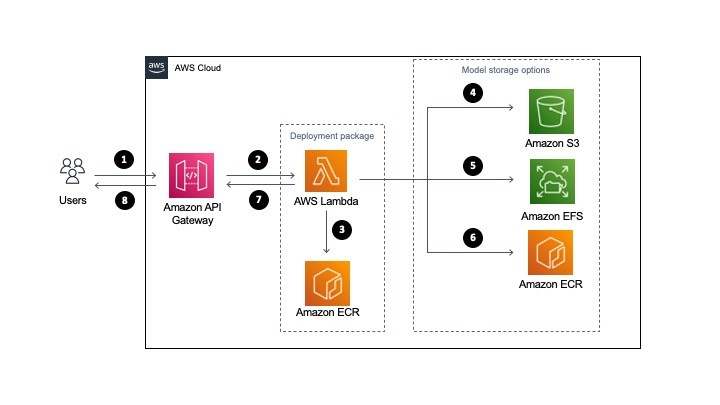
Choosing between storage mechanisms for ML inferencing with AWS Lambda
This post is written by Veda Raman, SA Serverless, Casey Gerena, Sr Lab Engineer, Dan Fox, Principal Serverless SA. For real-time machine learning inferencing, customers often have several machine learning models trained for specific use-cases. For each inference request, the model must be chosen dynamically based on the input parameters. This blog post walks through the architecture […]