AWS Architecture Blog
Category: Amazon EC2

Identification of replication bottlenecks when using AWS Application Migration Service
Enterprises frequently begin their journey by re-hosting (lift-and-shift) their on-premises workloads into AWS and running Amazon Elastic Compute Cloud (Amazon EC2) instances. A simpler way to re-host is by using AWS Application Migration Service (Application Migration Service), a cloud-native migration service. To streamline and expedite migrations, automate reusable migration patterns that work for a wide […]

Considerations for modernizing Microsoft SQL database service with high availability on AWS
Many organizations have applications that require Microsoft SQL Server to run relational database workloads: some applications can be proprietary software that the vendor mandates Microsoft SQL Server to run database service; the other applications can be long-standing, home-grown applications that included Microsoft SQL Server when they were initially developed. When organizations migrate applications to AWS, […]
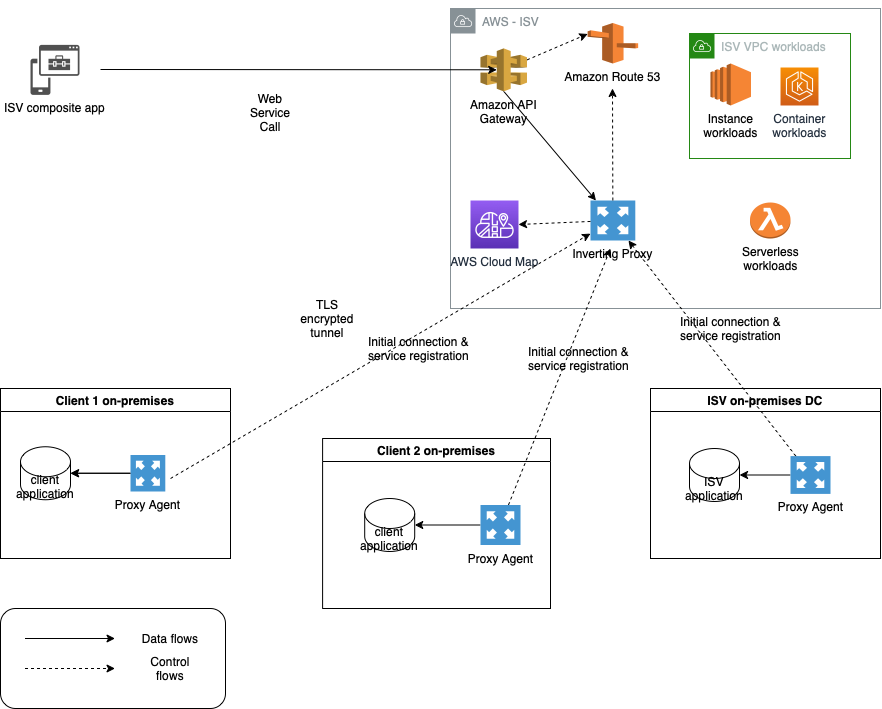
Implementing lightweight on-premises API connectivity using inverting traffic proxy
This post will explore the use of lightweight application inversion proxy as a solution for multi-point hybrid or multi-cloud, API-level connectivity for cases where AWS Direct Connect or VPN may not be practical. Then, we will present a sample solution and explain how it addresses typical challenges involved in this space. Defining the issue Large […]

Extend SQL Server DR using log shipping for SQL Server FCI with Amazon FSx for Windows configuration
For International Women’s Day and Women’s History Month, we’re featuring more than a week’s worth of posts that highlight female builders and leaders. We’re showcasing women in the industry who are building, creating, and, above all, inspiring, empowering, and encouraging everyone—especially women and girls—in tech. Companies choosing to rehost their on-premises SQL Server workloads to […]

Disaster recovery approaches for Db2 databases on AWS
As you migrate your critical enterprise workloads from an IBM Db2 on-premises database to the AWS Cloud, it’s critical to have a reliable and effective disaster recovery (DR) strategy. This helps the database applications operate with little or no disruption from unexpected events like a natural disaster. Recovery point objective (RPO), recovery time objective (RTO), […]

Multi-Region Migration using AWS Application Migration Service
AWS customers are in various stages of their cloud journey. Frequently, enterprises begin that journey by rehosting (lift-and-shift migrating) their on-premises workloads into AWS, and running Amazon Elastic Compute Cloud (Amazon EC2) instances. You can rehost using AWS Application Migration Service (MGN), a cloud-native migration tool. You may need to relocate instances and workloads to […]

Running IBM MQ on AWS using High-performance Amazon FSx for NetApp ONTAP
Many Amazon Web Services (AWS) customers use IBM MQ on-premises and are looking to migrate it to the AWS Cloud. For persistent storage requirements with IBM MQ on AWS, Amazon Elastic File System (Amazon EFS) can be used for distributed storage and to provide high availability. The AWS QuickStart to deploy IBM MQ with Amazon […]

How to Run Massively Scalable ADAS Simulation Workloads on CAEdge
This post was co-written by Hendrik Schoeneberg, Sr. Global Big Data Architect, The An Binh Nguyen, Product Owner for Cloud Simulation at Continental, Autonomous Mobility – Engineering Platform, Rumeshkrishnan Mohan, Global Big Data Architect, and Junjie Tang, Principal Consultant at AWS Professional Services. AV/ADAS simulations processing large-scale field sensor data such as radar, lidar, and […]

Scaling DLT to 1M TPS on AWS: Optimizing a Regulated Liabilities Network
SETL is an open source, distributed ledger technology (DLT) company that enables tokenisation, digital custody, and DLT for securities markets and payments. In mid-2021, they developed a blueprint for a Regulated Liabilities Network (RLN) that enables holding and managing a variety of tokenized value irrespective of its form. In a December 2021 collaboration with Amazon […]

Using Amazon Aurora Global Database for Low Latency without Application Changes
Deploying global applications has many challenges, especially when accessing a database to build custom pages for end users. One example is an application using AWS Lambda@Edge. Two main challenges include performance and availability. This blog explains how you can optimally deploy a global application with fast response times and without application changes. The Amazon Aurora […]