AWS Compute Blog
Category: Auto Scaling

How to prepare your application to scale reliably with Amazon EC2
This blog post is written by, Gabriele Postorino, Senior Technical Account Manager, and Giorgio Bonfiglio, Principal Technical Account Manager In this post, we’ll discuss how you can prepare for planned and unplanned scaling events with Amazon Elastic Compute Cloud (Amazon EC2), and make sure that your infrastructure is ready to sustain increased compute power requirements. […]

Understanding AWS Lambda scaling and throughput
Update: AWS Lambda functions now scale 12 times faster when handling high-volume requests. For more information, see the announcement post. AWS Lambda provides a serverless compute service that can scale from a single request to hundreds of thousands per second. When designing your application, especially for high load, it helps to understand how Lambda handles […]
Implementing Attribute-Based Instance Type Selection using Terraform
This blog post is written by Christian Melendez, Senior Specialist Solutions Architect, Flexible Compute – EC2 Spot and Carlos Manzanedo Rueda, WW SA Leader, Flexible Compute – EC2 Spot. In this blog post we will cover the release of Terraform support for Attribute-Based Instance Type Selection (ABS). ABS simplifies the configuration required to acquire compute […]
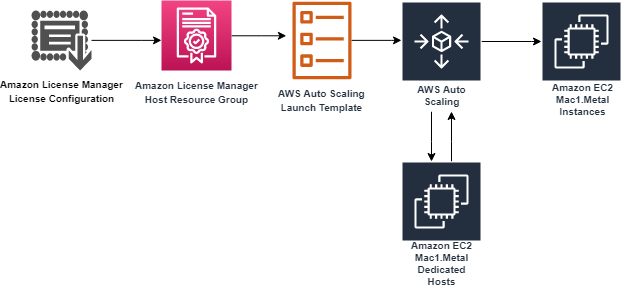
Implementing Auto Scaling for EC2 Mac Instances
This post is written by: Josh Bonello, Senior DevOps Architect, AWS Professional Services; Wes Fabella, Senior DevOps Architect, AWS Professional Services Amazon Elastic Compute Cloud (Amazon EC2) is a web service that provides secure, resizable compute capacity in the cloud. The introduction of Amazon EC2 Mac now enables macOS based workloads to run in the AWS Cloud. […]
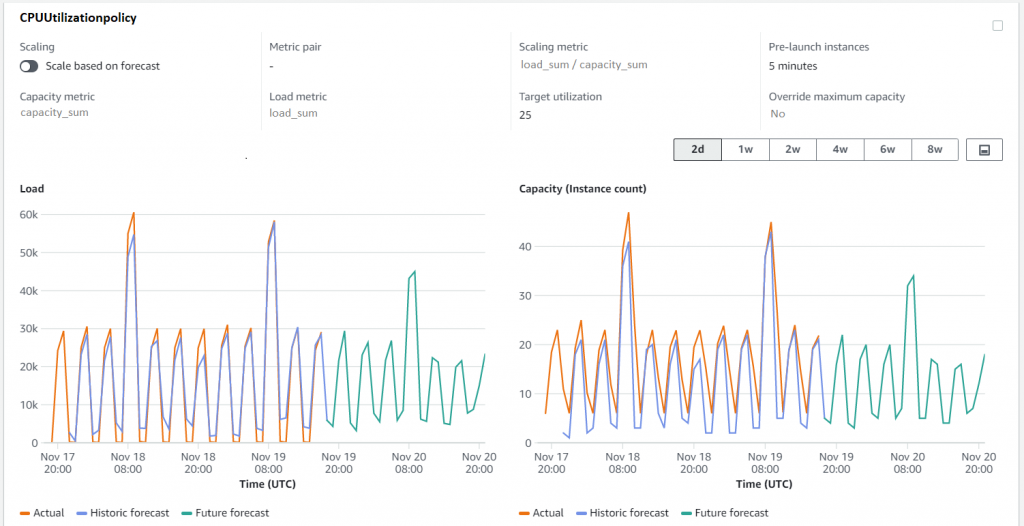
Using EC2 Auto Scaling predictive scaling policies with Blue/Green deployments
This post is written by Ankur Sethi, Product Manager for EC2. Amazon EC2 Auto Scaling allows customers to realize the elasticity benefits of AWS by automatically launching and shutting down instances to match application demand. Earlier this year we introduced predictive scaling, a new EC2 Auto Scaling policy that predicts demand and proactively scales capacity, resulting […]

Amazon EC2 Auto Scaling will no longer add support for new EC2 features to Launch Configurations
This post is written by Scott Horsfield, Principal Solutions Architect, EC2 Scalability and Surabhi Agarwal, Sr. Product Manager, EC2. In 2010, AWS released launch configurations as a way to define the parameters of instances launched by EC2 Auto Scaling groups. In 2017, AWS released launch templates, the successor of launch configurations, as a way to streamline […]

Introducing Native Support for Predictive Scaling with Amazon EC2 Auto Scaling
This post is written by Scott Horsfield, Principal Solutions Architect, EC2 Scalability and Ankur Sethi, Sr. Product Manager, EC2 Amazon EC2 Auto Scaling allows customers to realize the elasticity benefits of AWS by automatically launching and shutting down instances to match application demand. Today, we are excited to tell you about predictive scaling. It is a […]

Building private cross-account APIs using Amazon API Gateway and AWS PrivateLink
This post is written by Brian Zambrano, Enterprise Solutions Architect and Srinivasa Atta, Sr. Technical Account Manager With microservice architectures, multiple teams within an organization often build different parts of an application. Different teams may own functionality for a given business segment. An effective pattern to support this is a centrally managed public API. This […]
Scaling your applications faster with EC2 Auto Scaling Warm Pools
This post is contributed by Scott Horsfield, Principal Solutions Architect for EC2 Scalability, Surabhi Agarwal, Senior Product Manager for EC2 Auto Scaling, and Chad Schmutzer, Principal Developer Advocate for Amazon EC2. Customers have been using EC2 Auto Scaling to architect sophisticated, scalable, and robust applications on the AWS Cloud for over a decade. Launched in […]

Supporting AWS Graviton2 and x86 instance types in the same Auto Scaling group
This post is written by Tyler Lynch, Sr. Solutions Architect – EdTech, and Praneeth Tekula, Technical Account Manager. As customers seek performance improvements and to cost optimize their workloads, they are evaluating and adopting AWS Graviton2 based instances. This post provides instructions on how to configure your Amazon EC2 Auto Scaling group (ASG) to use […]